Embodied Intelligence Entering Homes: Don't Mistake Scope for Scenario, Find the Breakthrough Point First When Entering the Household
A family has never been just a "scenario." It is a physical space that consists of hundreds of distinct sub - scenarios. Defining products and planning development paths by equating the family with a single scenario is the core reason why embodied intelligence has been slow to enter households.
Put simply, the so - called "family scenario" is a false proposition.
To understand this judgment, we first need to clarify what a real "scenario" is.
A viable industrial scenario usually has three characteristics: relatively standardized environment, clear task goals, and quantifiable and verifiable results. Sorting parts on a factory production line is a scenario, delivering items to hotel rooms in the corridor is a scenario, and providing front - desk consultations in a commercial hall is also a scenario. Their boundaries are clear, and the demands are fixed. Robots only need to perform one type of task to complete the business cycle.
But a family is different.
An ordinary three - bedroom house is a collection of spaces like the living room, kitchen, bedroom, and bathroom. It is also a collection of demands for dozens of tasks such as cleaning, storage, cooking assistance, elderly care, child - accompanying, security inspections, and item delivery. Just the "cleaning" task alone can be split into sub - tasks like floor sweeping, table wiping, clothes tidying, and dishwashing, which have vastly different requirements for a robot's operational capabilities.
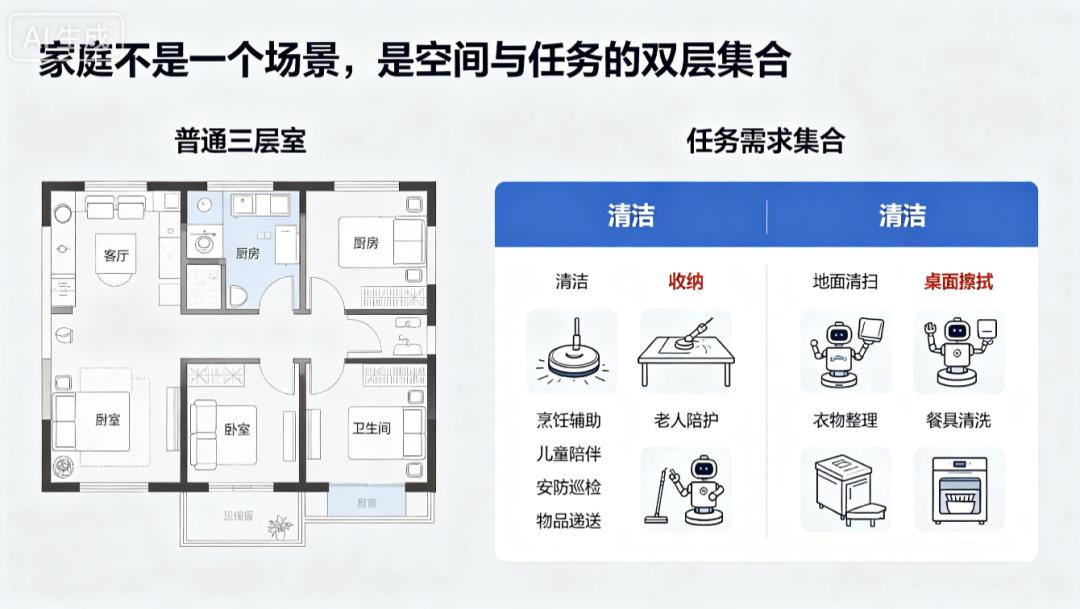
Calling such a complex entity a "single scenario" is as absurd as considering "the entire manufacturing industry" as a single implementable scenario.
When we restore the family from "a single scenario" to "a range of spaces," the path to implementation becomes instantly clear.
Embodied intelligence entering the family will not mean that one day a fully - capable housekeeper will suddenly appear and take over all household chores at once. It will follow the industrial law of making breakthroughs in single points and gradually penetrating the market: first, find the first sub - scenario within the family where the technology is achievable, there is a strong user demand, and the business model is viable. After achieving success in this sub - scenario, expand to the second and third ones.
In business terms, this is called the entry point.
This is exactly the problem faced by the commercialization of household robots. What value should a robot provide first to make users willing to pay for it? Xu Huazhe also mentioned in a recent interview that the Poke Robotics has not yet found that truly unique scenario.
On the one hand, the household robot industry is just in its infancy, and the technological capabilities are far from mature, so the available entry points are limited. On the other hand, a business cycle needs a fulcrum. Just as the business fulcrum of large language models is the dialogue app, technology needs to find an outlet to truly integrate into people's daily lives.
The essence of finding an outlet is to find reasons for the first - batch of users to pay. And for the family scenario, this is particularly difficult.
This step requires not only technology but also the ability to understand user demands and the ability to combine different functions into a product.
01 Housework is an ocean; the entry point is to build a ship first
Owning a robot nanny has always been a human fantasy.
Today, in many companies' demos, robots can already operate washing machines and cook food with ease, and wave goodbye when the owner goes out. This easily gives the illusion that the future is already here.
The problem is that demos show the upper limit of a robot's capabilities, while the family environment tests the lower limit. Moravec's Paradox still holds true today. Simple household chores that adults can easily complete are precisely the most difficult tasks for robots to master.
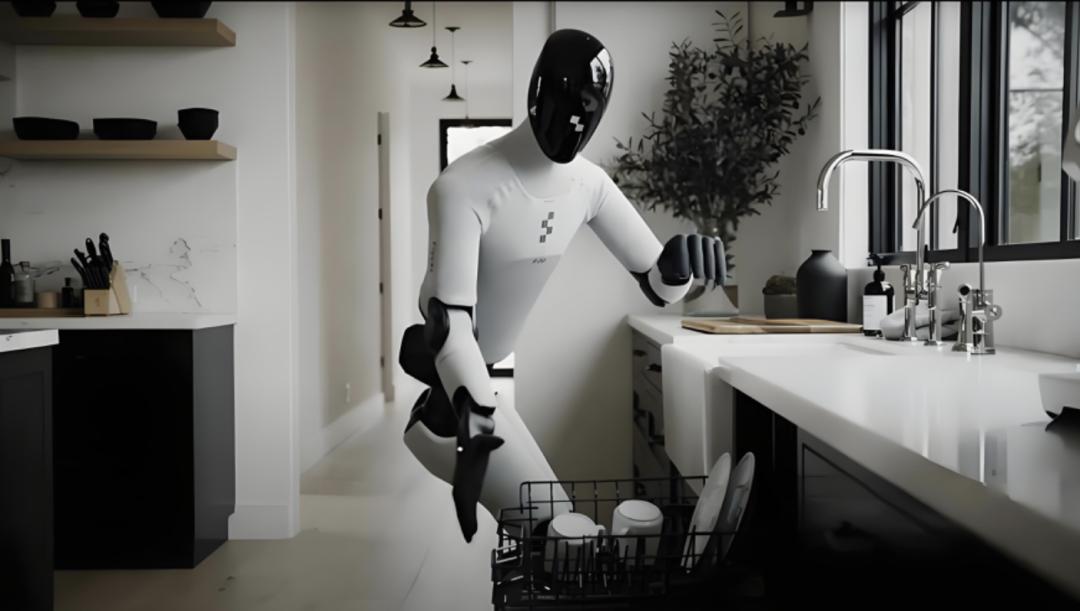
So, the question is, how can we seek the feasibility of commercial implementation in the stage when the technology is not yet mature?
Currently, most robots can only perform basic operations such as grasping items, folding clothes, and wiping tables within the family environment. However, it should be noted that these capabilities are mainly for demonstrating the technical feasibility and implementability of the products, rather than the so - called commercial value recognized by the outside world.
The real commercial space depends on solving pain points.
Functions that have the opportunity to open up the market usually need to meet three conditions: be high - frequency enough, be annoying enough, and cannot be easily replaced by existing tools.
The floor - sweeping robot is the most classic example. Floor cleaning needs to be done every day. It is labor - intensive and boring, and there is no more convenient alternative. By focusing on this single sub - area in the ocean of housework, it has supported a mature industry worth hundreds of billions.
According to this standard, storage is the most underestimated potential area. A tidy room will become messy again within a few days. This continuous increase in entropy is a common problem for all families. Robots can continuously put things back in place at a gentle pace, freeing people from the cycle of "tidying - getting messy - tidying again". Moreover, rigid household chores such as toilet cleaning and garbage disposal, which are dirty and tiring, naturally have a higher willingness to pay.
The common feature of these demands is that they are not "black technologies," but they are painful enough and practical enough.
Conquering the ocean does not require draining the sea. It only requires finding a reliable anchor point. For today's embodied intelligence, the most practical path is to find a pain point and an accurate demand anchor point in the vast ocean of housework, do this one thing stably, reliably, and irreplaceably, truly enter users' lives, and gain their trust.
Only when a product completes the business cycle in a specific scenario can it obtain real - world data from the family environment and, in turn, iterate its algorithms and capabilities. Only when users establish basic trust will they be willing to try its second and third functions. From a single anchor point to a sub - area, and then to a broader area, general capabilities will naturally develop in this process.
After all, the ultimate enemy of robots in the family is never the technical difficulty but the obsession with being "all - powerful." Always aiming to take over the entire ocean at once will only lead to self - satisfaction in demos. Instead, focusing on one point and doing a small thing to perfection may provide an opportunity to truly sail into the deep sea.
After all, humans did not conquer the ocean by learning to drain the sea. We just built a stable ship first.
02 Talk about emotions first, then about capabilities. The entry point doesn't need to consider ROI
Since the technological path is difficult to achieve in the short term, some people have chosen another way: temporarily put aside the discussion of capabilities and focus on emotions first.
Humans are not completely rational decision - makers. Behind many consumer behaviors, what people value is not just the pure functional value but also the emotional value. If robots can truly become human life partners, people may tolerate their many deficiencies in the early stage, providing a window period for the growth of the robots' capabilities. At the same time, it can also enhance user stickiness, killing two birds with one stone.
Most robot companies targeting family users hope to enhance the emotional value of their products to make the robots become part of the family first and then gradually develop their working capabilities. Euler Metaverse and UBTECH's new products have proposed similar strategies.
The key to whether this path can succeed lies in whether humans can establish an emotional connection with robots. This has been preliminarily verified with robotic dogs.
From a functional perspective, consumer - grade robotic dogs do not create outstanding practical value, but they still account for about 60% of the robotic dog market. This is an example where emotional value outweighs practical value. When users buy a robotic dog, they are comparing it to a pet dog. The ROI of raising a pet dog is negative, and people do not have high expectations for its practical value.
Many companies hope that robots can enter the family in a similar form of emotional companionship, with light - weight working capabilities. They first establish themselves as family members and then continuously iterate their functions through practice.
If some products are still trying to build household robots in a round - about way, another type of product chooses to push the emotional attribute to the extreme and directly target the greatest common divisor of human emotional needs, that is, the broadest form of companionship.
Following this entry point, the industry has two approaches.
UBTECH, Robonova, etc. have successively released humanoid robots, focusing on warm emotional companionship. Somnia Lab has also created an intimate interactive humanoid robot. Their judgment is that what truly has consumer - grade explosive power is not functional efficiency but emotional connection and long - term dependence.

This approach may seem quite science - fiction, but it hits the most basic human needs. Emotional connection has strong user stickiness and is almost the most instinctive underlying code of human beings. In fact, after the emergence of many new technologies, this type of path is one of the first to trigger commercialization because user demands are clear, and the willingness to pay is strong. Using this high - demand fulcrum may be able to pry open the door for robots to enter households and break the emotional barrier between robots and humans.
The sleep - soothing robot MoYa is also a type of emotional - companion robot. It has a fluffy appearance, can communicate with people in language, and even has a breathing - like movement, allowing you to relieve the day's fatigue and fall asleep peacefully in its embrace.
Emotional companionship, as a common human need, faces a wider audience in a world that is becoming more atomized and with weaker interpersonal connections. This also reduces the marginal cost of robot production, making this path more commercially valuable.
The last type is more functional companionship, that is, rehabilitation - type emotional - companion robots, mainly targeting the elderly, children, and special groups such as those with brain - degenerative diseases, depression, and autism. These products can not only establish an emotional connection with users but also provide functions such as reminders, diary - keeping, memory storage and retrieval for special groups, and even have a certain healing effect. However, more compliance efforts are needed in aspects such as medical device certification for medical - related functions.
The advantage of this path is that once an emotional connection is established, the stickiness is strong, and the fission speed within the target group is fast. However, developing such products requires a strong understanding of cross - disciplines such as medicine, psychology, and human - machine interaction.
For this unprecedented form of human - machine emotion, there are still many unknowns. Will the uncanny valley effect affect the establishment of an emotional connection? Will humans suddenly realize that it is just a cold machine during daily contact, leading to an emotional collapse? Even if it can be established, a series of ethical issues will follow.
As Yang Shiyuan, the founder of DYNA, said: "Capital can create press conferences, publicity, supply chains, channels, and early adopters, but it cannot help users form habits." Investing in emotions is a path full of variables, but it has high stickiness once it succeeds.
03 The duality of education; the entry point is the balance
If housework is a distant promise for robots and emotions are an elusive vision, then education is the most practical and closest path to immediate monetization among these three paths.
The reason is very simple. Chinese parents' willingness to pay for education never needs to be verified.
Education is one of the few fields where "the willingness to pay is greater than the maturity of the function." In other consumer scenarios, users need to clearly perceive the functional value when buying a product. However, in the education field, parents are willing to pay for the possibility that "this may be helpful to their children," even if the benefits cannot be quantified yet.
However, if one really wants to engage in education, it cannot just be used as a reason to increase sales. There is more room for in - depth development. In addition to subject - based education such as programming education and foreign - language learning, general education and quality education are also areas that can be developed.
The small humanoid robot Xiaobumi, which uses a low - price strategy to enter the market, is developing along this path. It has successively cooperated with CodeCombat and Xiaomawang, embedded the mature K12 programming education system into the robot, and connected family education with after - school competitions, constructing an education cycle of "hardware + courses + competitions."
However, there is still an unsolvable problem with family robots focused on education. What value can a robot provide that tablets, learning machines, and AI learning companions cannot? And this is the important commercial entry point for education - focused products.
Educational content itself is not scarce. The cost of knowledge acquisition is rapidly decreasing. Whether it is programming courses, foreign - language learning, or general education, there are already a large number of mature products on the market. If a robot is just a content carrier, it is difficult to prove its necessity. What a robot can additionally provide is a tangible and interactive physical presence and a real emotional connection that children feel when interacting with it. This aspect needs to be emphasized in product design.
Education and emotional companionship are naturally intertwined. The emotional companionship between a robot and a child is itself part of the learning experience. This also means that educational robots face a special challenge. They have two types of users: parents are the buyers, and children are the users. Parents focus on the learning results, while children focus on the user experience. When designing functions, in addition to achieving educational results to encourage purchases, it is also necessary to balance the learning experience and entertainment functions to maintain the usage time.
For parents, on the one hand, they hope that their children can have the opportunity to grow together with the robot. On the other hand, they also pay attention to the professionalism of the educational functions and need to see visible results.
However, during the use process, overly simple and not - smart enough interactive functions will quickly make children lose their interest. The robot will be regarded as a toy in their minds rather than an object they can communicate with.
So, although the education path seems smooth, it still needs to answer why the educational carrier should be a robot and balance the needs of parents and children.
04 Conclusion
Household robots may be the biggest opportunity and the most complex battlefield in the robot industry.
Compared with the clear logic of cost - reduction and efficiency - improvement in industrial scenarios, family demands are more diverse and vague. Users are not just buying functions but also a lifestyle, emotional satisfaction, and identity recognition.
None of the above three paths is smooth. The housework path is exchanging long - term engineering accumulation for future technological barriers. The emotional path is betting on a human - machine relationship that has not been widely verified. The education path has found a clear - cut payment logic, but it needs to solve problems such as differentiation and freshness.
Whoever enters this field first can get the data flywheel spinning earlier. Leading in data accumulation, model iteration, function iteration, and brand recognition. Once this positive cycle starts, the cost of catching up will be extremely high.
After defining the functions, household robots still face many challenges before they can be truly put into use. They not only need to reduce the price to below the psychological threshold of ordinary families but also solve the safety problems of robots, which is also a psychological barrier for many people to take the first step. And data privacy is like an iceberg hidden beneath the water. Once private data is not handled properly, it will trigger strong resistance from users.
The road ahead is tortuous. In the early stage of the industry's development, everyone is groping forward. The only thing that is certain is that in the most private and important space of human beings - the family, whether a robot can survive depends on whether it truly understands humans and can be trusted by them. Achieving this always requires understanding and insight into human nature. The door to the family is always opened from the inside.