Cursor breaks another bombshell: It once accounted for half of Anthropic's revenue
Who could have thought that it was its biggest rival that kept half of Anthropic's business alive?
Just yesterday, Business Insider dropped another bombshell, revealing a mind - boggling detail: At the craziest early stage, Cursor once contributed as much as 40% to 50% of Anthropic's revenue!
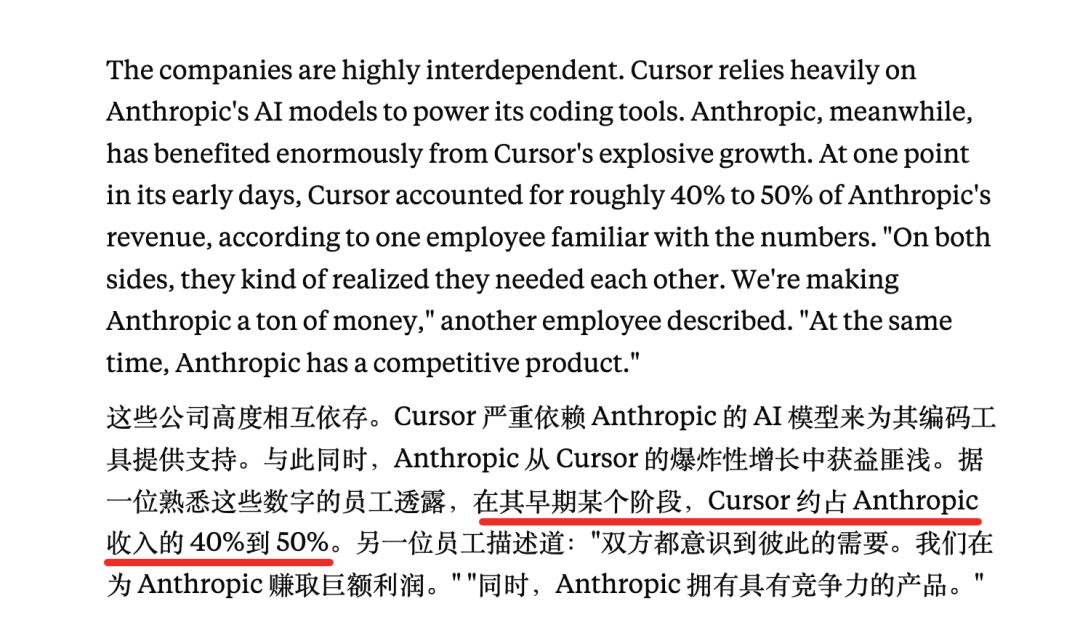
A startup tool company, with its explosive growth, fed half of the underlying model provider.
This leverage effect is epic and off the charts.
While Cursor was pouring money into Anthropic, Anthropic was secretly working on a big project — Claude Code.
As soon as it was launched, it stabbed its biggest benefactor right in the back.
The "Weird" Symbiosis: You Eat My Flesh, I Drink Your Blood
Cursor employees describe their relationship with Anthropic in one word: weird.
Cursor can't function without Anthropic's model. No matter how good its editor is, its underlying intelligence is entirely driven by Claude.
Conversely, Anthropic also can't do without Cursor. The more Cursor's users soar, the more exaggerated the API bills it pays to Anthropic.
At its peak, Cursor alone contributed nearly half of Anthropic's revenue.
"We made a fortune for Anthropic," an employee said. "But at the same time, Anthropic has a competing product that could wipe us out."
This is the classic platform hostage situation: You can't do without my model, and I can't bear to lose your bills.
It may seem like a win - win situation, but in fact, there are undercurrents of trouble because the supplier can turn into a rival at any time.
The "White Lie": Where's the Promised Research Project?
Before the official launch of Claude Code, Anthropic executives privately assured Cursor's leadership repeatedly: Don't worry, this is just a "research effort," not a serious commercial product.
Cursor believed them.
Then in May 2025, Claude Code was officially launched.
Six months later, its annualized revenue exceeded $1 billion. By February 2026, it soared to $2.5 billion — about $500 million more than Cursor's $2 billion at that time.
The speed of its growth is the most violent comeback in the history of developer tools.
Developers began to publicly post screenshots: I've ditched Cursor and switched to Claude Code.
There was a wave of "defection" on social media.
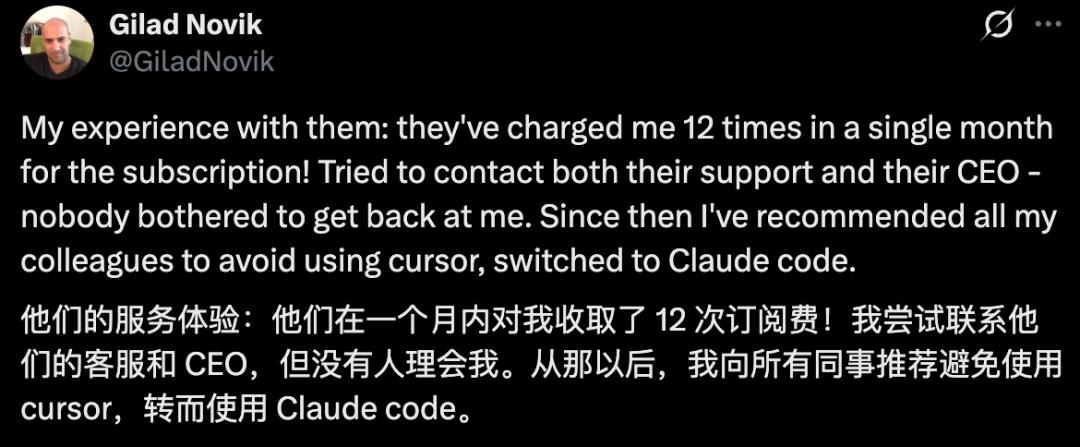

Someone summed it up quite aptly: Claude Code does more with fewer Tokens, outperforms in complex tasks, and doesn't require an editor — a terminal is enough.
The promised "research project" turned into a $2.5 - billion weapon.
This stab hit Cursor where it hurt the most.
A Cautionary Tale: The Alarm Bell of Windsurf's Supply Cut
If the explosion of Claude Code made Cursor uneasy, then the blow Anthropic dealt to Windsurf really scared them.
In June 2025, OpenAI announced a $3 - billion acquisition of the AI programming tool Windsurf.
As soon as the news broke, Anthropic reacted faster than anyone else — almost at the same time, it cut off Windsurf's API access to Claude 3.5 Sonnet and 3.7 Sonnet.
Windsurf CEO Varun Mohan publicly said he was willing to pay in full, but Anthropic didn't even entertain the idea.
Co - founder Jared Kaplan put it bluntly: It's just too strange to sell Claude to OpenAI.
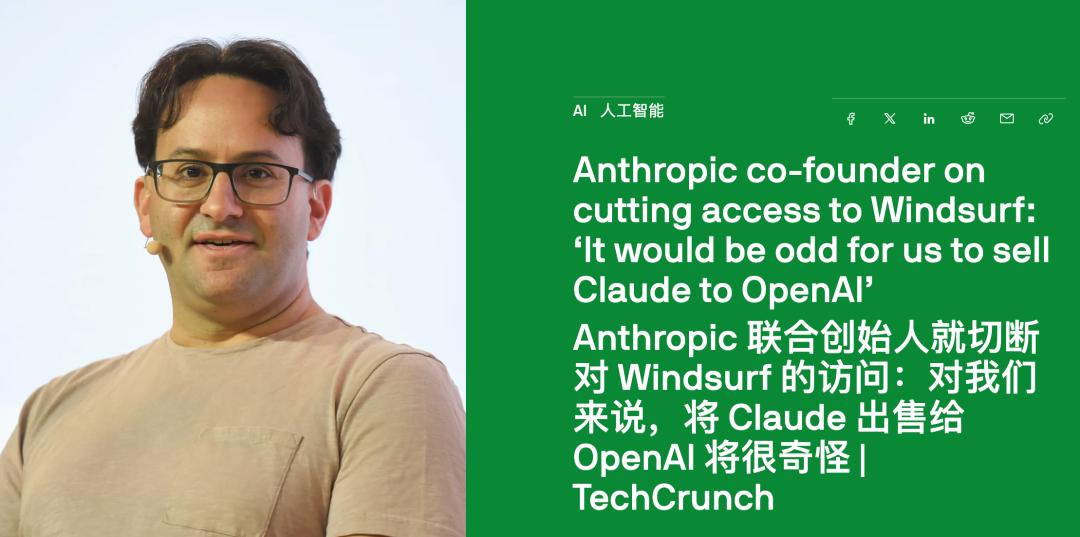
How ruthless is this move?
Overnight, Windsurf's users' experience plummeted, and they were forced to urgently look for alternatives.
This real - life example proves one thing: When you entrust your fate to someone else's API, they can pull the plug at any time.
Cursor's executives were chilled to the bone. Who can guarantee that they won't be the next to have their supply cut off?
Emergency All - Hands Meeting: Develop an In - House Model
On January 5, 2026, 25 - year - old Cursor CEO Michael Truell called an all - hands meeting. An employee described the meeting in one word: emergency.
At the meeting, Truell made it clear: We must ensure that we're not left behind. Cancel all unnecessary meetings. You may be temporarily transferred to another team this week. Everyone needs to be flexible and respond quickly.

The core resolution was simple: Develop an in - house model and take control of our own fate.
After the meeting, Cursor took a two - pronged approach: On the one hand, it conducted a comprehensive pricing comparison between Claude Code and OpenAI Codex and appeased its biggest customers; on the other hand, it focused on developing its in - house code model, Composer.
Composer is built on the Kimi framework. By the release of Composer 2.5 in May, Cursor said that over 85% of the work was its own, and the underlying open - source model only accounted for a small part.
The engineers' feedback was "extremely positive" — it's cheap and fast. In the current situation where Token costs are tight, this is especially valuable.
More importantly, the in - house model allowed Cursor to start breaking free from that fatal dependency.
Betting on Musk: Get $10 Billion Without Selling
The in - house model solved the core problem, but the computing power gap was still a fatal issue.
This spring, Truell approached Musk.
On April 21, he announced a partnership with SpaceX and agreed to be acquired by SpaceX for $60 billion later this year.
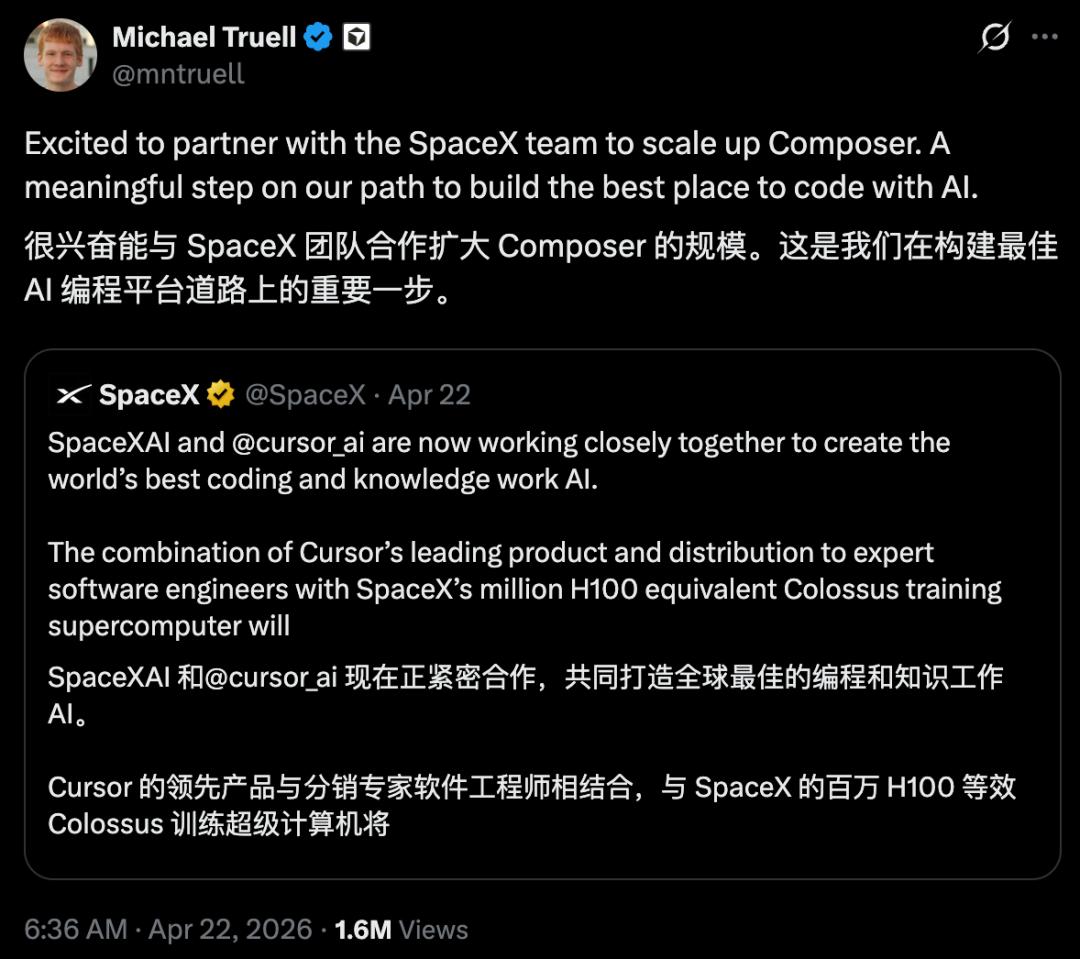
According to SpaceX's S - 1 filing, if either party backs out, SpaceX will pay a $1.5 - billion termination fee plus $8.5 billion in free computing power — a total of $10 billion in "break - up fees."
This 25 - year - old MIT graduate, who has worked for zero salary for years, finished a programming test in 10 minutes at 18, and won a $10,000 prize for a programming game at 15, is leading Cursor to transform from an editor company into a competitor in the race for models and computing power.
Currently, Cursor's annualized revenue has reached $4 billion, it has 700 employees, and it serves 64% of the Fortune 500.
"This is really crazy," Truell said. "We're well aware of how special and unprecedented this is."
Conclusion
Looking back at this timeline, we can see how power changed hands step by step.
A year ago, Cursor was still Anthropic's biggest benefactor on the books.
At that time, Anthropic needed Cursor far more than Cursor thought.
But Claude Code changed everything. When Anthropic's own programming tool reached an annualized revenue of $2.5 billion, it no longer needed Cursor to boost its financial statements.
And Cursor was forced to develop Composer in - house and secure SpaceX's computing power, cutting off every lifeline that once reached out to Anthropic one by one.
Two companies that once fed each other are now facing off on the same track.
The battle in AI programming is no longer about "whose editor is better."
It has evolved into a colder proposition — Who holds the three keys: models, computing power, and the developer entry point.
Reference:
https://www.businessinsider.com/cursor - ceo - michael - truell - spacex - elon - musk - anthropic - 2026 - 6
This article is from the WeChat official account “New Intelligence Yuan”. Author: ASI Revelation. Republished by 36Kr with permission.