Shake to Redirect: The "Digital Psoriasis" That Steals 2 Billion Hours of Users' Time Every Year
You may have had such an experience. You take out your phone and open a commonly used app. As soon as the splash screen ad appears, before you have time to find the "Skip" button, the screen instantly jumps to a limited-time flash sale page on a shopping platform.
You exit, go back, and reload. A few seconds are gone after this set of operations. Just when you get back to the home page and open another app, the same splash screen ad appears. You perform the same operations, and it jumps again, and you close it again.
You may think it's just a slip of your hand, but actually, you've fallen into a well-designed traffic trap.
On June 9, 2026, the Ministry of Industry and Information Technology held another meeting. The topic was nothing new: the 618 shopping festival was approaching, and app splash screen ads were up to their usual tricks again. They induce clicks and use the highly sensitive "Shake" feature. Before users can react, their phones have already completed the jump for them.
At the meeting, enterprises were required to conduct self-inspections and make rectifications. The language used was getting stronger: for those who refuse to make rectifications, measures such as interviews, notifications, and app removals will be taken in turn.
This is not the first time the Ministry of Industry and Information Technology has taken action against the "Shake" feature. Since 2023, from the requirement of "not using the highly sensitive 'Shake'" to the quantification of acceleration, angle, and time parameters, from notifications and naming and shaming to warnings of app removal, the regulatory measures have been getting stricter.
But if you open a few commonly used apps on your phone now, has the problem of splash screen ad jumps been solved? Most likely not.
Where does the problem lie? It's not that the technology can't do it; it's that some people don't want it to be done.
The Business of "Stealing Time"
Let's do some calculations first.
The "Shake" jump in splash screen ads essentially captures any slight movements, such as raising your hand, turning around, or taking your phone out of your bag, using the phone's gyroscope and accelerometer within the first few seconds when you open an app. These unintentional movements are "translated" as the user's consent to jump.
How much time is actually wasted in this way? Estimates from different sources vary greatly, but even using the most conservative model, the result is still shocking.
According to the "Report on the Governance of the Mobile Application Ecosystem" by the Ministry of Industry and Information Technology, more than 72% of mobile internet users have experienced involuntary jumps, among which the "Shake" feature accounts for 43%. Calculated based on the approximately 1.121 billion mobile internet users in China, this means that at least 800 million people have been tricked by the "Shake" feature, and it's very likely more than once.
Assuming that half of them experience an accidental jump once a day, and each jump takes 6.5 seconds, the annual loss from this alone exceeds 100 million hours.
And the actual data is likely to be even higher. Public reports show that the trigger threshold for the "Shake" feature in some apps is as low as a 5-degree tilt and a 0.5-second shake. Even the natural bumps while walking can trigger it. Calculated based on an average of 1.5 jumps per day and 8 seconds per jump, the annual loss exceeds 300 million hours. Considering the hidden costs such as interrupted operations and emotional depletion, the total loss is likely to be between 500 million and 1 billion hours.
The 2 billion hours in the title corresponds to a more frequent encounter model, which is not an exaggeration during major promotional events such as Double 11 and 618.
This time doesn't create any value for users, but some people are making a fortune from these "accidental touches."
Every jump, whether it's intentional or accidental by the user, is recorded as a valid click by the advertising system. However, in actual transactions, the billing method for splash screen ads is much more complex than "pay per click."
Advertisers can choose two mainstream models: CPM (cost per thousand impressions) and CPC (cost per click).
CPM is the most traditional way for splash screen ads. Advertisers pay a fixed fee for every 1,000 impressions. The industry average price ranges from 30 - 50 yuan (for static images) to 60 - 100 yuan. In this model, whether the user jumps or not doesn't directly affect the developer's single - time income.
However, the higher the jump rate, the more willing advertisers are to bid higher for the advertising space in the next cycle, which indirectly boosts the overall revenue.
CPC is more straightforward. Every time a user jumps, the advertiser pays once.
The specific price depends on multiple variables, such as the type of app (users of utility apps are often judged to have "low - value" click intentions, so the unit price is relatively low; e - commerce apps have a higher unit price), the industry the advertiser is in (games, finance, and e - commerce offer the highest bids), and even the advertising period (prices double during major promotional events).
Taking the public bidding data of a leading advertising alliance as an example, the minimum CPC price for splash screen ads can be as low as 0.1 yuan (for app activation), and during major e - commerce promotional events, the unit price often exceeds 2 yuan in real - time bidding.
So, let's do a real - world calculation: For an app with a daily active user base of one million, if it uses the CPC billing method (at 0.8 yuan per click and an average of 0.5 accidental clicks per user per day), the daily income is about 400,000 yuan; if it uses the CPM billing method (eCPM of 50 yuan), the daily income is about 50,000 yuan.
The difference between the two is 8 times. Most apps use a combination of the two models, and the final daily income ranges from tens of thousands to hundreds of thousands of yuan. This explains why developers would rather offend users than turn off that line of code.
Advertisers are willing to pay for these accidental clicks for a simple reason - it's cheap.
Internal data from a leading e - commerce app shows that the cost of acquiring new customers through jump ads is 67% lower than that of traditional in - feed ads. The secret of the low cost is simple: it counts users' forced accidental operations as its own marketing achievements.
This accidental - click monetization business supports three parties in the chain.
The first is app developers. They are the providers of advertising spaces and the direct monetizers. Whether it's the "Shake" splash screen or pop - up windows disguised as system notifications, the essence is to convert users' "carelessness" into quantifiable income.
The second is advertising alliances, which are the real operators. Leading alliances such as Tencent Youlianghui and Baidu Baiqingteng embed SDK toolkits into thousands of apps, remotely controlling the display method, jump logic, and trigger threshold of ads.
Why can a small tilt of the phone trigger the "Shake"? Why does the close button always appear a few seconds late? The answers are all hidden in the SDK parameter settings, and most users are completely unaware of this.
The third is advertisers, mainly e - commerce platforms. The second - quarter financial report of Weibo in 2025 shows that its advertising revenue accounts for 86% of the total revenue. Among them, advertising revenue from Alibaba contributes about 9.3% of the total revenue, and the year - on - year growth rate is 10%, which is the key engine driving Weibo's advertising growth during the 618 period.
You open Weibo but enter Taobao before seeing any Weibo content. This is no longer a joke but a commercial reality written in the financial report.
A complete monetization closed - loop is thus formed: the platform sells advertising spaces, the alliance adjusts parameters, and e - commerce platforms pay the bill. And users' time is the only "raw material" in this closed - loop.
What's more ironic is that many apps have started a second round of exploitation.
The customer service of Baidu Netdisk clearly states: "Currently, it is not supported to cancel ads, and members also do not have the right to remove ads." Meitu Xiuxiu is even more straightforward: "After closing, the app will be restricted from displaying the 'Shake' splash screen ads, but the number of splash screen ads will not be reduced."
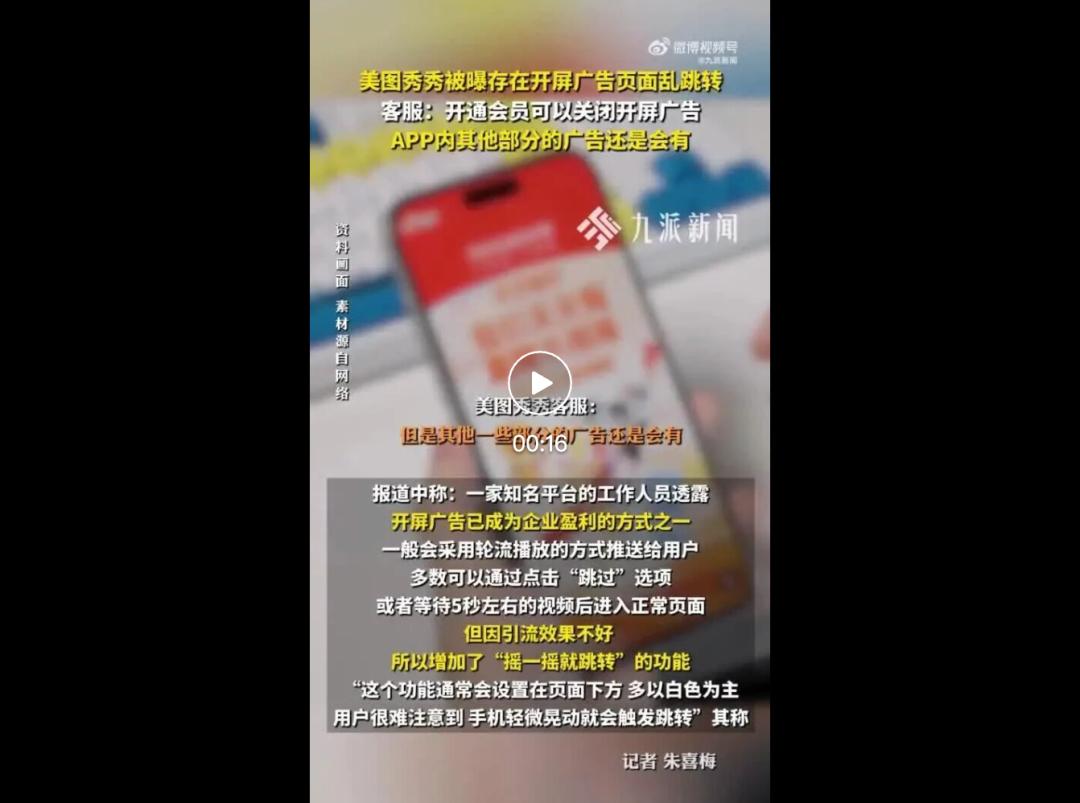
To put it simply: You pay for a membership, and it just changes from the "Shake" to "Click to Skip." The ads are still there, just in a different form.
The Cat - and - Mouse Game
There have been at least three rounds of offensive and defensive battles around the "Shake" feature.
In the first round, the regulators set the rules. In early 2023, the Ministry of Industry and Information Technology issued a document requiring that "highly sensitive 'Shake' and other methods that are likely to cause accidental triggers should not be used to induce users to operate." This was the first official move.
In the second round, standards were established. In 2025, the China Academy of Information and Communications Technology, in cooperation with the Telecommunication Terminal Industry Association, issued a standard, giving quantitative requirements for the trigger parameters of the "Shake" feature: the acceleration should be no less than 15 meters per square second, the rotation angle should be no less than 35 degrees, and the operation time should be no less than 3 seconds.
In plain language, it means that the phone has to be shaken vigorously (with sufficient acceleration), then turned at a significant angle (with a large enough angle), and this shaking has to last for a while (for a long enough time) to be considered a valid shake. At the same time, apps are required to clearly inform users of the consequences of the jump.
In the third round, there was high - pressure supervision during major promotional events. In May 2026, the Ministry of Industry and Information Technology notified that 31 apps and SDKs had violated users' rights and interests, among which 7 were involved in random jumps. On June 9, another meeting was held, clearly stating that stepped - up measures such as interviews, notifications, and app removals would be taken.
The standards on paper are getting more detailed, and the frequency of notifications is increasing. But when you open your phone, the splash screen ads still jump as usual.
The reason is that this is a typical asymmetric war.
The regulators can only conduct spot checks, while developers can make dynamic adjustments at any time.
When the regulatory pressure is high, they adjust the trigger threshold to a compliant level; as soon as the pressure eases, they immediately restore it to the level where it jumps at a 5 - degree tilt. A more covert method is to set up A/B tests, show highly sensitive ads to a group of users, monitor their complaint and uninstall rates, and continue to increase the sensitivity as long as the negative feedback does not exceed a certain threshold.
This is not a technical problem but a cost problem. Banning jumps only requires changing one line of code, but this change may mean the evaporation of tens of thousands of yuan in daily income. When the cost of an operation is real cash flow, the user experience automatically takes a back seat.
The binding force of the law is also limited.
Article 44, Paragraph 2 of the "Advertising Law" clearly states: "When publishing and sending advertisements on the Internet, it shall not affect users' normal use of the network. For advertisements published in pop - up forms on Internet pages, the close button shall be prominently marked to ensure one - click closure."
The "Administrative Measures for Internet Advertising" implemented in 2023 have also included splash screen ads in the management scope of pop - up ads.
However, legal expert Yue Shanshan pointed out that the essence of the "Shake" jump is to "translate" users' involuntary actions as consent, which seriously violates users' wishes. The problem is that the burden of proof lies with the users. How can you prove that you just picked up your phone and opened the app, rather than "wanting" to open that ad?
More importantly, the cost of violating regulations is too low.
An app can earn tens of thousands of yuan a day from the "Shake" feature. Even if it is notified and criticized, it just issues a rectification statement and comes back under a different name after a while. Without class - action lawsuits or sky - high fines, a fine of hundreds of thousands of yuan is just a "compliance cost" for a monetization channel that earns tens of thousands of yuan a day.
Zhu Wei, the deputy director of the Communication Law Research Center of China University of Political Science and Law, put it more straightforwardly: The "Shake" ad itself is not illegal, but "using technical means to induce jumps without users' consent" must be regulated. The problem is that the boundary between "inducement" and "misleading" has not yet been clearly defined in the judicial system.
Although the regulators are restricted, advertisers are not stupid either.
According to the CPC model, advertisers only pay for "valid clicks." Every time there is a jump, they pay once. This rule was originally designed for precision, but it has left a loophole for developers. "Accidental touches" have become "valid clicks." In the advertising system, the click - through rate has increased, and developers are making a fortune.
But what they want are real potential customers, not passers - by who close the page immediately after being annoyed by the pop - up window. Industry data shows that the daily average exposure of "Shake" ads is about 400 million times, and the click - through rate is as high as 8%, far exceeding the 1 - 2% level of normal splash screen ads.
However, about 80% of them are accidental touches, and the average stay time of users after the jump is less than 3 seconds, and the conversion rate is almost negligible. Advertisers are spending a lot of money on a bunch of invalid traffic with no commercial value.
Users are not idle either. More and more ordinary people are sharing counter - measures online: turning off the motion sensor permission, using app locks, blocking ad requests with VPNs, and even directly uninstalling apps.
Some mobile phone manufacturers have also taken advantage of the trend and built intelligent ad - filtering services into the system. Mainstream domestic mobile phones in 2026 all support fine - grained management of the "Access device motion and orientation" permission. After turning it off, the trigger rate of "Shake" ads drops to 0% in actual tests.
The direct consequence of the cooling on both the supply and demand sides is the breakage of the industrial chain.
Most of the few apps still holding on are small and medium - sized shopping or utility products. Advertisers are also trying to switch to more gentle interaction forms (such as swiping and clicking), but the overall ROI has dropped significantly. Data confirms this trend: The placement volume of "Shake" ads during major promotional events in 2026 has decreased by more than 80% compared to the peak in 2023.
Industry insiders put it more straightforwardly: The era of the "Shake" feature is over. Now, investing in this is like burning money and getting scolded.
But don't get too excited. A decrease in the placement volume doesn't mean an improvement in the user experience. Those still running the ads often set the sensitivity higher and the jump path more hidden. It's probably only the most optimistic estimates that will give a nice figure for how much the efficiency loss of users has decreased.
The real turning point may come from another direction.

In November 2025, the Market Supervision and Administration Bureau of Yuhang District, Hangzhou officially launched an investigation into Taobao's full - screen ads. This is not an interview by the Ministry of Industry and Information Technology but a law - enforcement action by the market supervision department. On June 9, 2026, the Ministry of Industry and Information Technology held a special meeting on the chaos of the "Shake" feature in the entire industry, requiring enterprises to conduct self - inspections and make rectifications.