"The company treats us like dogs," and there are widespread doubts within Meta about "Zuck's" reckless push for AI.
"True business battles are simple and unadorned," and so is the real business history unfolding. Among the top seven companies in the global technology industry and the leading tech giant in Silicon Valley, employees express their dissatisfaction by cursing at their leaders during meetings. There is no pretense, and it's far from sophisticated.
Yes, this is about Meta, which is struggling with AI.
According to a report by Wired last Friday, at the beginning of an internal Meta video conference attended by thousands of employees in early June, an attendee suddenly lost control of his emotions and interrupted a speaking colleague with frequent profanities, saying, "The company treats us like dogs" (Being the company’s b*tch).
The Meta employee who cursed also asked colleagues present to convey his criticism in writing to an AI - responsible executive (presumably Alex Wang), referring to the executive as "a piece of sh*t" (A Piece Of Sh*t).
According to those present, some people at the scene were so embarrassed that they covered their faces with their hands. When other attendees started talking about such an "exciting" start to the meeting, the video - conference organizer had to ask everyone to mute.
As a leading technology company in the social - media era and Mark Zuckerberg as a giant in the global internet from 2000 - 2010, after losing their once - dominant position, Meta has entered a cycle:
First, the big boss fully promotes a high - stakes new project in an attempt to break the deadlock; then the project stalls for various reasons, and the company and employees start to pay the price for the boss's all - in move.
This cycle of "starting too aggressively and then getting hurt" has been repeatedly played out by Meta in the past decade. It was the case with the metaverse, and now AI is also on this cycle's track.
From the Chief Product Officer to front - line employees, Meta employees are cursing because of AI
The fact that someone cursed at a large meeting attended by thousands of employees indicates that the disunity among front - line employees at Meta due to AI efforts is hard to hide.
Previously, Zimu AI wrote an article titled "Surviving Meta Employees Amid Massive Layoffs: Their Spirits Flushed Down the Toilet". At that time, Meta employees angered by the massive layoffs and the forced transfer to the AI application department only complained to friends on anonymous apps.
What is being uploaded on the anonymous workplace social software Blind now? It's the gossip that "Meta will lay off 8,000 employees in November". And the private complaints that used to be confined to small circles are now loud enough to be reported in major newspapers and magazines.

Previously, Zimu AI mentioned that Meta's newly established AI application department forced employees across the company to transfer. The employees who were forced to transfer could only do labor - intensive, low - skill jobs: setting questions for AI, grading, and doing basic training.
Now, the employees who were forced to transfer and provided information to Wired described their situation in a tone similar to that of victims of long - standing injustices:
"The AI application department is like a gulag. Once you're forced in, you immediately lose your life goals. It's almost impossible to communicate with anyone, and you just mechanically complete the assigned tasks every week."
"The work in the AI application department can't be compared with the previous software work. It's so simple and boring that it's killing. Almost all the colleagues who were transferred are depressed."
"Most colleagues in the AI application department feel that their souls are being tortured and they can't catch their breath."
The disunity among Meta employees has even led to public discordant voices from the company's top management. Last week, during a meeting with Instagram employees, Meta's Chief Product Officer, Chris Cox, said that the company's "AI frenzy" in the past few months had made the working environment "difficult and cruel".
When getting emotional, Cox, as an executive, also cursed several times: "What the hell is wrong with the company?" (It’s like what the f*ck).
In addition to direct cursing, Cox also said sarcastically: "The current working environment in the company is like running a marathon in a hailstorm. As you run, you find that your teammates are replaced, and the team leader is recording your movements to teach robots. In such an environment, it's really not easy for Instagram colleagues to regularly update and improve services for 2 billion users in a timely manner."
Regarding the large - scale push for AI, Cox said that he and some Meta executives had different views from the big boss: the company's strategy needs to be more down - to - earth and less focused on flashy things. The power of AI "isn't particularly exciting". "AI is neither God nor the devil. And AI isn't as powerful as people think. Although AI is evolving rapidly, it doesn't know when it's being updated."
Meta slows down its AI pace: Zuckerberg admits mistakes, employees can apply not to be monitored
According to the basic law of organizational behavior, if the number of ineffective employees in a business organization exceeds 30% of the total, the organization can no longer maintain normal operations.
To promote AI on a large scale, Meta laid off 10% of its original employees at the end of May, and the number of employees forcibly transferred after the establishment of the AI application department was about the same. That is to say, Meta has put nearly 20% of its original employees into the AI pit.
In this context, when a large number of front - line employees publicly claim that their work is like serving a gulag - style sentence, Zuckerberg has to back down and admit that he may have made a mistake and pushed AI too hard.
In an internal Meta memorandum made public by Reuters last Saturday, Zuckerberg said: "Considering the complex background and results of the company's recent actions, the company's decision - makers have indeed made many mistakes, and there may be more in the future."
In response to rumors of further large - scale layoffs for AI and more extensive forced transfers to the new AI department in the future, Zuckerberg said that the AI department may be downsized in the future: "The situation is changing at a pace we can't control. I don't want to make definite commitments too early... However, if some departments/teams make mistakes, the company can reduce their size, create new positions in other departments, and transfer some employees back."
To avoid employees' complaints that "Zuckerberg's words are unreliable", Meta has started to scale back its previous radical measures. The first to be targeted is the most criticized employee monitoring.
In early June, Meta announced in an internal company memorandum that it would scale back the plan to record employees' mouse movements, keyboard inputs, and other behavior data for AI training.
The number of Meta employees who have signed an open letter opposing this move has now exceeded 1,600. Meta took the opportunity to say that employees can apply for exemption from participating in the project. Even if they don't apply for exemption, the company will add control options, allowing employees to pause data collection intermittently for up to 30 minutes each time.
Meta also said that the team developing the keyboard and mouse monitoring software will introduce "multiple optimization measures" to reduce its impact on the battery life of employees' work computers.
Meta, the Arsenal in the field of large AI models, has a hard time competing for the fourth place
Actually, Zuckerberg's eagerness to develop AI is understandable. Meta's position in the field of large AI models is somewhat similar to Arsenal's in the English Premier League: it could have been among the top three, but it has become weaker over time, and it's not even sure to get the fourth place.
Meta's Llama was once the peak of open - source large models. According to the current popularity of AI products in terms of monthly active users and traffic, OpenAI, Anthropic, and Google are the undisputed top three.
The saying "There are four in the top three" is called the "Boston Three - Four Rule" in MBA courses: in a stable industry competition, there are no more than three leading giants that account for more than 15% of the total market share, and the market share of the first - place company is generally no more than four times that of the third - place company.
Even if, as the saying goes, "there is a fourth in the top three", currently, in terms of technology and popularity, DeepSeek or Perplexity has a chance to compete for this fourth place.
In this regard, as a once - dominant super - large company in open - source AI, Meta has a slim chance of competing for the fourth place in the AI industry based on its current market share.
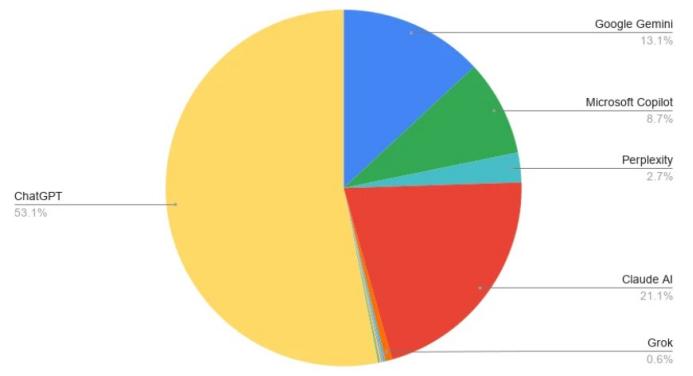
Caption: The popularity of AI chatbots in the United States as of June, as statistics by a market research institution
The more impatient, the harder it is to achieve results. In early June, there was news that Meta's Muse Spark was delayed.
When it was first announced in April, Alex Wang, who is in charge of this business, said that the API of the model "would be launched soon". However, in June, when Meta was asked about it, it still said that it was testing the model API with partners and "planned to" launch it this month.
According to The Wall Street Journal, the release of the Muse Spark API was postponed from April to May because a vulnerability was found during testing, and the infrastructure couldn't keep up, so it needed further construction.
To make matters worse, just when it was time to rush the work, Meta announced restrictions on employees' token usage.
Last Friday, Information reported that Meta announced in an internal company memorandum that it would limit employees' token usage to curb the continuous increase in the cost of internal AI tools.
The memorandum cited an employee - developed token - usage ranking tool called "Claude Economics" and said that Meta employees had consumed a total of 73.7 trillion tokens in the past 30 days.
The memorandum stated that although the company had taken down this ranking, the usage of AI tools by Meta employees had increased exponentially this year, and the cost would exceed billions of dollars.
To reduce costs, Meta will launch an internal platform called AI Gateway to track the token usage of each project team in real - time. The platform has an automatic early - warning mechanism that will alert when the token usage exceeds the limit or shows an abnormal peak.
The memorandum also said that Meta intends to limit employees' use of other companies' AI tools and will encourage employees to use Meta's own AI programming assistant, formerly known as Devmate. Meta will also enter a more systematic AI tool cost - management mode in 2027, including strict budget/resource allocation and tool support.
Meta's AI accessories: selling at a loss, having privacy disputes, and hard to break the deadlock
In an attempt to break the deadlock in its AI business, Meta has tried every means. Since its large - model efforts have been frustrated, it has turned to the path of wearable devices.
In early June, an internal memorandum written by Alex Himel, the vice - president in charge of Meta's wearable device business, was disclosed. The content is as follows:
In the second half of 2026, four new AI glasses with code names Modelo, Luna, RBM2 Refresh, and Mojito VIP will be released;
In the second half of 2026, 10 million wearable devices will be sold, and the monthly active users will be increased to 6.8 million;
Prototype machines with code names "Artemis" and "SSG" (Super - Sensing Glasses) for the future will be developed;
A subscription service called "Wearables for Work" for enterprise users will be launched;
Internal testing of a new AI pendant will start in the spring of 2027.
According to public information such as financial reports, after Meta's cooperation with Ray - Ban, the daily active users of its AI glasses in 2025 increased three - fold year - on - year, and the sales volume increased by more than 200% year - on - year. More than 7 million pairs were sold throughout the year, accounting for about 82% of the global smart - glasses market share.
Having finally made a breakthrough in wearable devices, Meta naturally wants to make good use of this advantage. According to the memorandum, Meta plans to run the Muse Spark model on wearable devices and also intends to equip them with a consumer - grade AI agent under development, with the product code name Hatch.
However, Meta's wearable AI devices may not necessarily become the Meta version of an AI phone and provide a consumer - grade entrance for its large models.
Not to mention the delay of Muse Spark, just the co - existence and contrast between the increasing sales and huge losses of Meta's AI glasses are so similar to the financial reports of some new - energy vehicle companies in certain countries that stockholders looking at the financial reports have a sense of déjà vu.
According to the first - quarter financial report of 2026, the Reality Labs department, which is in charge of Meta's wearable device business, had a revenue of $402 million, while the loss was $4.03 billion. For every dollar of goods sold, it lost ten dollars.
What's more embarrassing is that when Meta's AI glasses were launched at the end of September 2025, the losses of Reality Labs were even greater. In the third quarter when no AI glasses were sold, the loss was $4.43 billion; in the fourth quarter when AI glasses were sold, the loss jumped to $6.02 billion.
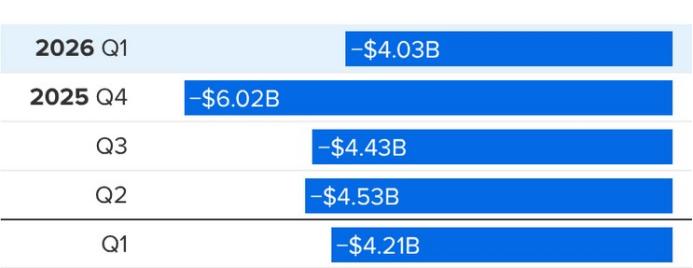
Caption: Comparison of losses of Reality Labs from 2025 to the first quarter of 2026
Even though Meta is a large company, it's hard to accept such huge losses in its breakthrough business. Not to mention that the privacy scandals of Meta's AI glasses have been continuous, and it's really hard to say whether they will sell well in the future.
In late October 2025, Meta announced an update to its privacy policy. Data such as AI voice and image analysis from users' Ray - Ban Meta smart glasses will be used to build more detailed user profiles to deliver more targeted ads on platforms such as Facebook and Instagram.
That is to say, Meta has realized the joke of "AI forcing ads to pop up in Iron Man's head - up display".
In early March 2026, several Kenyan data annotators reported that their outsourced work included handling various private images of Ray - Ban Meta smart - glasses users.
When Meta's AI glasses are voice - activated to answer questions, the captured images are transmitted to outsourced data annotators. The Kenyan workers said that they had seen a lot of inappropriate images of Meta AI - glasses users, such as using the toilet, having sex, being exposed, and showing bank - card numbers and passwords when withdrawing money from ATMs.
In the words of the Kenyan workers, "If users knew what they were actually recording, they would never dare to use these glasses again."
In early June, there was news that someone had removed the shooting indicator light from Meta's AI glasses.
The Ray - Ban Meta smart glasses originally had a shooting indicator light that would light up when the shooting function was in use to remind people around that "shooting is in progress". However, someone is selling a modification service on Facebook Marketplace, known as the "American flea market". For less than $100, customers can have the indicator light drilled out or covered. This service has appeared in 30 states in the United States.
For a super - large company to develop AI to the point where employees curse, the boss admits mistakes, software is delayed