Anhui, Jiangsu, Shandong and Henan "team up": Is it time for the peripheral regions to "rise"?
Jiangsu, Shandong, Henan, and Anhui are all major provinces capable of shouldering important responsibilities in the national regional pattern.
However, looking internally, regional imbalances still exist. Recently, at the 2026 Inter - provincial and Inter - municipal Work Conference on the Coordinated Promotion of High - quality Development in the Inter - provincial Border Area of Jiangsu, Anhui, Shandong, and Henan, ten cities including Xuzhou, Lianyungang, Suqian, Huaibei, Suzhou, Zaozhuang, Jining, Linyi, Heze, and Shangqiu gathered to discuss development.
Looking closely at these ten cities, they span the two major economic sectors of the eastern and central regions, where multiple national strategies intersect. However, as the "marginal low - lying areas" of each province, their development has long faced the embarrassing situation of being "ignored by the four provinces".
In the 1980s, the Huaihai Economic Zone spontaneously formed by these ten cities became one of the earliest "regional economic cooperation organizations" in China. To date, local cooperation has officially received support at the national level.
This "gathering" of ten cities from four provinces aims to promote the normalized development of regional coordination. A subsequent question is how can this four - province border area, which is still in the "deep - stage of cooperation", truly achieve industrial collaboration and create a "new growth pole" for high - quality development?
Broadly speaking, there are many similar "four - province border" areas across the country. Recently, the border area of Zhejiang, Anhui, Fujian, and Jiangxi (Quzhou, Huangshan, Nanping, and Raozhou) also introduced an action plan for coordinated development, and the inter - provincial adjacent areas in the Yellow River Basin are also seeking national policy support.
For the "low - lying areas" at the inter - provincial borders, what kind of industrial coordination mechanism is needed to truly achieve win - win results?
40 Years of Cooperation
"Support the inter - provincial adjacent areas such as those of Jiangsu, Anhui, Shandong, and Henan to take the lead in exploring mechanisms for project docking and policy linkage."
At the end of last year, the Department of Regional Coordination and Development of the National Development and Reform Commission issued an article titled "Continuously and Thoroughly Promote Regional Coordination and Development", placing this item in a prominent position in promoting regional linkage development.
Why is it Jiangsu, Anhui, Shandong, and Henan?
In terms of location, the border area of these four provinces spans the two major economic sectors of the eastern and central regions of China, overlapping with multiple national strategies such as the integration of the Yangtze River Delta, the ecological protection and high - quality development of the Yellow River Basin, and the rise of the central region. At the same time, this region is an "economic low - lying area" in the provincial domains far from the provincial capitals. With similar geographical locations and shared cultures, it has a natural foundation for collaborative development.
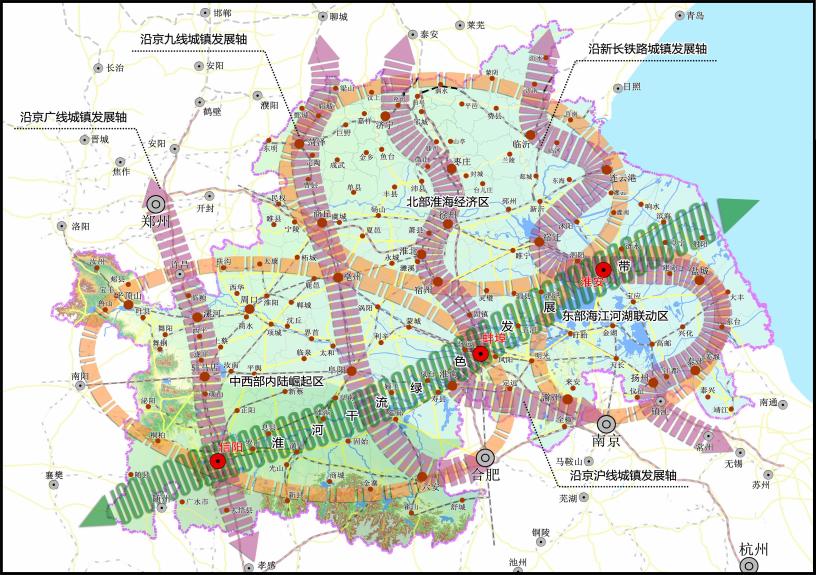
Image source: "Development Plan for the Huaihe River Ecological Economic Belt"
The cross - provincial cooperation in the border area of Jiangsu, Anhui, Shandong, and Henan can be traced back to March 1986 when the Huaihai Economic Zone was established, becoming one of the earliest regional economic cooperation organizations in China. In 2018, the State Council approved the "Development Plan for the Huaihe River Ecological Economic Belt", clarifying the northern Huaihai Economic Zone.
In December 2024, the Office of the Central Leading Group for Regional Coordination and Development issued the "Action Plan for the Coordinated Promotion of High - quality Development in the Inter - provincial Border Area of Jiangsu, Anhui, Shandong, and Henan", marking that the cooperation among ten cities from four provinces has officially risen from local exploration to the national level and become an important move in the "grand chess game" of regional coordinated development.
Although it has developed for 40 years and its status has been continuously upgraded, Zeng Gang, the dean of the Urban Development Research Institute of East China Normal University, admitted that compared with the integration of the Yangtze River Delta, the ten cities from the four provinces of Jiangsu, Anhui, Shandong, and Henan lack mature experience in previous coordinated cooperation, and cross - regional cooperation still needs to be accelerated.
As pointed out by local media, to date, the coordinated development of the ten cities from four provinces is still in the deep - stage of attack. Industrial linkage has not achieved full - scale in - depth integration. There are still blockages and shortcomings in the interconnection of infrastructure, and the cross - regional grass - roots governance system and coordinated development mechanism still need to be upgraded.
This reality is also reflected in the data.
During the "14th Five - Year Plan" period, the total GDP of the ten cities increased from 3.46 trillion yuan to 4.77 trillion yuan, and the proportion of the four - province GDP also increased from 12.81% to 13.06%, an increase of 0.25 percentage points. The proportion in the national GDP is about 3.4%, slightly lower than that at the end of 2020.
During the same period, the proportion of the GDP of the three provinces and one municipality in the Yangtze River Delta in the national GDP increased from 24.1% at the end of 2020 to 24.7% at the end of 2025, an increase of 0.6 percentage points. The economic growth rate is significantly faster than that of the above - mentioned ten cities.
Facing the above - mentioned gap, all parties in this negotiation put forward specific countermeasures. According to the "Key Cooperation Matters for the Coordinated Promotion of High - quality Development in the Inter - provincial Border Area of Jiangsu, Anhui, Shandong, and Henan from 2026 to 2027" (hereinafter referred to as the "Key Cooperation Matters"), all parties will focus on strengthening industrial coordination and promoting regional connectivity. They will replace the previous fragmented cooperation with a systematic layout to promote cross - provincial coordination to a new stage of higher quality and greater efficiency.
Hub Linkage
Transportation and logistics are the first move in regional coordinated development.
Qin Zunwen, the vice - president of the China Society of Urban Economy and the secretary - general of the Yangtze River Economic Belt Think - tank Alliance, told "Urban Evolution" that cities such as Xuzhou and Shangqiu are important regional hubs in the country. For example, the list of the first batch of cities in the new round of the National Comprehensive Freight Hub Chain - supplementing and Strengthening Improvement Action was recently announced, and Shangqiu is one of the ten cities on the list.
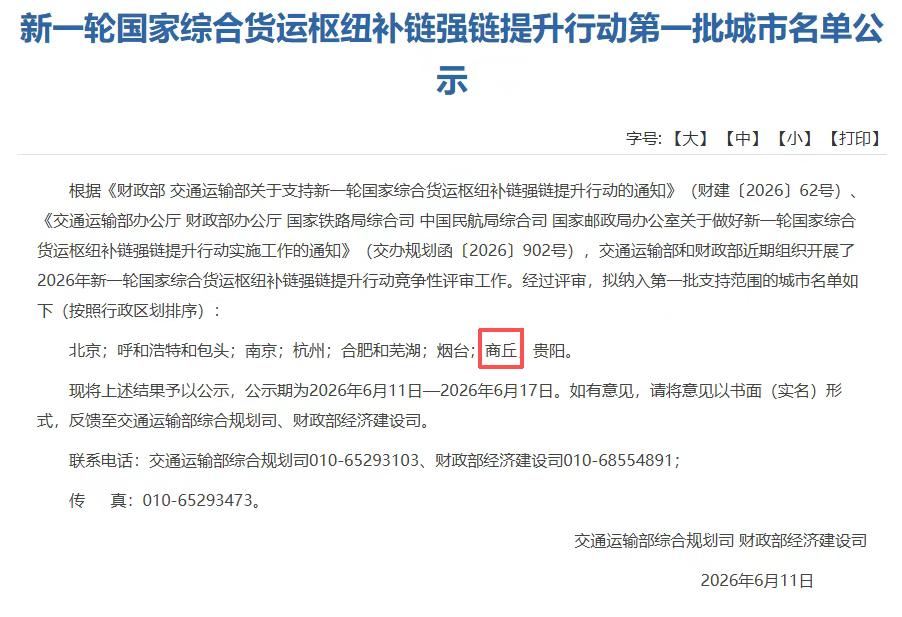
However, although there are rich hub resources in the region, there has long been a lack of effective linkage among cities. The hub advantages are relatively scattered, and the synergistic effect has not been fully exerted.
The new breakthrough is that at this meeting, the "Cooperation Framework Agreement for the High - quality Development of Multimodal Transport in the Inter - provincial Border Area of Jiangsu, Anhui, Shandong, and Henan" was signed. Based on the advantages of the regional comprehensive transportation hub resources, the port - to - port linkage between regions will be further deepened.
In the long run, the ten cities will promote the early connection of shipping in northern Jiangsu, southern Shandong, northern Anhui, and eastern Henan into a network through the development mechanisms of "port - to - port cooperation" and "port coordination".
Qin Zunwen believes that through cross - regional coordination, by connecting and dispatching the scattered port resources in a unified way, and achieving efficient connection of multimodal transport including railway, waterway, road, and air, the overall regional logistics cost can be effectively reduced, and the comprehensive competitiveness can be improved.
For example, as the rotating city for this cooperation, Suqian takes JD Group as the core resource and an important starting point to build a smart logistics and e - commerce network covering the ten cities. It promotes the co - construction and sharing of intelligent distribution centers and regional cold - chain bases, and focuses on creating an efficient e - commerce logistics circle with cross - provincial warehousing interconnection and off - site goods allocation.
At a deeper level, regional coordination is promoting the transformation of each hub city from a single transportation function to a more value - added hub economic industrial chain. Qin Zunwen said that each city should form a pattern of clear division of labor, complementary advantages, and differential development. Lianyungang should focus on overseas trade, Xuzhou should strengthen the processing function of land ports, Suqian and Shangqiu should focus on e - commerce distribution, and Zaozhuang and Jining should give full play to their advantages in processing and manufacturing.
In fact, the regional coordinated development of the ten cities from four provinces has brought new development breakthroughs to some cities. Local media in Henan previously reported that when goods can reach the ocean - going ships in Lianyungang from Shangqiu within a day, it effectively alleviates the locational anxiety of Henan, which is "not close to the sea and not along the border".
Zeng Gang emphasized that for the ten cities from four provinces to achieve real agglomeration development, the key lies in adhering to co - construction, sharing, mutual benefit, and ensuring that the cooperation can achieve win - win results and generate greater overall benefits. As the leading cities in the region, they should actively provide development opportunities for other cities instead of one - way siphoning and winning all.
This concept has been reflected in practice. Previously, Xuzhou, the "leader" of the Huaihai Economic Zone, opened the sponsorship seats for small and micro - enterprises in the "Jiangsu Super League" to Anhui, Shandong, and Henan this year, sharing the dividends of the event traffic. Later, Liu Hao, the mayor of Suqian, proposed to amplify the superposition effect of characteristic events such as the "Jiangsu Super League" and local cuisine to further stimulate the consumption vitality in the inter - provincial border area of Jiangsu, Anhui, Shandong, and Henan.
In Liu Hao's view, based on the characteristic and advantageous industrial foundation of each place, it is necessary to explore the co - construction of supply - demand docking platforms for industrial chains such as electromechanical equipment and new materials, and build an integrated e - commerce ecosystem such as "cross - border e - commerce + industrial belt" to promote industrial linkage on a larger scale.
Industrial Capacity Enhancement
As the coordination in the inter - provincial border area becomes normalized, the core proposition facing the ten cities from four provinces is how to reshape the industrial division of labor and achieve an overall leap in economic energy level.
In terms of industrial bases, many of these cities are old industrial bases and resource - based cities, facing the common problems of the decline of traditional industrial kinetic energy and the lag in the transformation of old and new kinetic energy.
"Promoting industrial upgrading by seizing the opportunity of inter - provincial cooperation cannot be limited to the development thinking of a single city or area." Zeng Gang said that each city should be based on the overall situation of the national industrial layout, focus on its own comparative advantages, and avoid homogeneous layout.
Taking Xuzhou as an example, as the national urbanization growth rate slows down, the industrial advantages of construction machinery and mining infrastructure equipment built by XCMG Group are gradually weakening. Transformation to new - quality productivity has become an inevitable choice. It can meet the needs of urban renewal, layout new tracks for refined and intelligent equipment such as urban operation and maintenance and intelligent maintenance, and promote the quality improvement and upgrading of traditional manufacturing.
Zeng Gang emphasized that with their relatively weak foundation, the ten cities from four provinces should give full play to their locational advantages of being adjacent to the core area of the Yangtze River Delta and take direct and effective measures to attract and undertake industrial transfer from the core area of the Yangtze River Delta.
Specifically, currently, core cities in the Yangtze River Delta such as Shanghai and Suzhou are promoting industrial "slimming" and transferring some manufacturing links to make room for frontier industries. The ten cities from four provinces should speed up the removal of inter - provincial barriers such as the business environment and industrial access and actively undertake the transfer of high - quality industries from the Yangtze River Delta.
While revitalizing traditional industries, seizing the opportunity to layout emerging tracks and cultivate new growth poles has become the common development consensus of the ten cities from four provinces.
The ten cities proposed to focus on frontier new tracks such as artificial intelligence and digital economy, establish a supply - demand docking mechanism for industrial chains, and strive to cultivate industrial clusters with national influence.
The top - level consensus is accelerating the transformation into practical implementation, and a series of new actions are being carried out. The "15th Five - Year Plan" outline of Xuzhou mentioned strengthening the coordinated linkage with cities in the inter - provincial border area of Jiangsu, Anhui, Shandong, and Henan to expand the depth of high - quality development. It focuses on promoting in - depth cooperation in industrial parks such as Xuzhou - Suqian and Xuzhou - Huaibei and co - constructing new functional areas in the inter - provincial adjacent areas.
"These cities are not the core development poles in their respective provinces. The key to breaking the situation lies in differential competition and complementary positioning." In Qin Zunwen's view, the optimal solution for the ten cities from four provinces to compete in the popular industrial tracks is to focus on the upstream and downstream supporting links of the industrial chains of provincial capitals and integrate into the national industrial system.
Regarding the collaborative development of the digital economy industry, Qin Zunwen suggested that the ten cities can gradually form a cross - provincial digital industrial corridor with clear division of labor based on their respective industrial endowments. Xuzhou and Lianyungang, relying on their industrial foundation, focus on the hardware manufacturing of intelligent manufacturing. Suqian exports mature e - commerce supporting and digital service capabilities. Cities such as Heze and Huaibei focus on parts and components matching to complete the hardware production supply chain.
Through such division of labor and complementary linkage, the entire digital economy industrial chain from hardware production, algorithm services to terminal applications can be connected, and finally, the qualitative change of the inter - provincial industrial clusters from scattered distribution to cluster formation can be achieved.
This article is from the WeChat public account "Urban Evolution", author: Liu Xuqiang, published by 36Kr with authorization.