The price of live pigs has hit a 17-year low, completely transforming the economics of pig farming. Experts say the pig cycle has distorted, the "floor price" will not return, nor will a reversal inflection point arrive.
The price of pigs has dropped to a level that makes pig farmers question their livelihoods!
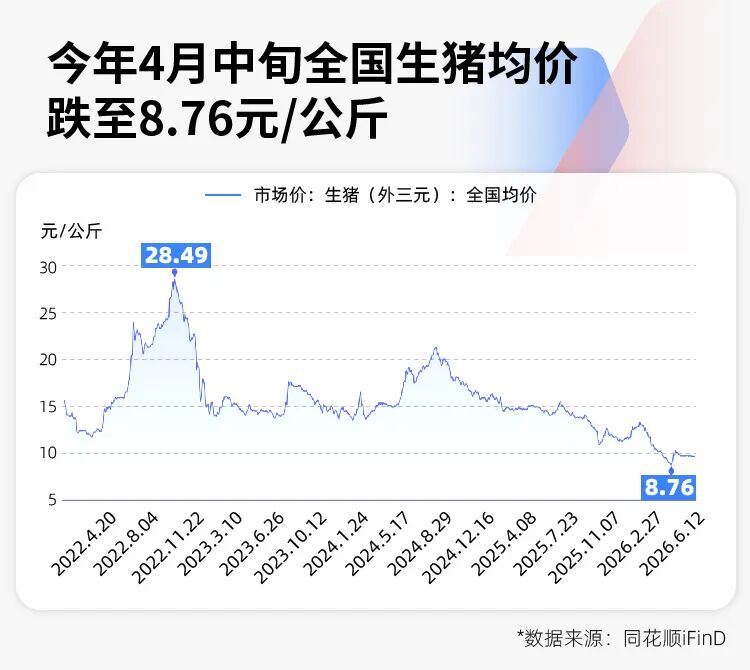
In mid - April this year, the slaughter price in some provinces fell below 4 yuan per catty, and the average price of live pigs hit a new low since June 2009 (nearly 17 years).
This downward cycle started in 2022. After entering the downward trend in December of that year, it has lasted for more than 40 months, and has been fluctuating within 10% of the bottom price for more than 20 months. Both the downward period and the bottoming period have set new historical records.
Affected by this, all listed pig enterprises reported losses in their first - quarter reports. Leading enterprises such as Muyuan Co., Ltd. lost 1.2 billion yuan, Wens Foodstuff Group Co., Ltd. lost 1.07 billion yuan, and New Hope lost about 900 million yuan...
Why has the pig price dropped so significantly, for such a long time, and set a record? Where is the bottom? Can pig farming still be profitable? How will the decades - long pig cycle evolve?
With a series of questions, a reporter from National Business Daily (hereinafter referred to as NBD) conducted an in - depth interview with Zhu Zengyong and Wang Ligang, researchers at the Institute of Animal Science of the Chinese Academy of Agricultural Sciences, in an attempt to dissect the underlying logic of the industry's transformation.

Why has the pig price dropped so sharply?
NBD: The total downward period and the deep bottoming period of this pig cycle have both reached historical highs. What exactly caused this?
Zhu Zengyong: The core reason is the production cycle of live pigs. The supply of commercial pigs this year is essentially determined by the inventory of breeding sows and the efficiency of breeding and farrowing last year.
From January to September last year, although the pig price showed a downward trend overall, due to the decline in feed costs, pig farming was still in a state of slight to small profit in the first three quarters. Therefore, the production capacity of breeding sows decreased slightly and steadily in the first three quarters, corresponding to an oversupply situation of commercial pigs in the first half of this year. The industry entered a comprehensive loss in October last year, and the production capacity of breeding sows began to be adjusted and reduced at an accelerated pace after October.
From the perspective of cycle characteristics, the overall upward time is short, and the downward time is long, showing an obvious characteristic of "narrow peak and long slope". After September 2024, the pig price showed a downward trend overall. In April this year, the pig price dropped to a low level in recent years. Although it has rebounded slightly after hitting the bottom, it generally shows a narrow - range shock trend.
NBD: Since this cycle has been in a downward trend for so long, why has the inventory of breeding sows not been able to decline?
Zhu Zengyong: The reduction of breeding sows is directly related to the development stage and characteristics of the industry. One important influencing factor is that after African swine fever, the scale level and industrial concentration of the pig industry have increased rapidly. In 2025, the proportion of farms with an annual slaughter of more than 500 pigs in the national total has exceeded 70%, and the proportion of the top 20 enterprises has reached 36%.
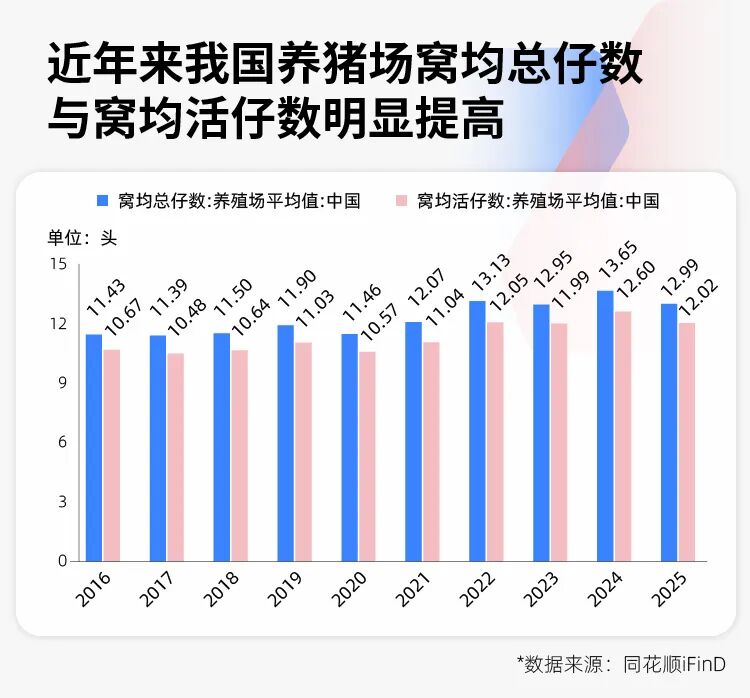
On the one hand, this has led to a rapid increase in production efficiency. For example, indicators such as PSY (the number of weaned piglets per sow per year) and FCR (feed conversion ratio, that is, how many catties of feed are needed to grow one catty of meat) have been significantly improved. On the other hand, the current pig industry shows obvious capitalization characteristics, and many leading pig enterprises are listed companies.
Leading enterprises focus more on the long - term development of the enterprise, and their production capacity is relatively stable. Moreover, due to high production efficiency and low comprehensive costs, the reduction of production is slow and the reduction range is small. The so - called "it's hard for a big ship to turn around". And many leading enterprises can also use tools such as futures to resolve the risk of market price fluctuations. They are no longer like small and medium - sized individual farmers in the past, who would start to reduce production irrationally and rapidly as soon as the pig price fell due to high comprehensive costs and weak risk resistance.
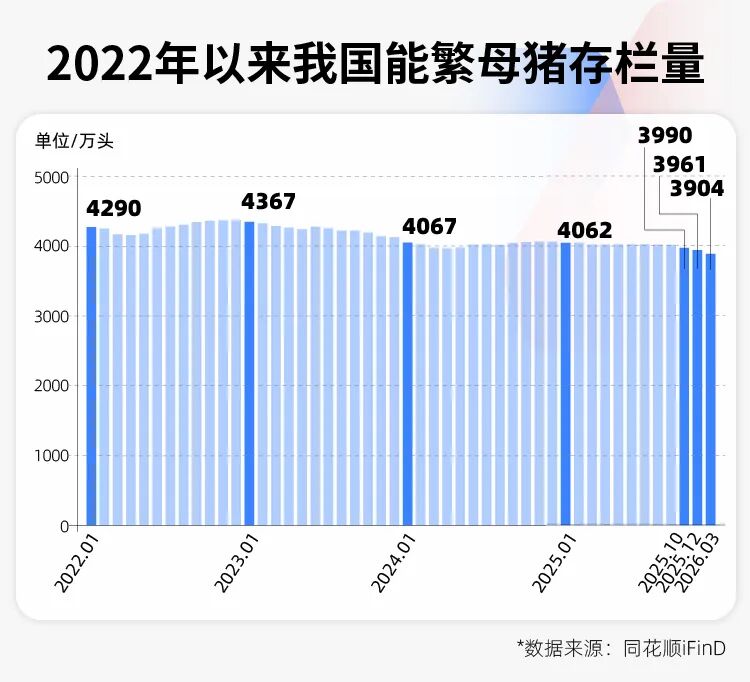
In addition, after African swine fever, the ability of China's pig industry to resist external shocks has been significantly enhanced. Coupled with the improvement of production efficiency, the reduction of breeding sows in this cycle no longer declines rapidly as in the past. Instead, it has declined steadily from about 40.78 million heads in December 2024.
NBD: Will the scale level continue to increase in the future?
Zhu Zengyong: The state defines scale as farms with an annual slaughter of more than 500 pigs. At an annual growth rate of about 2%, the scale rate can reach more than 90% after 10 years. By then, the scale will enter the stage of structural optimization, and the moderate scale center will increase steadily. It should be noted that listed companies represent industrial concentration, which is not necessarily the higher the better. It is a different concept from scale. The improvement of scale level will drive the improvement of industry efficiency.
Why has the cost of pig farming also dropped sharply?
NBD: Is the improvement of production efficiency mainly reflected in the two indicators of PSY and FCR?
Wang Ligang: Production efficiency should be considered from two aspects: First, sow efficiency. PSY comprehensively reflects the number of piglets per litter, the number of litters per year, and the mortality rate from birth to weaning. It is a relatively complete indicator to evaluate sow efficiency.
Second, the efficiency of fattening pigs. Although FCR is the main indicator, it is not the only one. Growth rate, mortality rate of fattening pigs, lean meat percentage, etc. will also affect the overall efficiency and cost. In addition, the daily weight gain of live pigs in the stage from 30 kg to 120 kg has increased from the original 700 grams to 800 grams to 900 grams to 1000 grams. The slaughter weight in 6 months has increased from 100 kg to 120 kg to 130 kg. While saving feed, it also saves labor, which is an important manifestation of efficiency improvement.
NBD: Can you explain how PSY has been specifically improved, how FCR has been reduced, and how much the production cost has been reduced by each of them?
Wang Ligang: The "pyramid" breeding system of three foreign breeds is currently the mainstream pig breeding system in China. That is, the pigs used for meat production are obtained by cross - breeding three foreign breeds: Large White, Landrace, and Duroc. Because of their high lean meat percentage, fast growth, and high feed conversion rate, they have become the mainstream of breeding.
The improvement of the reproductive and growth performance of pigs is inseparable from the progress in several aspects such as "breeding, feed, disease, management, and environment".
First is breeding. The goal of breeding is to select the genetic traits with the optimal economic benefits, such as good growth traits such as fast growth, less feed intake, and more lean meat, as well as good reproductive traits such as more piglets per litter and high survival rate.
Compared with 20 years ago, there have been several very important changes in pig farming. The most important change is that the number of piglets born per sow has increased by 20% to 30%, from 10 to 11 live piglets per litter to 14 to 15. This is not only due to high - quality breeding sources but also due to the progress of the domestic breeding system.
Second, due to the use of advanced technologies such as large - scale batch production technology, synchronous estrus reproduction technology, and early weaning, sows have more effective utilization days, so that the number of litters per sow per year has increased from about 2.1 to 2.3 to 2.4.
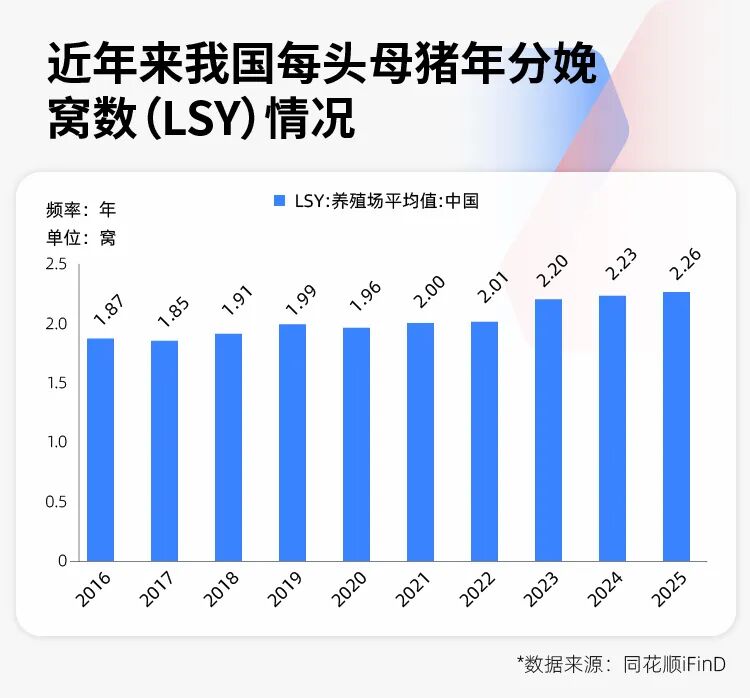
For example, batch production can concentrate breeding within one week, and at the same time, estrus - promoting drugs can be used to reduce the non - pregnancy rate of sows. In addition, many pigs are weaned at 24 or even 21 days now instead of 28 to 30 days in the past. As soon as the sows are weaned, they can be used again, which actually shortens the utilization interval. These technologies have all improved the efficiency of sows.
Third, more advanced and strict epidemic prevention and control and environmental control measures have also reduced the mortality rate of piglets.
PSY = the number of live piglets per litter × the number of litters × the survival rate. With more piglets, an increased number of litters, and an increased survival rate, the three aspects together have promoted the increase of PSY from 18 to 24 to 25, an increase of about 20% to 30%.
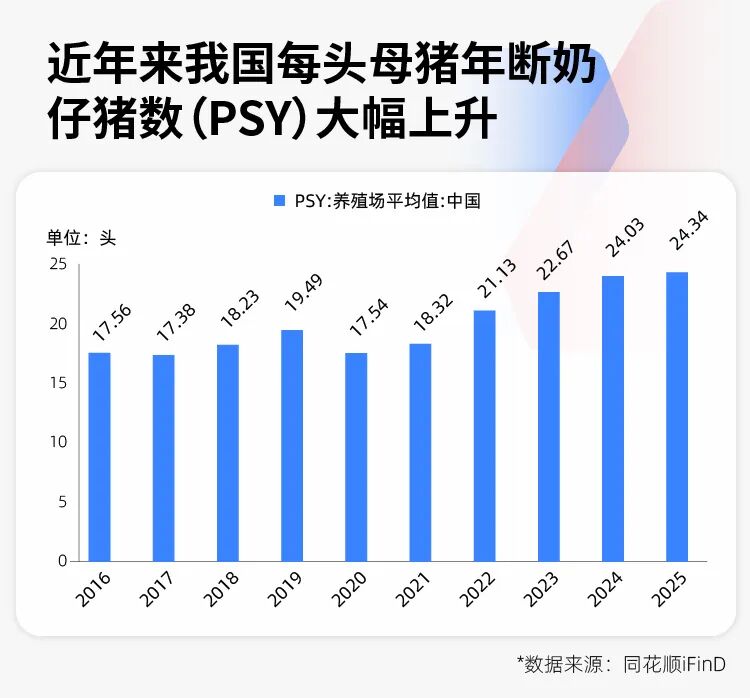
Taking the annual feeding cost of a sow as 5000 yuan (including pigsty depreciation, residual value, etc.), when PSY is 18, the cost of a piglet is about 278 yuan per head. When PSY is 24, it drops to about 208 yuan per head. The initial cost of each fattening pig is reduced by about 70 yuan, a decrease of more than 25%.
Currently, Denmark's PSY is at the international leading level, reaching 37. The leading domestic enterprises are about 30, and most large enterprises are 26 to 27. Many pig herds in China now have the same excellent genes as Danish pigs, but the supporting production management often lags behind. Many enterprises should be able to achieve an increase from 26 to 27 to 31 to 32 in five or six years. Further improvement will be slower. For example, if the number of piglets born is too high, there will be practical bottlenecks such as low birth weight of piglets and insufficient number of sow nipples. For example, Danish pigs only have 14 nipples. If 17 piglets are born, 3 of them cannot be effectively nursed. At this time, means such as nurse sows or frequent manual intervention are needed, and the production management pressure is very high.
FCR has dropped from 3.0:1 to 3.2:1 a few years ago to the current industry average of 2.65:1, and 2.4:1 to 2.55:1 for leading enterprises.
Regarding the reasons for the reduction, first, breeding lean pigs. The energy ratio of feed converted into fat and muscle is 3:1 to 4:1. The higher the lean meat percentage, the less feed is consumed. We continue to breed in the direction of lean pigs with high feed utilization efficiency, so the feed consumption is getting less and less.
Second, the technology of precise nutrition has improved rapidly. For example, Muyuan uses more than a dozen formulas instead of the original two or three formulas. Fixed energy and protein ratios are set for different growth stages. Including the current low - protein diet, less protein may actually promote growth.
Third, the feeding equipment has been improved. In the past, the design of the feed trough was not emphasized. Pigs would arch around when eating, and sometimes they couldn't even eat. As a result, the pigs didn't grow well, and a lot of feed was wasted. Now the feed trough has been redesigned more scientifically. Some enterprises are also using liquid feed, which not only improves the digestibility but also reduces waste a lot.
If the feed conversion ratio drops by 0.1, based on a slaughter weight of 130 kg, a pig will eat 13 kg less feed. The feed price ranges from 3 yuan to 4 yuan per kg, so about 40 yuan can be saved. If it drops by 0.4 to 0.5, the cost of a pig can be saved by about 200 yuan. Coupled with the increase of about 70 yuan in PSY, the overall cost reduction is about 300 yuan.
Currently, the international advanced level of feed conversion ratio is 2.2:1 to 2.3:1. There is still room for improvement of 0.2 to 0.3 in China. It is completely achievable to reduce the feed conversion ratio by more than 0.05 every year in breeding.
Overall, the national average cost has dropped from 14 yuan to 15 yuan per kg to about 13 yuan per kg, and 11 yuan to 12 yuan per kg for leading enterprises.
NBD: The current national average price of live pigs is 10.14 yuan per kg. Does this mean that enterprises below the cost line will not lose money and will not adjust and reduce their production capacity?
Zhu Zengyong: Based on the average cost of about 13 yuan per kg, the cost of leading enterprises with high efficiency is about 11 yuan to 12 yuan per kg. For them, it is a small to medium loss. For farmers with a cost of 13 yuan or even 14 yuan per kg, they are in a state of medium to deep loss. The reduction of production capacity is affected by many factors such as capital reserve, loss degree, and market expectation. The cost difference leads to different adjustment speeds and amplitudes for different subjects.
Why hasn't the reduction of sows reduced the supply of live pigs?
NBD: You just mentioned the improvement of production efficiency, and the core indicator is MSY (the number of fattening pigs slaughtered per sow per year, MSY = PSY × the survival rate of fattening pigs). Relevant data shows that the overall MSY of the industry has increased by about 30% to 40% in the past decade. This means that the same number of sows can produce more commercial pigs. To what extent does this "hidden production capacity" offset the effect of the reduction of