When PDRN is no longer scarce, L'Oréal and brands like Jumeiya embark on a protracted battle
Since the first half of the year, PDRN may be the most typical example in the "ingredient craze" of the beauty industry.
It is considered typical not only because of its growth rate - an almost 270 - fold increase in online sales in four years, with more than 4,000 brands flocking in, and the entire industrial chain from the raw material end to the brand end heating up simultaneously. A repair ingredient that had accumulated decades of clinical trust in the medical aesthetics field suddenly accelerated its entry into essences, creams, eye creams, and base make - up, becoming a "new standard" for mass skin care. This leap from serious medical treatment to daily consumption is rare in the cosmetics industry.
However, the faster it grows, the more questions need to be answered.
For salmon - derived, plant - derived, and recombinant routes, is there comparable evidence of efficacy? Brands are all doing ingredient combinations and applying delivery technologies. What do consumers perceive? When an ingredient goes from being scarce to popular, where should the focus of competition lie?
Based on such observations, "FBeauty Future Traces" sorted out the new product trends of PDRN since this year and interviewed many practitioners from the raw material end, brand end, and industry observers, trying to explore a more fundamental question: When an ingredient is no longer scarce, what can a brand rely on to keep moving forward?
When PDRN becomes the "standard", what new stories can new products tell?
Since the beginning of 2026, the pace of new product launches of PDRN (Polydeoxyribonucleotide) in the skin - care track has significantly accelerated.
This ingredient, which first became popular in the medical aesthetics circle because of the salmon needle, is being included in the product lines of more and more brands. International brands are ramping up, and domestic brands are also busy. A series of products containing PDRN have been intensively launched into the market in a short period.
According to the big data BEBD of Meixiu, as of now in 2026, there have been 931 new products containing sodium DNA (the INCI name of PDRN) in the filings, while the total number for the whole year of 2025 was 1,570. The filing volume in less than half a year is already close to 60% of last year's total. We sorted out a batch of representative products containing PDRN launched by some mainstream brands in the market since 2026:
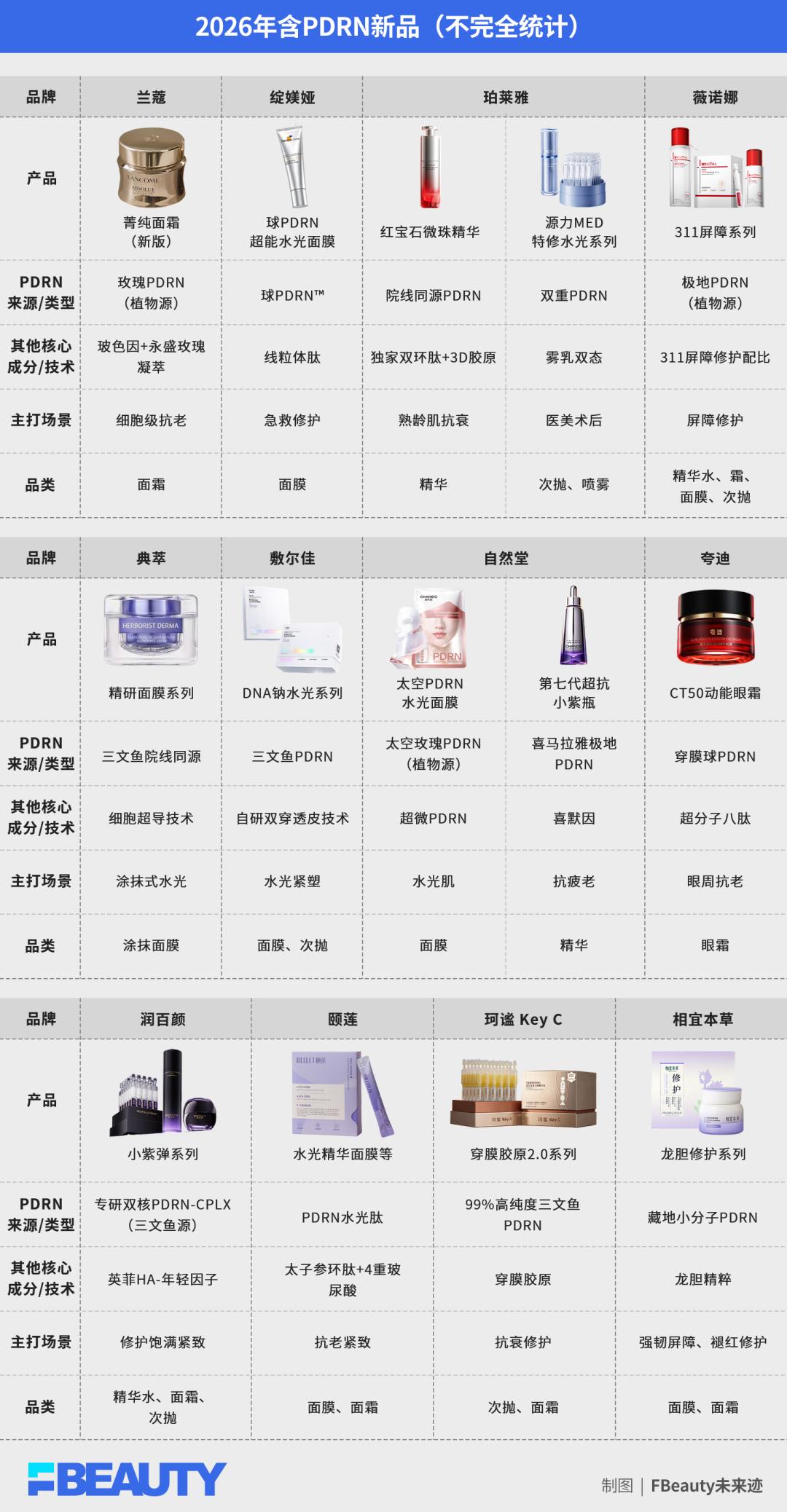
From the actions of this batch of new products, we can observe three trends:
Firstly, the category boundaries have been greatly expanded. PDRN first entered the market in the form of essences and ampoules. Now it has entered multiple categories such as masks, creams, eye creams, sprays, and even extended to the base make - up category. Some brands have launched products such as foundations and cushion compacts containing PDRN;
Secondly, the ingredient combination system has been established. PDRN rarely works alone as a single ingredient. Instead, as a high - value efficacy variable, it is combined with the brand's original core self - developed assets (such as Pro-Xylane, cyclic peptides, and collagen) to expand the system;
Thirdly, the application scenarios have been precisely refined. Brands have begun to embed PDRN into more specific skin - care scenarios, such as "after medical aesthetic procedures", "barrier repair", and "smearable hydro - filling", moving from "universal repair" to "scenario adaptation".
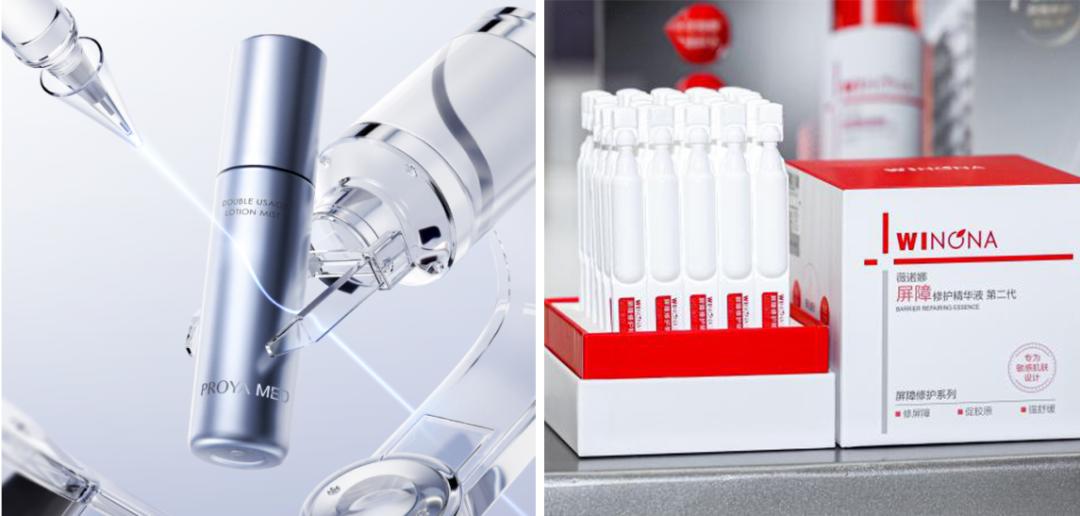
Proya Yuanli MED Repair Hydro - filling Spray, Winona 311 Barrier Repair Ampoules
In fact, what supports this wave of new product launches is a set of continuously rising industry base data.
According to the PDRN skin - care product market report released by the market research institution Future Market Insights, the global market size of PDRN skin - care products reached approximately $321.2 million in 2025. Among them, anti - aging and wrinkle - removing products accounted for 30.7% of the skin problem segmentation market. The report predicts that by 2030, this market size is expected to increase to 3 billion yuan, with a global compound annual growth rate of 9.7%. The Chinese market will lead the world with a compound annual growth rate of 10.3%.
According to the monitoring of the e - commerce database of Jiuqian Middle Platform, the combined sales of PDRN skin - care products on the three major platforms of Tmall, JD.com, and Douyin were only 1.5 million yuan in 2022, and soared to 408 million yuan in 2025, a nearly 270 - fold increase in four years. In the first four months of 2026, it had reached 223 million yuan. In addition, according to the analysis released by the overseas scientific research trend website PDRN.care, the interaction volume of PDRN on global social media increased by 322.3% year - on - year.
The coordinated response of the industrial chain is also taking place simultaneously. At the upstream raw material end, Ruijiming Biotech has laid out a full - spectrum solution with parallel "extraction + recombination" tracks. Baihong Group has built an "all - ecological PDRN" matrix covering salmon, probiotics, and plant sources. At the mid - stream ODM end, Cosmax exhibited the biosynthetic recombinant PDRN technology at the 30th CBE.
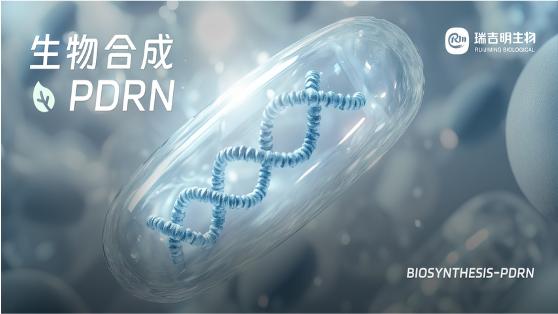
Image source: Ruijiming Biotech
From raw materials to OEM to brands, the entire industrial chain is almost making efforts simultaneously.
Mangqijin, a science popularization blogger and the person in charge of science communication at Chaogui Research Institute, analyzed to "FBeauty Future Traces": "The popularity of PDRN comes from the penetration of the 'Salmon Needle' in medical aesthetics into mass consumption on the one hand, and also from the industry's need for new popularity and new things on the other hand." He believes that PDRN is similar to human - derived bioactive ingredients such as hyaluronic acid and collagen, and consumers have a natural perception of its "high - order efficacy", which is an important basis for the continuous popularity.
The L'Oréal Group mentioned in an interview with "FBeauty Future Traces": "There are a large number of PDRN or similar technologies in the current market, but there are uneven levels in terms of ingredient quality, scientific understanding, product efficacy, and even safety guarantee." This judgment also confirms the gap between the popularity of the track and the degree of standardization from the side.
New products are densely launched, data is rising, and the industrial chain is in place, but standards and cognition are still catching up. There is no doubt about the popularity of PDRN. What is worth exploring next is what can really set brands apart when the scarcity of the ingredient gradually weakens.
The differentiation and choice of strategies, from the popularity of an ingredient to system competition
As more and more brands enter the PDRN field, an obvious question is: Since all are using PDRN, what are the real differences between products?
The answer lies in the brand's respective technology choices. From the source route at the raw material end, to the delivery path at the formulation end, and then to the ingredient combination idea at the product end, every link is differentiating.
The source of PDRN is the first choice brands face. Currently, there are mainly four routes in the industry, namely animal - derived, plant - derived, biosynthetic, and microbial fermentation - derived. Each source has its unique advantages and certain limitations.
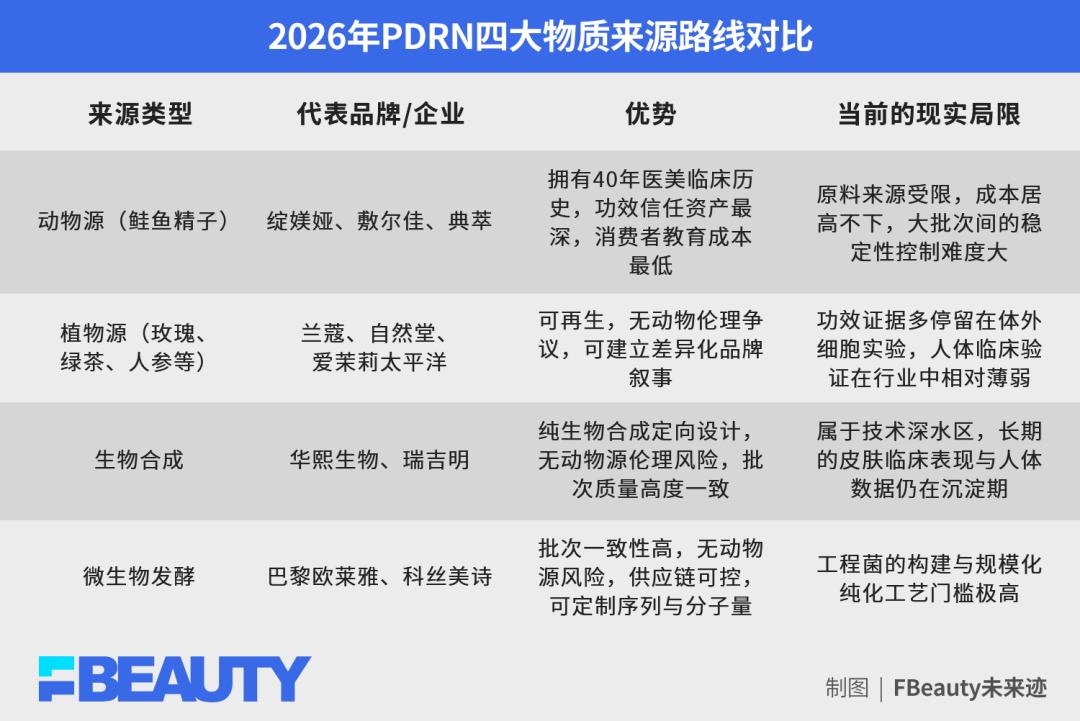
Regarding this differentiation, Xia Haifeng, the senior product manager of Ruijiming Biotech, analyzed in an interview with "FBeauty Future Traces" that the advantage of extracting PDRN from salmon lies in its long - standing application history and in - depth research: "Salmon - extracted PDRN has a 40 - year usage history, and its effectiveness and safety have been recognized by the market." However, he also predicted that recombinant PDRN will be "the fastest - growing segment in the next three years", which can promote the popularization of PDRN from a "scarce ingredient" to a "high - value - added efficacy ingredient".
The L'Oréal Group gave a more comprehensive judgment: "The source of PDRN itself is not the fundamental factor determining efficacy and safety, but a starting platform for development."
This means that the source of PDRN raw materials is not a single - choice question of "which is better", but a comprehensive decision made by brands based on their own positioning, cost structure, and efficacy focus.

If the choice of source determines where the ingredient "starts from", then the delivery technology solves the tough test of whether external macromolecules "can penetrate the barrier". PDRN faces the same transdermal problem as biomacromolecules such as recombinant collagen.
In 2026, the industry launched an intensive competition in transdermal technology in this link:
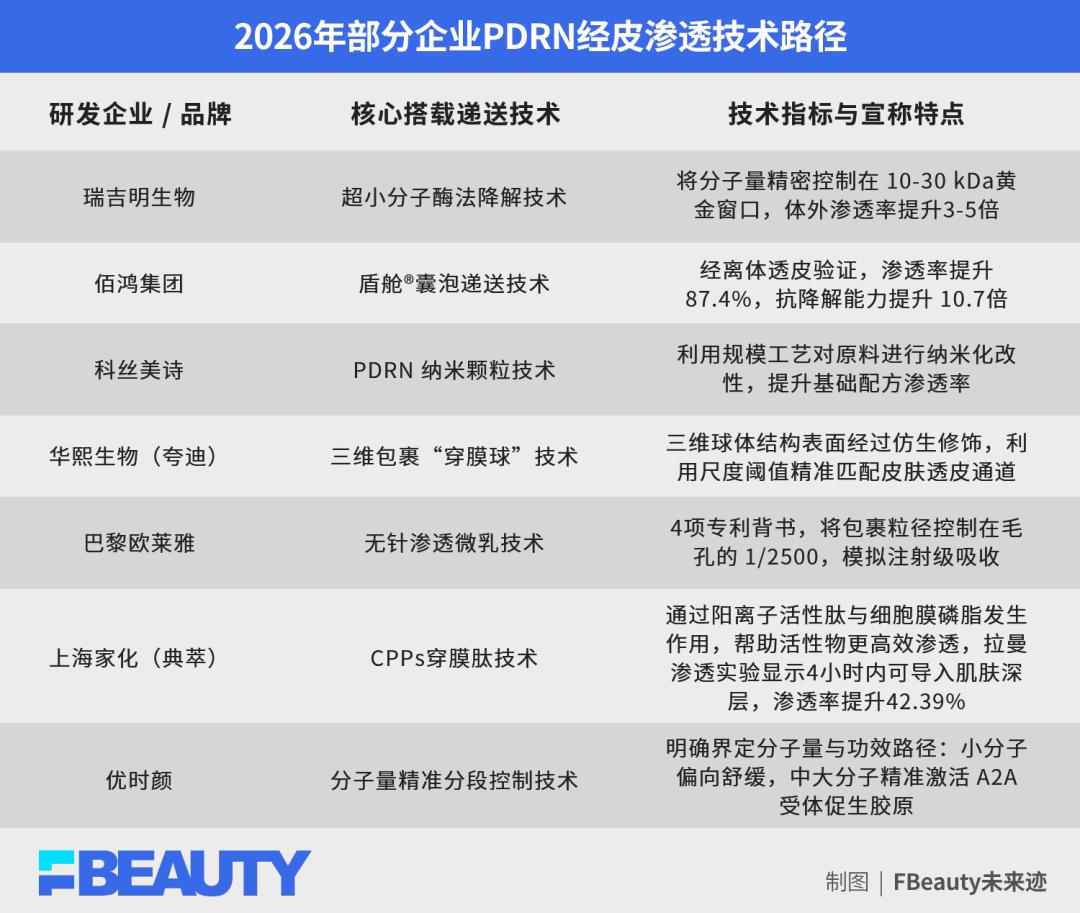
Xia Haifeng introduced in detail Ruijiming's evaluation method: By using the Franz diffusion cell in vitro model with excised pig skin to measure the penetration amount, and then combining with the fibroblast activity screening to calibrate the efficacy critical point, finally locking in the window of 10 - 30 kDa, which "can penetrate the skin without inactivation".
The L'Oréal Group regards the delivery technology as the third layer of the competitive barrier. They believe that the bioavailability of active ingredients and the transdermal penetration efficiency have become the new core dimensions of industry innovation competition.
In addition to the traditional water - based system of skin - care products, the tentacles of delivery technology have even extended to the more complex powder - oil system of color cosmetics.
Cosmax's new recombinant PDRN nanosphere technology is a typical example: Because color cosmetics form a dense film and are rich in pigment powder, conventional PDRN is easily adsorbed and inactivated when added, and can only stay on the skin surface for simple soothing. Cosmax chooses to wrap the molecules with a cationic chitosan skeleton. On the one hand, it protects the PDRN structure from degradation. On the other hand, it actively adsorbs and breaks through the stratum corneum barrier, directly raising the penetration efficiency of "combining makeup and skin - care" to a new height.
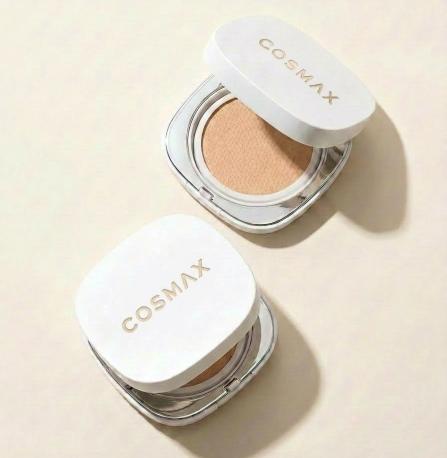
Cosmax's efficacy base make - up products
The paths are different, but the goals are highly consistent - to make PDRN truly reach where it should go.
As mentioned before, in this year's new products, PDRN rarely appears as a single ingredient. Lancôme incorporates it into the formulation framework of Pro - Xylane. Proya makes it work in synergy with bicyclic peptides and 3D collagen. Fuerjia puts it on the same technical platform as nanosphere collagen.
Taking Lancôme as an example, the L'Oréal Group explained the logic behind it: "The smearable PDRN, Pro - Xylane, and the Everlasting Rose Extract form a 'long - life active trio', targeting three dimensions of cell energy, signals, and structure respectively, and systematically intervening in multiple aging targets in the scientific framework of skin longevity."
L'Oréal Paris has also laid out 2 patents around the golden combination ratio of active ingredients, elevating the ingredient combination of PDRN from the empirical level to the patent level.
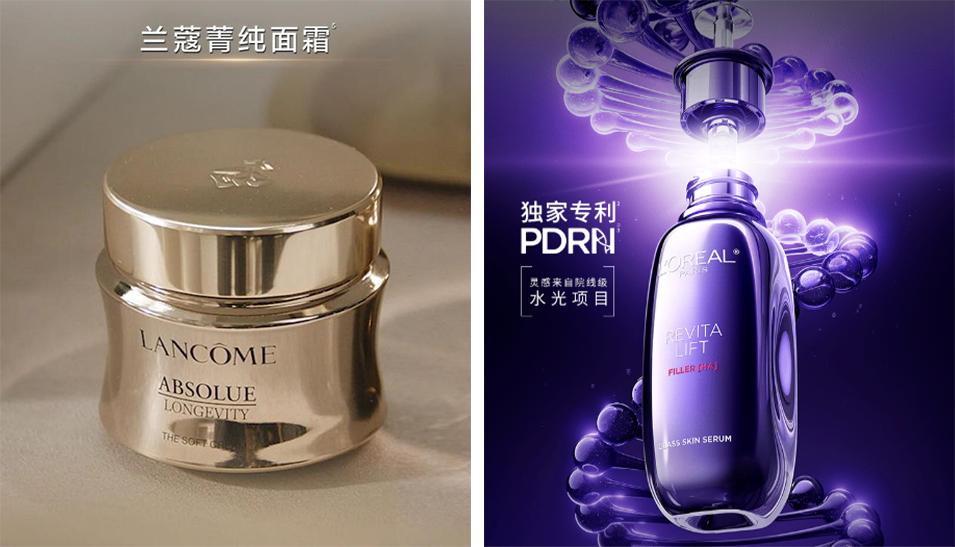
Lancôme Absolue Cream, L'Oréal Paris Super Hydro - filling Essence
The practice of brands integrating PDRN into their existing ace product lines is an embodiment of "rational integration" - PDRN is not a popular label forcibly stuffed into products, but an efficacy - enhancing variable connected to the existing formulation system.
Xia Haifeng also confirmed this trend. He revealed: "The demand of downstream brand customers has shifted from 'buying raw materials' to 'co - creating raw materials'. They are more concerned about what value it can bring to the construction of the brand's future core ingredient barrier."
From source to delivery to ingredient combination, the technological differentiation in the PDRN track is clearly visible. The gap between brands is changing from "who uses PDRN" to "who has built a complete technological system around PDRN". The L'Oréal Group summarizes this logic as the "ingredient × combination × delivery" trinity framework - ingredient selection is the starting point, ingredient combination is the amplification, and delivery technology is the implementation.
As technology advances, whether the standards and cognition can keep up is a problem that this track must face next.
The "vacuum period" and rational thinking behind the prosperity
As the technological differentiation in the PDRN track becomes clearer, another problem emerges: Does the rapid advancement of technology cover up some underlying problems that the industry has not yet solved?
Firstly, there is a gap in technology verification. Undoubtedly, PDRN from different sources has different claims about efficacy, but the thickness of the evidence chain behind them is completely different.
Xia Haifeng admitted: "Salmon - extracted PDRN has a large amount of in vitro, animal, and clinical research