The phase-out of low-efficiency production capacity is entering a countdown. Five government departments have jointly issued a document, which sets clear energy efficiency red lines for nine major industries to be fully implemented by 2028. Enterprises that fail to meet the standards three years later will be shut down.
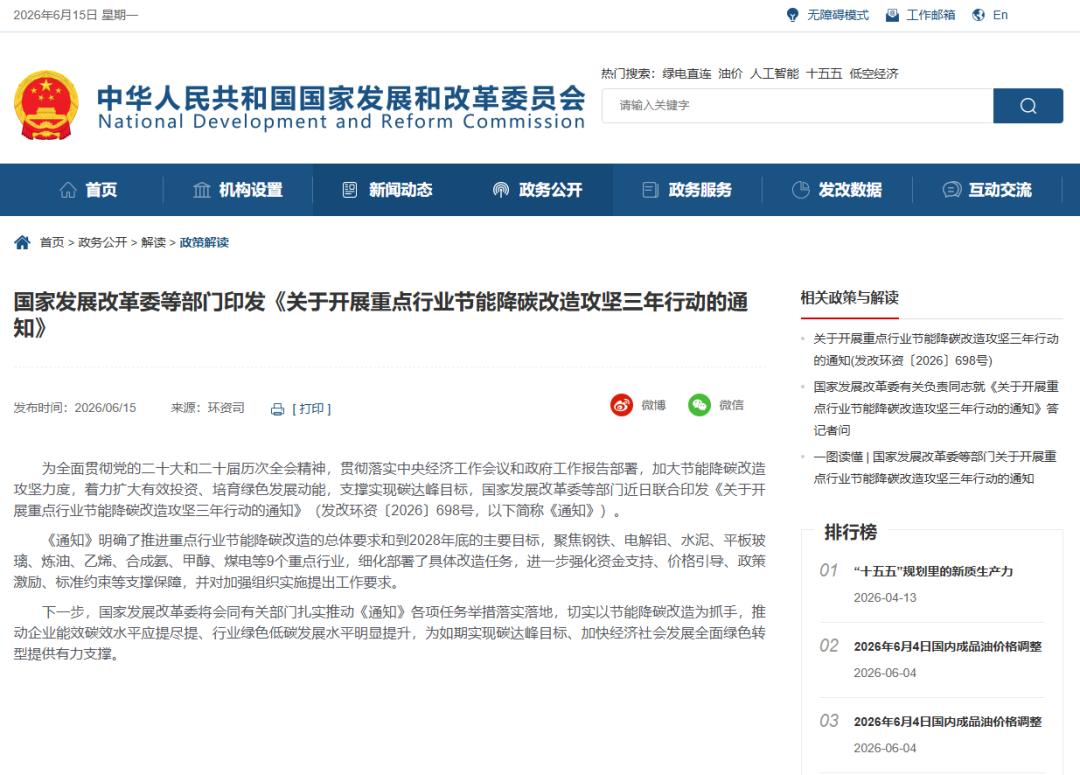
Five departments require nine industries to eliminate inefficient production capacity by the end of 2028, forcing the industry to transform.
Yujian Energy learned that on June 15, 2026, five departments including the National Development and Reform Commission jointly issued a document stating that for nine industries including steel, electrolytic aluminum, cement, flat glass, oil refining, ethylene, synthetic ammonia, methanol, and coal-fired power, the production capacity below the energy efficiency benchmark level must be basically eliminated by the end of 2028. Projects that fail to complete the transformation on schedule or still do not meet the requirements after transformation shall be phased out and shut down as required.
Yujian Energy believes that the joint document issued by the five ministries and commissions has set a unified red line for the nine industries, which is not common in the previous policies that were promoted by industry and in batches. The requirement of reducing coal consumption by 5 grams for coal-fired power transformation, the permission to increase the price by up to 0.1 yuan per kilowatt-hour, and the non-negotiable elimination clause, when combined, require the nine major industries to recalculate their accounts.
Reducing coal consumption by 5 grams for coal-fired power seems insignificant, but it's extremely challenging in practice
The notice issued on June 15 set a hard target for the coal-fired power industry: "After transformation, the power supply coal consumption of the unit should be reduced by more than 5 grams of standard coal per kilowatt-hour." With 5 grams of coal, based on the national coal-fired power generation of about 5 trillion kilowatt-hours in 2025, the entire industry can save 25 million tons of standard coal in a year. However, when allocated to each power plant, it becomes an investment that needs to be carefully considered.
The real dilemmas of thermal power plants are not reflected in the document.
The power industry accounts for 43% of the country's total carbon emissions, and coal-fired power is the main battlefield for carbon reduction. However, the faster the new energy installation, the lower the load rate of coal-fired power. For every 10 percentage points decrease in the load, the power supply coal consumption may increase by 3 to 5 grams. Technically speaking, it requires "fast adjustment, deep adjustment, and wide load", that is, the unit should operate efficiently even at low loads. This requires a series of technologies such as flow passage transformation, cold end optimization, and waste heat utilization. The transformation cost of a single 300,000-kilowatt unit can easily reach tens of millions of yuan.
The notice also requires the transformation of "existing coal-fired power units above 300,000 kilowatts" and encourages the "integrated development of coal-fired power and new energy". However, for coal-fired power enterprises to build their own photovoltaic and wind power projects, there are a series of supporting issues such as land, grid connection, peak shaving, and energy storage. After a series of measures, whether the capital chain of small and medium-sized thermal power enterprises can hold up is a real problem.
Yujian Energy believes that the policy has clearly outlined the technical route and the time limit for reaching the standards. However, if the financial support does not follow up, only state-owned central enterprises and provincial state-owned enterprises with strong capital will be able to complete the transformation in the end. Those independently operated old power plants, burdened with historical debts and environmental protection arrears, are likely to choose to shut down voluntarily before 2028.
An increase of no more than 0.1 yuan per kilowatt-hour, who will foot the bill?
The differential electricity price is the most powerful economic lever in this notice. Localities can merge and integrate the current differential electricity price, stepped electricity price, and punitive electricity price, and increase the price by no more than 0.1 yuan per kilowatt-hour on the basis of the trading electricity price. For residential users, 0.1 yuan doesn't make much of a difference, but it's a different story for industrial users.
Take the electrolytic aluminum industry as an example. One ton of aluminum consumes about 13,500 kilowatt-hours of electricity. With an increase of 0.1 yuan per kilowatt-hour, the cost per ton of aluminum directly increases by 1,350 yuan. In 2025, the average spot price of domestic electrolytic aluminum fluctuated around 19,000 yuan per ton. The cost increase of 1,350 yuan is enough to push a large number of small and medium-sized aluminum plants below the break-even point.
The Liancheng Branch of Chinalco and Lanzhou Aluminum have achieved an alternating current consumption per ton of aluminum better than the national standard benchmark level, taking the only two "pace-setter" spots for energy efficiency in the electrolytic aluminum industry. Baise Guangtou Yinhai Aluminum has reduced the electricity consumption per ton of aluminum by more than 700 kilowatt-hours through technological and process upgrades, reducing carbon dioxide emissions by nearly 80,000 tons per year, and its energy efficiency level has leaped to the first echelon of the industry. These enterprises have completed the first half of the transformation, and the differential electricity price is beneficial to them - as the backward competitors are subject to price increases, market space is freed up.
However, for those enterprises that have not completed the transformation, the differential electricity price is like a sword hanging over their heads. The increased electricity charges collected are used to "offset the system operation costs", which essentially means using the electricity charges of backward production capacity to subsidize the green transformation of the entire power system.
The design logic of this mechanism is clear: Those who hold back pay the price. However, from the perspective of industrial consequences, it accelerates industry concentration. Three years later, the number of small and medium-sized players in industries such as electrolytic aluminum, cement, and steel will probably decrease significantly.
The notice shows that central investment will provide a subsidy of 20% of the approved total investment for eligible projects, giving priority to projects whose energy efficiency reaches the benchmark level after transformation. 20% is not a small amount, but the premise is "eligible" - enterprises need to have the funds to launch the project first before they can apply for the subsidy. For enterprises with tight cash flow, this is still a chicken-and-egg problem.
The shutdown clause is written into the ministry's document. Those who are still on the fence should wake up.
"Projects that fail to complete the transformation on schedule or still do not meet the requirements after transformation should be phased out and shut down as required." In the past, the common expressions were "guide", "encourage", and "suggest", but this time the word "should" is directly used. The tone of administrative compulsory ruling leaves no room for explanation.
Which projects are the most at risk? The annex to the notice clearly states: In the steel industry, blast furnaces below 1,200 cubic meters and converters below 100 tons; in the electrolytic aluminum industry, prebaked anode aluminum electrolytic cells below 300 kA and independent aluminum carbon projects below 150,000 tons per year; in the cement industry, cement grinding stations below 600,000 tons per year. These have long been classified as "backward production capacity" in the industry and have been maintained by local protection or low-cost labor in the past. Now the window period for these production capacities is clear. They either complete the transformation by the end of 2028 or shut down.
However, the really dangerous ones are a group of enterprises that are "just on the benchmark line". Their energy efficiency barely meets the standard, but there is still a gap from the benchmark level. The notice requires "improve as much as possible" - meeting the standard is not enough, they need to continue to improve. The dilemma these enterprises face is: If they want to improve one more level, the investment will double, but the benefits are not obvious. The likely reality is that the wait-and-see sentiment will spread.
Baoshan Iron & Steel Co., Ltd. invested 3.2 billion yuan in energy conservation and low-carbon projects in 2025. All four of its major bases have completed ultra-low emission transformation, and it has built a leading distributed photovoltaic cluster in the industry, consuming more than 1.7 billion kilowatt-hours of green electricity annually and reducing carbon emissions by more than 2 million tons throughout the year. This is not just to cope with inspections, but to transform low-carbon into quantifiable assets - an increase in the proportion of green electricity, a surplus of carbon quotas, and a green premium for products.
The overall data of the steel industry shows that as of the end of 2025, more than 80% of the crude steel production capacity has completed ultra-low emission transformation, and more than 30% has reached the energy efficiency benchmark level. The production capacity above the benchmark level in the cement industry has increased by 15 percentage points compared with 2020. Those who started early have gone a long way, while those who are late are still hesitating whether to put on their shoes.
As of the end of 2025, the national carbon emission trading market had a cumulative trading volume of 865 million tons of carbon dioxide equivalent, and the carbon price remained at around 62 yuan per ton. The steel, cement, and aluminum smelting industries were included in the carbon market in 2025. The notice further clarifies that quotas will be allocated according to the principle of "encouraging the advanced and spurring the backward", and enterprises with a carbon emission intensity better than the benchmark value will obtain reasonable quota benefits. This means that high-efficiency enterprises will not only avoid penalties in terms of electricity price but also make extra money in the carbon market. The gap between the two will widen significantly after three years.
The end of 2028 is the deadline. This is not a suggestion but an administrative decision written in the joint document of the five departments.
From the release of the document in June 2026 to the acceptance at the end of 2028, there are 30 months at most. 30 months are enough for an enterprise to complete a round of in-depth energy-saving transformation, and also enough for an enterprise to be completely out of the game due to hesitation.
Enterprises above the energy efficiency benchmark level are already enjoying the first-mover advantages: They can get central investment subsidies first, avoid penalties from the differential electricity price, and sell their carbon quotas for money. For enterprises below the energy efficiency benchmark level, there are only two options - transform or shut down. There is no third way.
This article is from the WeChat official account "Yujian Energy". Author: Zhao Jianan. Republished by 36Kr with permission.