SpaceX goes public: What matters more than the bubble controversy is the birth of the fourth-generation business model
On June 12, 2026, SpaceX officially listed on the NASDAQ. On the first day of listing, its stock price closed up 19%, and its market value was fixed at $2.1 trillion. It became the sixth - largest listed company in the United States, falling within the Wall Street's expected range of $1.7 - 2.5 trillion. There were no surprises on the first day of listing.
This largest - scale IPO in human history raised a total of $75 billion, almost equivalent to half of the total funds raised by U.S. stock IPOs in the whole year of 2025. Since the company's revenue in 2025 was less than $19 billion and the net loss was about $4.9 billion, the corresponding PS valuation exceeded 100 times.
This is equivalent to the market pricing a trillion - level giant with the logic of first - level venture capital. So, as expected, the controversy arrived: some people said it was a milestone in human civilization, while others said it was the biggest bubble blown by Elon Musk.
But rather than focusing on the short - term stock price and Elon Musk's wealth ranking, we want to talk about an essence that most people have ignored: the real value of SpaceX is far more than just a space company. It is personally verifying the fourth - generation enterprise model in human business history: the systematic company.
The story of the IPO is simple: from a rocket company to a space infrastructure platform
SpaceX has three layers of business: space launch (Launch), satellite connection (Starlink), and AI. Among them, the launch business provides entry capabilities and is continuously evolving. Starlink builds a continuous operating cash flow and is growing steadily. AI bears the long - term narrative of high - valuation premiums.
Among them, Starlink is the only profitable segment, while the launch and xAI are still in the stage of heavy investment.
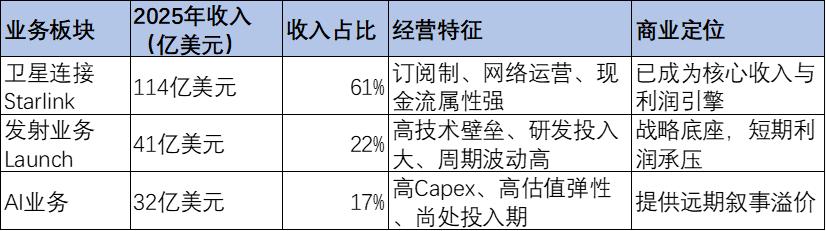
Figure: Business breakdown of SpaceX. Source: Summary by Jinduan Research Institute
1. Rockets monopolize the global launch market, and the Starship is the decisive factor
Rockets are the foundation of SpaceX, covering Falcon, Dragon, and Starship. Among them, the Falcon 9 is currently the absolute mainstay of SpaceX. As the world's first orbital - class reusable launch vehicle, with the technology of full recovery of the first stage and most recovery of the fairing, it has reduced the marginal cost of a single launch to about $15 million, leading by a large margin.
In 2025, SpaceX completed 170 launches, accounting for 87% of the total U.S. launches and 83% of the global orbital payload. The single - launch payload capacity is about 4.4 times the average of other institutions.
However, even though it has monopolized the global launch market, the annual launch - related revenue is only a little over $4 billion. The market ceiling of space launch itself is not high. Even if the future demand expands 10 times, it cannot support the ambition of Mars colonization.
The Starship is the real breakthrough point. Since its first launch in 2023, SpaceX has so far cumulatively invested $15 billion in the Starship project.
Its value lies not only in greater payload capacity but also in transforming space launch from "customized service" to "scaled - up payload capacity": the unit payload cost of the Falcon 9 is about $830 - 880 per kilogram, and the target of the Starship is to reduce it to $100 - 200 per kilogram, a decrease of more than 80%. In the long term, it aims to achieve one launch per hour and 10,000 launches per year, increasing the annual orbital capacity to the million - ton level.
The next - generation Starlink satellites, space computing power, lunar missions, and even Mars missions, all long - term stories, depend on the commercial progress of the Starship.
2. Starlink is a high - growth cash - cow business
The launch service is a discrete project - based business with a relatively low ceiling. To achieve the long - term dream, Elon Musk chose to reuse the low - cost orbital entry capability internally. The first large - scale business to succeed was Starlink.
In the past few years, the evolution logic of Starlink has been very clear, and its proportion in SpaceX's revenue has been continuously increasing: in 2021, it accounted for only 10%; in 2023, it exceeded 50%; in 2025, it even reached 77%. More importantly, it has achieved profitability: in 2025, its revenue was $11.4 billion, the net profit was $4.4 billion, the gross profit margin was close to 60%, the operating profit margin was about 35%, and the net profit margin exceeded 10%.
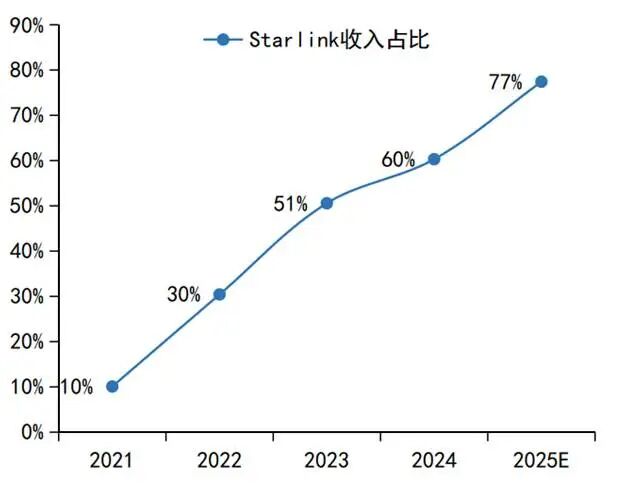
Figure: Proportion of Starlink in SpaceX's revenue. Source: Guosen Securities
The significant commercial significance of Starlink is that it has transformed SpaceX from a project - based company that "launches single rockets" into a communication operator with continuous subscription revenue and the ability to expand through compound interest.
Currently, it has nearly 10,000 low - Earth - orbit satellites, with a downstream rate of over 200Mbps, and its performance has exceeded the average level of terrestrial fixed and mobile broadband. As of the end of the first quarter of 2026, the number of users has exceeded 10.3 million, doubling compared with the beginning of the year.
Its future growth is also relatively certain. In the second half of 2026, V3 satellites will be deployed via the Starship. The downstream capacity will be 10 times that of V2, the upstream capacity will be 20 times that of V2, and the cost will be 90% lower than that of V1. We know that the company's long - term plan is to expand the satellite scale to 15,000 by 2031 and finally build a global satellite Internet constellation of 42,000 satellites.
In the future, with the further improvement and encryption of satellite performance, Starlink will completely transform into a mainstream operator. It is estimated that the potential market space of Starlink exceeds $300 billion: residential broadband can cover 200 million households, corresponding to a market space of $200 billion; direct satellite - to - mobile connection is about $60 billion; scenarios such as aviation, marine, and enterprise will contribute an additional tens of billions of incremental revenue.
3. Long - term integration of AI: the ultimate imagination for the listing valuation
AI is the most controversial and has the greatest imagination space in SpaceX's valuation. In the IPO prospectus, the estimated target market is $28.5 trillion, and in fact, most of it comes from AI.
Actually, in February 2026, SpaceX completed a share - swap merger with xAI at a consideration of $250 billion: Colossus provides training and inference computing power, Grok focuses on large - scale models, and the X platform provides internal data. Many people think this is to tell a good IPO story and package SpaceX into an integrated aerospace - communication - AI platform.
At the same time, the data in 2025 was quite dismal. The AI revenue was only $3.2 billion, with a large - scale loss of over $6 billion, and the capital expenditure was as high as $12.7 billion. Although the short - term growth in the next three years will rely on the rapid growth of computing power leasing, just the long - term computing power agreements signed with Anthropic and Google can bring stable annual revenue of $25 billion. However, this business model is not very valuable.
The real story is to move AI from the ground to space.
Elon Musk proposed that Starlink satellites are not only communication nodes but also computing nodes. Relying on the high - speed laser links of V3 satellites, a grid - like distributed computing power can be built in orbit. Each AI satellite is equipped with a computing power chip, powered by solar energy and cooled by space radiation, completely getting rid of the constraints of terrestrial power, land, and cooling.
SpaceX has planned a constellation of millions of AI computing power satellites, which will be deployed as early as 2028. After the entire constellation is completed, the total power consumption of the AI computing power launched into space annually can reach 100GW, which is equivalent to the total scale of global terrestrial data center construction in 2027.
In its vision, solar energy in space is inexhaustible, and the cost of radiation cooling is much lower than that on the ground. The comprehensive cost can be an order of magnitude lower than that of terrestrial data centers. It is the only scalable path for AI computing power to evolve to the TW level. According to the prediction of Starcloud, a space data center startup, the space energy cost (including launch fees) will be 10 times cheaper than the terrestrial solution.
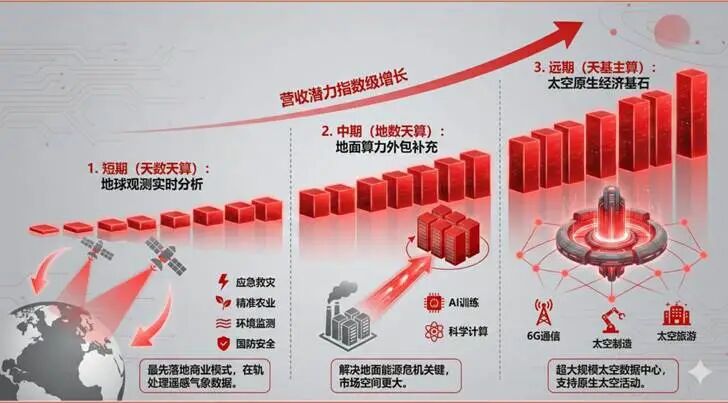
Figure: Outlook on the potential of space AI computing power. Source: SpaceX roadshow materials, China Merchants Securities
The controversy stems from this: the industry competitiveness of the Grok model still needs to be verified. The loss of core talents and high capital expenditure are real problems. The market expects SpaceX's total capital expenditure in 2026 to be $60 billion, of which $50 billion will be invested in AI.
At the same time, there are also reverse skeptical clues in the market, such as "space computing power is currently uneconomical". After all, many of Elon Musk's claims have not been realized. However, it cannot be denied that it is the AI narrative that has completely enabled SpaceX to break out of the valuation framework of traditional aerospace companies.
Looking at SpaceX from the perspective of the business model: the fourth - generation business model
Putting aside the technical details and valuation disputes, from the perspective of business history, the most special thing about SpaceX is that it is practicing a brand - new enterprise organizational form - the fourth - generation business model: the systematic company.
The iteration of business civilization is essentially the evolution of the way enterprises integrate resources and solve problems. In our framework, there have been three generations of mainstream business models so far.
1. The first generation is vertical integration.
Vertical integration means that an enterprise operates in multiple core links, from upstream raw material procurement, production and manufacturing, product distribution to terminal sales. It completes a complete value chain internally and forms an internal supply - demand relationship.
The advantage is that it can build a cost moat. By "locking raw materials upstream + controlling channels/terminals downstream", it can reduce dependence on external partners and avoid the risks of industrial chain fluctuations. This model is particularly effective in the early stage of an industry when the supply chain is not mature.
The disadvantage is that the management complexity increases non - linearly, the enterprise's flexibility is limited, and covering multiple business links may lead to a decrease in professionalization and innovation efficiency, making it difficult to adapt to market changes quickly. At the same time, when the capacity utilization rate is low, it is easy to cause asset idling, resource waste, and amplified fluctuations in gross profit margin.
Typical examples include Ford Motor's full - chain control from rubber plantations, steel mills to automobile assembly plants; BYD's vertical integration from three - electric systems to the whole vehicle; and Muyuan's closed - loop of the entire industrial chain from feed, breeding, farming to slaughter.
2. The second generation is the group - type model.
The group - type business model refers to a multi - business combination across different fields. Through capital allocation, organizational structure, and platform - building capabilities, different business units can achieve stable compound interest within the same governance system.
The advantage is that "when one area doesn't perform well, another may", and different business cycles can hedge against each other. At the same time, resources such as brand, channels, and management can be shared. However, the disadvantages are also obvious. It is prone to the "big - company disease", with resources being scattered and insufficient focus on core businesses. Therefore, many group companies are now starting a wave of spin - off listings, such as GE and ThyssenKrupp.
Typical paradigms include Siemens' "software + hardware + industrial software + service" platform, GE's "equipment installation - long - term service" high - barrier equipment chain, and the Japanese general trading company's "investment + trade + integration of industry and finance" global resource integration. Other representative companies include Xiaomi, Honeywell, Tencent, Midea, PepsiCo, LVMH, etc.
3. The third - generation business model is industrial chain division of labor.
Enterprises collaborate and perform their respective duties in different links of the value chain. They only need to focus on what they are best at. This is the mainstream model under the globalization wave in the past three decades because the advantages are obvious. It can significantly improve efficiency and quality while reducing costs. Division of labor is even regarded as the ultimate form of the business model.
For example, the most successful Apple has an extremely well - divided industrial chain in its supply system: design is in the United States, chips are produced by TSMC, assembly is done by Foxconn, and components come from all over the world. Other typical cases include the semiconductor division of labor, Uniqlo focusing on brand and retail, and Zhongji Innolight focusing on optical module assembly.
However, the disadvantages are selectively ignored. The finer the division of labor, the higher the transaction costs. The information silos and poor coordination across organizations are particularly magnified during shocks. Under the recent trend of anti - globalization, international supply chains are more likely to experience disruptions, and external dependence on key technologies/raw materials may also form a "bottleneck".
Especially when an industry enters the uncharted territory of hard technology, such as general AI, controllable nuclear fusion, and space colonization, there are no mature solutions in the industrial chain and no ready - made suppliers, so the division - of - labor model will fail collectively.
For example, the recent slow development of AI is due to the failure of the division - of - labor model: the most lacking in optical modules is the production capacity of optical chips, and at the same time, the industrial chain's willingness to invest in the new CPO technology direction is limited, so NVIDIA has to get involved itself. In the case of PCB, the production capacity of HDI and other products is insufficient, and the upstream electronic cloth and copper foil are also in short supply. Even if there is no shortage of semiconductors, optical modules, and PCBs, electricity is in short supply.
4. The fourth - generation business model emerges as the times require
To solve these problems, we have observed that the fourth - generation business model - the systematic model - has emerged. Its solution is to actively take on more responsibilities, start from the ultimate goal, work backwards, and solve all the bottlenecks in the entire chain one by one.
Apple, CATL, TSMC, Tesla, Amazon, and Google have shown some signs of this model. Google is the most typical, with a closed - loop from chips, communication technologies, cloud, data, models, to applications. But the real complete form should be SpaceX.
Reconstructing SpaceX from a systematic perspective
When SpaceX was founded, its positioning was to make humanity a "multi - planetary species". Since no one had solved these problems before, Elon Musk had to solve them one by one based on the first - principles.
What was the state of the entire aerospace industrial chain when Elon Musk founded SpaceX in 2002?
• Rocket engines: There were no mature commercial suppliers.
• Reusable technology: The entire industry thought it was impossible.
• Low - cost satellites: The industrial chain simply did not exist.
• Satellite Internet: The spectrum, technology, and