Practical Handbook for Enterprise AI Implementation: The 4-3-6 Principle
Over the past year or so, Lao Yang has been talking about digitalization and then AI. He uses his personal project experience to tell everyone how to avoid pitfalls. In the past, discussions about the implementation of AI in enterprises were relatively fragmented and lacked a systematic approach. In the coming period, Lao Yang will systematically share a practical guide on the entire process from awareness to implementation of enterprise AI.
Lao Yang writes about AI on his official account not to prove how advanced AI is for the so - called traffic, but to help enterprises transform AI into a management ability that can be implemented, operated, reviewed, and continuously create value. Lao Yang believes that what enterprises really need at present is not more tool introductions, but a complete set of methods from cognition to organization, from projects to operations, and from cost to governance.
The problem with most enterprises in promoting the implementation of AI projects currently is that they have purchased office AI, customer - service AI, and knowledge - base products, and have also let employees participate in several training sessions. However, there is no unified entrance, no business owner, no knowledge owner, no evaluation set, and no operation dashboard. As a result, these tools end up being used in a fragmented way. Therefore, the difficulty in enterprise AI construction is not "whether to have it" but "whether it can enter the business process and be used continuously."
Previously, when enterprises carried out digitalization, they were used to buying software, building systems, and doing integrations. Although AI projects seem to be system projects, they are essentially different. Traditional digital systems mostly solidify deterministic processes, while AI systems assist in judgment, generate content, call knowledge, and execute tasks in uncertain scenarios. Therefore, the implementation of AI cannot rely solely on purchasing software or having the technical team develop models in isolation.
So the main line of enterprise AI construction should be: Focus on business value, build a data and knowledge base, select appropriate models and platforms, embed AI capabilities into positions and processes, and then continuously improve through operation, governance, and review. So an AI project does not end when it goes live; it just begins.
If we summarize the implementation of enterprise AI with a formula:
Enterprise AI implementation = Strategic guidance × AI leadership × Scenario breakthrough × Data and knowledge × Technical platform × Organizational culture × Security governance × Operational value. If any of the multipliers in the formula is zero, the final effect will be greatly reduced, and the project may even fail.
It is not difficult to see that the implementation of AI projects in enterprises is a complex project. So where should we start? Lao Yang believes that enterprises should have a correct understanding. Today, we will mainly talk about relevant content in terms of cognition.
Four basic judgments for enterprise AI construction
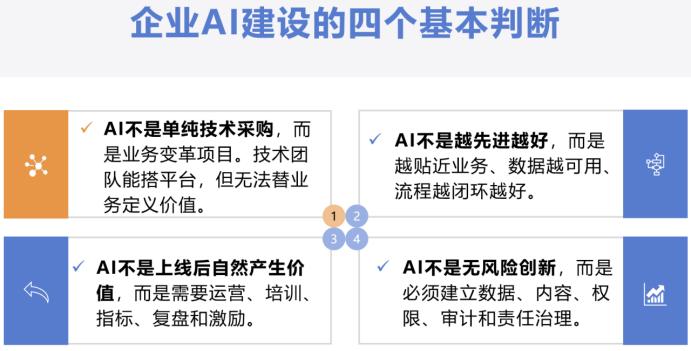
These four judgments are not just ideological slogans but management prerequisites that enterprises must unify before implementing AI. If these four judgments are not understood by the senior management, business, and information departments together, there will be directional deviations in subsequent project establishment, procurement, implementation, and operation. These are also the four common mistakes that most enterprises make in AI construction. For example, for most enterprise leaders, they think that implementing an AI project is simply a technical procurement. They believe that as long as they purchase an advanced model, they can achieve AI intelligence. It should be noted that when an enterprise buys a model or platform, it only obtains an entry to a certain ability. What really determines success or failure is whether the business provides real scenarios, real samples, and real acceptance criteria. Take an AI contract review project as an example. If the legal department does not provide historical contracts, risk rules, and judgment criteria, no matter how hard the information department tries, it can only deliver a tool that "seems to be able to answer questions."
It is recommended that enterprises put these four judgments on the first page of the AI project kick - off meeting. Every time a new project is launched, let the business owner, IT, security, and suppliers jointly confirm: What is the business value of this project? Why choose this technology? Who will operate it after going live? Where are the risk boundaries?
"Three don'ts" and "Three must - dos" for enterprise AI construction
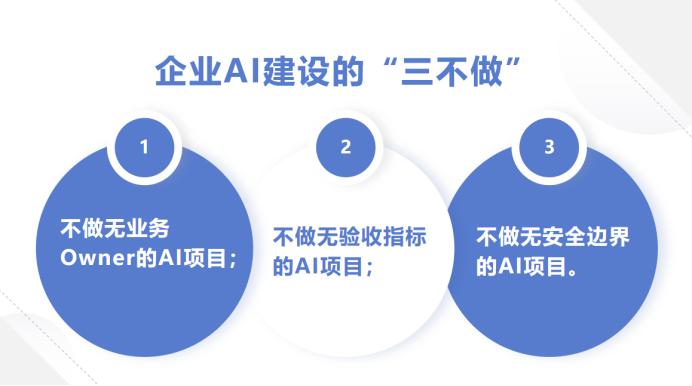
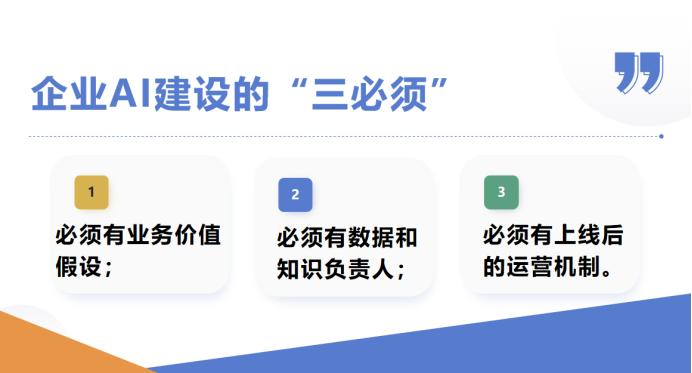
The role of the "Three don'ts" and "Three must - dos" is not to add processes but to prevent AI projects from starting with problems. It is recommended to be used as a hard threshold for enterprise AI project establishment. For example, if the business does not participate in the AI project construction, then don't do it. Why? For most traditional enterprises, the value of an AI project can only be confirmed by the business. Without a business owner, the project will ultimately become an attempt by the information department or the supplier to prove its value. Then a simple statement from the business like "it doesn't meet the actual work" or "it's not useful" will nullify all previous efforts and make the previous investment a waste. This is also a common problem for most traditional enterprises.
Six underlying logics for enterprise AI construction
In addition to the "Four basic judgments" and the "Three don'ts and Three must - dos," enterprises also need to master a more fundamental judgment framework. It helps managers not to be misled by trendy terms when facing various AI tools, suppliers, and scenarios, but to always clearly return to business value and organizational capabilities.
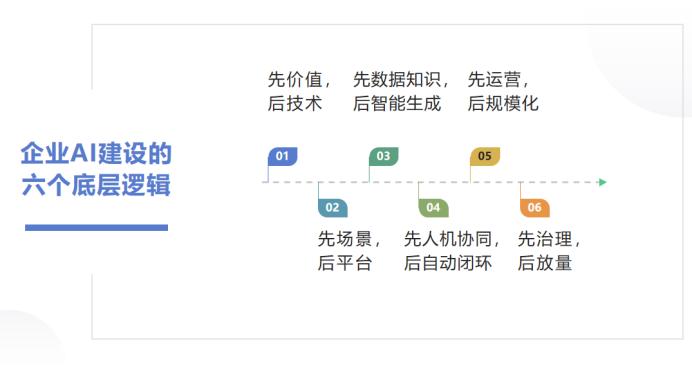
From the above, it is not difficult to see that value determines the direction, scenarios determine the entry point, data and knowledge determine the quality, human - machine collaboration determines the responsibility, operation determines the sustainability, and governance determines the scale.
Often, if an enterprise builds a platform first and then looks for scenarios, it will often fall into the situation of "having a platform but no one using it." If it looks for scenarios first but lacks knowledge governance, it will fall into the situation of "a good - looking pilot but a non - useful launch." If there is no operation after the launch, it will fall into the situation of "being lively in the first month and quiet in the third month." These six logics actually correspond to six key risks in the entire life cycle of an AI project and can be used as the "master switch" for enterprise AI projects. If any project violates two or three of these logics, it should suspend expansion and recalibrate at the levels of scenario, value, data, or governance.
Finally, let's summarize the three most common pitfalls that enterprises are likely to encounter in the process of AI project construction:

So, it is not difficult to see that the initial understanding of AI projects is very important. Understanding determines the direction. However, many enterprises start off on the wrong foot and don't know how to review and correct their mistakes. They keep going further on the wrong path. Eventually, they invest money, but the AI project only becomes an idealized vision.
So, how is your enterprise's understanding of AI? Welcome to leave a comment in the comment section.
This article is from the WeChat official account "Xiangjiang Digital Review" (ID: benpaoshuzi). The author is Lao Yang. It is published by 36Kr with authorization.