Medical founders have started lining up to sell their companies to state-owned capital
In early June 2026, an announcement caused a stir in the medical venture capital circle.
The Sinopharm Science and Technology Innovation Research Institute, under Sinopharm Group, plans to acquire 20% of the shares of ADICON Medical Systems Co., Ltd. for approximately 1.654 billion yuan. After the transaction is completed, this central enterprise will become the actual controller of ADICON.
As soon as the news came out, the first reaction of people in the circle was: "Why?"
It should be noted that in 2025, ADICON had a revenue of 1.198 billion yuan, a year-on-year increase of 8.01%; the net profit was 361 million yuan, a sharp increase of 41.74%. What's even more eye-catching is that the company has 1.432 billion yuan in cash on its books, almost enough to buy itself.
Why did a leading company in the industry, which is short of neither money nor profit and is at the peak of its performance, suddenly "sell itself"?
The answer lies in a broader picture: In the first half of 2026, in less than six months, nine domestic medical companies have announced the transfer of their controlling stakes. Among them, CRO companies account for as high as 50%, and IVD companies account for 40%.
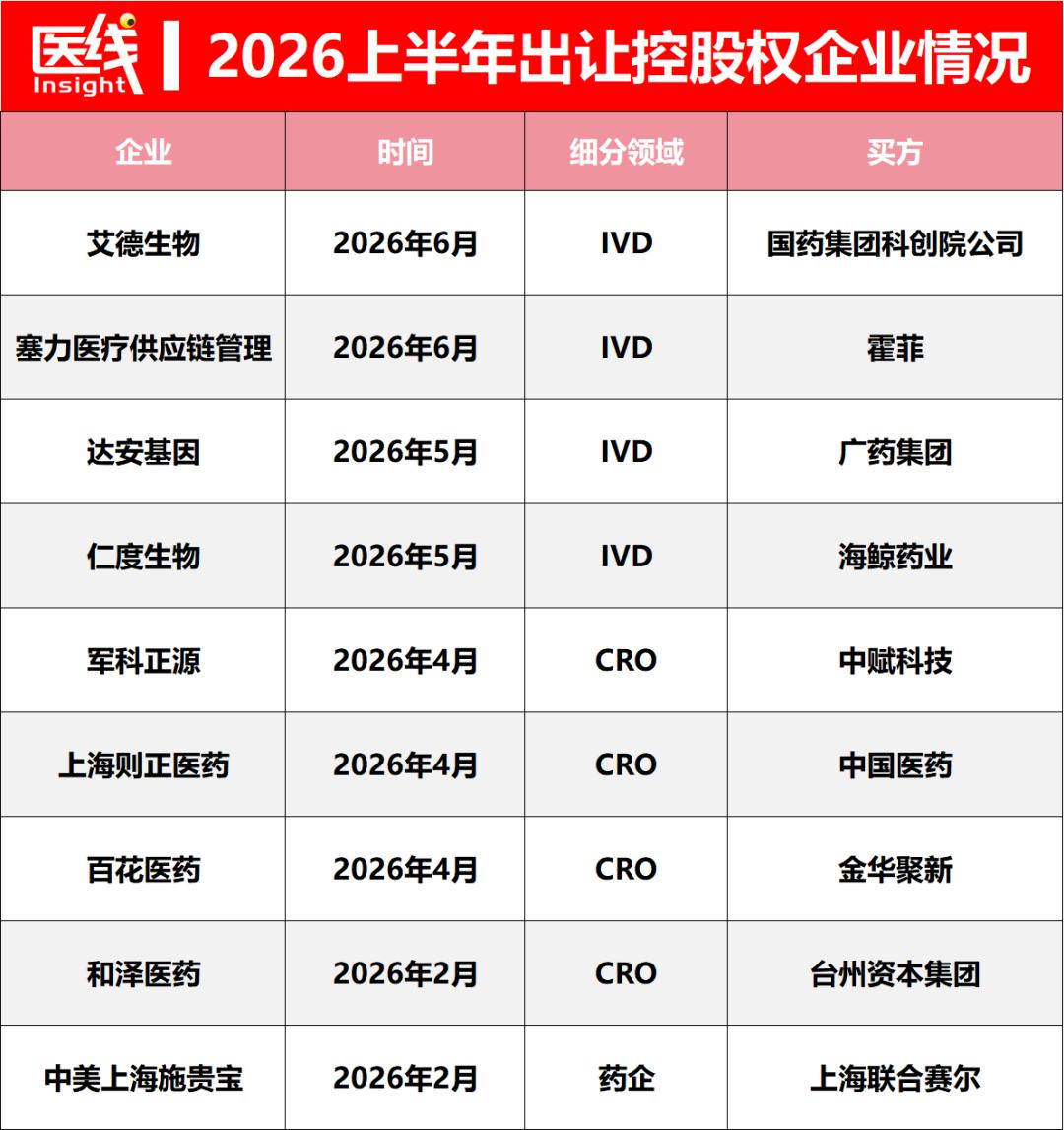
Data source: Public information on the Internet
It can be seen that many companies are shifting from local capital maneuvers to a systematic industrial clearance. After all, when a giant like WuXi AppTec has laid off more than 5,000 employees in a year, the underlying logic of China's medical venture capital has been rewritten.
In this process, those founders who once regarded "independent IPO" as the ultimate goal are starting to line up to hand over their control rights, allowing central enterprises and local state-owned assets with funds, channels, and compliance resources to take over the game.
Reconstruction of Buyers: The "National Team" Enters the Game
On the M&A table of China's medical and health industry, the portrait of buyers is undergoing a fundamental change.
In the past decade, the active players on this table were US dollar PE firms with a lot of capital and multinational pharmaceutical companies. However, in this wave of "change of ownership" in the first half of 2026, the seats of buyers are now filled with central enterprises and local state-owned assets.
Sinopharm Group's plan to take control of ADICON is just the beginning. On June 9, 2026, Jinhua Juxin completed the transfer of 20.68% of the shares of Baihua Pharmaceutical for 890 million yuan, and the State-owned Assets Supervision and Administration Commission of Jinhua City became the new actual controller; in April 2026, China National Medicines Corporation completed the acquisition of 70% of the equity of Shanghai Zezheng Pharmaceutical for 525 million yuan; after Heze Pharmaceutical introduced Taizhou state-owned assets and Taikun Fund, Taizhou capital became its controlling shareholder.
In the seemingly unrelated fields of CRO and IVD, the operators behind the equity transfers are surprisingly similar.
Why are state-owned assets "buying at the bottom" so intensively and aggressively at this time?
First, after a three-year capital winter and valuation adjustment, the bubbles in the medical track have been squeezed out.
With the inverted valuation between the primary and secondary markets, state-owned capital with patience has ushered in a historical window period to acquire high-quality pharmaceutical production capacity in batches at a reasonable and cost-effective price.
Second, it is the evolution of "Investment Promotion 2.0" by local state-owned assets.
By analyzing the operating methods of Jinhua Juxin and Taizhou capital, it is not difficult to find that the investment promotion logic of local governments has been upgraded from the past "providing land, policies, and building industrial parks" to "directly buying the controlling stake."
Behind this is a relatively clear industrial jigsaw puzzle and the demand for "strengthening and supplementing the industrial chain." For local state-owned assets, the significance of such transactions is not just financial investment. More importantly, by controlling the listed platform, they can complement the regional pharmaceutical R & D service capabilities and promote the integration of the local biomedical industry chain in R & D, production, and capital platforms. Taizhou state-owned assets' control of Heze Pharmaceutical can also be understood as complementing the R & D service link around the local pharmaceutical industry cluster.
Finally, the way state-owned assets enter the market is accelerating towards "fundization."
Take Nanjing Pharmaceutical, a leading state-owned pharmaceutical distribution company, as an example. Facing the dilemma of thin gross profit and weak bargaining power in its main distribution business, it recently established a special M&A fund of 750 million yuan in cooperation with related parties, aiming to cross - cut into the high - profit medical device industry such as regenerative materials and bone repair by acquiring Daqing Biology and Kejian Technology.
Through the capital link and fund - based operation, state-owned assets not only inject the high - quality production capacity and tax sources of listed companies into the local real economy but also connect the upstream and downstream nodes of the regional industrial chain. This is a much smarter move than simply providing subsidies.
When the "national team" enters the market with the will of industrial integration, China's medical capital game has officially entered the M&A era from the wild - growth VC/PE era.
The Dilemma of Sellers: Cutting off the Arm, Changing the Course, and Compromising
Although they are all transferring their controlling stakes, there is a lot of helplessness in the world of sellers.
In this wave of change, we have seen three different micro - samples.
Sample 1: The "Arm - Cutter" Dragged Down by Abnormal Sales Expenses.
Represented by Rendu Medical and Seli Medical, their "selling" is to save themselves.
By looking through Rendu Medical's financial reports, it can be found that from 2022 to 2025, the company's revenue plummeted from 304 million yuan to 162 million yuan, a drop of 47% from the peak; the net profit has been in the red for three consecutive years, and the loss in 2025 was 11.7089 million yuan.
The decline in revenue and profit stems from the traditional business model that relies too much on marketing. In today's situation where product profits are being squeezed thinner and thinner by medical insurance negotiations and centralized procurement price cuts, Rendu Medical's sales expense ratio is still very high: 55.32% in 2023, 50.67% in 2024, and 47.97% in 2025.
Roughly estimated, about half of the annual expenses are spent on sales and promotion. In contrast, its R & D investment accounts for only about 20%.
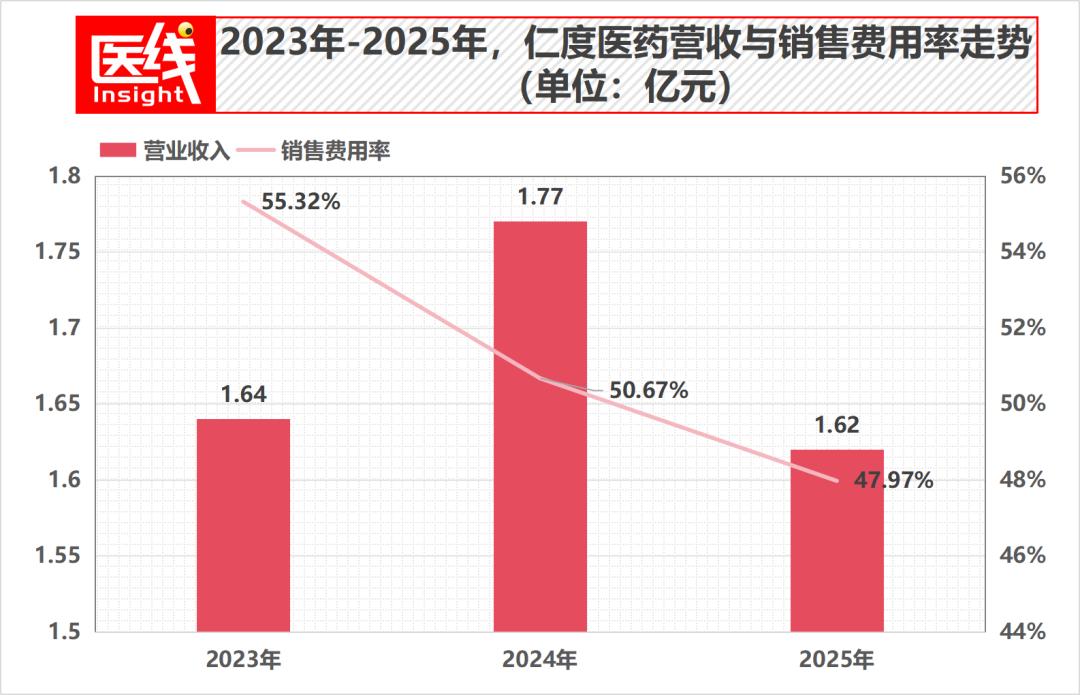
Data source: Rendu Medical's financial report
The extensive "emphasis on marketing and neglect of innovation" has led to continuous blood loss for the enterprise. In the first quarter of 2026, the operating cash flow was negative, at - 10.1263 million yuan.
Under this pressure, the founder and relevant shareholders transferred 21.25% of the shares to Haijing Pharmaceutical for approximately 516 million yuan. After the transaction is completed, Haijing Pharmaceutical will become the controlling shareholder.
Seli Medical is also under the same pressure. In the first quarter of 2026, its revenue plummeted by 36.75%, and the net profit was a loss of 17.7 million. Eventually, it had to sell 50% of the equity of its core subsidiary to raise funds and optimize its asset structure.
Sample 2: The "Active Course - Changer" Who Introduces a Central - Enterprise Controlling Shareholder During the Stable Performance Period.
ADICON at the beginning of the article is more suitable to be classified into this category.
Why does a company that is short of neither money nor profit still want to introduce a state - owned controlling shareholder? The reason is that in the context of the accelerated integration of the IVD industry and the increasing importance of in - hospital channels and compliance capabilities, ADICON chose to introduce central - enterprise resources through the change of control rights to enhance its future operational resilience and industrial synergy capabilities.
Macroscopically, the IVD industry is in the "window period" of M&A integration: in the international market, Abbott spent 21 billion US dollars in cash to acquire Exact Sciences; QIAGEN was also reported by foreign media to be evaluating strategic options including potential sale. The giants are accelerating the "big fish eating small fish" process.
Microscopically, the founder is well aware that the domestic growth ceiling of a single IVD enterprise has been reached. Taking advantage of the peak performance and a solid balance sheet, the founder handed over the control rights to China National Pharmaceutical Group at a premium of 1.654 billion yuan. What was exchanged was not only a decent exit for the founder but also a ticket for ADICON to the next decade with the in - hospital channels and strong compliance moat of the "national team."
Sample 3: The "Compromiser" Facing a Narrowed IPO Channel and a Significantly Discounted Valuation.
In addition to struggling for survival and cashing out at a high position, more small and medium - sized enterprises are facing the helplessness of having their independent capital exit route blocked. With the normalization of tightened A - share IPOs and the low attention of the Hong Kong stock market to service - type enterprises, the independent listing routes of a large number of medical enterprises have been cut off.
Take Pengli Biology, a pre - clinical CRO enterprise, as an example. It failed to go public on the Science and Technology Innovation Board in 2023 and finally chose to "sell itself" to Opal Biomedical for 1.451 billion yuan at the beginning of this year.
This transaction price was significantly discounted by about 55% compared with its valuation of over 3.2 billion yuan in the last round.
When the bubble of the "high - valuation era" has completely burst, accepting the reality of the rational return of valuation and actively looking for industrial buyers at a reasonable discount has become the most rational compromise and exit route for these enterprises blocked outside the IPO door.
Question: Why Are CRO and IVD the Main Players?
Looking at the overall situation beyond individual cases, a key question emerges: Why are CRO and IVD the absolute main players in this wave?
Because these two tracks were the main beneficiaries during the rapid development of China's medical industry in the past decade and are also the two hardest - hit areas after the tide has ebbed.
First, let's look at the CRO track.
Among the enterprises that transferred their equity in the first half of 2026, CRO companies accounted for as high as 50%. The small and medium - sized outsourcing enterprises that have persisted in this track for several years have "reached the end."
To understand the trend, we should first look at the giants. WuXi AppTec's annual report for 2025 shows that as of the end of 2025, it employed 33,834 employees, a significant reduction of 5,580 employees compared with 39,414 in the same period in 2024; Jiuzhou Pharmaceutical also laid off 210 employees.
The past prosperity of China's CXO industry was essentially due to two waves of dividends: the "hot - money effect" brought about by the fanaticism of innovative drugs for VC at the front end and the "engineer dividend" of China's cheap and high - quality labor at the bottom.
Now, the financing in the primary market has tightened, and the new drug R & D pipelines have shrunk significantly. However, behind the appearance of "no orders to take" and price wars, small and medium - sized CROs are facing a cruel reconstruction of the underlying competition logic.
One is the dimensionality - reduction strike in the era of "full - chain supremacy." Leading enterprises such as Opal Biomedical and Baijun Biology are completing the R & D and production closed - loop through M&A. Downstream pharmaceutical companies also prefer one - stop delivery to reduce the communication cost across links. The orders of small and medium - sized CROs that can only provide single - link services are accelerating to be lost.
The other is that the "life - and - death line" of technical barriers has been infinitely raised. In the current situation where AI, big data, and automated experimental equipment are deeply penetrated, small and medium - sized enterprises with scarce funds are unable to bear the huge upgrade costs.
Under the double pressure of business interruption and technological disconnection, small and medium - sized CROs that rely on manpower and hard work are unable to maintain their huge production capacity expenses. They have no other choice but to be swept up and incorporated by state - owned assets or merged by industrial giants seeking full - chain complementarity.
Second, it is the clearance of the IVD track.
In the first quarter of 2026, among the 64 listed IVD enterprises, 33 fell into negative growth, accounting for more than 52%, and nearly half were in a loss state.
In the past two years, dozens of IVD enterprises have successively transferred their controlling stakes. This has once again heated up the judgment in the industry that small and medium - sized IVD enterprises are accelerating their clearance.
After the end of the nucleic acid dividend period, the track is very crowded, and the products are highly homogeneous. Against the background of medical insurance cost control and centralized procurement, small and medium - sized reagent manufacturers without underlying core technical barriers are accelerating to be removed from the map of China's medical industry.
There is no doubt that this "major change wave" in the first half of 2026 is a watershed for China's medical and health industry.
For investors and entrepreneurs in the primary market, a consensus is being formed: the Chinese - style entrepreneurial obsession of "preferring to be the head of a chicken rather than the tail of a phoenix" must be put aside.
With the ebb of capital and the normalization of tightened IPO channels, exiting through M&A will officially become the mainstream end - game for China's medical and health track in the next 5 to 10 years from the past "helpless move."
Rather than struggling desperately in the depleted cash flow, it is better to actively look for industrial buyers while still having chips.
By squeezing out the water and struggling for survival, China's current medical enterprises are returning to the essence of business in a new way. And those who can really stay at the table are always those long - termists who have real clinical value and firmly hold a healthy cash flow.
Facing the industry reshuffle, state - owned assets and industrial capital in many places are accelerating to enter the medical and health track in the form of M&A funds, industrial - chain - strengthening funds, and industrial funds.
Represented by the Shanghai Biomedical M&A Fund, the Shanghai State - owned Assets M&A Fund Matrix, and the Daqing Medical Device Industrial - Chain - Strengthening M&A Fund jointly established by Nanjing Pharmaceutical, the new round of funds emphasizes industrial integration around leading enterprises in the industrial chain, key links, and existing assets.
It can be seen that state - owned assets and central enterprises with a lot of money have just begun their large - scale integration.
This article is from the WeChat public account "Medical Insight", author: Yushan, published by 36Kr with authorization.