What is the secret behind Zhipu AI's nearly 600 billion market valuation?
On the opening of June 15, Zhipu (02513.HK) opened nearly 15% higher. Buying orders continued to pour in, and the stock price soared nearly 45% during the session, closing with a gain of 32.82%. On this day, its amplitude and turnover rate were both pushed to the extreme, and the trading volume quickly swelled to the tens of millions of Hong Kong dollars level.
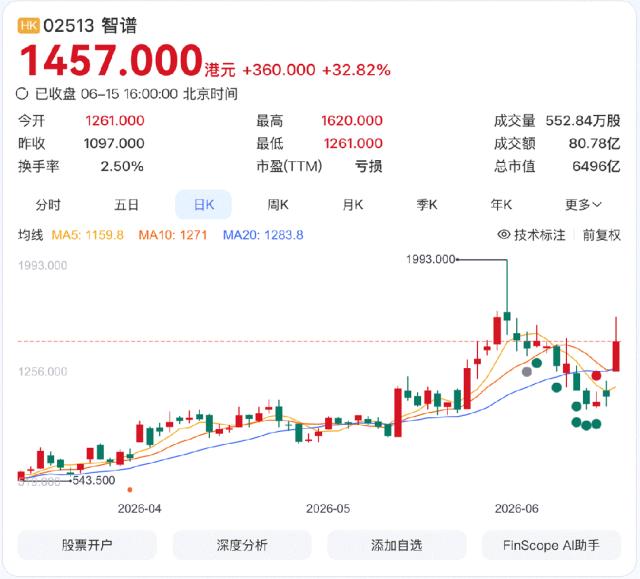
During the same time window, MiniMax (0100.HK), which is called the "AI duo" with Zhipu in the Hong Kong stock market, has fallen from the annual high of HK$1,330 to around HK$402, a decline of more than 70%. One can still have a violent single - day rally above a market value of HK$500 billion, while the other is constantly hitting new lows.
Zhipu's own trend is also quite volatile.
Starting from the issue price of HK$116.2, it reached a historical peak of HK$1,993 during the session on May 29, 2026. Its market value once exceeded HK$880 billion, a nearly 40 - fold increase compared to the issue price.
Then there was a steep straight - line decline. In just a few trading days, more than HK$300 billion to HK$400 billion in market value evaporated, and the stock price retreated to just over HK$1,000. Then it violently rallied on June 15.
Looking at the two companies together, there is only one question that the market cares most about: Against the background of MiniMax's continuous decline, Zhipu's relative resistance to decline and even a violent counter - rally in the opposite market, is it because of its strong fundamentals or a game played by the capital side?
To answer this question, we first need to understand what kind of company Zhipu is. It bears the title of "the world's first stock of general large - scale models", and the secondary market gives it a pricing based on the AGI narrative. However, its revenue and cost structure tell a different story.
A government - enterprise software integrator in the guise of AGI
Zhipu's revenue has indeed been growing exponentially.
From 2022 to 2024, its operating revenues were 57.4 million yuan, 124.5 million yuan, and 312.4 million yuan respectively. In the first half of 2025, it was 190.9 million yuan, and the full - year revenue in 2025 reached 724 million yuan, a year - on - year increase of 131.9%. Based on the 2024 revenue, it ranks first among independent large - scale model developers in China.
So, where does the revenue come from?
According to the prospectus, in the first half of 2025, 84.8% of Zhipu's revenue came from localized deployment, while the API call revenue that truly represents the cloud - based SaaS logic only accounted for 15.2%. Among the 84.8% of localized deployment, mainland Chinese customers contributed 88.4%, and overseas markets such as Southeast Asia only accounted for 11.1%.
This set of figures reveals Zhipu's real business.
It mainly relies on providing privatized and localized model deployment and customized fine - tuning for large domestic government - enterprises, financial institutions, and energy giants. These customers have extremely strict requirements for data privacy and self - controllability, and naturally reject large - scale models that transmit core data to the public cloud. Therefore, Zhipu must send an engineer team to the site for development, fine - tuning, software and hardware adaptation, and long - term operation and maintenance. This is a highly labor - intensive project - based integrated delivery, which is different from the software business of "develop once, replicate infinitely, and have zero marginal cost".
The cost of labor - intensity is directly reflected in the gross profit margin.
Zhipu's comprehensive gross profit margin has been declining from 64.6% in 2023 to 56.3% in 2024, and further dropped to 50.0% in the first half of 2025. The larger the scale of localized deployment, the higher the non - standard marginal cost, and the lower the gross profit margin.
As of June 2025, its R & D team had 657 people, accounting for about 74% of the total employees. The overall R & D investment was 4.4 times the revenue during the same period. Behind each seemingly glorious large government - enterprise order, a large algorithm and engineering team is needed to do customized work with a large amount of manpower.
What is more fatal than the gross profit margin is the computing power bill.
There is an anti - common - sense aspect in the large - scale model business: Traditional software can be distributed infinitely after one - time R & D, while for large - scale models, the revenue grows linearly, but the computing power cost is consumed exponentially. The computing power service fee that Zhipu paid to third - parties was only 14.6 million yuan in 2022, rose to 311.7 million yuan in 2023, soared to 1.5528 billion yuan in 2024, and was already 1.1451 billion yuan in the first half of 2025.
This cost does not show economies of scale with the expansion of revenue and the so - called technological iteration. The expansion of model parameters and the pursuit of ultra - long context capabilities have led to a continuous increase in computing power consumption during the inference stage.
As a result, in 2025, against the surface prosperity of 724 million yuan in revenue, Zhipu recorded a net loss of 4.718 billion yuan, and the net cash flow from operating activities was deeply in the red at - 2.246 billion yuan.
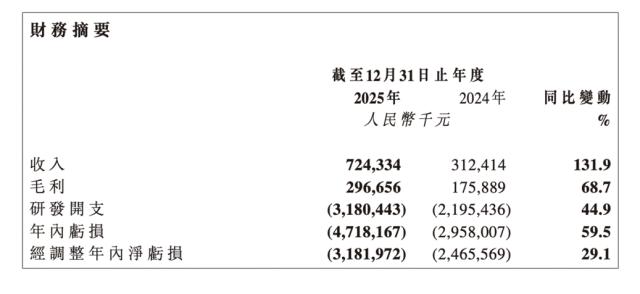
Source: Corporate annual report
The R & D investment being 4.4 times the revenue means that for every 1 yuan it earns, it has to pay far more than 1 yuan in "computing power tax" to chip manufacturers and cloud service providers. Before there is a revolutionary breakthrough in the chip architecture, in the next few years, it is more like a computing power consumption black hole that needs continuous massive blood transfusion from the capital market, rather than a technology company that can generate free cash flow for shareholders.
Two moats that are difficult for others to replicate
A heavy - weighted business model does not mean that Zhipu has no barriers. On the contrary, it is this heavy - weighted model that allows it to hold two moats that are difficult for others to replicate.
One is the open - source flywheel.
On June 13, 2026, Zhipu announced that its flagship open - source model GLM - 5.2, which has the strongest capabilities and supports a 1M ultra - long context, would be open to all users of the GLM Coding Plan, and would be officially open - sourced under the most lenient MIT license in the following week.
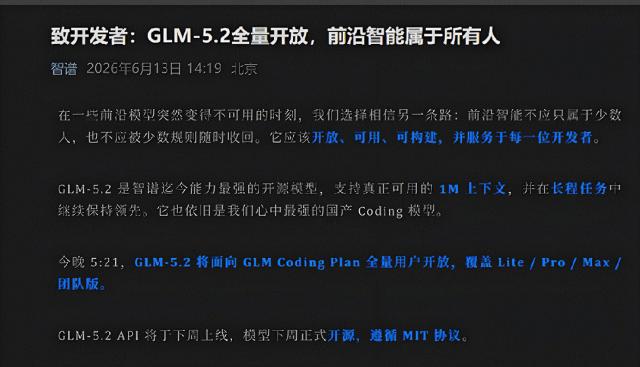
Open - source is no longer just simple academic sharing today, but an aggressive pricing strategy. Releasing the top - level base model for free or even completely open - source is to attract developers.
Once medium - large enterprises or small - medium developers build their core business processes and intelligent agent applications based on GLM - 5.2, subsequent large - scale computing power calls, exclusive privatized fine - tuning, and data cleaning projects will all precipitate into highly sticky long - term revenue within the Zhipu system.
The other is hidden in its list of cornerstone investors.
When Zhipu listed on the Hong Kong stock market, it attracted a cornerstone lineup with a "national team" flavor: JSC International Investment Fund SPC under Beijing Financial Holdings Group subscribed for US$179 million, JinYi Capital under the Tsinghua University Education Foundation subscribed for US$7 million, Taikang Life Insurance subscribed for US$30 million, GF Fund subscribed for US$42 million, and together with Shanghai Gao Yi and others, a total of 11 core state - owned, insurance, and top public and private equity institutions planned to subscribe for HK$2.98 billion, with the cornerstone subscription accounting for nearly 70%.
In China, when government - enterprises, especially those in secret - related industries such as finance, energy, public security, and government affairs, purchase large - scale model infrastructure, the capital background, data security, and self - controllability of computing power of the supplier are deal - breakers. Zhipu's strong Tsinghua - affiliated gene and the background of heavy state - owned capital investment are exactly the policy access tickets for it to win 84.8% of the localized large orders, and also a trust gap that AI startups with a pure US - dollar VC background or within large - enterprise systems are difficult to cross.
The moats are real, but they cannot support a price - to - sales ratio of 576 times.
What supports the bubble is the special capital mechanism in the Hong Kong stock market
Based on the full - year revenue of 724 million yuan in 2025, which is approximately HK$780 million, Zhipu's corresponding static price - to - sales ratio at a market value of HK$495.8 billion is as high as 576.26 times, and the enterprise value - to - revenue ratio (EV/Revenue) is 581.52 times.
For comparison: For top - level SaaS cloud - computing companies in the early stage of global explosion with the highest growth expectations, a price - to - sales ratio of 20 to 40 times is already considered an extreme over - estimation.
A price - to - sales ratio of 576 times means that even if Zhipu maintains a 100% revenue growth rate every year for the next 5 years and completely ignores its annual cash - flow losses and computing power expenses in the tens of billions of yuan, the current price is still extremely expensive. At least 80% of this price is the scarcity premium given by the "Chinese version of OpenAI" narrative, plus the liquidity bubble caused by the small tradable shares.
Then why hasn't the bubble burst in the short term, and why can there be a single - day sharp rise? The answer lies in the special capital mechanism of the Hong Kong stock market.
The first force is the forced buying orders of passive index funds.
On June 8, 2026, Zhipu was officially included in the Hang Seng Tech Index and the Hong Kong Stock Connect list. The Hang Seng Tech Index has accumulated a decline of nearly 13% this year, and the index compiler urgently needs core hard - tech assets to reshape its attractiveness.
According to Morgan Stanley's calculation, the inclusion of new components such as Zhipu will bring a 5% to 7% weight replacement, corresponding to approximately US$1.25 billion to US$1.75 billion in passive incremental funds; JPMorgan is more aggressive, believing that the weight is close to 9%, corresponding to approximately US$4 billion, or about HK$31.2 billion in ETF buying orders.
These passive funds that track the index have no right to pick valuations. Once the effective date arrives, regardless of whether the price - to - sales ratio is 50 times or 500 times, they have to complete the position - building within a very short window. When it comes to a new stock with a small tradable share, it will inevitably cause a sharp upward pulse.
The second force is the south - bound funds.
Bloomberg predicts that after being included in the Hong Kong Stock Connect, Zhipu may attract HK$51 billion to HK$92 billion in south - bound funds. Behind this is the structural gap in the A - share market: There is almost no pure - blooded listed company of a general base large - scale model in the global first - tier in the domestic market.
Facing the AI industrial revolution, a large amount of public and institutional funds have a strong anxiety about core position allocation. Zhipu, as the only large - scale model leader with pure blood and state - owned capital endorsement in the Hong Kong Stock Connect, has become a safe outlet to fill this gap.
The third force is more subtle, which is the difference in the chip structure between it and MiniMax. Both companies were listed in January this year. According to the Hong Kong stock market rules, cornerstone investors have a 6 - month lock - up period, and both will face core share unlocks in July.
However, the amount and nature of the unlocked shares are very different.
According to CICC's analysis, the unlocked shares of MiniMax on July 9 account for as much as 63% of the total Hong Kong - listed shares, and more than one - third of them are held by financial investors such as early - stage VC and PE. Under MiniMax's financial situation where the loss in 2025 increased by 302% year - on - year to US$1.87 billion, these people have a strong motivation to cash out at the top.
The unlocked shares of Zhipu on July 8 only account for 11.6%, and the main body is still cornerstone investors with state - owned capital background such as Beijing Financial Holdings. This kind of patient capital shoulders the task of supporting the country's underlying AI computing power ecosystem and is unlikely to sell off the shares for book profits in the early stage of unlocking.
Quantitative funds and hedge funds are seizing this expected difference and are vigorously conducting pair - trading of "shorting MiniMax and going long on locked - up Zhipu". This is the core trading logic for Zhipu's abnormal resistance to decline in the overall correction of the AI sector.
MiniMax also shot itself in the foot. When it launched its new - generation flagship M3, it quietly changed the API payment model from the intuitive "pay - per - use" to the complex "pay - per - Token consumption". Some developers found that the Token consumption soared for the same work, and the panic of "hidden price increase" triggered a wave of concentrated complaints and cancellations, further shaking the market's confidence in its commercialization closed - loop.
The nearly 45% sharp rise on June 15 had a more direct fuse, which came from geopolitics. On June 12, 2026, local time, overseas AI giant Anthropic cut off all non - US users' access to its two cutting - edge models, Claude Fable 5 and Mythos 5, which had been released for less than 72 hours, due to the US government's export control order. The business processes of hundreds of millions of overseas and domestic overseas - going users were instantly paralyzed.
Zhipu reacted extremely quickly. The next day, on June 13, it suddenly announced the full - scale opening of GLM - 5.2, emphasizing its 1M ultra - long context performance, to take in the developers who were left in the lurch due to the supply cut of Claude.
In actual tests, GLM - 5.2 showed the strength comparable to Opus 4.8 in handling long - range tasks such as 740,000 logs and thousands of lines of code. The overseas supply cut, the underlying substitution of domestic top - level open - source models, and the instant jump in the developer ecosystem and market share ignited the resonance of long - buying among on - site hot money, south - bound funds, and passive index funds.
The last piece of the puzzle to support the valuation is the A - share market. On June 1, 2026, Zhipu officially announced that it planned to issue new shares on the A - share Science and Technology Innovation Board, accounting for 2% to 8% of the total share capital after issuance, and raise