The most popular women's clothing stores in shopping malls are all starting to look the same | Business Friday
Text | He Zhexin
Editor | Qiao Qian
If you spread out the map of the busiest shopping malls in any big city, you'll probably find such a store on the floor with the densest foot traffic.
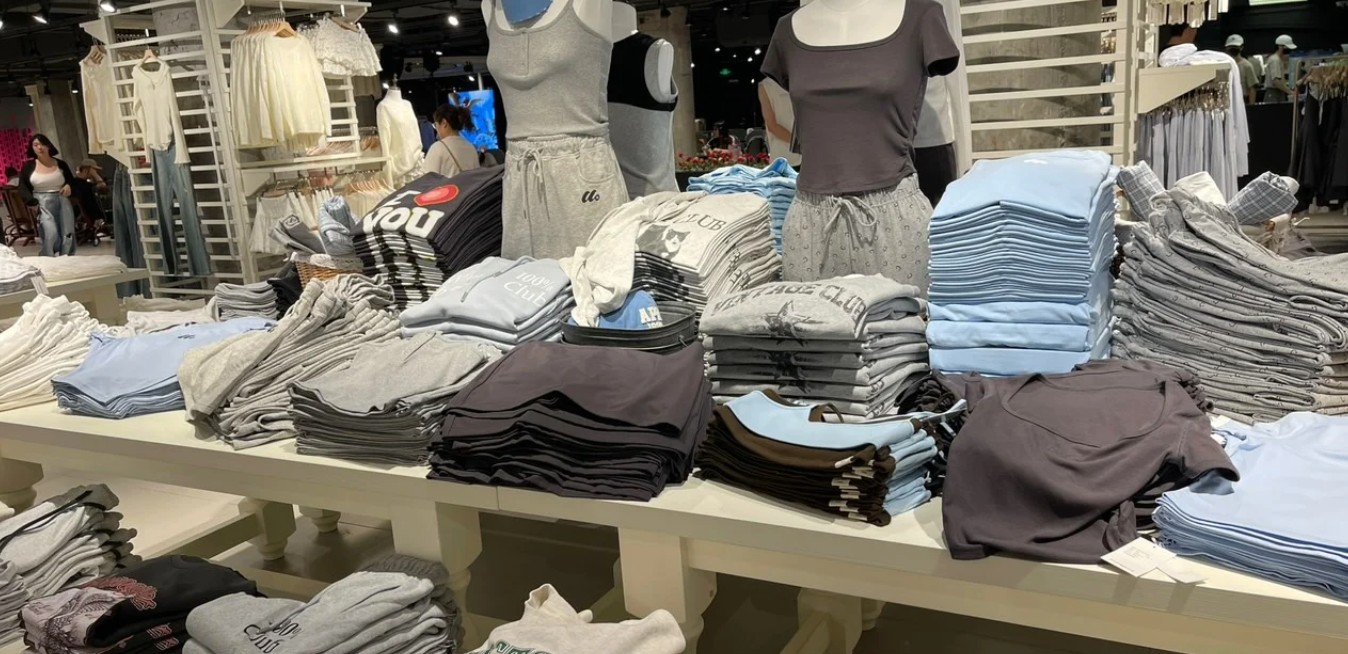
There's usually no door at the entrance. The entire store sign is lit up, with bright color blocks, looking like a screen that's always live - streaming. As you walk inside, there are rows of crop tops, low - rise straight - leg jeans, and trendy outfits for young girls with vivid color combinations. The clothes are arranged by color blocks, and there are more mirrors than hangers. K - POP hits are played on a loop inside the store. The air - conditioning is turned up high, and the air is mixed with the smell of new cotton. Most of the clerks are young, slender, and good - looking. There's often a queue in front of the cash register, and almost all the people in the queue are girls aged from their teens to their early twenties.
The store signs often have only a few English letters: W.Management, One Moment, Basement FG, MUSTOFF, Bettersay, Unifree.
W.Management on Nanjing Road Pedestrian Street. Photo by the author.
These brands, which are classified by the outside world as "affordable teenage fashion", mostly sell women's clothing in Y2K, American campus retro, and Korean girl - group styles. Their prices are mainly between 100 and 200 yuan, yet they occupy the most prominent positions in mid - range and even high - end shopping malls.
In terms of style, they are easily reminiscent of once - popular brands like Brandy Melville, Chuu, and Hollister, which attract consumers with bright colors, a unified aesthetic, and youthful designs. Indeed, most of these brands were born around 2022 and 2023 when "trendy outfits for young girls" were in vogue. However, compared with their predecessors, the most prominent feature of these Chinese - version apprentices is not their style but their expansion speed.
Take W.Management, the one with the strongest momentum, as an example. This brand, which belongs to Hangzhou Wanmo Brand Management Co., Ltd., opened its first store in 2023. According to a report by Xinhua News Agency in February this year, the number of its stores across the country has exceeded 40, covering nearly 30 cities.
In the past year or so, these teenage fashion brands have almost become the most - watched new species in the physical retail of women's clothing. On the other hand, the e - commerce of women's clothing is still deeply trapped in the dilemmas of high return rates, rising traffic costs, and the frequent closures of online celebrity stores. To some extent, the women's clothing industry has come full circle and returned to offline.
However, if we look deeper, what these brands are really selling may not just be clothes. The first thing to be replicated is a new way of acquiring customers offline - the so - called "idol industry" has almost become a common practice for all brands.
According to a previous store - visiting report by Vista Hydrogen Business, W.Management will invite small - star celebrities, beauty bloggers, models, and even Cosplayers to serve as "one - day store managers" when opening the first stores in each city. They are packaged completely according to the idol operation logic: fan voting, direct - shot videos, support materials, and small card peripherals are all available. Which store manager goes to work and when they appear are even decided by fan voting. After consumers spend a certain amount, they can also get the opportunity to take photos and interact with the store managers.
Basement FG has gone a step further. After its parent company received an investment from Lehua Entertainment in 2023, Lehua artists began to frequently appear in store activities.
What connects these brands is even the same group of mobile people. The actor Zi Yu, who became popular for the BL drama "Inverse Love", had appeared in the store systems of Brandy Melville, W.Management, and Basement FG before becoming famous.
As a result, what consumers are queuing for has gradually changed from the clothes themselves to an offline experience. For brands that highly rely on young female customers, this model is more direct than simply placing advertisements and is easier to spread on social media.
Attracting people into the store is just the first step. What really determines whether these brands can continue to expand is another set of more traditional retail capabilities.
In terms of expansion methods, they almost all choose the franchise model instead of direct operation. They focus on offline first and then consider online. Their store - location selections are also highly similar: well - established shopping centers such as LOHAS, MixC, Joy City, Intime in77, Zhengjia Square, and Zhengda Square are their common targets. According to the statistics of Winshang Big Data, in shopping centers over 50,000 square meters in 27 cities across the country, about 60% of W.Management's stores are located in mid - range malls, and about a quarter are in high - end projects.
The store scales show different routes. Basement FG focuses on the super - large store model. According to the official website of its parent company, Beijing Blue Signal E - commerce Co., Ltd., the area of its flagship stores usually exceeds 2,000 square meters. W.Management also prefers large warehouse - style stores. The area of the store it is about to take over at Fashion Walk in Causeway Bay, Hong Kong, is nearly 2,800 square meters.
In contrast, MUSTOFF adopts a lighter standard shopping - mall store model. The area of its stores is mostly several hundred square meters, which is more conducive to rapid replication.
Some insiders told 36Kr that some members of the W.Management team come from Peacebird. If this statement is true, it's not hard to understand its advantages in franchisee resources, mall relationships, and store - acquisition capabilities.
Of course, the biggest test behind the large - store model has never been the decoration but the supply chain. The SKU scale of Basement FG reaches 3,000 to 5,000, and W.Management claims to develop over 10,000 new products every year.
The more SKUs there are, the higher the inventory risk. For comparison, Uniqlo has long kept its SKUs at around 1,000. Although H&M and Zara have a large SKU scale, they maintain turnover efficiency through high - frequency replenishment and small - order quick - return systems respectively. In fact, in the past few years, the global fast - fashion industry has moved its production lines closer to the main markets, actively reduced SKUs, decreased discount promotions, and increased the proportion of high - value products to cope with the competitive pressure brought by various e - commerce platforms.
The biggest advantage of these teenage fashion brands is that their supply chains and consumer markets are almost on the same map.
W.Management, One Moment, and MUSTOFF were all born in the Yangtze River Delta, and they all regard this area as the first stop for expansion. As one of the most mature clothing industrial belts in China, the Yangtze River Delta is home to a large number of garment factories and fabric suppliers. A complete closed - loop from design, sample - making to production and retail has been formed, and the "small - order quick - return" model is the industry standard.
For these brands, this means a shorter decision - making chain and lower trial - and - error costs. Compared with European and American fast - fashion brands that need cross - border procurement and long - distance transportation, they can capture fashion trends more quickly and complete new product launches more frequently. To some extent, what they are selling is not just clothes but a speed advantage based on the local supply chain.
W.Management claims that its stores launch over 100 new products every week and complete a full renewal every 50 days. A clerk at Basement FG told 36Kr that some stores can even launch new products daily and adjust the display weekly. In a sense, they are bringing Shein's reaction speed into physical shopping malls.
However, if only the brands themselves work hard, this expansion is still difficult to succeed. Behind the rise of these teenage fashion brands, there is a background that is more easily overlooked: the commercial real - estate environment is changing. The "2025 China Commercial Real - Estate Rent Index Research Report" shows that in the second half of 2025, the average rent of shops on the core commercial streets in key cities decreased by 0.81% year - on - year. Most projects are still reducing rents to increase the occupancy rate.
Meanwhile, the total number of shopping centers across the country has approached 9,412, with a total commercial area of 671 million square meters. After the incremental era ended, the commercial real - estate industry has entered a typical stock - competition stage.
For shopping malls, the most important question has changed from "which brands to introduce" to "who can really bring in customers".
The most representative case happened in Causeway Bay, Hong Kong. According to insiders who told 36Kr, before H&M exited Fashion Walk at Hang Lung, it negotiated the monthly rent from the initial about HK$10 million to about HK$5 million, but still didn't renew the lease in the end. According to Bloomberg, the rent of the store taken over by W.Management is only about HK$2 million.
In the traditional commercial real - estate logic, it's hard for a Chinese women's clothing brand that has only been established for two or three years to be on the same candidate list as an international fast - fashion giant like H&M. However, the evaluation criteria are changing now.
Hang Lung told 36Kr that although the property positioning in the Chinese mainland and Hong Kong is different - Hong Kong's properties are more community - oriented and fragmented, while those in the mainland are more concentrated - the criteria for shopping malls to select brands have changed from focusing on brand tone in the past to evaluating based on customer flow now.
This statement is also confirmed by real - estate practitioners. In the past, the first thing to consider in investment promotion was the product category, and the second was brand awareness. Now, more important indicators are the single - store sales ability and customer - attracting ability. According to market news, the sales volume of W.Management's Beijing LOHAS store reached 12 million yuan in the first month of its opening. In other words, the expansion of these teenage fashion brands is not only a brand story but also the result of the change in commercial real - estate logic.
If we extend the time axis, they actually correspond to another bigger industry proposition: has fast - fashion really declined?
Perhaps the answer is that fast - fashion has not disappeared but is undergoing a transformation in form.
Some brands choose to abandon physical retail. Forever 21, which once defined American fast - fashion, had its US operating company file for bankruptcy protection again in 2025 and close all its US stores. However, the brand - trademark holder, Authentic Brands Group, still continues to license the brand for operation, shifting it to a lighter - asset brand - management model.
Other brands retain their stores and reshape their brand value. After Richard Dickson took over Gap, it achieved revenue growth for two consecutive years and same - store growth for eight consecutive quarters. What it relied on was not store reduction but product, marketing, and brand renewal.
And these Chinese teenage fashion brands in front of us may represent a third answer: re - define fast - fashion with a local supply chain, more frequent new product launches, stronger offline experiences, and a more aggressive expansion speed.
However, when "fast" and "affordable" are taken to the extreme, many things are intentionally or unintentionally sacrificed. A single size reduces inventory pressure but excludes a large number of consumers. The style formed by relying on public aesthetics and the hit - product logic is easily replicated by later - comers. The lack of original design and brand - asset accumulation means that the brand's moat may not be very solid after the popularity fades.
Interestingly, Brandy Melville, which is regarded as a template, is the most restrained one. According to Jiemian News, it has only opened four stores in China in five years. The master is sparing with words, while the apprentices are copying in batches.
Perhaps the real test has just begun. 36Kr learned that the Hangzhou team operating One Moment has jointly taken over the Chinese business of the American denim brand GUESS this year. This once - global fashion brand, also held by Authentic Brands Group, has just completed the contraction of its stores in the Chinese market.
This means that a more important question is about to be verified: is this methodology that has been proven successful with teenage fashion brands only applicable to the young - female market, or can it be replicated in a more mature, complex, and high - customer - price - point brand system?
Time will tell the answer. But regardless of the result, the emergence of these teenage fashion brands has shown one thing: the era that relied on brand aura and channel monopoly to drive growth is fading away, and a new retail cycle defined by traffic, efficiency, supply chain, and offline experience has begun.