From an idea to a product, young developers translate observations of daily life into code.
On June 14, the final of the Geek Track of the HarmonyOS Innovation Competition concluded at the HDC Huawei Developer Conference (HDC 2026).
Previously, 20 shortlisted teams stood out from numerous entries. In the 36 - hour coding challenge, they were the first to use HarmonyOS 7 and competed in areas such as AI, 3D spatialization, and user experience. With the announcement of the final award list, the outcome of the competition is settled. However, what is more worthy of attention than the awards themselves is what a group of young developers behind these works are concerned about and what they are trying to answer with code.
When looking through the list of participants, we were surprised to find that many of the developers are still students. They don't have the resources of established companies, complete business teams, or even sufficient development experience. But in this competition, they transformed their life observations, professional backgrounds, and interests into runnable products.
These works present an aspect of this innovation competition that is worth observing: young developers are no longer just chasing abstract technical propositions but are using code to respond to their own lives.
How did these young people discover problems in life and write solutions with code? How did a group of college students turn the inspiration in their minds into real runnable works within 36 hours of extreme development? When the HarmonyOS ecosystem opens up AI capabilities, multi - device collaboration, and development tools to more small and medium - sized developers, will the threshold for innovation be rewritten?
With these questions, the Post - wave Research Institute interviewed several young developers and talked with them about this unique development experience.
Converse with Living Civilization: Bring Murals into Your Phone
Xie He first felt that murals were close to her during an in - person flying Apsara performance in Henan.
Before that, murals were more like a distant dream hidden in remote grottoes for her. Even in the era of rampant short - videos, where she could see fleeting images of figures in the murals with floating robes at any time, the distance between the screen and reality gave Xie He a strong sense of distance while experiencing historical culture.
It wasn't until that performance that the flying Apsara figures from Dunhuang murals were brought into the real world. The once - static images on the wall became vivid scenes in front of her, and the distance between her and the murals seemed to disappear.
So, if not everyone has the time, budget, and opportunity to visit Dunhuang immediately, can we use a mobile phone to open a door to the world of murals?
This idea eventually landed on Xie He and her two teammates. They come from Zhengzhou University of Light Industry - a team focusing on interdisciplinary studies. The three of them are from the majors of computer science, Internet of Things, and bioengineering respectively. Since their freshman year, they have been exposed to HarmonyOS in the studio and have accumulated more than a year of development experience. Thus, the project "Wall Walk · Time and Space" was launched.
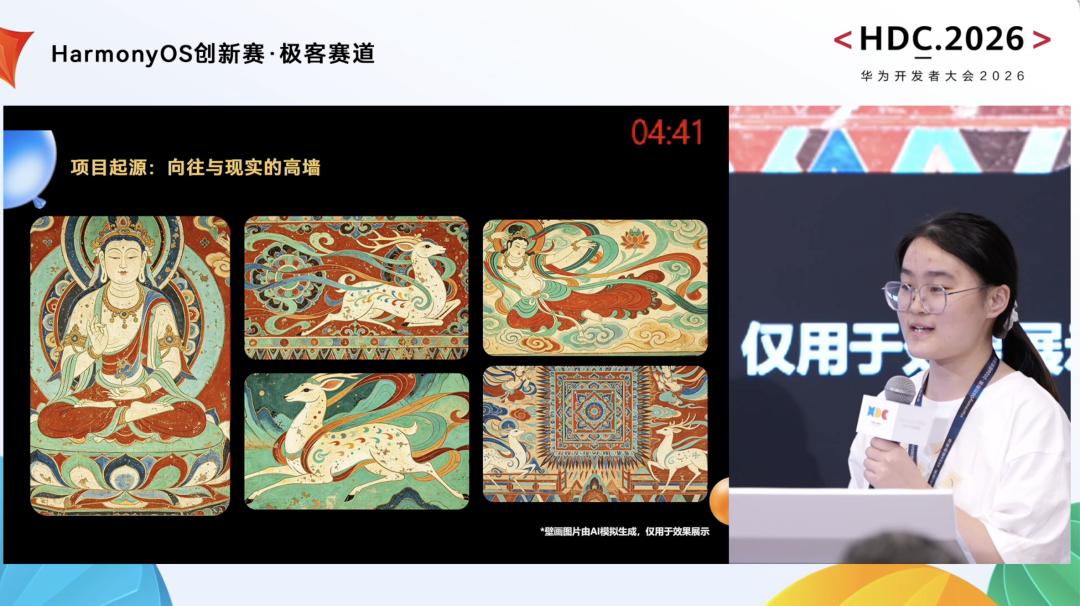
Xie He participating in the competition, provided by Huawei
What they want to create is not an ordinary "swiping pictures + voice explanation" app. Instead, it allows users to move, approach, and adjust the perspective as if they were walking into a real space, and see the characters, scenes, and stories in the murals while walking. In their view, traditional culture should not just stay in the position of "being watched". It can also become a "walk - in, conversable, and restorable" living civilization.
However, turning this idea into reality is much more difficult than expected. The biggest obstacle is 3D modeling: large models, slow loading, abnormal perspectives, scene misalignment... Problems kept emerging. The project was launched in October last year, and they had to restart the development of the underlying engine three times. After repeated exploration, they finally chose to combine HarmonyOS's 3D graphics capabilities with the Unity engine to make the murals stand firmly.
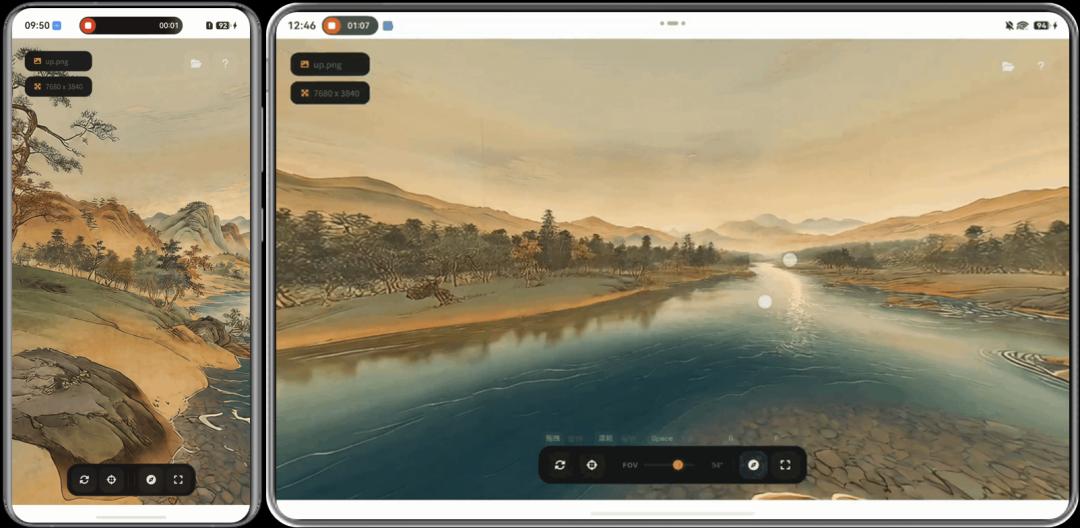
Interface of the "Wall Walk · Time and Space" App, provided by the interviewee
Xie He said that they are real beneficiaries of the HarmonyOS ecosystem, which enabled these students with limited resources to reach this stage. The most direct help is the toolchain. "When learning some software, you may get stuck at the very first step of environment installation." However, with HarmonyOS's toolchain, you can complete the download and installation with just one click, without the need to configure paths repeatedly, allowing beginners to take the first step smoothly.
Secondly, AI assistance also plays an important role. With HarmonyOS's AI - assisted development tools, you can get prompts for error troubleshooting, interface searching, and organizing implementation ideas. In Xie He's view, this is the biggest difference between the past and now: in the early days of learning development, you had to systematically study a large amount of theory before daring to write the first page of code. However, AI can quickly help you sort out the learning path and refine requirements, "greatly accelerating our growth".
HarmonyOS has shown these young developers another possibility. Last year, they developed a sign - language translation app called "Vision Access" and successfully launched it on the market. During the operation, they also participated in the HarmonyOS app developer incentive program and received their first income during college. For student developers, this kind of feedback is very direct: the things they write are not just limited to homework and competition documents - they can be launched on the market, used by people, and even bring real rewards, which becomes the confidence for the next round of development.
Through such repeated attempts, Xie He and her partners have not only obtained two successful works through the HarmonyOS ecosystem but also gained the passion for continuous development and the possibility of promoting in - depth connections between cultural exploration and young people.
See Every Movement: Let AI Be Your Fitness Buddy
Compared with Xie He's team, which focuses on the distant view of murals, Lan Feng has a more down - to - earth insight into the needs of young people.
Currently, fitness has become an inseparable topic and habit for young people, and more and more people are starting to go to the gym. However, not everyone can adapt to the diverse equipment in the gym smoothly, and Lan Feng is one of them.
Lan Feng, a sophomore at Taiyuan Institute of Technology, is a marathon enthusiast. Later, in order to increase strength training, he entered the gym for the first time. Facing various kinds of equipment, problems arose: different manufacturers have different usage methods for the same piece of equipment, and the labels are not clearly written; he wanted to use AI photo recognition, but the image - search tools couldn't recognize accurately. There are a lot of training plans available online, but except for coaches and fitness buddies, no one can correct your movements in real - time.
This is very unfriendly to fitness beginners.

Lan Feng participating in a marathon, provided by the interviewee
He tried all the sports and health apps on the market. They can help you arrange training plans, record calories, or recommend some equipment - free fitness exercises. However, none of them can guide users to have an immersive training experience in the gym. In other words, in Lan Feng's view, 'no app truly empowers the fitness process itself.' And this statement became the starting point of the 'Arua AI Fitness Coach'.
What Lan Feng wants to do is to integrate AI into fitness to help beginners identify equipment, observe, and correct movements.
As an independent developer, Lan Feng has neither a team nor large - scale ready - made data. He has to complete all the data related to the skeletal point states of each movement, the samples needed for equipment recognition, and the feedback data of running postures by himself.
It is the HarmonyOS ecosystem that supports him in pushing the project forward.
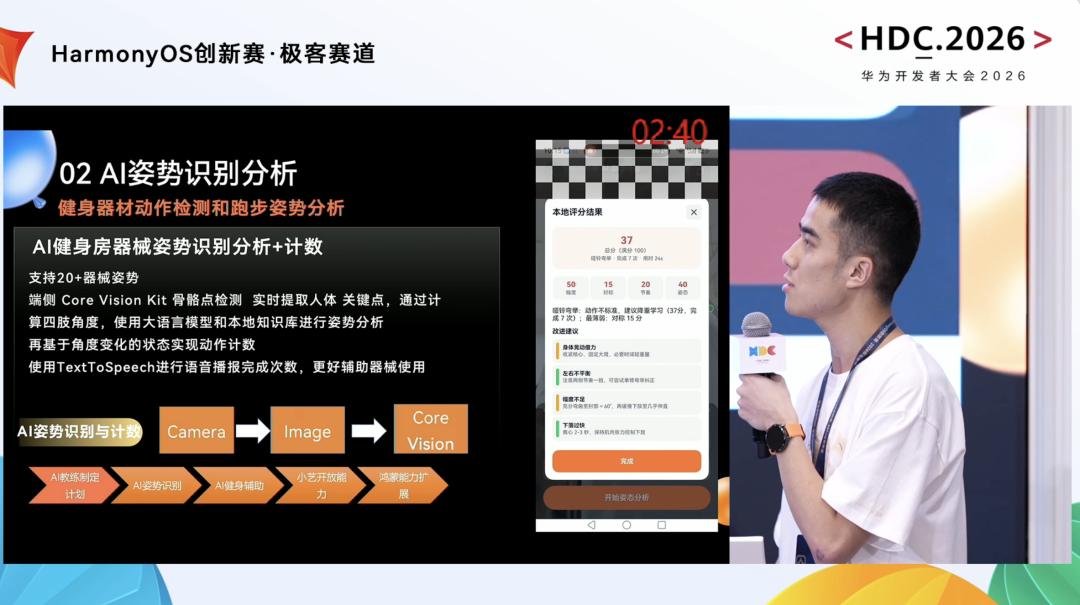
Lan Feng participating in the competition, provided by Huawei
The skeletal point detection function of HarmonyOS allows AI to 'see' users' movements for the first time, rather than just generating cold suggestions. This is the missing piece of the puzzle that initially motivated him to start.
What helps him more is HarmonyOS's expansion ability in AI. "In terms of AI - related expansions, HarmonyOS is indeed better than other manufacturers." In his view, Huawei's push notifications, Xiaoyi, and intelligent agent expansions enable the app to participate in training more actively in the future: instead of waiting for the app to be opened to respond, it can remind you before training, provide feedback during training, and conduct a review after training. AI no longer waits passively for instructions but can actively call tools and solve problems.
This is also the biggest difference between Arua and ordinary fitness apps. The core problem Lan Feng wants to solve is actually the fitness anxiety of most ordinary young people - they have a plan but don't know where to start when they get to the gym. Hiring a personal trainer is too expensive, and self - exploration is prone to injuries. Arua fills this gap.
With the help of the HarmonyOS ecosystem, Lan Feng single - handedly built this AI fitness buddy for young people. In this process, the value of HarmonyOS is not just technical support but also lowering the threshold for individual developers, giving them more space to create their own possibilities.
Awaken Traditional Patterns: Bring Intangible Cultural Heritage into Daily Design
In addition to cultural exploration and fitness management, some young people in the HarmonyOS innovation competition are also concerned about the inheritance of intangible cultural heritage.
Recently, at the China International Consumer Products Expo, Wei Tao, the governor of the Guangxi Zhuang Autonomous Region, spent 580 yuan to buy a blue swallowtail - pattern Zhuang brocade handbag. The video of him scanning the code to pay on the spot quickly went viral. Subsequently, the topic related to the 'Zhuang brocade bag' received more than 80 million views on Douyin, and the topic of 'Zhuang brocade' received more than 550 million views.
Traditional patterns thus entered Wu You's field of vision through short - videos.
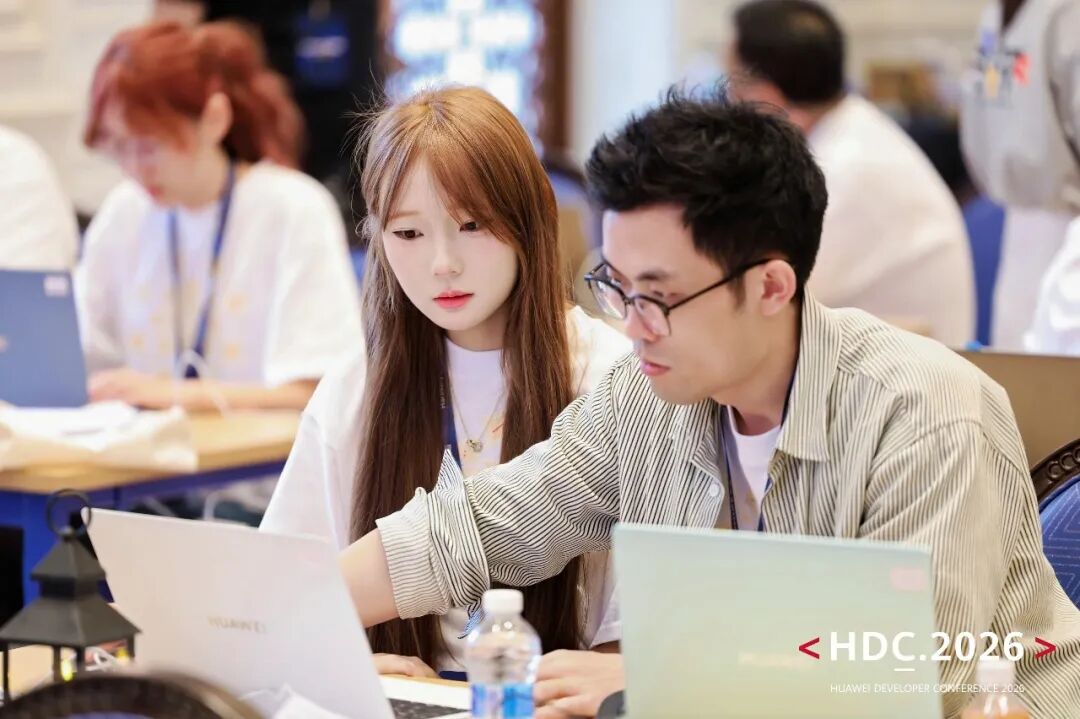
Wu You and her teammate participating in the competition, provided by Huawei
Wu You, a sophomore at Wuxi Institute of Arts and Technology, majors in visual communication and often comes into contact with various visual elements. She found that most of the visual elements that young people see and use in their daily lives are foreign IPs. They are simple, direct, and have high dissemination efficiency, and are easy to become phone cases, canvas bags, stickers, and various peripherals.
However, traditional patterns are different. Each pattern has its origin, craftsmanship, and history. Without promotion, no one will notice their beauty and delicacy.
This is where Wu You and her teammate Wang Ji's idea of creating 'Wen Yuan' started. It is not just an app for intangible cultural heritage popularization but can transform traditional patterns from 'objects to be introduced' into materials that both ordinary people and designers can use. A college student without a design background can use it to create the first draft of jewelry, packaging, or cultural and creative products. A designer can also get inspiration from it and put traditional patterns into more modern usage scenarios.
The difficulty in turning this idea into a product lies not in 'displaying patterns' but in making them truly usable. After a user selects a pattern, how to put it on a specific product, how to generate the corresponding 3D effect, and how to make the design result editable and reusable are the problems that Wen Yuan needs to solve. The most difficult part for the team during development is also the process of transforming patterns into product effects.
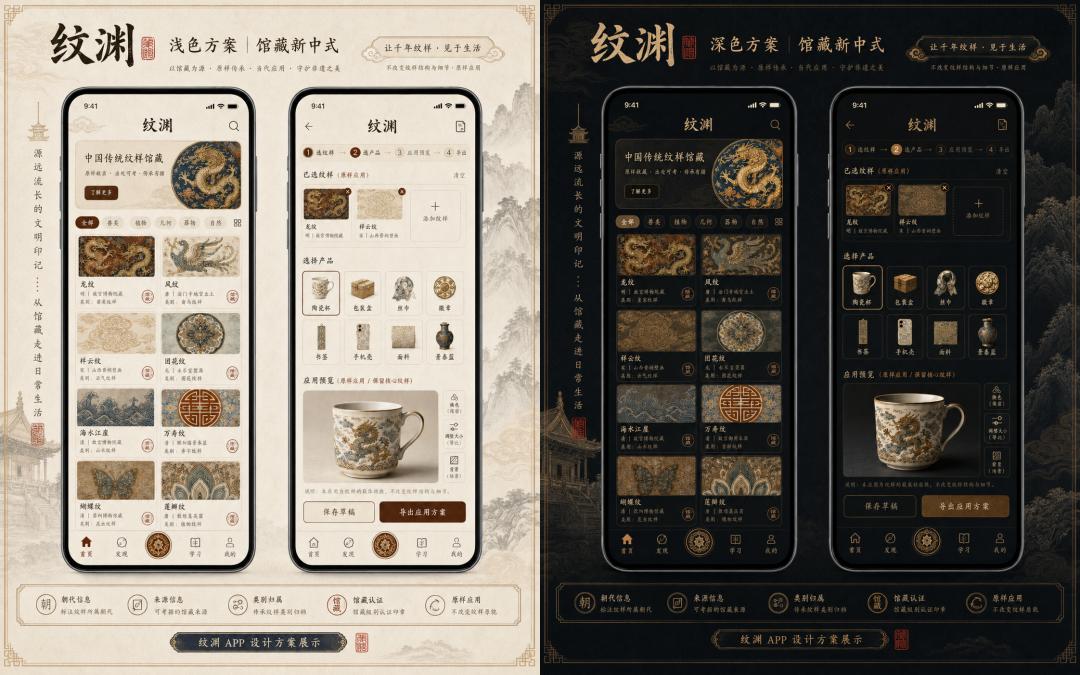
Design scheme of the Wen Yuan App, provided by the interviewee
The support provided by HarmonyOS gradually became apparent in this aspect. After the team found the 3D Gaussian modeling ability in the development documentation, they spent a few days trying to integrate it into the project to solve the problem of combining patterns with product models. For Wen Yuan, this is not a function for'showing off skills' but a fulcrum for traditional patterns to move from two - dimensional patterns to actual product previews.
Another important ability is one - time development and multi - device deployment. Wu You knows well that most design practitioners process design materials on computers. Therefore, developing only a mobile app is far from enough. HarmonyOS's ability in this regard allows this student team to focus on optimizing the product itself instead of rebuilding systems for different devices, leaving the multi - device deployment work to HarmonyOS.
Of course, the reduction of development and creation thresholds by AI also helps Wu You a lot. Wu You said that without AI, work efficiency would be at least halved. The AI Q&A in the HarmonyOS development documentation, the AI assistant in the development tools, and the existing questions and answers in the community have greatly improved their efficiency during development.
In the future, she also hopes to connect to the Xiaoyi intelligent agent, allowing users to make secondary creations of patterns according to their own needs and apply them to specific products.
Relying on the support of the HarmonyOS ecosystem, Wu You has brought traditional patterns into the vision of more young people, making these beautiful and delicate intangible cultural heritages no longer just stay in books but have the possibility of secondary creation and product implementation. This is not only realizing the dreams of young developers but also opening a window for the inheritance of intangible cultural heritage.

From cultural exploration, to health management, to the inheritance of intangible cultural heritage, although they point to different fields, the underlying logic is similar: these young developers do not invent needs from a distant technical perspective. Instead, as users, they first feel a gap in life and then try to fill it