1 billion, another robotics company breaks financing record, with Zhu Xiaohu investing in five consecutive rounds
A huge financing deal has emerged in the field of embodied intelligence.
On June 15th, Shihang Intelligence, an ocean embodied intelligence company, announced the completion of over 1 billion yuan in Series A financing. It is reported that this is currently the largest single - round financing in the global ocean robot field.
The list of investors in this round of financing is quite impressive. New investors include Shanghe Momentum Fund, Vertex Growth under Singapore's Temasek, the agricultural industry fund under CITIC Group, Yuzun Capital, and the listed company Dayang Motor. Old shareholders such as GSR Ventures, Vertex China Fund, Huaying Capital, Changshi Capital, Shengjing Jiacheng Capital, and Anyu Capital also continued to increase their investments.
Among them, GSR Ventures has invested in Shihang Intelligence for five consecutive rounds.
In the past few years, when people mentioned "embodied intelligence", they often thought of humanoid robots, robotic arms, and autonomous driving, all of which are on land. However, the ocean is actually a more challenging scenario. What Shihang Intelligence wants to do is to let robots go underwater instead of humans to do those dangerous, labor - intensive, and costly jobs.
Many industrial media have commented: DJI in the sky, Unitree on the ground, and Shihang underwater.
Orders Exceed 1 Billion Yuan in Half a Year
Ocean robots may seem far - fetched, but in reality, there is a great demand for them, such as ship cleaning.
When a ship stays in the sea for a long time, barnacles, seaweeds, and various attachments will grow on the ship's bottom. Once the ship's bottom gets dirty, the resistance of the ship in the sea will increase, and the fuel consumption will also rise. In the past, this kind of work often had to be done by divers, which was dangerous, labor - intensive, and of limited efficiency.
An important scenario that Shihang Intelligence has entered is intelligent ship cleaning and maintenance.
This job may not sound exciting, but there is a real demand for it. For a ship to operate, its bottom needs to be maintained; ports, shipping companies, and shipowners all need to calculate costs. If robots can do this job more stably, more cheaply, and more safely, customers will have reasons to pay.
In addition to ship cleaning, Shihang Intelligence's robots have also entered scenarios such as ocean photovoltaics, offshore wind power, ocean ranches, seabed exploration, and ocean scientific research.
These scenarios have one thing in common: many tasks are underwater, the environment is complex, it is dangerous for humans to go underwater, and traditional equipment is expensive and heavy.
For example, in offshore wind power, not only do the blades and towers of wind turbines need maintenance, but the underwater foundations, submarine cables, and related structures also need to be inspected. Another example is ocean ranches, where underwater equipment, the breeding environment, and the status of net cages all need long - term monitoring. Seabed exploration, submarine pipelines, and submarine optical cables also rely on underwater operations.
These jobs were not left undone in the past, but they were costly, risky, and inefficient.
What Shihang Intelligence wants to do is to hand these jobs over to robots.
According to the company's disclosure, as of now, Shihang Intelligence's robots have achieved large - scale applications in scenarios such as ship cleaning, ocean photovoltaics, offshore wind power, ocean ranches, seabed exploration, and ocean scientific research. In the first half of 2026 alone, the company's order amount has exceeded 1 billion yuan.
Obtaining real orders and making real deliveries is also the key for capital to continue investing. Many cutting - edge technology companies talk about "what the future will be like", but Shihang Intelligence has proven that "it can work underwater now and make customers pay".
Installing a Smart Brain for Ocean Robots
The real difficulty of ocean robots is not just the ability to move in the water. The more challenging part is that they need to complete tasks underwater.
The underwater environment is completely different from the land. Land robots can rely on cameras, lidars, and network communications to obtain a large amount of information in real - time. Underwater, it is much more troublesome. The water is turbid, the light is weak, communication is interrupted, and ocean currents constantly change the robot's posture.
This requires robots not to rely entirely on manual remote control. They must have a certain degree of autonomy, knowing where they are, where they are going, what they see, and what to do next.
In April this year, Shihang Intelligence released the ocean embodied large model "Cangqiong CEORION", which is equivalent to installing a smarter "brain" for ocean robots.
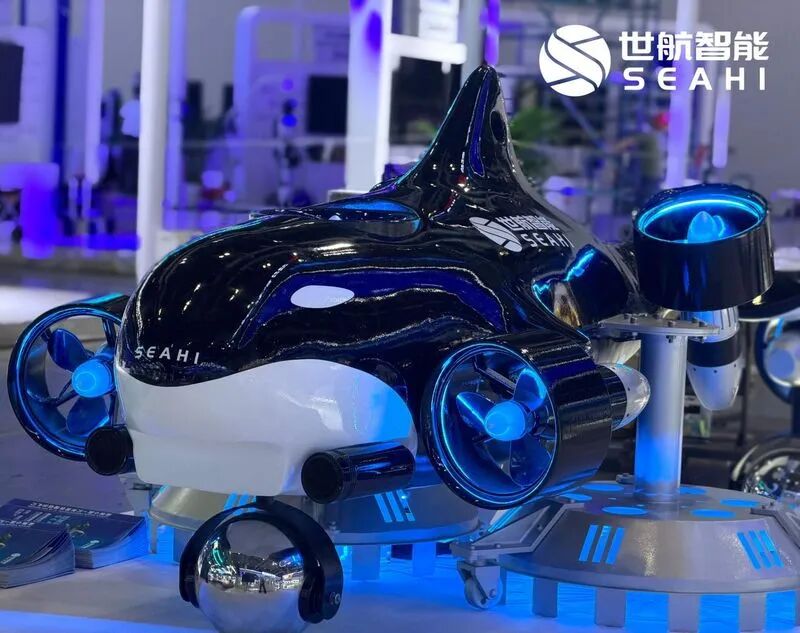
Source of Shihang Intelligence's orca ocean robot model: Shihang Intelligence
Many traditional underwater robots often rely on manual remote control or pre - written programs. Between different tasks, different systems and models often need to be switched. What Shihang Intelligence wants to do is to let one model understand the environment, understand the task, and generate actions simultaneously.
For example, when a robot is inspecting underwater, it not only needs to see an object but also judge whether it is abnormal; when cleaning the ship's bottom, it not only needs to get close to the hull but also control the force and angle; when grasping, cutting, and welding, it also needs to avoid collisions and misoperations as much as possible.
According to Shihang Intelligence's disclosure, "Cangqiong CEORION" uses a unified end - to - end architecture, putting environmental perception, task understanding, and action generation in the same model, and training it with real - world operation data and simulation data.
The company claims that ocean robots equipped with this model can cover 12 major categories of underwater operation scenarios, including inspection, detection, cleaning, grasping, cutting, welding, exploration, search and rescue, and emergency response.
In simulation tests, the task success rate of "Cangqiong CEORION" exceeds 90%, and the success rate of fine - control positioning and grasping exceeds 90%. Facing previously unseen sea areas, water quality conditions, light changes, and different robot platforms, the zero - sample adaptation ability of the model exceeds 70%.
These data still need to be further verified in more real - world commercial scenarios. However, it points to a trend: the competition of ocean robots is no longer just a hardware competition but a comprehensive competition of hardware, software, algorithms, data, and engineering experience.
Especially data.
Land - based robots can relatively easily collect training data. However, ocean data is expensive and difficult to obtain. Every real - world underwater operation will encounter different water quality, light, ocean currents, obstacles, and equipment states. The more real - world operation data one accumulates, the more likely one is to train the model to be more reliable.
Shihang Intelligence claims that the company has built an ocean world model based on millions of hours of commercial operation data and continuously iterates and optimizes it through real - world tasks.
A Big Business in Ocean Labor
Chen Xiaobo, the founder and CEO of Shihang Intelligence, was born in 1989 and is an alumnus of Harbin Engineering University. He has been deeply involved in the field of ocean robots for a long time. He won the First - Class Award for National Defense Science and Technology Progress at the age of 28 and is one of the youngest recipients of this award.
The core ability of Shihang Intelligence is "full - stack self - development". The company claims that it has self - developed six core systems, including power, control, sensing, navigation, sealing, and deployment and recovery.
These terms may sound a bit technical, but they are easy to understand in the underwater scenario.
The power system determines whether the robot can move stably underwater; the control system determines whether it can perform fine operations; the sensing system determines whether it can see and perceive the surrounding environment; the navigation system determines whether it will get lost; the sealing system determines whether it will be damaged by water after entering the water; the deployment and recovery system determines how the robot is launched from the ship and retrieved safely.
If any link is unstable, it will be difficult for the robot to be truly commercialized.
Shihang Intelligence claims that its robots have the ability to operate at full sea depths from 0 to 10,000 meters and with full degrees of freedom, supporting functions such as autonomous navigation and multi - robot collaboration.
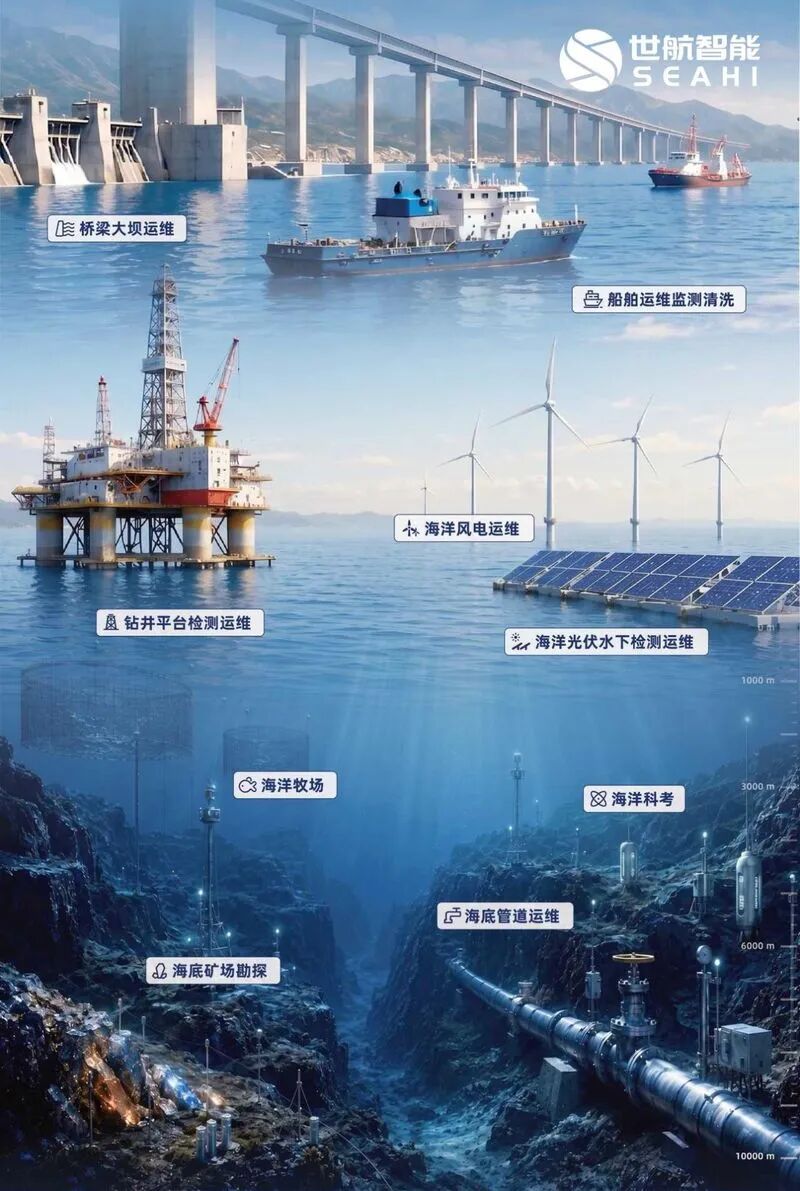
Shihang Intelligence's ocean service scenarios. Source: Shihang Intelligence
Since this year, the company has also been promoting standards and the overseas market.
In January, Shihang Intelligence led institutions such as the Waterborne Transportation Institute of the Ministry of Transport to formulate China's first "Operating Procedures for Underwater Cleaning Robots". In March, Shihang Intelligence won the First - Class Award for Scientific and Technological Progress of the China Institute of Navigation in 2025. In April, Shihang Intelligence, as a Chinese company, was selected for the National Underwater Hull Inspection and Cleaning Program of the Maritime and Port Authority of Singapore.
Looking at these things together, it shows that Shihang Intelligence is not just making single robots but trying to enter a larger maritime service system.
In terms of the profit - making model, the most imaginative aspect of ocean robots may not just be selling robots.
If it's just selling a single robot, the income is one - time. However, ship cleaning, offshore wind power inspection, seabed facility maintenance, and ocean ranch operation and maintenance are all long - term needs. What customers need is not just "buying a robot and leaving it there" but the continuous completion of underwater tasks.
So, the bigger business in the future may be "robots + operation services + data capabilities".
This is a bit like turning underwater labor - intensive jobs into a set of standardized services. In the past, it relied on humans going underwater; now, it relies on robots. In the past, it relied on experience and manual judgment; now, it relies on robots, algorithms, and data for continuous iteration.
Of course, this path is not easy.
The customers of ocean robots are very practical. Shipowners, ports, energy companies, and ocean engineering companies are not concerned about concepts but about several questions: Can it work stably? Can it reduce downtime? Can it reduce safety risks? Can it save money compared to the original solution?
Shihang Intelligence's financing in this round is quite large, but financing is just the beginning. Next, it needs to prove that the robots can operate stably in more sea areas, more complex environments, and more frequent tasks, and also prove that orders can be turned into revenue, and revenue can form a continuous commercial closed - loop.
However, from the perspective of the industrial trend, the robot labor force in the ocean has indeed reached a point worthy of attention.
On the one hand, scenarios such as offshore wind power, ocean photovoltaics, ocean ranches, deep - sea exploration, and port shipping are constantly growing; on the other hand, manual underwater operations are increasingly unable to meet the requirements of efficiency and safety. As long as the ocean industry continues to expand, the demand for underwater inspection, cleaning, maintenance, and exploration will increase.
Shihang Intelligence's over 1 billion yuan in Series A financing essentially means that capital is betting on one thing: in the future, many difficult, tiring, and dangerous jobs in the sea may no longer be mainly done by humans but by robots.
The ocean robot industry used to be a niche one. However, if it can truly move from single - point tasks to large - scale operations and from product sales to continuous services, it will no longer just be a hard - tech story but a real productivity - driven business.
This article does not constitute any investment advice.
This article is from the WeChat official account "Pencil News" (ID: pencilnews). Author: Xi Wen, Editor: Huang Xiaogui. Republished by 36Kr with permission.