Even Apple has to pay rent now.
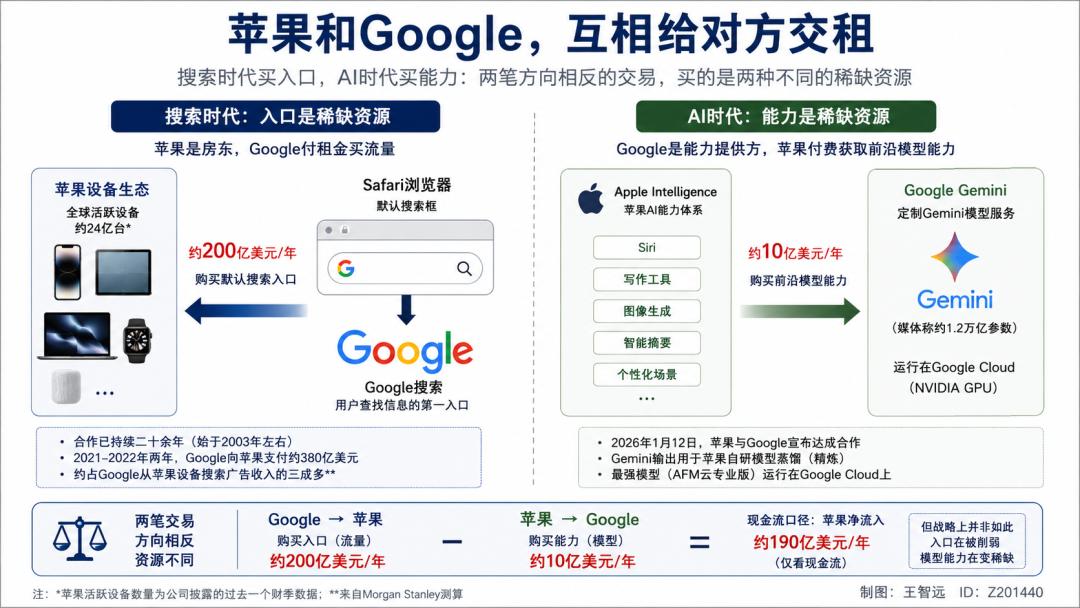
Google pays Apple $20 billion every year. All for one thing:
The default search position on the Safari browser. The first search box users see when they open the browser is Google. This deal started around 2003 and has been going on for over two decades.
01
There is a figure in the court materials of the US Department of Justice's antitrust case. Just from 2021 to 2022, Google paid about $38 billion for this. Morgan Stanley calculated that this amount is more than 30% of Google's share from search advertising on Apple devices.
To put it simply, this is a business of traffic tax.
Another sum of money flows in the opposite direction, from Cupertino to Mountain View.
On January 12, 2026, Apple and Google issued a joint statement saying that Apple's next - generation foundation model will be built using Google's Gemini.
Bloomberg's Gurman said that Apple pays about $1 billion a year for this. Google customized a model with 1.2 trillion parameters for Apple, which is eight times the number of parameters of Apple's original cloud - based model. CNBC, CNN, and TechCrunch all confirmed this cooperation on the same day.
The two sums of money flow in opposite directions and the things they buy are completely unrelated.
The first sum buys the entry point. With billions of devices, Google is the first door for users to find information. The second sum buys the ability. Since Apple can't catch up in cutting - edge models on its own, it pays to bridge the gap.
Just looking at the net cash flow, Apple is still the winner. It receives $20 billion and pays out $1 billion, making a net profit of $19 billion. But Winton, the chief futurist of ARK Invest, calculated a more eye - catching figure in January this year.
Looking at the two deals together, Apple has a net loss of $21 billion in "users searching for information through its devices". There is a problem with this calculation method. It combines two completely different types of transactions on one income statement.
The two rents are used to buy two different scarce resources, and the prices of these two things are moving in opposite directions.
First, let's see why the money for search is still flowing. The answer is simple. The entry point is still scarce.
Apple has about 2.4 billion active devices in its hands. The most consumption - power - oriented people in the world focus their attention here. To intercept this flow of attention, Google has to pay a sky - high price.
For twenty years, no search engine has offered a price close to this.
Tim Cook told the truth in 2018, saying that the Google search engine is the best. Eddy Cue was even more straightforward in the court: Even if Microsoft gave away Bing for free, it wouldn't be good enough.
However, the foundation of this rent has shown its first crack.
In May 2025, Cue testified in court. In April 2025, the search volume on Safari declined for the first time in 22 years. He attributed the reason to the diversion of AI search tools.
Things like ChatGPT and Perplexity are changing the way some people search for information. On the day the news came out, Alphabet's stock price dropped by 7%, and its market value evaporated by $155 billion. Wall Street voted with its feet.
Now, let's see why the money for the model has started to flow. The answer is equally simple. The ability of cutting - edge models is scarce.
There are no more than five or six institutions in the world that can continuously train truly cutting - edge large models, and Apple is not among them. Multiple media outlets quoted people familiar with the matter as saying that the failure rate of Apple's self - developed model in complex tasks in 2025 was about one - third.
Instead of struggling on its own, Apple spent $1 billion to buy Google's ability to fill this gap.
So, an interesting picture emerges:
In the old battlefield of search, Apple is the landlord, and Google pays rent to buy traffic. In the new battlefield of AI models, Google becomes the landlord, and Apple pays rent to buy technology.
Think about this picture: Apple and Google. Apple receives $20 billion in rent on one side and pays $1 billion in tuition on the other. The same company is both a landlord and a tenant.
To be honest, this kind of thing is really rare in business history.
The two trends are moving in different directions. The old business of search entry points is being gradually eroded by AI, while the threshold for model ability is rising.
Net cash flow is a snapshot of today, while the direction of rent tells you about tomorrow. Whoever can offer something that others don't have can keep collecting rent.
02
Apple's response this time was so fast that it didn't seem like itself.
The day after WWDC ended, Software Vice President Federighi and AI Vice President Subramanya sat down with a group of media for a technical discussion.
The first thing Federighi did when he took the stage was to distance himself.
His exact words were: We use zero Google Assistant. In plain language, we don't use any of Google Assistant's features.
Then he listed one by one that they don't use any Gemini models deployed by Google for its customers, don't use Google's client - side code, and don't use Google Search as the knowledge base.
They didn't even put the Gemini app in iOS. Several Apple news websites were present and independently reported the same statement.
Immediately afterwards, Subramanya added a sentence.
Apple's several foundation models are customized for its own chips, trained with its own data, and finally refined with the output of Gemini's cutting - edge models.
The four most crucial words in this sentence are "refined with the output", which is called distillation in technical terms.
What does it mean? Let Gemini be the teacher. First, it does the work, and then Apple's small models learn from the teacher's answers. After learning, when they graduate, there is no trace of the teacher left. The models produced are Apple's own.
One of the headlines on those Apple news websites was very accurate: "There isn't a drop of Gemini in Apple's new models."
If the story ended here, it would be really good. Apple borrowed Google's strength, but its products are clean and under its own control.
But if you really lay out what Apple took from Google one by one, the picture isn't so pretty.
First, there is a knowledge dependency.
Four out of Apple's five foundation models have been distilled with the output of Gemini. Without these outputs as targets, the quality of Apple's own models won't improve.
Subramanya himself said that they use the "Gemini cutting - edge models", which are the latest ones. What does this mean? With each round of model iteration, Apple has to go back to Google for the latest output. Just because you've graduated doesn't mean you won't need to go back for further study next year.
Second, there is a computing - power dependency.
Apple's most powerful model is called AFM Cloud Pro, which is specifically used for complex reasoning and intelligent - agent - level tool calls. Where does this model run? On Google Cloud, using NVIDIA graphics cards.
Apple's own private - cloud infrastructure simply can't handle the heaviest reasoning loads, so it has to extend this layer to Google's data centers.
Apple emphasizes that these machines can be audited by third - parties and user data won't be stored. The privacy policy is indeed strict. But the fact is that the hardware isn't in its own hands.
At the same time, Apple is developing its own AI chip called Baltra. In cooperation with Broadcom and using TSMC's 3 - nanometer process, it is expected to be available in 2027. However, Baltra is designed specifically for reasoning, not for training.
Bloomberg reported that Apple has cut a lot of investment in large - model training.
In other words, the bridge Apple is building leads to "running reasoning on its own", not "training models on its own". The other end of the bridge solves the computing - power problem, not the knowledge problem.
So, Federighi's statement "There isn't a drop" makes perfect sense at the product level. But at the ability level, Apple's dependence on Google hasn't disappeared. It has just changed its form, becoming a combination of knowledge binding and computing - power binding.
You don't live in the landlord's house, but you have to go back to his school for classes every semester. The set of exercises you train the hardest for has to be done in his gym.
Apple of course knows this.
It has made a series of hedges in the contract structure. The transaction is non - exclusive. The Foundation Models framework was designed with a contingency plan, allowing for the replacement of suppliers.
Developers can use the same set of APIs to call Apple's own edge - side models or the cloud - based Gemini. They can switch suppliers as they like in the future.
Xcode 27 has installed coding agents from Anthropic, Google, and OpenAI. Apple won't let Google touch the entry layer of Siri. It has full control over the scheduling logic, default backend, and user interaction. But at the developer - tool layer, all three are included.
The exclusive entry and multiple - choice backend are the best evidence of this hedge.
If there were really no dependence, there would be no need to buy insurance. The act of buying insurance precisely shows that you are clearly aware of the risks.
Apple has made so much effort to claim "There isn't a drop" because it knows better than anyone: Just because there isn't a single line of code doesn't mean there isn't a trace of dependence.
It needs the market, developers, and users to believe the story: Apple still has full control. But every hedging action it takes is a preparation for the day when this story might fall apart.
If you want to see a company's real situation, just look at how it hedges. The statement tells you what it wants you to believe, and the hedging tells you what it believes itself.
03
Whether the hedging works this time isn't up to Apple.
The key lies in one thing: Is the cost of cutting - edge models getting cheaper or more expensive?
If it is getting cheaper, in industry terms, it's called model commodification. Simply put, more and more players can develop cutting - edge models, the price is dropping, and the gap between models is narrowing.
In this scenario, Apple is the biggest winner.
With the world's largest device base and the most powerful distribution channels, Apple can rent the model from whoever has a good one and switch to whoever is cheaper. No one can hold it hostage.
The rent will only get cheaper, and Apple won't mind paying. Its moat lies in distribution and trust, not in the model itself. The entry point is still scarce, and models have become something that anyone can provide. Apple will still be the landlord.
What if it is getting more expensive? Or rather, if the cutting - edge capabilities continue to be concentrated in the hands of a few companies? That's a different story.
The number of institutions that can train truly cutting - edge models is decreasing. The rent will rise, and the options will shrink. Apple's situation in three to five years will gradually change from "I choose you" to "I can't do without you".
By then, non - exclusive contracts and switchable frameworks won't work. You can indeed switch suppliers, but if there are only two or three companies in the world that can offer what you want, your bargaining power will be worthless.
There is strong evidence on both sides at present.
Those who advocate commodification have a straightforward reason. The prices are crashing. Anthropic has cut its API price by 67% in the past year, Google has cut it by 70 - 80%, and OpenAI has also been reducing prices. The capabilities of open - source models are catching up.
The reason is simple: If the cutting - edge capabilities are really so scarce that only a few companies can provide them, they don't need to cut prices. Price - cutting itself is evidence of competition.
But those who advocate centralization also have eye - catching evidence.
The four major US technology giants, Google, Amazon, Microsoft, and Meta, spent a total of about $700 billion on AI infrastructure in 2026.
This figure was calculated by the Financial Times based on Q1 financial reports and has been cited by many media outlets.
What does $700 billion mean? It's higher than the GDP of Sweden. And this money is highly concentrated on one purpose: building data centers, buying chips, and training models.
This is the largest single - year concentrated investment by enterprises in human history, and this threshold is still rising.
What's even more interesting is what happened to Meta.
Meta is the most active promoter of open - source AI. It allows global developers to use its Llama series of models for free. But its latest closed - source model, codenamed Avocado, performed worse than Google's Gemini 3.0 in internal tests.
Both the New York Times and Reuters reported that Avocado's capabilities are between Gemini 2.5 and 3.0 and are not at the cutting - edge level.
The release date was postponed from the end of 2025 to March 2026, then to May, and then to June. Meta's management even discussed an option internally: Temporarily rent a Gemini from Google to boost the performance of its AI products.
Think about it. A company that spends $115 - 135 billion a year and has the world's largest social dataset is considering renting a model from a competitor.
The threshold for training cutting - edge models is rising, so high that even a company as large as Meta isn't sure it can keep up with each round.
Apple is facing the same problem.
It's just that Apple chose to rent from the beginning, while Meta only realized it had to rent after running for a while. Two forces are pulling on this rope at the same time.
The first force is pushing models towards being as accessible as water, electricity, and gas, something that everyone can use and afford. The second force is pushing models towards being like uranium mines, with a threshold so high that only a few can obtain the license.
Apple is betting on the first direction.
Its entire strategy, including renting models, developing its own reasoning chips, controlling the entry point, and opening up the backend, is based on one premise: Models will get cheaper, and I will always have options.
But what if this premise doesn't hold?
If the cutting - edge capabilities continue to be concentrated in the hands of a few companies, Apple will eventually find that the hedges it carefully designed are for a future that will never happen.
Whether the scarce things are getting cheaper or more expensive, and which way this trend turns, will determine who will still be the landlord and who will become the long - term tenant in three to five years.
04
By now, I guess some people are asking: What does all this have to do with me?
Well, Apple, Google, and WeChat are currently doing the same thing to the developers in their respective ecosystems.
In June this year, Apple issued a death notice for SiriKit at WWDC. This framework, which has allowed apps to access Siri since 2016, is officially abolished.
Starting from the launch of iOS 27 this fall, if an app wants to appear in the new Siri's world, there is only one way: Break down its functions into standardized actions and register them as App Intents. Let Siri call them directly. If you don't register, you'll disappear from the entry point.
In the same month, Google launched