Behind Claude are all seasoned veterans from major tech companies, and the profile of Anthropic's 1,680-person engineering team has been revealed: most of them are from Google, with 12 years of work experience on average and hold bachelor's or master's degrees.
Recently, it was discovered that Anthropic's official website is still recruiting software engineers, with the highest salary for relevant positions reaching approximately $570,000.
Some people questioned that this is false, while others said it was old information. However, on the official recruitment website, Anthropic is indeed still recruiting a large number of software engineers with high salaries: there are 67 open positions in the AI research and engineering direction, 33 in the applied AI direction, about 12 in the computing direction, 25 in the engineering and design - product direction, 15 in the security protection direction, and 67 in the sales direction.
Among them, the annual salary of a Staff Software Engineer for the Claude Code model performance is between $405,000 and $485,000. Another Claude Code system software engineer, more focused on the system's underlying layer, has an annual salary ranging from $320,000 to $485,000. The highest salary ceiling of $850,000 is offered to the TPU Kernel Engineer, indicating that what is truly scarce are those who can improve the efficiency of model training and inference.
In January of this year, Dario Amodei made an astonishing prediction: in the next 6 - 12 months, AI will completely replace software engineers. Meanwhile, half of the junior white - collar positions will disappear within the next 1 - 5 years. This caused a great stir at that time, and many developers felt anxious about the future.
Some people believe that the above two things expose the contradiction of Anthropic: on one hand, it claims that AI will reshape or even replace software engineering work; on the other hand, it is competing for top - tier technical talents with highly competitive salaries.
In fact, the expansion speed, talent sources, and ability structure of Anthropic's engineering organization deviate significantly from the general public's conventional perception of a "cutting - edge AI laboratory."
Recently, an analysis based on public LinkedIn data shows that the core profile of Anthropic's current engineering team is not the "researcher - intensive AI laboratory" that the outside world imagines, but is more like a rapidly expanding infrastructure company.
This analysis was conducted by recruitment practitioner Sebastian Cuadros. He retrieved all the people who listed Anthropic as their current employer on their LinkedIn profiles, a total of 5,306 people. He then screened out 1,680 employees who were truly engaged in engineering positions and further analyzed the 7,986 past job descriptions left by these people before joining Anthropic.
The results show that the members of Anthropic's engineering team are mostly senior engineers from companies such as Google, Meta, Amazon, Microsoft, Stripe, Databricks, Snowflake, and Palantir, with over ten years of engineering experience and expertise in back - end, distributed systems, databases, security, and large - scale production system construction.
Not a "Ph.D. laboratory," but a rapidly expanding infra engineering corps
Anthropic is no longer a simple "model laboratory" - style organization but has entered the stage of productization, commercialization, and large - scale expansion of infrastructure.
Anthropic expanded almost overnight.
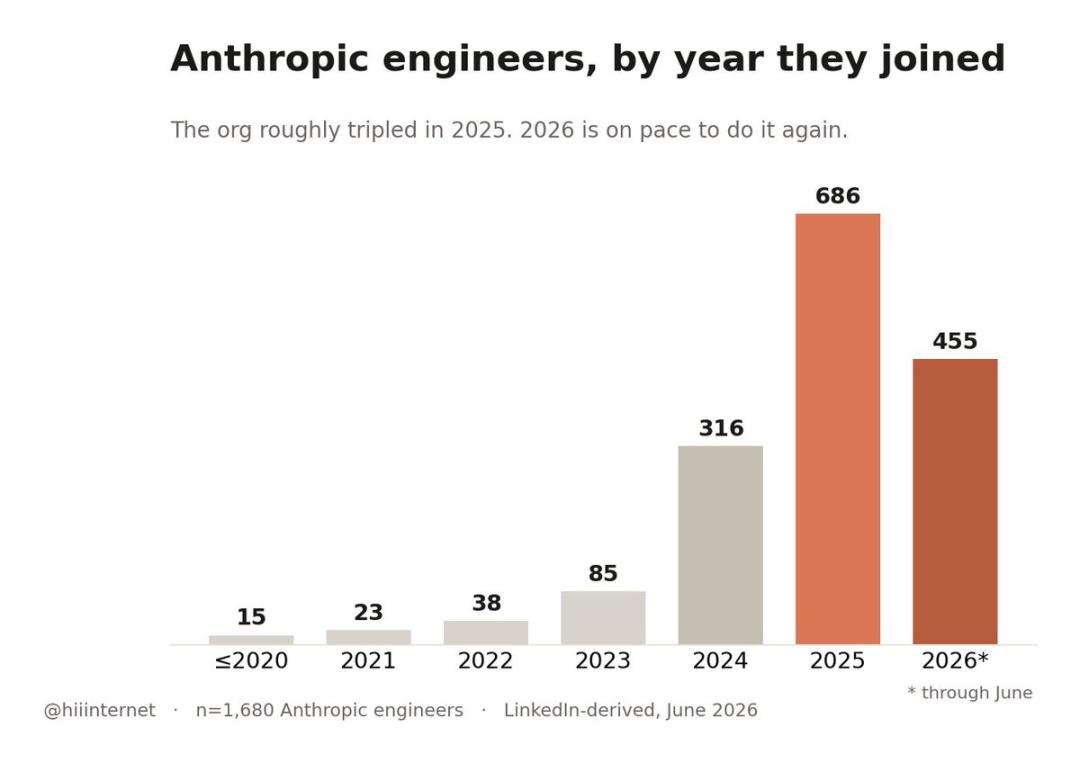
According to the analysis, among the engineers still at Anthropic, only 15 joined the company before 2021. In 2025, the organization's scale approximately tripled, with 686 engineers recruited that year. In 2026, it is progressing at the same pace, and as of June, 455 people have been recruited.
Currently, half of the engineering team members have been at Anthropic for less than a year. Those who joined in the past 12 months account for 53%, and the median tenure is only 10 months. That is to say, this is a giant engineering organization established in about 18 months.
Anthropic almost only recruits senior engineers.
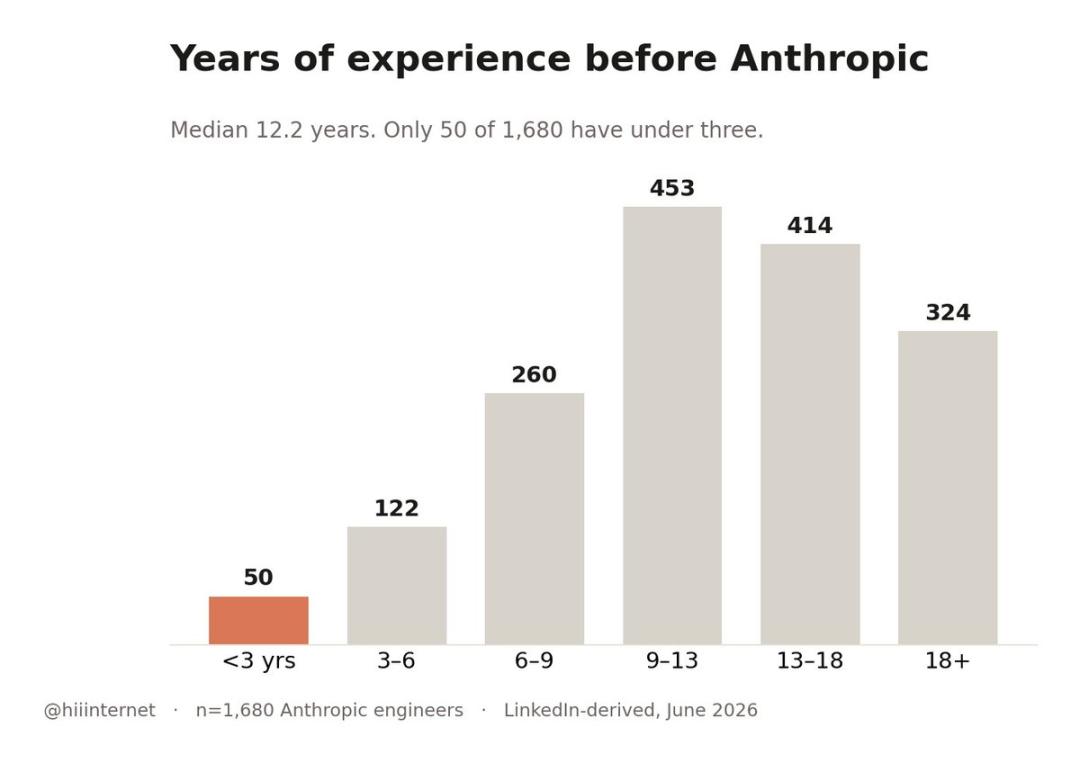
Among the 1,680 engineers, the median work experience before joining Anthropic is 12.2 years. The middle 50% of them have 8.8 to 16.5 years of work experience. Only 50 people have less than 3 years of work experience, and those with 13 or more years of experience account for 44%. There is almost no recruitment of fresh graduates.
So, a typical new - recruited engineer at Anthropic is someone with 12 years of work experience but has only been at the company for 10 months.
Only a very small number of "junior employees" can enter Anthropic.
Data shows that 172 engineers have less than 6 years of work experience, among which 50 have less than 3 years. However, these people are not ordinary fresh graduates or general - type intermediate engineers but are specially selected talents.
Compared with the overall engineering organization, this group of young engineers has a higher proportion of Ph.D.s, 19%, higher than the overall 13.7%. The proportion of those with product engineering or software engineering - related titles is also higher, 15%, while the overall proportion is only 5%. At the same time, the proportion of those with FAANG resumes is lower, 32%, lower than the overall 50%.
They make up for their lack of work experience mainly through other high - intensity screening criteria:
The first type is the internship pipeline. 50% of them listed internship experiences at the following companies: 16 at Meta, 10 at Google, 6 at DeepMind, 5 at Microsoft, 5 at Amazon, and also at Jane Street, Two Sigma, HRT, Optiver, and Nvidia.
The second type is those who switched from quantitative trading to the laboratory. 9% of them are from top - tier trading companies, including Jane Street, Two Sigma, Five Rings, HRT, Optiver, and Citadel. These are young math and computer competition - type talents who entered the AI laboratory through the high - frequency trading industry.
The third type is those with AI alignment scholarships. 6% of them have been involved with MATS, SERI, Redwood, or ARC. This is an entry almost only for junior talents and hardly exists among senior engineers.
Therefore, a typical young engineer profile might be: having a background from MIT, winning a silver medal in the International Olympiad in Informatics, with a Codeforces rating of over 2900, and entering the fields of reinforcement learning and AI security after about four years of work. When being screened, their competition rankings and papers are considered, rather than work experience.
The schools these people attended are also more international. In addition to Berkeley, Stanford, Cambridge, and MIT, they also include Tsinghua University, the University of Oxford, Imperial College London, the National University of Singapore, Shanghai Jiao Tong University, and the Swiss Federal Institute of Technology Zurich. This shows that for early - stage talents, Anthropic is more willing to use a global, high - standard, and strict - screening approach to find a very small number of "outliers."
Anthropic is clearly more focused on infrastructure rather than true research.
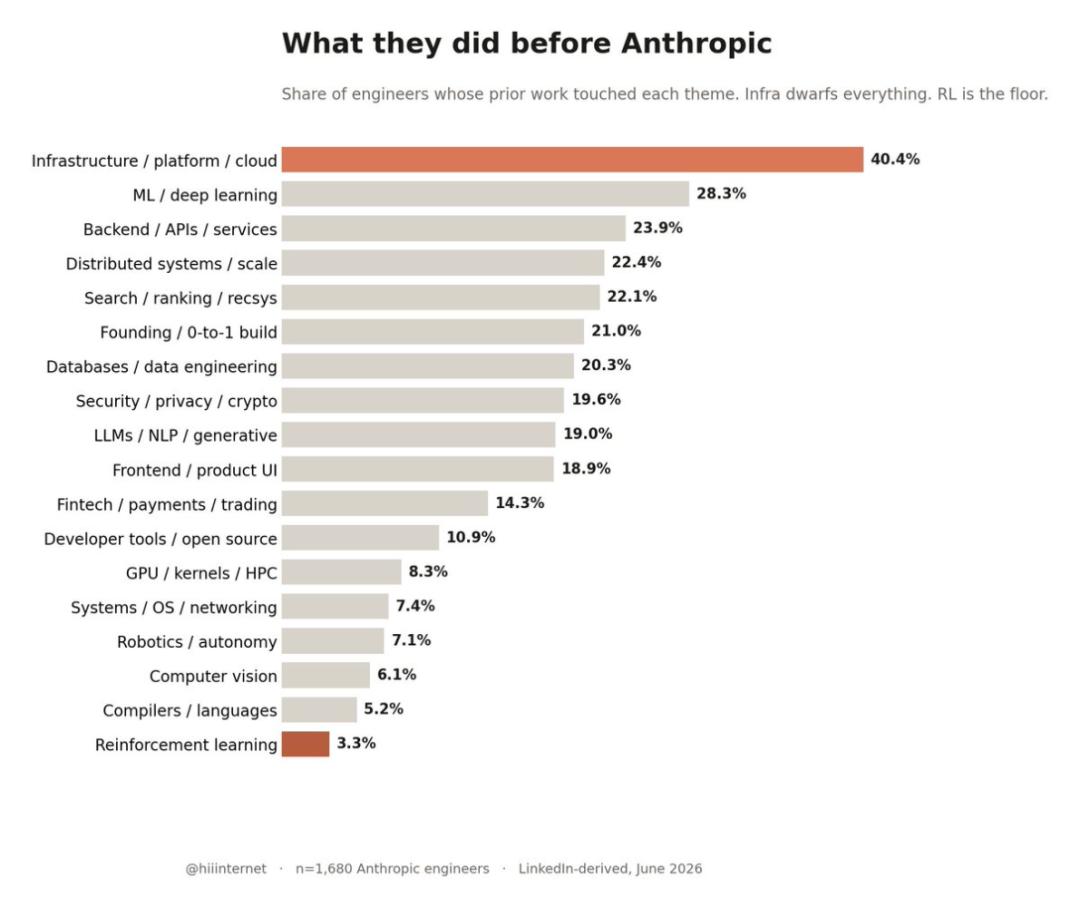
The analysis shows that 40% of the engineers have backgrounds related to infrastructure. Among them, the back - end, distributed systems, databases, and security directions each account for about 20%. In contrast, experiences related to reinforcement learning only appear in the backgrounds of 3.3% of the engineers.
This contrasts with the outside world's perception of Anthropic as a cutting - edge AI laboratory. A typical Anthropic engineer is more like someone who has been building large - scale production systems in ultra - large - scale cloud providers or infrastructure startups in the past decade, rather than a research scientist mainly publishing papers.
The skills they listed themselves also illustrate the same point: 585 people know Python, 566 know Java, 443 know C++, 376 know JavaScript, 302 know SQL, 230 know Linux, 189 know distributed systems, and 154 know AWS. Those more glamorous model - training jobs do exist, but they are very rare.
Among them, the most attention - grabbing is the TPU Kernel Engineer position. On the current recruitment webpage, the work locations for this position are in San Francisco, New York, and Seattle, with an annual salary ranging from $280,000 to $850,000. $850,000 is the highest salary shown on the recruitment webpage.
The position requires candidates to optimize machine - learning systems on accelerators such as TPU/GPU, involving low - latency, high - throughput sampling, low - precision inference, custom collective communication, performance modeling, and even kernel tuning at the assembly level. This type of position is directly related to model inference cost, training efficiency, and computing power utilization, so it has become a key area for Anthropic to recruit talents with high salaries.
In addition to low - level performance optimization, Anthropic also has a strong demand for infrastructure engineering talents. For example, the "Senior and Above Infrastructure Engineer (Cluster Infrastructure Direction)" position in London has an annual salary ranging from £325,000 to £485,000 (converted at the current exchange rate, approximately $439,000 - $655,000).
This position is responsible for the full - lifecycle management of Anthropic's computing clusters, covering cluster configuration, upgrade, decommissioning, fault recovery, security default configuration, and high - bandwidth interconnection across cloud platforms and self - built data centers. The job description specifically mentions that Anthropic's computing power scale is expanding at a speed "almost faster than any other company."
For large - model companies, the competition in model capabilities is increasingly transforming into competition in computing power efficiency, inference cost, cluster stability, and infrastructure engineering capabilities.
For example, the "Head of Data Center OFE Strategic Sourcing" position, responsible for the procurement of key electrical and mechanical equipment in data centers, including generators, switchgear, UPS, cooling equipment, transformers, etc., has an annual salary ranging from $290,000 to $365,000.
In the product and security direction, Anthropic is also expanding through high salaries. For example, the "Cybersecurity Product Engineering Manager" position has an annual salary ranging from $405,000 to $485,000. This position requires candidates to have many years of software engineering and engineering management experience and the ability to advance prototype products to the stage of use by paying customers and large - scale deployment.
In addition, the "Incident Response Manager (Product and Engineering Direction)" position has an annual salary ranging from $290,000 to $365,000. This position is responsible for building the incident response system on the product and engineering side of Anthropic and coordinating the cooperation of multiple parties such as engineering, product, security, legal, marketing, and management.
According to statistics, 80% of the people share the same job title: "Member of Technical Staff."
A former Instagram CTO, a former Adept founder, and a Stanford professor are all just "MoTS" here. This job - grade system is deliberately flattened. The employees' seniority, specific functions, and levels are not directly reflected through their titles.
The largest source of talent is not AI laboratories, but Google.
Everyone thought that Anthropic was mainly poaching people from OpenAI and DeepMind, but its largest talent pipeline is actually Google. The proportion of employees from several competing laboratories is very small.
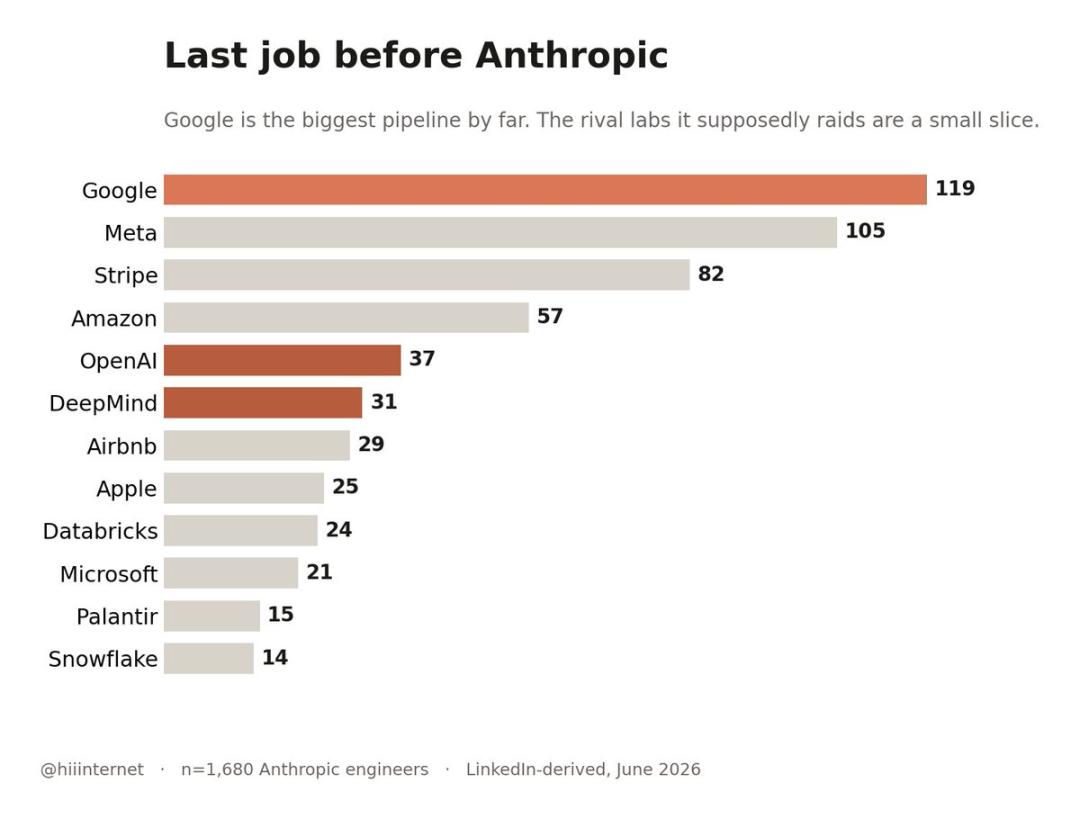
Anthropic significantly attracts talents from companies known for their engineering rigor: Stripe, Databricks, Snowflake, Palantir, and Airbnb.
If we look at the institutions where the engineers have worked in their past resumes, Google ranks first with 405 people, followed by Meta with 273 people, Amazon with 197 people, Microsoft with 171 people, Stripe with 124 people, Apple with 87 people, Stanford with 68 people, DeepMind with 62 people, Airbnb with 51 people, and OpenAI with 48 people. Half of the entire engineering organization has worked at FAANG companies.
Of course, they do poach people from other laboratories. OpenAI is the fifth - largest direct source, and DeepMind is the sixth - largest direct source. Approximately 94 engineers have directly switched from a cutting - edge AI laboratory.
Breaking the "Ph.D. myth" impression
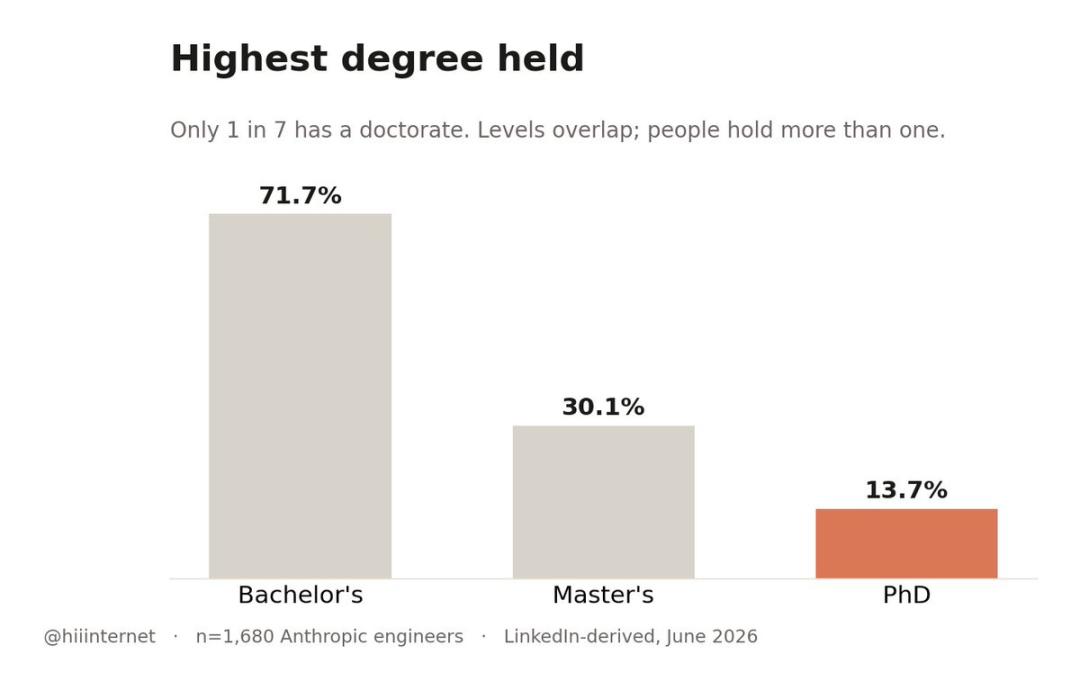
Data shows that only 13.7% of Anthropic's engineers have a Ph.D., meaning only about one in seven is a doctor.
A typical newly - recruited engineer at Anthropic is a senior engineer with a bachelor's or master's degree, rather than a research scientist. The idea that "the laboratory is full of Ph.D.s" is basically wrong at the engineering position level.
The distribution of their professional backgrounds also very much conforms to the characteristics of a construction - oriented organization: 819 people have a background in computer science, followed by 78 in mathematics, 70 in physics, and 69 in computer engineering. Philosophy also ranks among the top 20, with 13 people, which may be related to security.
In terms of school sources, Stanford is the most important school source for Anthropic's engineering recruitment. From historical cumulative data, Stanford has 144 people, Berkeley has 118 people, MIT has 80 people, Carnegie Mellon has 73 people, Harvard has 42 people, Cambridge has 39 people, the University of Washington has 36 people, the University of Waterloo and Cornell University each have 35 people, Oxford has 33 people, and Princeton has 32 people. Among them, the four schools of Stanford, Berkeley, MIT, and Carnegie Mellon together account for about a quarter of the engineering organization.
The profession is not collapsing, but the job structure is starting to fracture
Anthropic's situation shows that senior software engineers are still very important at present. Previously, the software engineer position was almost "eliminated" in public opinion.
In 2025, the software engineer job market presented a "contradictory state": job - seekers generally felt it was more difficult to get responses to their applications, while recruitment managers also thought it was more difficult to find suitable candidates than before. By this year, this contradiction has not completely disappeared, but the overall market has shown positive changes.
The latest "2026 Software Engineer Job Market Status" released by The Pragmatic Engineer shows that the recruitment of software engineers by top - tier technology companies is recovering, the number of job openings in the United States and the United Kingdom is increasing, and the number of software engineering positions opened by some high - paying technology companies has increased by about 20% compared to a year ago.
