A locality has halted the ABS issuance of "micro-loans", which may affect the turnover of hundreds of billions of yuan in loan assets.
Last week, multiple sources told "A Fintech Goose" that Chongqing has halted the issuance of ABS by small loan companies.
A person in the Chongqing fintech market told "A Fintech Goose": In fact, after the Spring Festival, some small loan companies went to the local financial regulatory department for filing, but they were told to suspend the process at that time and did not get approval.
According to the "Interim Measures for the Supervision and Administration of Small Loan Companies":
Small loan companies can raise funds through standardized forms such as issuing bonds and asset - backed securitization products.
However, first of all, small loan companies need the approval of the provincial - level local financial regulatory authorities. Then, it is necessary to check whether the company's governance mechanism, internal control system, risk management system, and whether there are any violations and other conditions are met.
As early as the end of last year, "A Fintech Goose" also mentioned in a related article - at that time, "All ABS and financial bonds of consumer finance companies were suspended from issuance. Those that had been approved but not issued were not allowed to be issued." Since this was the case for consumer finance companies, it seems reasonable for small loan companies to follow suit.
All kinds of signs indicate that the current supervision of loan - assistance business is penetrating into every link -
From the upper limit of interest rates, clear indication of interest and fees, to the constraints on withholding and clearing and settlement at the payment end, as well as the issuance of ABS by small loan companies at the capital end... all are being re - defined.
Of course, there is also a view that, judging from various events in Chongqing in the past six months, it is quite possible to speculate whether there is a change in the financial supervision in Chongqing.
From the earlier "Ruan Lu's investigation" and the chain reaction of strict investigations on payment channels triggered by the "Tongrong Small Loan" incident... The supervision of the small loan industry in Chongqing is shifting from the "open and inclusive" stage of high - speed expansion to the rhythm of risk clearance.
01
Chongqing is generally recognized as the "Capital of Small Loans" - Almost all small loan companies under mainstream Internet giants are registered here. Local policy changes always provide some references for local financial regulators in other provinces and cities.
It's hard to say whether other provinces and cities will also halt the issuance of ABS by small loan companies.
In fact, there are not many small loan companies with the qualification to issue ABS at present, and they are mainly concentrated in a few leading small loan companies, with most of them in Chongqing.
In the past, "A Fintech Goose" has repeatedly counted the scale and coupon rates of ABS/ABN issued by these small loan companies.
In Chongqing, those with the qualification to issue ABS include: Meituan Sankuai Small Loan, Du Xiaoman Small Loan, JD Shengji Small Loan, Ctrip Small Loan, and Didi's Xijiang Small Loan...
These leading small loan companies, as issuers, have cumulatively issued ABS/ABN worth tens of billions in 2025.
Before half of this year has passed, "A Fintech Goose" found through statistics that the scale of ABS and ABN issued by each small loan company is also considerable.
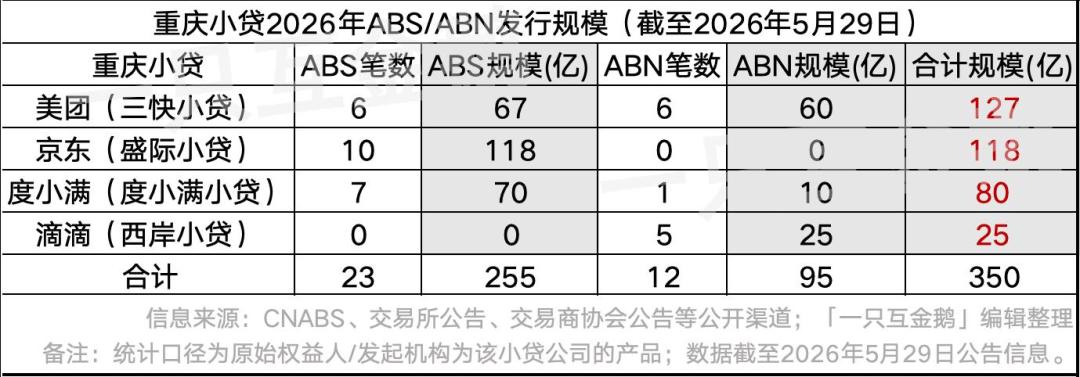
- Meituan Sankuai Small Loan issued ABS worth 6.7 billion and ABN worth 6 billion, with a cumulative total of 12.7 billion;
- JD Shengji Small Loan issued ABS worth 11.8 billion and did not issue ABN;
- Du Xiaoman Small Loan issued ABS worth 7 billion and ABN worth 1 billion, with a cumulative total of 8 billion.
- There is no information found on the ABS issued by Didi Xijiang Small Loan, and it issued ABN worth 2.5 billion.
The leading small loan companies in Chongqing have cumulatively issued ABS/ABN worth about 35 billion this year.
Note that the above table is only a statistics from the perspective of small loan companies as the "original equity holders/originating institutions".
There is another way of playing in the market: Trust companies act as the issuing entities in the front, while the underlying assets are still from the same group of small loan companies behind the scenes.
"A Fintech Goose" has also made a preliminary statistics on the ABS of small loan companies issued through trust channels:
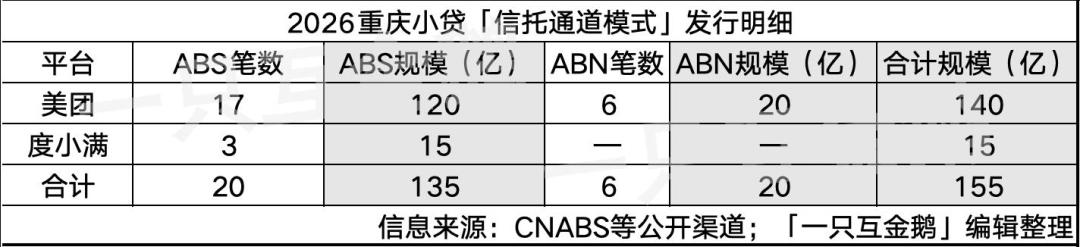
Mainly -
- Meituan issued 14 billion through cooperation with Huaneng Guocheng Trust, China Foreign Trade Trust, Huaxin Trust, and CITIC Trust;
- Du Xiaoman mainly cooperated with China Foreign Trade Trust and issued 3 batches, totaling 1.5 billion.
Currently, "A Fintech Goose" is not clear whether this halt is only for small loan companies directly issuing ABS/ABN as the original equity holders/originating institutions, or whether it also includes the channel model where trust companies act as the issuing entities and small loan companies only provide the underlying assets.
Last week, there were also rumors that trust companies in 6 regions received notices: They are not allowed to add new trust pools for consumer loans and loan - disbursement pools.
It seems that the channel - type business is also not optimistic.
Here, it should be mentioned -
JD has another channel that does not go through the small loan entity at all. Instead, through "Beijing Jingdong Century Trading Co., Ltd.", it issues ABS/ABN with the accounts receivable claims of JD IOU (rather than small loan claims) as the underlying assets.
In the first 5 months of 2026, the issuance scale of this channel was about 13.9 billion. This model is definitely not affected by the relevant policies of Chongqing small loans.
02
If only the issuance of ABS by small loan companies as the original equity holders is suspended, it will have a great impact on the leading small loan companies with an annual issuance scale of tens of billions.
Small loan companies do not absorb deposits, and their own capital is limited. They rely on asset securitization to achieve the circular off - balance - sheet of credit assets - packaging and transferring the loans that have been issued, and then continue to make loans after freeing up capital space. ABS is a key link in asset turnover.
Once this channel is closed, the credit assets that have been issued cannot be off - balance - sheet to recover funds, and the capital return can only rely on the repayment of the underlying assets upon maturity.
Taking a common 12 - installment loan as an example, it takes nearly a year to recover all the principal and interest, and the ability to make new loans will be greatly restricted during this period.
This is why the title of this article mentions that "the turnover of tens of billions of loan assets will be hindered". (In less than half a year, only the 4 leading small loan companies have cumulatively issued 35 billion.)
03
What should small loan companies do?
For the leading small loan companies with an annual issuance scale of tens of billions, they either have to accept the passive shrinkage of the loan - disbursement scale, or turn to joint loans or trust channels as an alternative -
However, the latter has a higher capital cost, and as mentioned above: There were also rumors in the market that this channel in several regions was also being halted.
"A Fintech Goose" found through research that currently, the coupon rates of the priority level of ABS/ABN issued by these mainstream leading small loan companies are usually around 1.6% - 2.1%, which is almost one of the lowest - cost sources of funds for loan - assistance platforms at present. (It is not ruled out that some small loan companies have lower - cost funds through bank loans or shareholder loans.)
Some market analysts believe that the increase in financing costs and the narrowing of profit margins are only short - term pains. The platforms can also transform into a light - capital model - not bearing credit risks and not occupying capital, and shifting from earning interest spreads to earning profit - sharing.
However, this model is not very optimistic either.
For example, looking at the financial report of Qifu Technology not long ago, in the first quarter of 2026, the revenue of the "platform service" representing the light - capital model decreased by nearly 40% year - on - year; the "financing revenue" representing the heavy - capital model - in short, the interest earned from self - lending - increased by more than 10% year - on - year.
To some extent, this shows that the willingness of capital providers such as banks to cooperate in pure lead - generation and profit - sharing is greatly weakening.
Even the leading players who first called for the transformation to a light - asset model are going back and relying more on the heavy - capital model.
The core reason is that most city commercial banks, rural commercial banks, private banks, and consumer finance companies still do not have the ability to independently review small - scale consumer credit at present. They are more willing to let the platform bear the risk with its own funds - this is the value of the heavy - capital model.
It is really difficult to persuade banks to accept the pure profit - sharing model.
The heavy - capital model of self - operated small loans highly depends on ABS off - balance - sheet to free up funds. Halting the issuance of small loan ABS just hits the bottleneck of this model.
There are also voices asking whether the small loan entities can be relocated to other regions, such as Fuzhou or Shenzhen?
"A Fintech Goose" believes that this is not advisable: Firstly, it is uncertain whether the policies of other regions will follow suit; secondly, in the past three years, there has been no public case of a small loan company under a mainstream Internet platform relocating its registered address across provinces - the small loan license is issued by the local authorities, and it cannot be moved at will.
In short, Chongqing, the "Capital of Small Loans", halting the issuance of ABS by small loan companies this time does not affect a single company, but the low - cost capital channels of the leading players in the entire loan - assistance industry.
The issuance scale of tens of billions cannot be seamlessly connected by simply changing the channel.
Next, the changes in the loan - disbursement rhythm and financing costs of these leading loan - assistance platforms may be the real indicators worthy of attention.
It's hard to say whether the balances of some leading loan - assistance platforms can remain above 200 billion or 170 billion.
This article is from the WeChat official account "A Fintech Goose", written by Xiaohuiya, and published by 36Kr with authorization.