"With the money that could fund one SpaceX, 24 companies have been supported" — A Panoramic Analysis of Commercial Aerospace Financing in China
On June 12, 2026, SpaceX officially listed on the NASDAQ under the ticker symbol SPCX. The issue price was $135 per share, corresponding to a market value close to $1.8 trillion, and the fundraising scale reached as high as $75 billion. This was the largest technology IPO in human history.
Looking back at its development history, before going public, SpaceX had cumulatively raised approximately $11 billion (about 77 billion RMB) through the primary market.
When the global spotlight was on Musk's rockets, a frequently mentioned topic was: How is China's commercial space industry doing now?
We conducted a systematic review of China's commercial space industry throughout its history.
The result showed a thought - provoking comparison. The 24 pure commercial space companies in China with the most financing had a cumulative historical financing total of about 62 billion RMB, while SpaceX had raised about 77 billion RMB in the primary market before going public.
In other words, the financing scale consumed by the 24 leading Chinese companies was comparable to that of SpaceX.
This was both a gap and a story.
This article will start from the data and analyze the financing structure of these 24 companies, the map of the investment forces behind them, and the development differences between them and SpaceX.
I. The overall picture of 24 companies: The financing powerhouse of China's commercial space industry
Ranked by the cumulative historical financing amount, we got the following list:
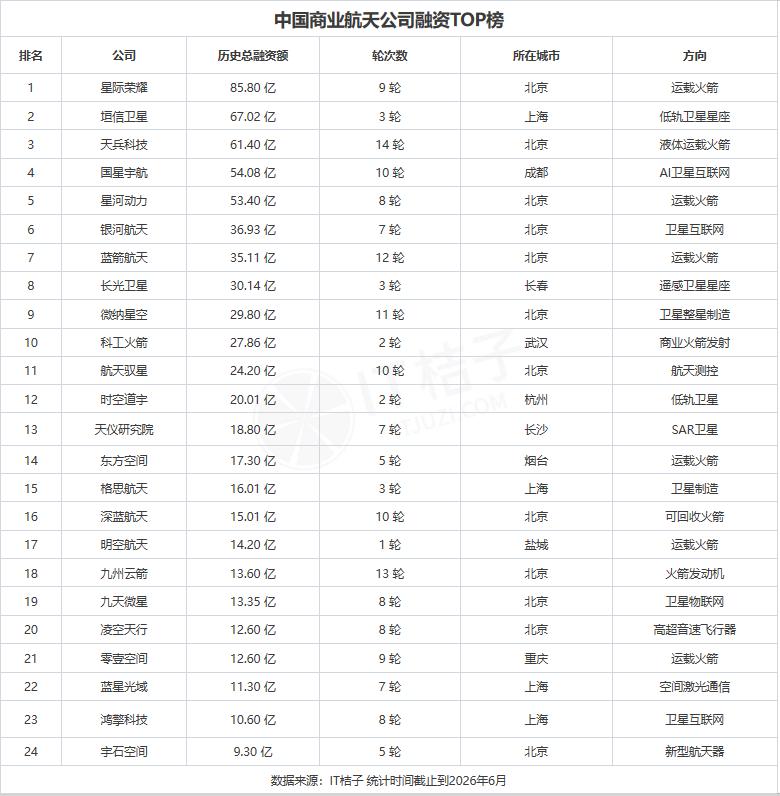
The total financing amount of this list reached about 62 billion RMB, indicating that the commercial space industry had become a financing track worth hundreds of billions.
Star Glory at the top of the list led with 8.58 billion RMB, but Yuanxin Satellite in second place had raised 6.7 billion RMB in just 3 rounds of financing, showing that the financing density of the satellite internet track was much higher than that of rockets.
Notably, 12 companies on the list had entered the Series D and later stages. Four rocket companies, Star Glory, Tianbing Technology, Xinghe Power, and Landspace, had all reached the Pre - IPO window, and the competition for the "first share of China's commercial space industry" had entered the final stage.
Another prominent feature was the urban concentration.
Beijing, with 12 companies and about 36 billion RMB in financing, dominated the market. Four of the top 5 rocket companies were located in the Beijing Economic - Technological Development Area/Fengtai District. Behind this concentration was the rocket R & D foundation and talent reserve brought by central state - owned enterprises such as the China Aerospace Science and Technology Corporation.
Different from Beijing, Shanghai became the second - largest center with 4 companies, clearly focusing on the satellite track. Yuanxin Satellite, Gesi Space, Hongqing Technology, and Lanxing Guangyu formed a complete chain from satellite manufacturing to constellation operation to space communication. The G60 Satellite Constellation Plan was an important industrial driving force.
Cities such as Chengdu, Changchun, Wuhan, and Yantai each occupied a place in the segmented tracks by virtue of their specific industrial genes or policy support.
II. Where did the 62 billion RMB go?
Rockets and satellites: The financing logic of the two tracks
From the perspective of track distribution, 9 rocket companies had a total financing of about 33.1 billion RMB, with an average of 3.68 billion RMB per company. It was a typical track with heavy assets, high barriers, and a long cycle.
10 satellite companies had a total financing of about 27.5 billion RMB. Although the total amount was similar, the financing rhythm was significantly different. Yuanxin Satellite had raised 6.7 billion RMB in just 3 rounds, reflecting the "high - profile and aggressive" financing strategy of the satellite internet.
The total financing of the two tracks exceeded 60 billion RMB, accounting for 97% of the total volume of the top 24 companies.
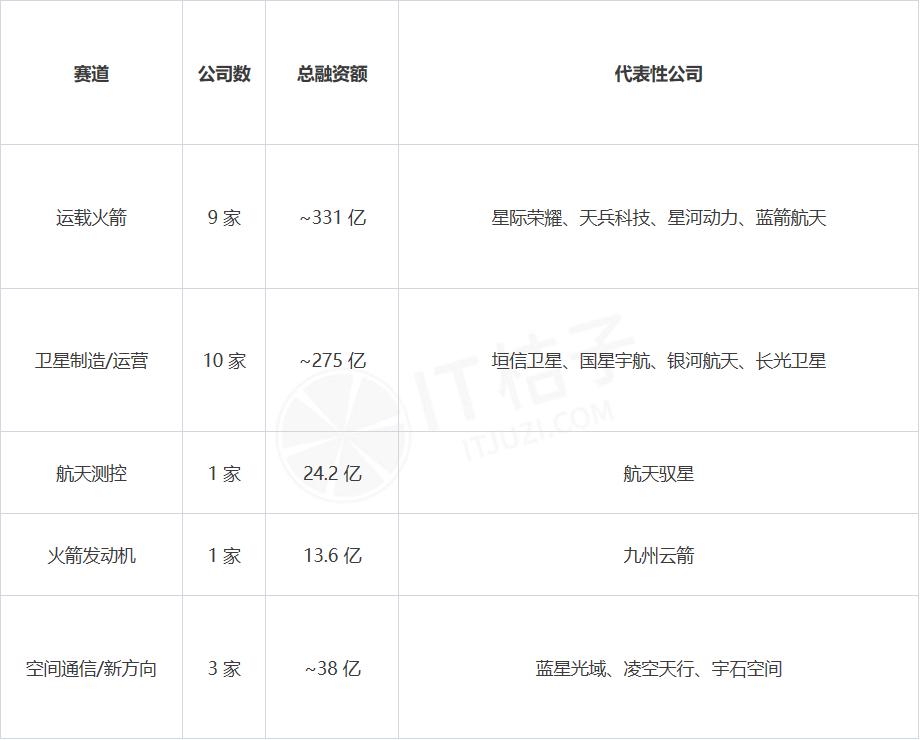
This pattern of "rockets running and satellites taking off" was actually a portrayal of the division of labor in China's commercial space industry. Rockets determined "whether it could go up", and satellites determined "what to do after going up". The former was the infrastructure, and the latter was the application ecosystem.
Now, sufficient funds had been injected into the infrastructure level, but the commercial closed - loop at the application ecosystem level had not yet been formed. This was the most core difference from SpaceX.
III. Who is betting on China's commercial space industry?
By aggregating the investors of all historical financing events in the commercial space industry one by one, we extracted valid records covering 183 companies and 434 investment institutions. Taking participation in at least 3 financings as the active line, 61 institutions entered the active list; 22 institutions had participated in at least 5 financings. The investment front in the commercial space industry had bid farewell to the early stage of "sporadic betting", and a group of core players who continued to increase their bets was taking shape.
Boyuan Industry Investment: The low - key top player in the track
Among the 434 institutions, Boyuan Industry Investment ranked first with 10 participations, covering at least 9 companies such as Spacety, Tianbing Technology, Galaxy Space, Micro - Nano Star, Yidong Aerospace, and Xingyi Lianxin. Its coverage breadth and participation density far exceeded those of other institutions.
Since 2026, Boyuan Industry Investment had continued to increase its bets. In April, it led a 1.3 - billion - RMB strategic financing for Spacety. In February, it participated in Galaxy Space's billions - level Series C financing and Yidong Aerospace's hundreds - of - millions - RMB Series B+ financing.
Boyuan Industry Investment managed a fund of about 30 billion RMB and had cumulatively invested in more than 35 commercial space enterprises, with an investment of nearly 8 billion RMB, covering the entire industrial chain of rocket manufacturing, satellite R & D, core components, and constellation operation. If Founders Fund and DFJ stood behind the rise of SpaceX, then the most important "patient capital" behind China's commercial space industry was undoubtedly Boyuan Industry Investment.
The second echelon: Three different investment logics
Following Boyuan Industry Investment, Shunxi Fund, Yuanhang Capital, and CSC Financial Capital tied for second place with 9 participations each, representing three completely different investment logics.
Shunxi Fund was a market - oriented venture capital platform under Beijing State - owned Assets Management. With a management scale of over 60 billion RMB, its 9 participations covered 9 companies. Since 2026, it had participated in Zhongxing Hi - Tech's Series A+ financing, Orbit Chenguang's Pre - Series A financing, Lingkong Tianxing's Series C financing, Galaxy Space's Series C financing, and Fuchang Space's Series B+ financing. Together with Jingguorui's 4 participations, they formed the "dual engines of Beijing state - owned assets".
The core team of Yuanhang Capital had a background from Beihang University and adhered to the strategy of "investing early, investing in small companies, and investing in hard - tech". It tied for second place with 9 participations. Since 2026, it had participated in Yunyao Aerospace's Series B+ financing (500 million RMB), Zhihang Technology's Series B financing, and Xingsi Semiconductor's Series D financing (1.5 billion RMB). The valuations of projects such as Xinghe Power, Micro - Nano Star, and Aerospace Yuxing, which Yuanhang Capital had invested in during the 1.0 era of the commercial space industry, had increased by more than a hundred times. It was one of the few professional aerospace funds in China that had "in - depth industrial understanding + early - stage investment ability + determination to accompany the growth continuously".
CSC Financial Capital's 9 participations reflected the increasing presence of the securities - firm sector in the commercial space industry. Its strategy was biased towards the "Pre - IPO window + strategic placement" route. Since 2026, it had participated in Zhixing Space's Series B+ financing, Gongda Satellite's Series B+ financing, and Orbit Chenguang's Pre - Series A financing. The last investment was made jointly with leading institutions such as Sequoia China, Cathay Capital, and Kunlun Capital, which had significant signaling meaning.
Local industry investment: The capital mapping of the urban competition
At the local industry investment level, Shenzhen High - tech Investment (7 participations), Wuxi Venture Capital Investment (7 participations), and Chengdu Science and Technology Innovation Investment (6 participations) were the three most active ones. Shenzhen High - tech Investment continuously laid out in aerospace component enterprises, synergizing with Shenzhen's advantage in precision manufacturing. Wuxi Venture Capital Investment focused on Micro - Nano Star, Sibetu, and Juntian Aerospace, linking with Wuxi's foundation in the Internet of Things and high - end manufacturing. Chengdu Science and Technology Innovation Investment participated in Star Glory's 5 - billion - RMB Series D+ financing and Star Development's Series A financing, continuously laying out around Chengdu's industrial clusters in rocket engines and satellite manufacturing. The commercial space industry was moving from "dominated by Beijing" to a multi - city ecosystem, and local industry investment was the most direct capital expression of this urban competition.
Yida Capital and the market - oriented VC echelon
Among the pure market - oriented institutions, Yida Capital led with 8 participations. Since 2026, it had participated in Kongwei Communication's Series C financing (jointly with China Internet Investment Fund and Agricultural Bank of China Investment), Xinhui Aerospace's Series A financing (jointly with Tongchuang Weiye), and Jianyuan Technology's Series B financing (jointly with IDG Capital), covering the dimensions from satellite communication to rockets to core components, which was the most complete among market - oriented institutions.
Puhua Capital (7 participations, participating in Spacety's 1.3 - billion - RMB strategic financing, Jiuzhou Yunjian's Series C+ financing, and Dahang Yueqian's Series A financing) and Shenzhen Capital Group (7 participations) followed closely. Qifu Capital (6 participations), Zhongke Chuangxing (5 participations), and CDH Investments (4 participations) formed a stable second echelon. Among the 22 institutions with at least 5 participations, market - oriented VCs and local state - owned asset platforms each accounted for approximately half.
The entry of leading VCs: Signals and significance
Sequoia China, Hillhouse Capital, and IDG Capital, the three most influential VCs in China, all made substantial investments in the pure commercial space track in the first half of 2026.
Hillhouse Capital was the most active among the leading VCs with 4 participations. Three of them were directed at Yushi Space. In March 2026, it participated in the Pre - Series A financing, and in May, it participated in the Series A financing (500 million RMB, jointly with 11 institutions such as Orient Securities Capital, Blue Lake Capital, and Gaorong Venture Capital) and continuously increased its investment. In addition, it participated in Qingwei Aviation's Pre - Series A financing in March. Yushi Space was the only domestic enterprise focusing on the "new - type spacecraft" direction, and its technical route was unique. Hillhouse Capital verified its judgment through continuous follow - up investments.
Sequoia China's first investment in the commercial space industry was in April 2026, participating in Orbit Chenguang's Pre - Series A financing (jointly with CSC Financial Capital, Cathay Capital, Kunlun Capital, Haisong Capital, and Innoangel Fund). Orbit Chenguang focused on dawn - dusk orbit computing power satellites and space data centers. Its first experimental satellite, "Chenguang No. 1", had been developed, and it planned to form a constellation of 120 satellites, focusing on the concept of "space - based computing power". This investment marked that Sequoia had extended from its previous investments in eVTOL (Volant Aero, HT Aero) to real space infrastructure.
IDG Capital participated in Jianyuan Technology's Series B financing in February 2026 (jointly with 8 institutions such as Yida Capital and Jiuzhi Capital). Jianyuan Technology was a representative of the stainless - steel rocket route, which echoed the technical route of SpaceX's Starship.
Overall, the investment landscape of the commercial space industry was no longer a fragmented wasteland. Boyuan Industry Investment (10 participations) and Shunxi Fund (9 participations) led as the two state - owned giants. Yuanhang Capital (9 participations) and CSC Financial Capital (9 participations) represented the professional and securities - firm sectors. Yida Capital (8 participations) led the second echelon of market - oriented VCs. The concentrated entry of Sequoia, Hillhouse, and IDG in 2026 meant the end of the "wait - and - see period" of leading VCs for the commercial space industry. When the valuation anchor was pushed up by SpaceX's listing, greater capital forces were accelerating their influx.
IV. The different development of China's commercial space industry pattern and SpaceX
Before going public, SpaceX had raised approximately $11 billion (about 77 billion RMB) in the primary market, while the 24 leading commercial space companies in China had a total financing of about 62 billion RMB. Their scales were similar, but the destinations of the funds and the choices of technical routes reflected two completely different industrial logics and development paths.
The first difference lay in the choice logic of technical routes.
SpaceX had followed the path of "single - point breakthrough and vertical integration" - from Falcon 1 to Falcon 9 to Falcon Heavy to Starship, following a single main line. The reuse record of a single booster of Falcon 9 had reached 34 times, and Starship was challenging the fully reusable super - heavy rocket.
China's commercial space industry presented a pattern of "multiple routes in parallel". Multiple liquid - recoverable rockets such as Zhuque - 3, Hyperbola - 3, and Tianlong - 3 were being advanced simultaneously, and the technical routes covered different directions such as stainless - steel rocket bodies, liquid oxygen methane, and liquid oxygen kerosene. This decentralized exploration increased the total financing amount in the short term, but it also meant a greater space for trial - and - error and a faster potential for technological evolution. Once a certain route was successful, the "second wave" of market - oriented investment would have a huge release space.
The second difference lay in the path of the commercial closed - loop.
As of March 2026, Starlink had more than 10 million paying users, covering 164 markets. Its revenue in 2025 was about $11.8 billion, providing a stable cash - flow feedback for SpaceX's rocket R & D. This closed - loop of "using applications to support R & D" was currently not available in China's commercial space industry.
However, the downstream application ecosystem of China's commercial space industry had its own unique path. The G60 Satellite Constellation Plan of Yuanxin Satellite and Gesi Space targeted market demands different from those of Starlink. The SAR satellite constellation of Spacety had initially taken shape in disaster monitoring and agricultural remote sensing. Orbit Chenguang's "space - based computing power" was an exploration in the new category of computing power satellites. The application scenarios of China's commercial space industry did not necessarily need to copy SpaceX's path.
The third difference lay in the structural characteristics of the capital ecosystem.
SpaceX's core investors were mainly long - term market - oriented capital, such as Founders Fund, DFJ, Google, Fidelity, and Baillie Gifford. Its financing logic was "technological breakthrough → valuation increase → financing → new breakthrough".
In the capital structure of China's commercial space industry, local state - owned assets and government - guided funds had a higher weight, and the financing logic was more inclined to "industrial layout → investment promotion → financing → industrial cluster".
The former had the advantage of mature market - based pricing and exit mechanisms, while the latter had the advantage of long - term capital patience and industrial synergy. Boyuan Industry Investment's coverage of the entire industrial chain and Shun