Executives exit in various ways, Alibaba AI doesn't need a "top leader"
A long and strange rumor about high - level executives leaving their positions is pushing Alibaba's AI business to the center of public opinion once again.
According to IT Home on June 13th, Zhou Jingren, a partner of Alibaba, has recently submitted his resignation application. Just six days ago, on June 8th, Alibaba announced that Zhou Jingren would serve as Alibaba's Chief Scientist and lead the establishment of the AI Future Research Institute, focusing on the exploration and breakthrough of cutting - edge AI technologies.
In just half a year, Zhou Jingren has actually been transferred three times. After Lin Junyang left in March, he temporarily took charge of Qwen. In April, he was appointed as the Chief AI Architect, in charge of the Tongyi Large - model Business Unit. With this new arrangement for frontier exploration and no involvement in specific business, it's no wonder that the outside world comments that it's a "promotion in name but demotion in reality".
As of the time of publication, Alibaba has not responded directly to this rumor, but this is not the first time that Alibaba's AI business has experienced an "ungraceful" handover.
Lin Junyang in March, Wuzhao in June, and then the rumor about Zhou Jingren a few days later. Each change has swept across the Internet like a thunderbolt, suddenly hitting the brakes at important junctures.
When these personnel shocks are put together, they may point to the same answer: in this company's AI landscape, there is no need for an absolute "number one position".
Those Who Can't Stay
Early in the morning on March 4th, Lin Junyang, the technical leader of the Qwen team, left a line on social media: "me stepping down. bye my beloved qwen."
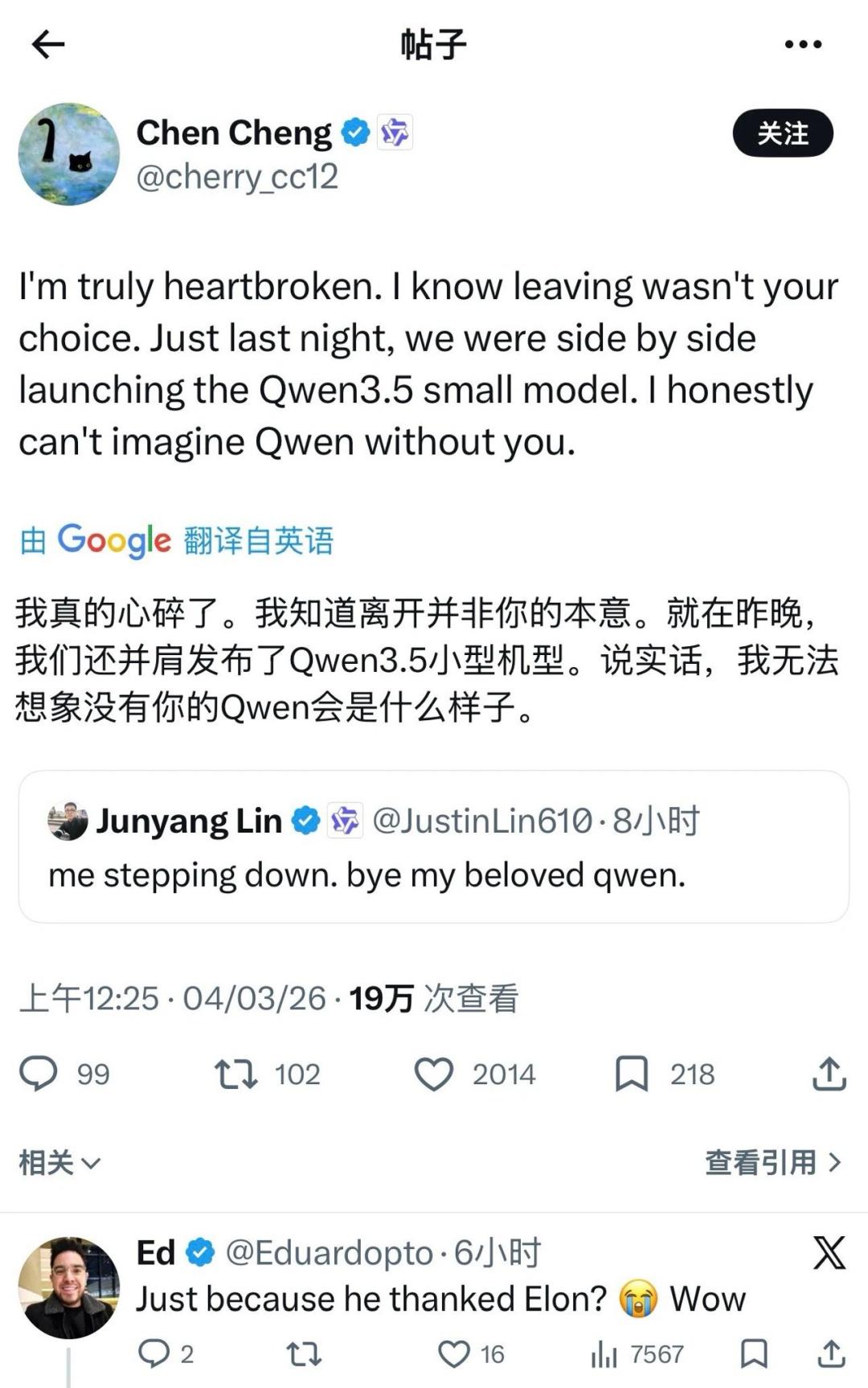
Less than 24 hours before that, he had led the team to open - source Qwen 3.5, which received public praise of "amazing" from Elon Musk.
This 32 - year - old tech geek said goodbye to the project he created with the briefest words. Around the same time, Yu Bowen, the person in charge of Qwen's post - training, and core members like Hui Binyuan also left the team one after another. A once - sought - after open - source dream team by global developers was on the verge of disintegration at its peak.
According to LatePost, the organizational structure adjustment was one of the fuse factors.
The Tongyi Lab planned to split the Qwen team from a vertically integrated model into horizontally divided teams. Pre - training, post - training, text, and multi - modality were split into independent teams, which was completely contrary to Lin Junyang's long - advocated "small team, large closed - loop" full - stack approach. The KPI pressure oriented towards results and the internal evaluation of the "semi - finished product" finally crushed this idealist.
The storm soon escalated to the group level. Senior executives such as Wu Yongming, Jiang Fang, and Zhou Jingren came out for communication, and an internal communication meeting was held to barely stabilize the situation.
When people thought this was the biggest variable for Alibaba this year, DingTalk had just experienced a more sensational leadership change storm.
On June 11th, Alibaba announced that Chen Hang (nickname: Wuzhao), the CEO of DingTalk, would step down, and Chen Yusen, a 92 - year - old tech geek, would take over. The fuse for the whole thing was a 75,000 - word resignation essay titled "Inside DingTalk".
This article, written by a former product manager of DingTalk, comprehensively reviewed the whole process from the project establishment to the failure of DingTalk's AI project "ONE" from an internal perspective. It named Wuzhao 73 times, directly pointing out deep - seated problems such as high - pressure overtime work in the team, chaotic product decision - making, repeated strategic positioning, and rigid management.
After the article fermented, the Partner Committee of Alibaba rarely issued a severe statement on the company's internal network, criticizing the management style of the DingTalk team and pointing out that "this is not what Alibaba's culture should be like".
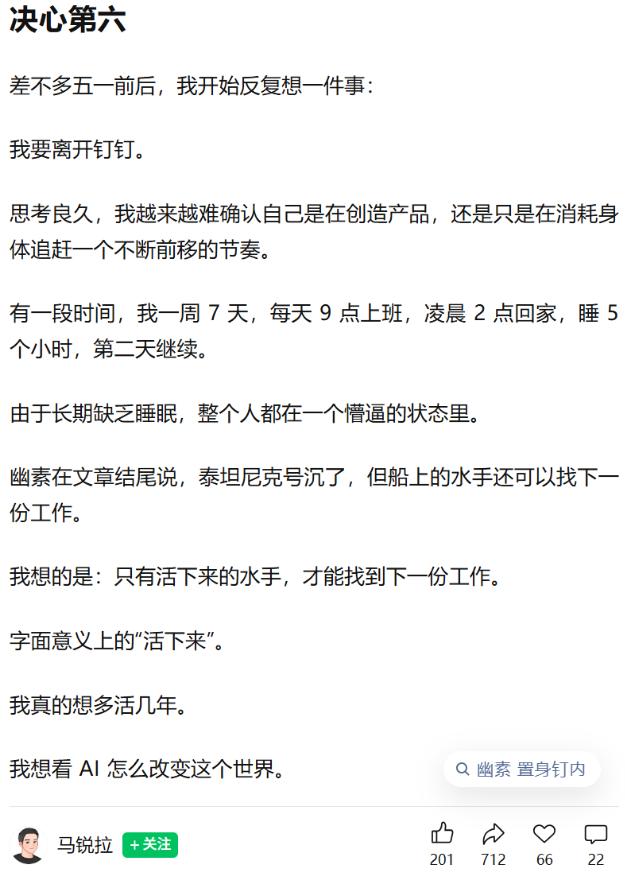
Meanwhile, Ma Ruila, the vice - president of DingTalk and the person in charge related to AI products, also confirmed her departure and posted "Outside DingTalk" on social media, sighing that "it's getting harder and harder to confirm whether I'm creating products or just consuming my body".
After Wuzhao, the founder of DingTalk, returned, he held high the banner of AI transformation, held three major press conferences in a year, and went all - in on AI. However, the 75,000 - word article tore open the cracks under the halo: extreme leadership will, high - pressure military - style management, and organizational internal friction caused by the pursuit of the "product illusion".
Chen Yusen, the successor, also has a technical background, but he believes more that certainty is the prerequisite for commercial AI. The product MuleRun he is in charge of has served enterprises and users in 43 countries around the world in less than two years since its launch. The proportion of paying users with a monthly consumption of more than $200 reaches 34%. His performance in going global and user retention is more mature, and he is better at the operation of AI - native organizations.
Three personnel changes, three almost identical patterns: internal contradictions accumulate to the critical point, public fermentation in some form, and the intervention of the top management for remedy. However, after the storm, the market sentiment is always filled with lingering speculation and uneasiness.
Centralization and Decentralization
Alibaba's AI strategy is undergoing a drastic shift from "decentralization" to "centralization".
In the past twenty years, Alibaba has undergone multiple organizational reforms. From the business expansion in the Taobao era, to the "big middle - platform, small front - end" in 2015, and then to the "1 + 6+N" in 2023.
Although these adjustments seem different on the surface, there is a common main line behind them: decentralize power. Let more businesses have independent decision - making power and let those closest to the customers make decisions.
But in the case of AI, the logic has changed. AI is not an independent business like e - commerce, payment, or cloud computing. It is becoming the infrastructure that all businesses rely on.
If each business develops its own model, the result will be repeated investment of resources, inability to precipitate capabilities, and inability to share data. Computing power is getting more and more expensive, talents are becoming more and more scarce, and AI is also getting "bigger".
Since 2026, Wu Yongming has made three major adjustments to the AI organizational structure.
In March, the Alibaba Token Hub Business Group was established, integrating the Tongyi Lab, the MaaS business line, the Qianwen Business Unit, the Wukong Business Unit, and the AI Innovation Business Unit, directly under the responsibility of Wu Yongming. In April, the Group Technology Committee was established, with Wu Yongming as the team leader and Zhou Jingren as the Chief AI Architect. Wu Zeming and Li Feifei entered the unified decision - making framework. In June, the Tongyi Large - model Business Unit and the Future Life Lab were merged to form the Token Foundry Business Unit, still directly managed by the CEO.
The logic of these three steps is clear: collect models, collect talents, and collect products. The reporting relationship of Alibaba's AI business is getting shorter and the decision - making chain is getting more and more concentrated.
Zhou Jingren's appointment as "Chief Scientist" can be seen as a symbolic footnote to this power centralization to some extent. Zhou Jingren has been in charge of the Tongyi large - model within Alibaba for many years, but the most core model R & D team of Tongyi was transferred to the Token Foundry in the organizational adjustment on June 8th and is no longer under his responsibility.
It means that the most core team under Zhou Jingren has been transferred, and Alibaba has given him a "highest academic title". This is a promotion in position but also a substantial stripping of power.
From the perspective of the team, this pattern is also obvious. The reason why Qwen in Lin Junyang's era could achieve quick results was largely due to a vertically integrated model of "small team, large closed - loop". The researchers were involved in both pre - training and post - training, writing code and managing Infra. The information flow was extremely fast and the decision - making chain was extremely short.
However, under this model, Qwen was relatively isolated from other Alibaba businesses.
When the AI strategy changes from a "single - point battle" to an "overall battle", and when the model is no longer an independent project but must drive the commercialization of the entire group, the vertically integrated "small kingdom" will inevitably give way to the horizontally divided "assembly line", even if it means the loss of some core members.
Wu Yongming seems to have made a choice. The revenue of Alibaba Cloud's AI - related products has had three - digit growth for 11 consecutive quarters. In the fourth quarter of fiscal year 2026, it reached 8.971 billion yuan, accounting for more than 30% of the external commercialization revenue for the first time. Qwen 3.7 - Max has entered the top five globally and ranked first among domestic programming models in international rankings.
Judging from the data, this integration is having an effect, but in the process, some people will inevitably need to leave the existing power center.
People Leaving in the AI Era
Taking a broader view, Alibaba's problem is not unique. This round of AI - driven organizational change is taking place globally at the same time.
Google took the lead in action. In April 2023, it merged the Brain team, which had been operating for nearly a decade, with DeepMind to form Google DeepMind, led by Demis Hassabis and reporting directly to CEO Sundar Pichai.
At the beginning of 2025, all AI engineering groups scattered in various product lines were merged into DeepMind. Demis Hassabis later said that this organizational upheaval was accompanied by painful running - in, but it was worth it.
Meta's actions were even more drastic. It restructured its AI organization four times within half a year in 2025, with the core direction of bridging the gap between the FAIR Lab and the product AI team. In May 2026, Meta announced layoffs of about 8,000 people and transferred about 7,000 people to new AI - related teams, establishing an "AI - native design structure".
Mark Zuckerberg said bluntly that the AI transformation "will inevitably encounter various challenges" and that in the future, "it is almost certain that more mistakes will be made".
In China, Tencent abolished the enterprise - level AI Lab that had been established for nearly a decade. Some personnel were merged into the Hunyuan team. Yao Shunyu was recruited from OpenAI to Tencent as the Chief AI Scientist, reporting directly to President Liu Chiping.
Gu Quanquan, the core scientist of ByteDance's Seed team, announced his departure. The AI4S team under him is facing organizational adjustment, and many backbones have started their own businesses. Every company is facing a similar problem of "tension between organization and technology" under the wave of AI competition.
Alibaba's current adjustments are completely in line with this global trend. But the problem lies in that the way and rhythm of implementing these adjustments determine the magnitude of the shock.
Google's merger took place in April 2023, and it took nearly two years to truly complete the "unified" integration, which reserved a relatively long running - in period for the organization. Microsoft and Meta's reorganizations were accompanied by layoffs and personnel turmoil, but they were relatively concentrated on the functional adjustment of the management. However, Alibaba's shock directly affected the founders of the team and the technical soul figures.
This may indicate that Alibaba's strategic stance in the AI era is a more radical model than most competitors. It doesn't intend to wait for the internal running - in to be completed naturally, but is more willing to cut through the Gordian knot with the "scalpel" of personnel adjustment. The price is that each organizational "surgery" is accompanied by a public opinion storm, and each high - level change requires the management to come out and put out the fire.
But from another perspective, in this AI arms race, OpenAI has Microsoft as its backer, Google has DeepMind, and Meta has the world's largest user data pool. Alibaba doesn't have many choices.
Alibaba is not in the leading position. To catch up or even overtake, what is needed is not a gentle and gradual organizational evolution, but a more concentrated and decisive power integration. Judging from a series of operations since Wu Yongming took office, he knows exactly what he is doing.
If Zhou Jingren really leaves, he will be the fourth core figure to leave the Qianwen team of Tongyi in 2026. The team that made Qwen a global star open - source model has been torn apart in just a few months.
In just half a year, Alibaba's AI business has experienced three major personnel shocks: Lin Junyang's departure, the rumor of Zhou Jingren's leaving, and Wuzhao's stepping down as the CEO of DingTalk. Each is related to the centralized adjustment of the AI strategy in some way, and each is also accompanied by the spread of public opinion and controversy.
In the past decade, Alibaba was used to telling its rise with a "hero narrative": Jack Ma's free - thinking, Zhang Yong's strategic planning, Wuzhao's wild growth, and the passionate struggles of countless tech experts.
But in the AI era, the individual narrative has changed to a system competition. The deployment of computing power, the scheduling of data, the penetration of scenarios, and the rhythm of commercialization all require a mechanism beyond individuals to operate.
The heroes are fading, and the "factory" is starting. This battlefield without a protagonist may be the most real appearance of AI commercialization.
This article is from the WeChat official account "Super Focus Foci", author: Fang Wensan. Republished by 36Kr with authorization.