The soft-shell market is booming — how is the "pioneer of soft-shell" accelerating its rapid growth?
Softshell Jackets Are Booming, but Many People Don't Know What to Buy
Chinese consumers' understanding of outdoor equipment is undergoing a subtle change.
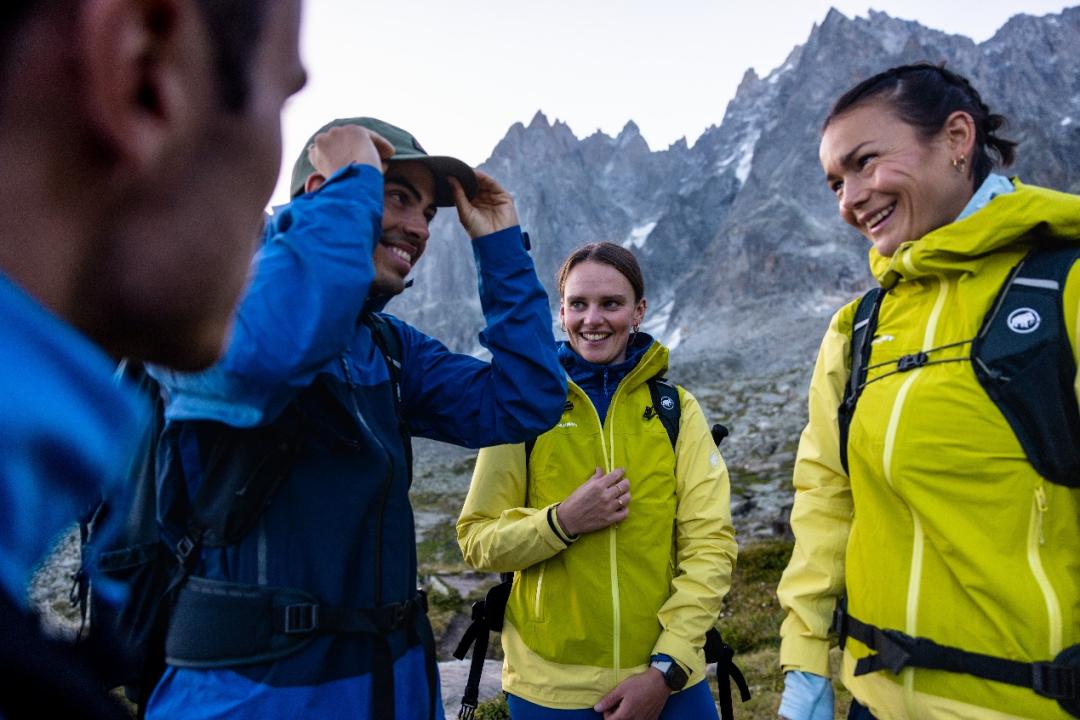
In the past few years, hardshell jackets were the iconic items in the explosion of outdoor consumption in China. They are professional, wear-resistant, and waterproof, and have almost become the identity label of hardcore outdoor enthusiasts.
However, as outdoor activities have shifted from a niche interest to a popular lifestyle, the actual wearing scenarios have become more complex. Today's consumers not only wear outdoor clothing when climbing mountains, rock climbing, or skiing. More often, outdoor outfits can be seen on the way to work, in the suburbs on weekends, during trips, and even in the office and coffee shops.
The boundary between outdoor and daily life is becoming more and more blurred, and equipment no longer only serves extreme weather and professional sports. Therefore, mass consumers have more specific requirements for a functional jacket: it should not only emphasize protection but also adapt to movement, temperature differences, comfort, and dressing in urban life.
The popularity of softshell jackets has emerged in this context. As a classic outdoor equipment, softshell jackets retain a certain ability to resist wind and water, and are softer and more breathable than traditional hardshell jackets. They are suitable for physical activities and can be easily integrated into urban scenarios.
In the past two years, the discussion of softshell jackets on social media has increased significantly. The "2025 China Sports and Outdoor Windbreaker Market Consumption White Paper" jointly released by JD.com and the China Textile Business Association shows that the social media volume of softshell jackets has increased by 136% year-on-year, more than twice the increase of hardshell jackets.
From equipment bloggers comparing the differences between softshell and hardshell jackets and popularizing the performance of DWR water repellency and breathability, to commuters, cyclists, and suburban hikers sharing their actual experiences of wearing one jacket in multiple ways, a large amount of UGC content has continuously refreshed the public's understanding of softshell jackets. On Xiaohongshu, content such as "commuting softshell jackets", "urban mountain-style softshell outfits", and "actual tests of Mammut's Ultimate softshell jackets" is constantly increasing, which also shows that softshell jackets are meeting the urban daily and light outdoor needs that hardshell jackets cannot cover.
However, the increasing attention does not mean that the category awareness has matured. In fact, softshell jackets may be one of the most easily misunderstood categories in outdoor clothing at present.
On e-commerce platforms and short video live streaming rooms, "softshell jackets" have become a high-frequency keyword. Cotton-padded jackets, fleece-lined windbreakers, thin windproof jackets, and even some ordinary woven jackets may be labeled as "softshell windbreakers". Consumers see the outdoor packaging, but only find that the jackets do not have the expected windproof, water-repellent, breathable, or elastic performance after they actually receive them.
Similar consumer confusion is not uncommon. Some consumers said that they placed an order because of the selling point of "high elasticity and breathability", but found that the jacket was more like an ordinary commuting windbreaker after receiving it, and they still felt stuffy after sweating. Others bought the so-called "thickened softshell jackets" in the live streaming room, but only realized that they were just fleece-lined and cotton-padded jackets when they got them. They can keep warm, but they are not the same as real outdoor softshell jackets.
The essence of this kind of problem is not just the false labeling of individual products, but that "softshell jackets" are being used as a marketing label. It seems more professional than ordinary jackets and more practical than hardshell windbreakers, and it is easier to be put into the current popular outdoor narrative. However, without a clear functional definition, it is difficult for consumers to judge whether they have bought a softshell jacket or an ordinary jacket with an outdoor name.
Another misunderstanding comes from consumers themselves. In the Chinese consumption context, "windbreakers" have long been closer to the concept of hardshell jackets. When many people understand outdoor jackets, the first thing they think of is strong wind resistance, heavy rain-level waterproofing, and high wear resistance and scratch resistance. Although this set of standards is important, it cannot be completely used to evaluate softshell jackets.
Therefore, softshell jackets are often compared with hardshell jackets. Some people think that since softshell jackets are outdoor jackets, they should be able to withstand rain for a long time. Others put scratch resistance and wear resistance first and ignore the more core breathability, elasticity, and dynamic comfort of softshell jackets. Consumers seem to be comparing performance, but actually they are comparing the tasks of two different categories.
This directly causes a mismatch in purchase expectations. Wearing a softshell jacket in continuous rain and finding that it cannot be as waterproof as a hardshell jacket, consumers then think that the product is not professional enough. Using a softshell jacket on a route with dense shrubs and frequent scratches and finding that the fabric pilling or wearing, consumers then judge that it is not "outdoor" enough.
Today's softshell jacket market is facing two problems at the same time: on the one hand, the concept of softshell jackets is being generalized on the product side, and ordinary jackets can also use the softshell label. On the other hand, there is a judgment mismatch on the consumer side, and real softshell jackets are often compared with hardshell jackets in terms of extreme protection.
The hotter the category, the more the awareness needs to be reorganized. For softshell jackets, what the market lacks now is not more products, but a clearer category consensus: what exactly is a softshell jacket, what scenarios is it suitable for, and what standards should be used to judge its quality.
The Core Value of Softshell Jackets Is to Find a Balance between Protection and Comfort
If the core task of hardshell jackets is to deal with heavy rain, snow, and high-friction environments, then the value of softshell jackets has been to provide more flexible and comfortable body protection since their birth.
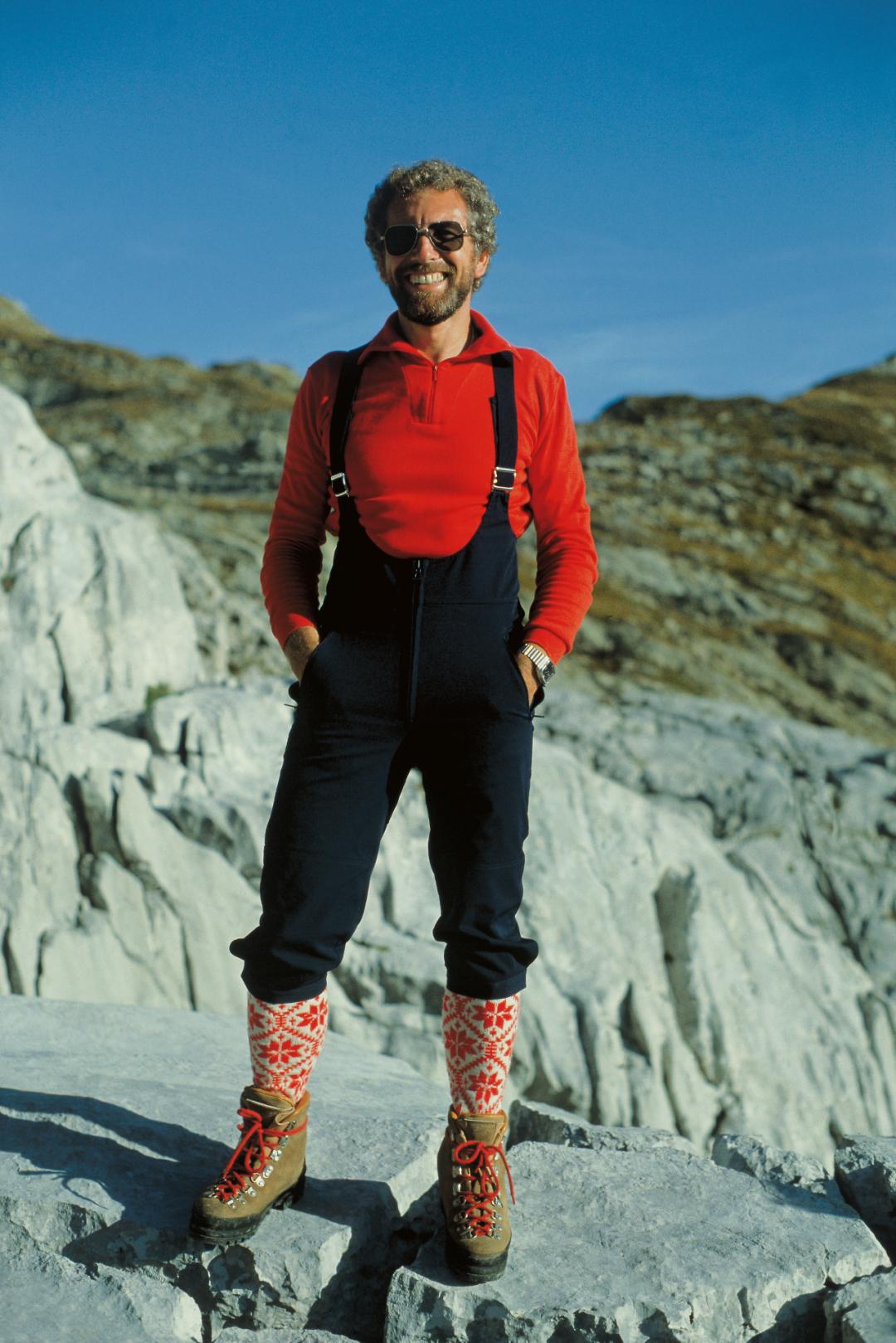
In 1984, Mammut, a Swiss professional outdoor brand, combined Schoeller® material with Lycra® elastic fabric to make the first softshell pants. Compared with the outdoor clothing that emphasized rigid protection at that time, this fabric achieved a new balance between wind resistance, breathability, and extensibility, and also laid the product prototype and technical foundation for modern softshell clothing. It was this innovation that gave Mammut the category status of "the originator of softshell jackets".
From this starting point, softshell jackets are not a low - end version of hardshell jackets, but a set of outdoor clothing logic re - established around dynamic activities.
According to Mammut's internal definition, softshell jackets are outdoor clothing made of fabrics with windproof, water - repellent, elastic, and moisture - permeable functions. According to different fabric structures, they can be divided into three - layer membrane - coated, two - layer non - membrane - coated, and single - layer softshell jackets.
On this basis, Mammut has a clear softshell jacket evaluation system: taking wind resistance, water repellency, elasticity, and moisture permeability as the four core dimensions to divide the category boundaries between softshell jackets, hardshell jackets, and ordinary windproof jackets.
This definition gives the functional logic of softshell jackets. Wind resistance and water repellency are the basic thresholds for a qualified softshell jacket. It needs to help the body resist wind, light rain and snow, and temperature differences in daily outdoor activities. However, the real difference between softshell jackets and ordinary jackets and hardshell jackets lies in whether they can maintain moisture permeability, elasticity, and freedom of movement in a sports state.
The body state in outdoor sports is constantly changing. Going uphill, cycling, skiing, and walking fast will all make the body continuously heat up and sweat. Stopping, entering the shade, or encountering wind will quickly cool down the body. If the clothing can only block the external environment but cannot timely discharge the water vapor generated by the body, a stuffy and wet feeling will soon appear. In a low - temperature environment, the sweat vapor remaining on the body surface may further increase the risk of hypothermia.
Therefore, what softshell jackets really need to solve is not "waterproofing", "wear resistance", or "whether they can be as durable as hardshell jackets". Their more core task is to keep people dry, stretched, and comfortable in dynamic sports.
From this, we can also see that softshell jackets and hardshell jackets are not simply in a substitution relationship. Hardshell jackets are more suitable for environments with heavy rain, snow, strong wind, high altitude, and more climbing friction. Softshell jackets are more suitable for high - frequency scenarios such as hiking, cycling, skiing, lightweight mountain climbing, running and fitness, weekend camping, and urban commuting. They may not undertake the most extreme protection tasks, but they can better adapt to the real state of the body during continuous activities. It is worth mentioning that the use scenarios of softshell jackets and hardshell jackets are not clearly defined, and there is a considerable overlapping area in the middle. Many senior outdoor players also prefer to use high - performance professional softshell jackets in medium - to high - intensity mountain routes such as regular snow - mountain trips and long - distance hikes.
In terms of wearing methods, softshell jackets are also more flexible. In non - extreme weather, they can be directly used as the outer layer to cope with wind, light rain, and morning and evening temperature differences. When the environment becomes colder or the weather becomes more complex, they can also be used as the middle layer and cooperate with hardshell jackets and warm - keeping equipment.
From the perspective of professional evaluation, we can also see that the key to judging a good softshell jacket lies in the balance of functions.
The Swiss consumer magazine Kassensturz once tested ten popular softshell jackets from professional stores and online stores. The test dimensions included rain resistance, breathability, and durability. Finally, Mammut's Ultimate Comfort SO hooded jacket was rated as the best.
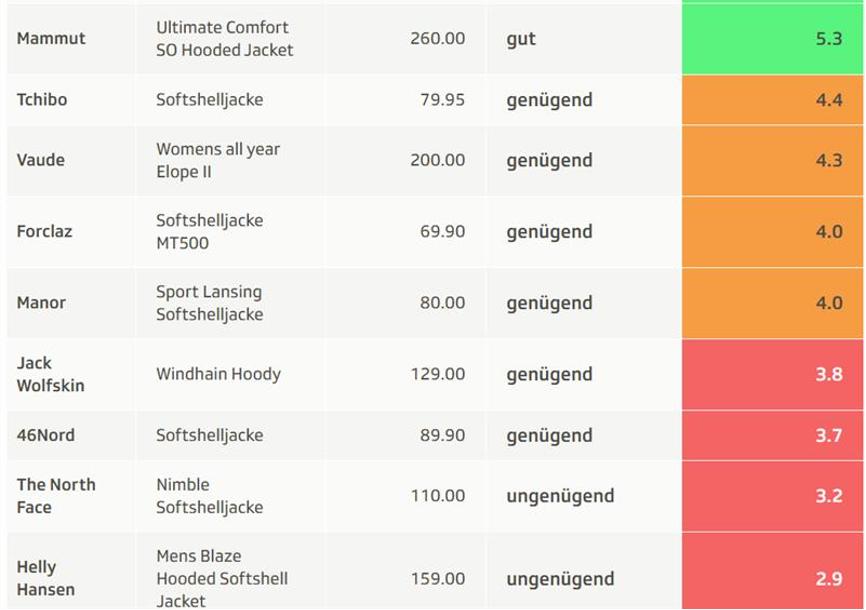
The value of this result is that it does not evaluate softshell jackets with a single parameter, but puts softshell jackets back into the real usage context: they should be able to resist light rain, maintain breathability during sports, and withstand a certain intensity of use. Mammut's softshell jackets that have obtained excellent evaluations often achieve a more stable comprehensive performance among multiple core dimensions.
This exactly responds to the core problem of the softshell jacket category: a good softshell jacket should not only be extremely strengthened in a single indicator. Basic protection, dynamic moisture permeability, and freedom of movement constitute the most important value combination of softshell jackets.
From the Originator of Softshell Jackets to the Product Matrix, How Does Mammut Establish a Category Reference System?
Currently, the softshell jacket category in the market is still in a stage of lacking unified standards. For brands, the truly valuable role is not just to launch more products, but to help consumers understand what abilities a good softshell jacket should have.
This is also Mammut's special position in the softshell jacket market.
As one of the early outdoor brands that promoted the development of the softshell jacket category, Mammut continued to apply softshell jackets to hiking, mountain climbing, and daily outdoor scenarios after launching softshell pants in the 1980s. For today's consumers, "the originator of softshell jackets" is indeed an important brand history, but more importantly, Mammut has formed a relatively complete product structure and performance evaluation system around softshell jackets.
In terms of product structure, Mammut's softshell jackets cover three - layer membrane - coated, two - layer non - membrane - coated, and single - layer products, corresponding to different needs such as professional outdoor activities, long - time hiking, season changes, and urban commuting.
Three - layer membrane - coated softshell jackets emphasize protection, moisture permeability, and stability. Two - layer softshell jackets seek a balance between lightness, comfort, and water repellency. Single - layer softshell jackets are more suitable for daily commuting and lightweight activities. Products such as Macun 2.0, Hikers, Granite, and Comfort Jacket cover different usage radii from season changes, light hiking to urban commuting.
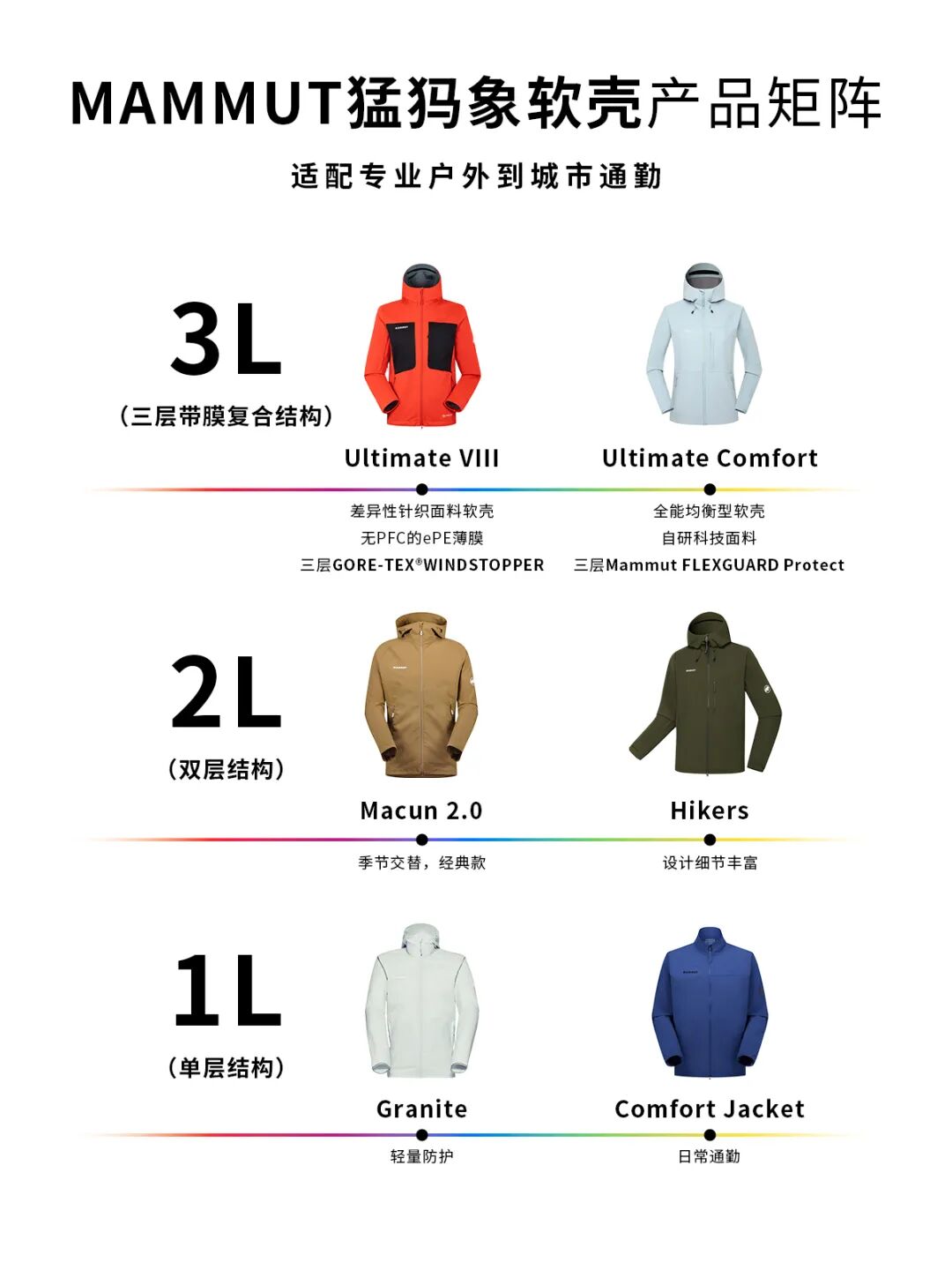
Mammut's Softshell Jacket Product Matrix
The significance of this product matrix is that it does not simply understand softshell jackets as a certain fixed type of jacket, but disassembles them into different fabric structures, different exercise intensities, and different wearing needs. Consumers can find the corresponding type of softshell jacket according to the real usage scenario.
In terms of core indicators, Mammut adheres to using the four dimensions of wind resistance, water repellency, elasticity, and moisture permeability as the evaluation indicators for softshell jackets, promoting this category to move from concept generalization to clearer category judgment.
Wind resistance and water repellency are the basic thresholds for a qualified softshell jacket. Moisture permeability and elasticity determine whether it can truly adapt to dynamic activities. Some products in the market often sacrifice moisture permeability and elasticity in order to pursue wear resistance or control costs. As a result, they seem more "durable", but actually make people feel stuffy, hard, and restricted when wearing them. The core advantage of Mammut's softshell jackets is that while doing a good job in basic protection, they also put moisture permeability and elasticity in a sufficiently important position.
This idea is most concentratedly reflected in the two three - layer membrane - coated products, Ultimate VIII and Ultimate Comfort.
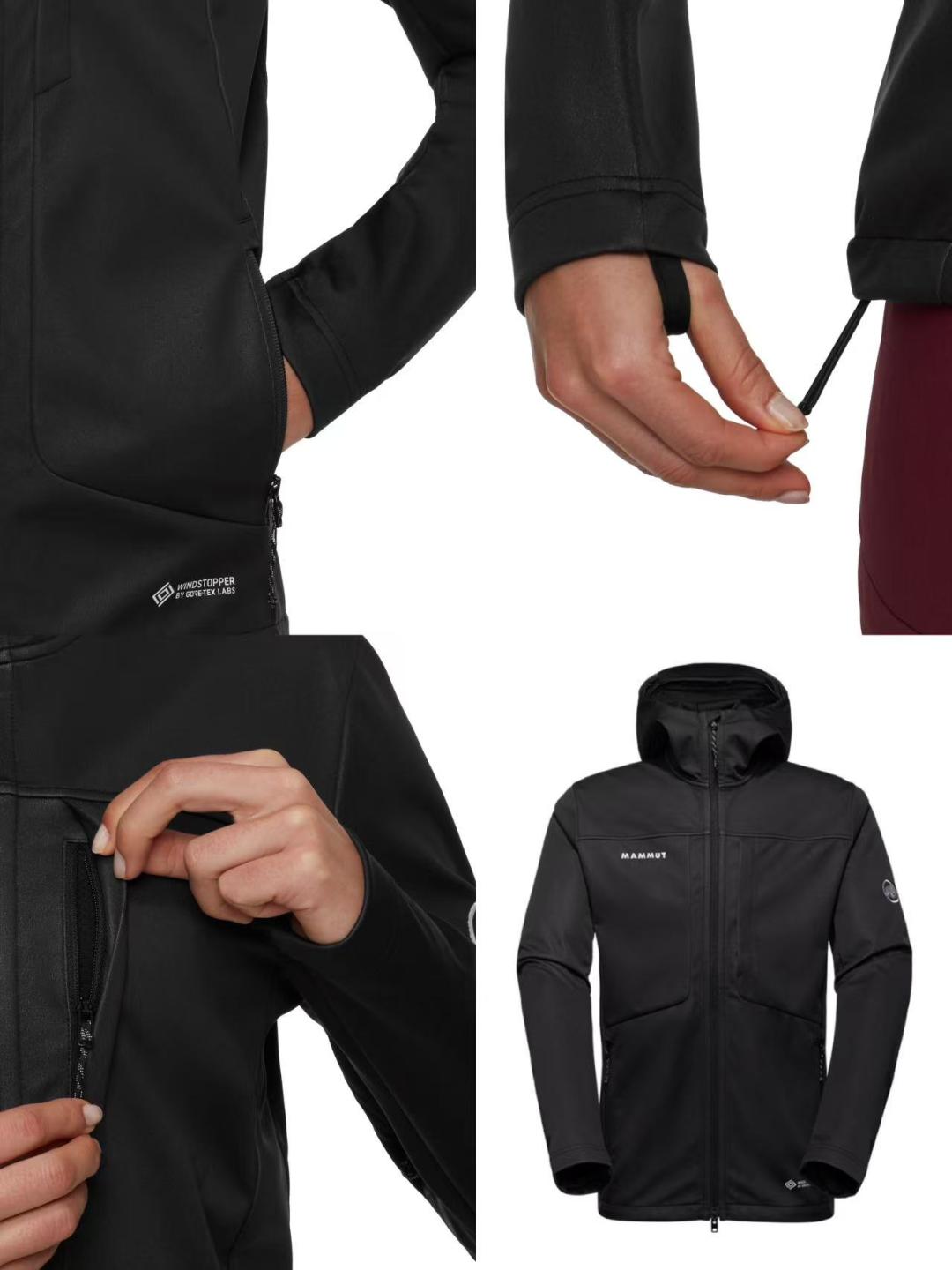
Details of Ultimate VIII
The Ultimate series was born in 2000 and is one of Mammut's most representative softshell jacket product lines. By Ultimate VIII, this series has been upgraded seven times and has taken a differentiated knitted softshell jacket route.
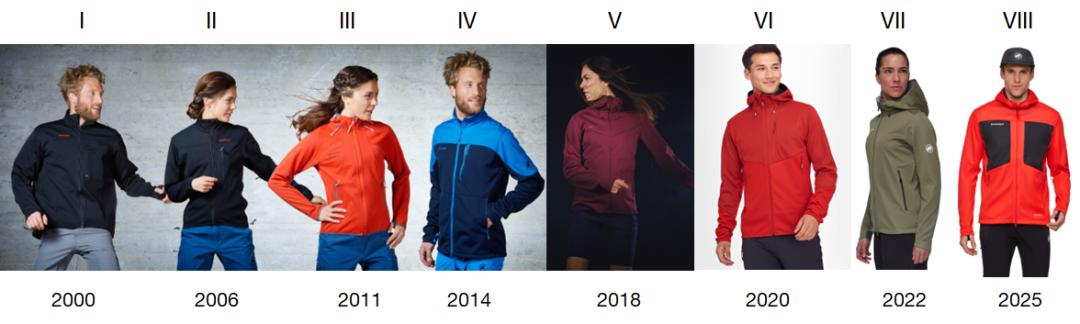
Iteration Schematic of Mammut's Ultimate Series
Compared with common woven fabrics, Ultimate VIII is softer and more elastic, without the "plastic stiffness". It uses GORE - TEX® WINDSTOPPER three - layer fabric technology and is paired with an ePE windproof film without PFC and recycled polyester fabric. While blocking the wind, it helps the body's water vapor to be discharged. Coupled with four - way elasticity, underarm ventilation zippers, and a three - dimensional pattern design, this softshell jacket does not simply pursue "softness", but makes a systematic balance among wind resistance, moisture permeability, and freedom of movement.
