After the full-scale invasion of AI, the gaming industry is panicking.
In June, the 2026 Summer Game Festival was held in Los Angeles, bringing together dozens of top global game manufacturers such as Capcom, Square Enix, EA, Ubisoft, and Sega, and releasing the latest news of over 50 games.
The 3A game boom triggered by "Black Myth: Wukong" two years ago has somewhat cooled down. At this Summer Game Festival, global traditional 3A game giants generally showed a conservative tendency, and the released content was almost dominated by old IPs and sequels. "CrossFire: Phantom," represented by Tencent, is also betting on the global old IP.
There's no way around it. Research shows that not only do 3A games require a large amount of time and resources to produce, but their demand is also declining. More interestingly, research also shows that social media platforms such as TikTok and YouTube are competing with immersive 3A game blockbusters for players' attention.
Of course, it's not just 3A games. When Internet entertainment is extremely prosperous, the traffic in the entire game industry has taken a sharp turn for the worse.
According to Gamma Data, in the first half of 2025, the cost of buying traffic for the top 100 mobile games increased by 86.6% year - on - year, and the customer acquisition cost continued to rise. The overall user scale of the top 10 games declined, and only a few new products achieved positive growth. Entering the AI era, there are more and more eye - catching and time - consuming contents, and the game industry will only become more and more desolate.
Games with high cost, large scale, and high quality seem to be losing their meaning of existence.
Explosion of Production Capacity: AI Penetrates the Entire Game Industry Chain
Compared with the entire content production industry, the game industry has been more comprehensively impacted by AI. In the production process, its production process, like that of novels and TV dramas, has been subverted by AI. Data from the Game Work Committee of the China Audio - Video and Digital Publishing Association shows that the overall penetration rate of AI in the Chinese game R & D end has reached as high as 86.36%.
Let's take a look at major game companies specifically.
37 Interactive Entertainment has self - developed a large - scale model, and the proportion of AI art assets exceeds 80%; the penetration rate of material generation in Tanwan Games exceeds 85%; in Q4 2025, the proportion of AI materials in NetEase's intelligent selection and placement exceeded 80%; Tencent's VISVISE has been applied to nearly 100 game projects, including "Peacekeeper Elite," "Honor of Kings," and "PUBG Mobile."
Interestingly, game manufacturers are not only using AI to make games, but the gameplay of AI has also become the key form and content of some games, and in the current situation where game innovation is getting lower and lower, it brings a bit of freshness. For example, "Historical Simulator: Chongzhen" and "Forest Box," which have become somewhat popular on social platforms, both attempt to use AI as the gameplay itself.
In "Chongzhen," players play the role of Emperor Chongzhen and write imperial edicts, and AI helps polish them. The game deduces the direction of national governance based on the content of the edicts given by players; "Forest Box" is an "AI decoration" game. A video titled "Four Layout Switches of a Cream - Style Room" has accumulated over 100 million views on Xiaohongshu, Instagram, and TikTok.
AI has even extended to game NPCs. In the past two years, young people's demand for social interaction has been decreasing, and the concept of AI companionship has become very popular. A survey by Gamma Data shows that about 60.1% of players prefer to play games alone, and AI intelligent NPCs show great potential among this group of introverted players.
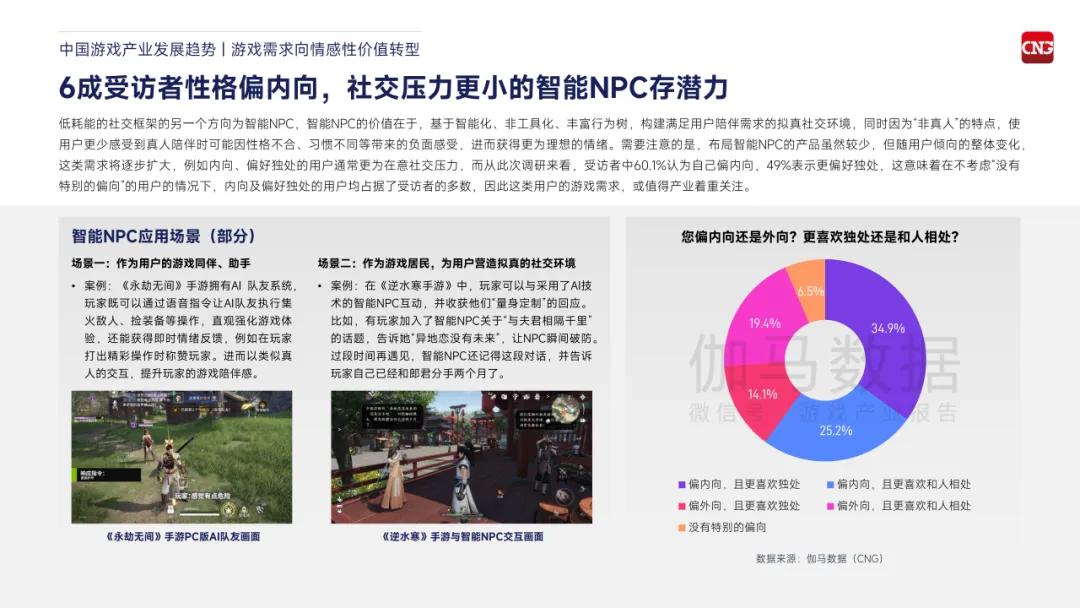
In early 2025, "Peacekeeper Elite" applied AI capabilities and successively launched AI teammates with long - term memory functions. As of March this year, the cumulative number of users who have experienced all AI NPC gameplays in "Peacekeeper Elite" has reached 110 million, the highest number of active users on weekends reached 17.7 million, the number of message interactions per game reached 70, and the microphone activation rate was nearly 75%.
AI production, AI gameplay, AI teammates... As the game industry is occupied by AI, what does this actually mean?
First of all, AI production has undoubtedly changed the development cost and development cycle of games. In the past few years, the time for games to go online has actually been continuously lengthening. According to Unity, in 2022, the average time to launch a game was 218 days, and in 2023, it rose to 304 days.
After the popularization of AI, game production has gradually become "fast."
37 Interactive Entertainment once publicly stated that its art AI produces more than 30,000 pictures and more than 3,000 models per week, and produces more than 80 AI videos and more than 200 AI audios per week. According to a report by "Southern Metropolis Daily," AI can compress the cycle of a game project from 30 days to within a week.
The change in the production end has given rise to an "explosive" supply in the entire industry.
The "2026 Game Industry Status Report" shows that the supply of new games globally has increased explosively. In 2025, the total number of new games released throughout the year reached 225,000, with an average of 617 new games going online per day. But like the entire content industry, AI has become ubiquitous. The number of games on the Steam platform that clearly mark the use of generative AI technology has exceeded 10,000, accounting for about 8% of the total number of games on the platform.
Players are gradually getting aesthetically fatigued. The payment rate of games is originally higher than that of novels and short dramas, and the ARPPU (Average Revenue Per Paying User) of some strategy games (SLG) even exceeds $40. "Pay - to - win players" have a low acceptance of AI, and some AI - made games have been widely criticized by players.
The popular game in 2025, "Light and Shadow: Expedition 33," was accused of using AI to generate temporary placeholder texture materials in the early stage of development. In player communities such as Reddit, NGA, and the Steam comment section, many AI - native games have been criticized for being "too AI - like" and "a patchwork of gameplays."
More importantly, the profit differentiation in the entire content industry caused by AI is particularly severe in the game industry. Data shows that globally, 80% of the annual revenue growth in the game market is concentrated in the top 50 games on the list. The fate of the vast majority of games whose production is accelerated by AI is doomed from the day they are launched.
However, while game manufacturers are competing fiercely with each other using AI, the flow of funds in the entire Internet entertainment market has undergone a huge shift. According to the latest data from Sensor Tower, in 2025, the in - app purchase (IAP) revenue of non - game applications globally exceeded that of game applications for the first time, becoming one of the largest sources of revenue in the mobile Internet.
Compared with five years ago, the in - app purchase scale of non - game applications has almost tripled; and in 2025 alone, its year - on - year growth rate reached 21%. The game industry, which was once the cash cow of the mobile Internet, only had a year - on - year growth of 1.3%, almost stagnating.
AI production, AI gameplay, AI teammates... AI has not made games better. It has just made games more numerous, faster, and more ordinary.
When AI levels the production cost of all content, and even some short dramas are being gamified, the one who can earn the most money from users in the shortest time will be the ultimate winner, and game manufacturers dare not slow down at all.
Universal Resistance: Collective Anxiety of Players, Practitioners, and Manufacturers
Just as AI is sweeping across all industries, the game industry, which has already "benefited" from technological progress, was the first to launch a resistance against AI. In the early days, the mainstream business model of the game market gradually followed the example of Hollywood blockbusters. Leading companies invested funds, and vertical teams carried out long - term development, and then marketed globally.
In the AI era, games have to some extent lost their "craftsmanship" attribute.
Globally, in the wave of AI "resistance," it involves manufacturers, practitioners, and players. Among them, the mindset of players is the easiest to understand. It is reported that currently, some players' "dislike" of AI games has reached the point of being overly sensitive. In some game communities, as long as a game "seems a bit like an AI game," it will cause a stir.
A typical example is "Light and Shadow: Expedition 33." At the 2025 TGA Awards Ceremony, this game won two awards, "Game of the Year" and "Best Debut." But soon, some players found that it used AI during the development process, and the trophy it just won was announced to be taken back by the organizer.
In February 2025, Steam players launched a petition, asking the platform to add an AI filtering function.
In terms of practitioners, "resisting AI" is closely related to the survival of the industry. The emergence of AI has triggered a "job - loss" fear among all mankind, and this fear has become a reality in the game industry. According to incomplete statistics, the game industry in Europe and America laid off more than 45,000 employees between 2022 and 2025.
Sony, Xbox, EA, Epic Games, Ubisoft... have all launched lay - off plans. The "art positions," once considered the most creative and irreplaceable jobs in the game industry, have become the center of the lay - off storm, and the proud 3A game industrial system in Europe and America is accelerating its collapse.
However, why do game manufacturers "resist" AI when it can significantly reduce production costs?
In April 2026, the world's largest game developers' conference, GDC, was held. Cabel Sasser, co - founder of Panic, Adam Saltsman and Rebekah Saltsman, co - founders of Finji, and many well - known game manufacturers such as Black Tabby Games clearly stated that they refused to use AI.
From the perspective of game manufacturers, the dividends brought by AI to them are not as much as the outside world imagines.
It is reported that when Google DeepMind released the experimental prototype of the world model Genie 3, the stock prices of many game companies fell: the engine company Unity tumbled 21%, the UGC game platform Roblox fell more than 12%, and Take - Two also fell 10%. This game company is developing the most expensive open - world game in history, "Grand Theft Auto 6."
In the past two years, the winter of the game industry has truly arrived.
At the beginning of 2026, game industry analyst Matthew Ball said that global game investment is sliding to the lowest point in nearly a decade. To date, compared with the peak in 2021, the investment flowing into game studios has shrunk by 85%, even falling below the level in 2019.
Some game studios keep emphasizing the importance of the "hand - crafted" model in order to attract the attention of capital.
At the end of last year, Swen Vincke, the founder of the Belgian game company Larian, was criticized by countless players for mentioning AI generation. Swen Vincke urgently issued a statement: The studio currently has 72 artists, including 23 concept artists, and is still recruiting.
"Hand - crafted" seems to have become the most precious and scarce resource for a game manufacturer.
On the other hand, players' aversion to AI directly affects game consumption, which may also be the most concerning point for game manufacturers.
According to survey data from Circana, about 25% of players said that if a game uses generative AI to create pictures, dialogues, music, or voice - overs, their likelihood of buying the game will decrease. This proportion has risen again from 22% in 2024, becoming the "Sword of Damocles" hanging over the entire game market.
At the same time, the value of "hand - crafted enthusiasts" and "technology enthusiasts" has risen sharply.
Omdia said that the global game industry revenue reached $234 billion in 2025, and about $71 billion flowed to technology suppliers, accounting for more than 30% of the total value of the game market. Some independent game developers have started to mark on Steam: "All the content of this game is manually created by humans, and no generative AI is used."
Once upon a time, the game industry was the most fanatical believer in technological progress. It chased every graphics card upgrade, embraced every engine revolution, and was committed to making the wildest dreams come true with technology. Until this time, the entire game industry was horrified to find that it was technology itself that wanted to devour their dreams.
This is the most black - humorous chapter of the 21st century.
Contradictory Survival: Opposing AI on One Hand and Betting on AI Side Businesses on the Other
Although in the current game industry, from developers to players, a large - scale "anti - AI wave" has been launched, and the boundaries of AI use in the core game content field are constantly tightening, in the face of the future AI trend, game manufacturers who want to stand at the forefront of global technology have to be vigilant on one hand and bet crazily on the other.
According to incomplete statistics, A - share game companies such as Giant Network Group Co., Ltd., Youzu Networks Co., Ltd., Kingnet Network Co., Ltd., and 37 Interactive Entertainment Network Technology Group Co., Ltd. all clearly stated in their first - quarter reports in 2026 that they would increase R & D investment and application of AI.
After all, AI has a direct cost - reducing effect on some games with huge cost inputs, such as 3A games.
In April 2026, an in - depth report released by Morgan Stanley estimated that generative AI can reduce the development cost of large - scale 3A games by 44%, releasing about $22 billion of incremental profit space in the industry, and more than 20% of the investment in global game consumption expenditure will achieve efficiency upgrades through AI.
It should be noted that the AI genes of game manufacturers may not only be applied to games. With the growth of the AI concept market, after the decline of main - business traffic and growth anxiety, game manufacturers have started to cultivate AI side businesses everywhere: AI agents, comic dramas, digital humans... Of course, these side businesses are basically to fill the revenue gap.
A typical example is CMGE Technology Group Limited.
In May 2026, CMGE and Kingnet Network launched the one - stop AI agent GamePartner.AI for the global casual game market. It is reported that GamePartner.AI is an intelligent collaboration platform for game practitioners. It has officially started recruiting the first batch of domestic developers and will be launched globally one after another.
According to the annual performance announcement of CMGE for the year ended December 31, 2025, the company's total annual revenue was about RMB 1.39 billion, a year - on - year decrease of 27.98%; the net loss for the year was about RMB 1.477 billion, a year - on - year narrowing of 30%. To some extent, GamePartner.AI pinpoints CMGE's future survival hope.
Secondly, AI comic dramas have become the best side - business choice for many game manufacturers in the AI era.
On the one hand, game manufacturers have a natural technological advantage in AI comic drama production. On the other hand, game manufacturers have a large number of top - tier IP reserves. Entering the comic drama field itself has a certain traffic foundation. Previously, the comic drama "Delta Destiny: I Dominate the World with My Skills," adapted from the game "Delta Force," exceeded 200 million views in 29 hours after its launch.
After the success of "Delta Force," a large number of AI short dramas "riding on the coattails of game IPs" have emerged in the market. Including but not limited to "GTA," "The Last of Us," "Cyberpunk 2077," "Minecraft," and "Roblox." According to ADX industry - version data, there are already more than 60 short dramas or AI comic dramas with "Delta" in their titles.