"Unmanned" KTV: More profitable without services?
After the mass - style KTV and mini singing booths, the KTV industry has a new story.
In the past two years, a type of 24 - hour self - service KTV stores has quietly increased around schools, communities, and in shopping malls in remote areas, becoming a new choice for many young people. Compared with the common mass - style KTVs, self - service KTVs are characterized by online reservation, scanning the code to open the door, and the freedom to bring in outside food. There is hardly any staff involved throughout the consumption process.
Beyond KTVs, Jingzhe Research Institute has also noticed that offline commercial spaces such as billiard halls and gyms have also become popular with the "self - service" model in recent years, featuring 24 - hour unmanned self - service business attributes. Why is this "zero - service" self - service business model becoming popular? Can self - service offline commercial spaces be a good business? Behind these questions, the current offline commercial spaces may be experiencing an unprecedented scene revolution.
Who is paying for self - service KTVs?
"A small sofa, a small coffee table, a TV screen. Scanning the code to order songs is the same as in an ordinary KTV, which is equivalent to a miniaturized KTV private room." Last month, Jingwen, a post - 95s worker in Nanchang, and her friends experienced a self - service KTV.
Jingwen told Jingzhe Research Institute that she originally planned to go to a traditional mass - style KTV, but couldn't book a private room on a whim on the weekend. Then she found a self - service KTV on an online platform. "The three of us arrived around 4 p.m. The staff at the door said all the rooms were full and we had to wait until 5 p.m. So we went out for a walk, bought some cakes and drinks and came back." Jingwen chose a small private room for 68 yuan for 2 hours. "There was an operation guide posted on the door. After verifying the coupon online, the door opened. The time starts counting from the moment the door opens. Unlike traditional KTVs where you have to choose fixed time slots, the whole process is quite convenient."
The most satisfying thing for Jingwen is that you can bring in outside food. "No one cares what you bring in. In the past, you had to hide food secretly when going to a KTV." However, there was a small incident during the singing. The battery of the microphone in the private room ran out. "Although there are spare batteries for self - charging on the wall, you have to replace the battery yourself, which is not a good experience."
In Jingwen's opinion, it would be more enjoyable to go to a self - service KTV alone. "It's okay for three people to just sit and sing, but if we all stand up, it will be very crowded and we can't move around."
To experience the actual difference, Jingzhe Research Institute visited a self - service KTV in Songjiang, Shanghai. At the scene, Jingzhe Research Institute observed that the store is located on a busy food street, and there are two traditional KTVs within a straight - line distance of less than 300 meters. However, due to the unclear guiding signs and the complex on - site environment, it may be difficult for first - time customers to find the exact location of the store. Jingzhe Research Institute also had to pass through several food stalls in the food street, take the escalator to the second floor, and then walk through a corridor to finally reach the store.
In terms of price, it's not too expensive. With the group - buying deal (available on weekdays), the small private room (marked for 1 - 4 people) for the "8 a.m. - 6 p.m." daytime slot costs only 39.9 yuan for 3 hours, and the medium - sized private room costs only 59.9 yuan for 3 hours. Without the group - buying deal, the full - price for 2 hours of the small, medium, and large private rooms throughout the day is 58 yuan, 68 yuan, and 138 yuan respectively. The whole service experience is indeed completely self - service. After entering the store, Jingzhe Research Institute didn't see any staff, only a small table, four chairs, a freezer, and two self - service beverage vending machines. There are only 16 private rooms in the whole store. Besides the beverage vending machines in the lobby, you can also scan the code to consume in the private rooms, which offer snacks, alcoholic and non - alcoholic beverages, instant noodles, playing cards, and cigarettes.
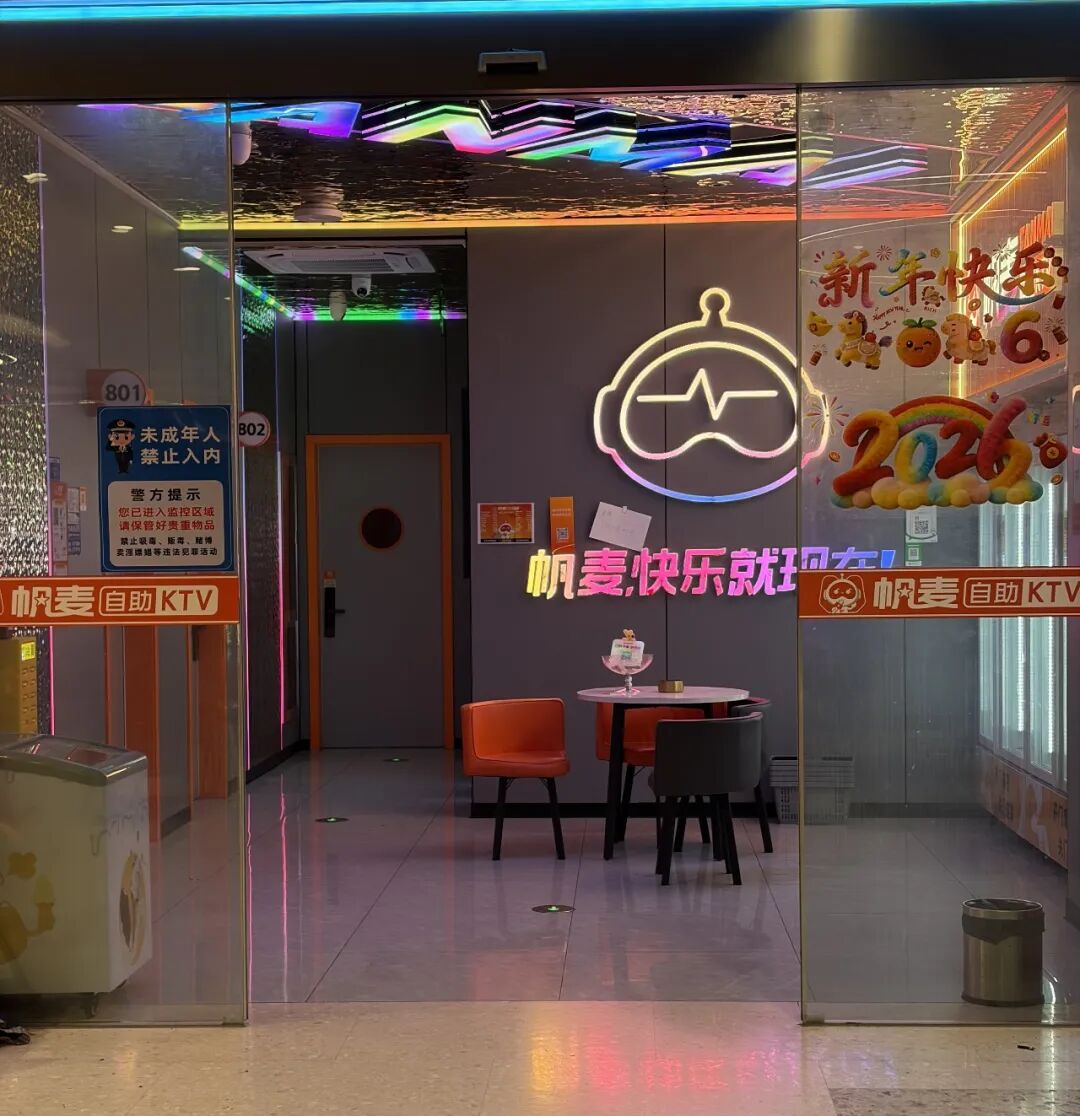
*The lobby of the self - service KTV (Photo taken by Jingzhe Research Institute)
The internal environment of the private rooms is generally clean and the layout is simple. The lighting control, air - conditioning switch, and song - ordering interface in the room are all integrated on one screen, and it also supports watching movies. The song library selection is relatively rich, with most new and popular songs available. However, many songs lack copyright, and the played MV is not the original one. For example, Jay Chou's latest album "Son of the Sun" appears on the interface, but the picture doesn't match the song after ordering. In addition, you can also hear the singing from the next room when singing.
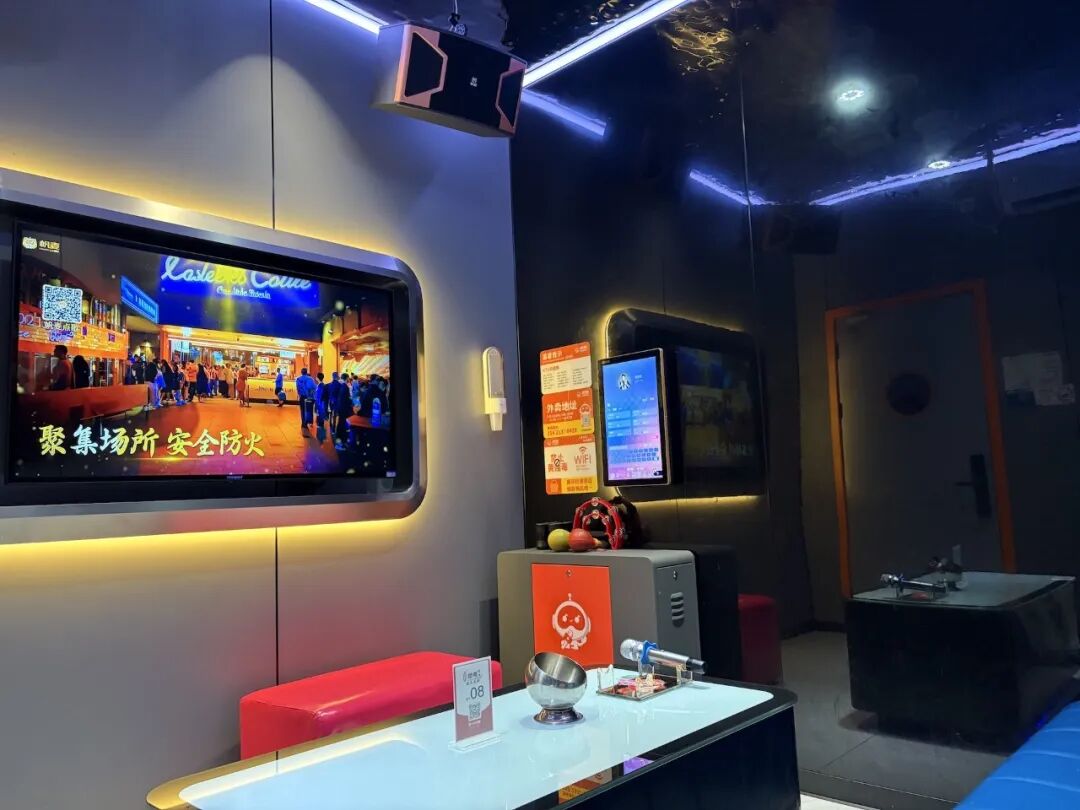
*The internal furnishings of the self - service KTV (Photo taken by Jingzhe Research Institute)
In terms of passenger flow, when Jingzhe Research Institute arrived at the store at 7:30 p.m., four or five rooms were in use. By around 9 p.m., about half of the private rooms were in use, and the customers were mainly young people.
After a comprehensive experience, the differences between self - service KTVs and traditional mass - style KTVs are very obvious. In terms of space, self - service KTVs create a light - social scene, targeting "introvert - friendly" customers and meeting the needs of small gatherings, especially for 1 - 2 people. In terms of service, almost all manual links are cut off. From reservation, entering the store to leaving the store, there is no need for on - site staff intervention throughout the process.
Is self - service KTV a good business?
From an operational perspective, compared with traditional KTVs, self - service KTVs reduce venue costs and a large amount of labor costs, so it seems that they can make more money. But is this really the case?
To answer this question, let's first look at the "predecessor" of self - service KTVs - mini singing booths.
Around 2017, glass - enclosed singing booths of about two square meters began to spring up in shopping malls and cinemas. The business model of scanning the code to sing and charging by the minute or by the song is also very distinctive: compressing venue and labor costs to the extreme and making money from fragmented time.
Fengmian News once reported that there are mainly two ways to join a mini singing booth franchise: one is to buy the equipment at a price of 26,000 yuan per unit and pay an additional 300 yuan per month for platform service fees; the other is to pay a deposit of 3,000 yuan and be responsible for venue rental by yourself, and the brand party will share the revenue. The total annual cost is about 50,000 to 80,000 yuan. The investment threshold is not high, and in an ideal situation, the cost can be recovered in less than half a year.
Capital once enthusiastically pursued mini singing booths. For example, in February 2017, Youchang M - bar completed a Series A financing of 60 million yuan; in August 2018, the mini KTV brand WOW (Wowu) received a Series B financing of 200 million yuan. Data from Zhiyan Consulting shows that since the second half of 2016, mini KTVs have spread rapidly across the country, and the number of devices has increased from 36,000 to 70,000 in 2018. The "2020 China Music Industry Development General Report" pointed out that the market scale of mini KTVs reached 14.05 billion yuan in 2019.
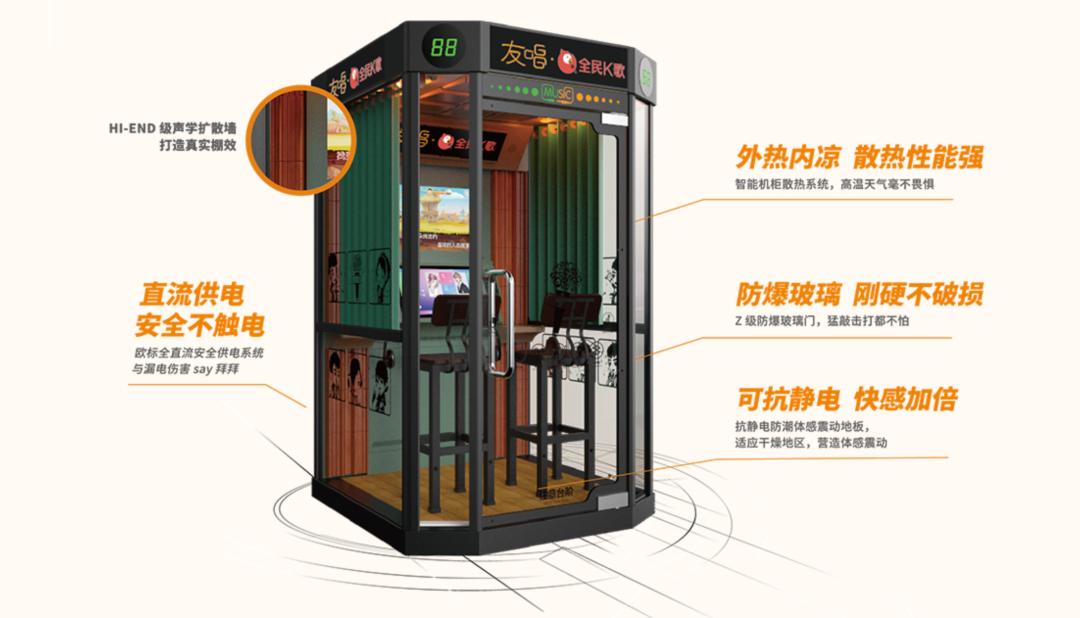
*Image source: Youchang official website
However, after 2020, as offline businesses faced the severe test of losing passenger flow, the popularity of mini singing booths gradually declined, and many franchisees left the market at a loss. The reason is not complicated: the pricing of mini singing booths is not cheap. Some singing booths charge 8 to 10 yuan for a song or nearly 50 yuan per hour, which is comparable to the price of traditional KTVs. More importantly, although mini singing booths are suitable for waiting for someone or killing fragmented time, few people would make a special trip for them, which means it has low - frequency demand. Moreover, there is almost no social interaction when singing in a two - square - meter space. Once the novelty wears off, it's natural that customers won't come back.
In fact, from the perspective of operating costs, self - service KTVs are in a compromise position: they require more investment than mini singing booths but less than traditional KTVs. According to Sanxiang Metropolis Daily, the investment in a traditional KTV usually reaches about 3 million yuan, while the cost of opening a self - service KTV is only one - sixth of that of a traditional KTV, and the labor cost of self - service KTVs is only one - tenth. Only a cleaning aunt and a store manager are needed for daily operation. Self - service KTVs also bring singing back to a more exclusive scene. For example, opening near universities or communities can, to some extent, alleviate the problems of low - frequency demand and weak social interaction.
However, this doesn't mean that self - service KTVs can make money easily. A detail in cost accounting is that although the labor cost of self - service KTVs is greatly reduced, fixed costs such as rent, water and electricity, equipment depreciation, and cleaning still exist. The operation and maintenance pressure also remains. While the self - service model saves on labor, it also brings new problems: the microphone batteries run out easily, and when encountering operational problems, customers have to figure it out by themselves or call the boss. The sound equipment and sound - insulation effects also vary.
In addition, there are many consumer complaints on social media, such as the room not being cleaned when the reservation time arrives and problems not being handled in time. Of course, the self - service model itself means limited service, but the details of the venue environment often determine whether it can attract repeat customers.
In essence, it's hard to say that self - service KTVs are a category innovation. They don't create new demands or open up a brand - new consumption scene. Singing is still singing, and private rooms are still private rooms. The core change actually occurs at the operational level, replacing manual labor with a self - service system, attracting price - sensitive customers with lower prices and the freedom to bring in outside food, and increasing the room - turnover rate with smaller spaces and more flexible time slots.
This does have a certain survival space in the short term, but more importantly, it hasn't reversed the overall downward trend of the KTV industry. According to the data in the annual "China Music Industry Development General Report", the overall scale of the karaoke industry was still in the tens of billions of yuan in 2019, but it had shrunk to more than 6 billion yuan by 2024.
This set of data exposes the cruel fact that KTV is no longer a must - choose for young people. In previous years, scripted role - playing games and escape rooms, and later various outdoor activities have all diverted its customers. Jingwen told Jingzhe Research Institute that she chose to go to a self - service KTV simply because it was too hot outside and she could only choose indoor activities. She checked her previous group - buying records and found that she hadn't been to a KTV for more than two years. The last time she went was in July 2023, to a theme - style KTV, and that store has already closed. "Now everyone is going outdoors, like climbing mountains and camping."
However, from the application of the self - service model in KTVs, we can see that a business thinking is becoming popular in offline business forms: by reducing labor costs and improving space reuse, achieving revenue through continuous operation.
Where is the moat of "self - service"?
In addition to self - service KTVs, other offline commercial spaces such as billiard halls, gyms, and mahjong parlors are also gradually replacing manual labor with the self - service model to lower the consumption threshold. However, these businesses are also not easy to run.
"At its best, the monthly revenue could reach more than 60,000 yuan. After deducting various expenses, the profit was about 15,000 to 20,000 yuan. In bad times, it was basically break - even. However, if the competition continues to intensify, it's hard to say." In January 2024, Fang Fang opened a 24 - hour self - service billiard hall in a Wanda shopping mall in Shanghai. The store covers an area of about 300 square meters, with ten billiard tables and two mahjong rooms.
*Photo provided by Fang Fang
Her initial investment was about 400,000 yuan, and the largest cost was for billiard tables and decoration. "There were relatively few second - hand billiard tables on the market at that time, so I bought all new ones, which cost more than 10,000 yuan each." Thanks to getting into the market early, the competition in the surrounding area was not fierce (there was only one commercial billiard hall and one self - service billiard hall within one or two kilometers). The pricing was also slightly lower than that of traditional billiard halls (three to five yuan cheaper per hour), and she recovered the cost in about a year and a half.
Billiards is an entertainment activity with the most customers at night. Traditional billiard halls usually close at 2 a.m., while Fang Fang's self - service billiard hall can operate 24 hours a day. "Some people come as late as 4 or 5 a.m. and leave at 7 or 8 a.m." Fang Fang observed that many of the customers are post - 2000s, who have a high acceptance of the self - service model. There are also "night owls" living in the surrounding area who come out to play billiards because they can't sleep at night.
In Fang Fang's opinion, the real advantage of a self - service billiard hall is to provide a quiet and pure place for those who don't want to socialize, don't want to be