Who says arts students are useless? Both Ultraman and Amodi are frantically writing long essays.
You know what? "Writing long-form essays" is actually much more useful than it seems.
In the past few months, both OpenAI and Anthropic have started to act very "humanities-like".
OpenAI has released policy agendas, discussing youth protection, labor force transformation, and global standards; issued industrial policy documents, emphasizing that the AI era should be people-centered, expand opportunities, and share prosperity; on the same day it secretly submitted its S-1, it also published an article titled "Built to benefit everyone: our plan", placing the company's future in the narrative of "making AGI benefit everyone".
Anthropic hasn't been idle either. It established the Anthropic Institute to discuss how powerful AI systems will affect society; published an article on recursive self-improvement, warning that when AI starts to help build the next generation of AI, the world needs to understand this transition in advance; and put Claude into the biological research scenario to discuss how AI agents can improve the bioinformatics workflow and accelerate scientific research.
Technology is of course the most important, but technology alone is not enough. On the eve of IPO, the most valuable AI companies are all telling stories.
Because when an AI company goes public, it's not just selling models.
It's also selling a set of explanations about the future.
Models answer the question of ability, stories answer the question of trust
In the AI competition, models are the most direct language.
Context length, reasoning ability, coding performance, API price, latency, and stability are all things that the market can directly perceive. Whether a model is strong or not, users will vote with their feet.
Of course, the reason why OpenAI and Anthropic have come this far is first and foremost because they have strong enough models.
But for a company on the eve of IPO, just being able to speak with models is not enough.
IPO is essentially pricing the future. Investors are not buying the part of the company that has already been completed at the moment, but its growth in the next ten or twenty years.
Once it comes to things about the "future" that are still difficult to be directly verified, the root of all decisions lies in trust.
The future of AI companies is difficult to be fully explained by traditional financial data. While they have rapid revenue growth, their costs are also very high. Although they have a large user base, their business models are still changing.
Meanwhile, the speed of model iteration is very fast, and the model gap between different companies is narrowing. No company can guarantee that its existing advantages can be sustained. Enterprise customers are being connected, but the competition is also fierce. Looking outward, issues such as regulation, copyright, security, youth protection, and employment impact may all change the company's growth path.
In this highly uncertain industry, "stories" become particularly important.
The so-called stories, of course, have a bit of a word game meaning, but they can't be made up randomly. They are more like a framework for a company to explain its own future. The company needs to answer the market: Who am I, where do I stand, what risks do I understand, what opportunities do I have, and why am I more worthy of investment than other companies.
The capital market has always operated in this way. Investors don't just buy financial statements, they also buy narratives.
Electric vehicle companies talk about energy transformation, cloud computing companies talk about digital infrastructure, chip companies talk about the computing power cycle, and platform companies talk about network effects. Although the narrative itself cannot replace performance, it will affect how the market understands performance, how it tolerates short-term losses, and how it prices long-term growth.
The same goes for AI companies.
If OpenAI and Anthropic were just two companies providing large model services, they would both be pulled back into the same set of product valuation logic: How much is the subscription revenue, how high is the API gross profit, can the computing power cost be reduced, how long can the model gap be maintained, and will enterprise customers migrate.
Regardless of whether the product is called ChatGPT, Claude, or Gemini, and regardless of whether the entry is a chatbot, API, coding agent, or enterprise platform, as long as they are still model providers, the market will constantly ask the same question: What makes you irreplaceable? Why do we have to choose you?
So, they are both presenting themselves as something bigger than just models. OpenAI places itself in the narrative of AGI infrastructure, public policy, and the intelligent entrance for all people, while Anthropic places itself in the framework of safe AI, trustworthy agents, and systematic risk governance.
The two companies tell different stories, but they are facing the same problem. They are both trying to make capital believe that they are not just a model service that can be easily replaced, but an infrastructure that is hard to bypass in the future AI era.
The fact that storytelling suddenly becomes important on the eve of IPO doesn't mean that technology is no longer important. On the contrary, only when technology is important enough can stories have a basis to be believed.
The model ability determines whether a company has the qualification to enter the game, and the narrative ability determines how the market understands its position in the game.
At this stage, blogs, policy suggestions, research reports, and long essays on values are all ways to compete for market trust.
One talks about risks, the other talks about participation
Both OpenAI and Anthropic are telling stories, but they are not telling the same kind of stories - or rather, the "personas" they create for themselves are a bit different, but they can both find corresponding concepts in traditional Chinese Confucian culture.
Anthropic seems to be shaping itself as a "sober person in the era of risks", a fresh and upright figure like a scholar-official.
Its stories basically follow the same pattern: AI will become stronger and agents will become more useful, but the closer we get to the real world, the more someone needs to foresee risks in advance, design boundaries, and repair the foundation. And Anthropic is the one who "has super-strong AI and a profound sense of responsibility, and can stay sober when others are intoxicated".
However, for other AI companies, Anthropic is probably like that top student in school who finishes the homework quickly and then says the questions are too easy and asks the teacher to assign more.
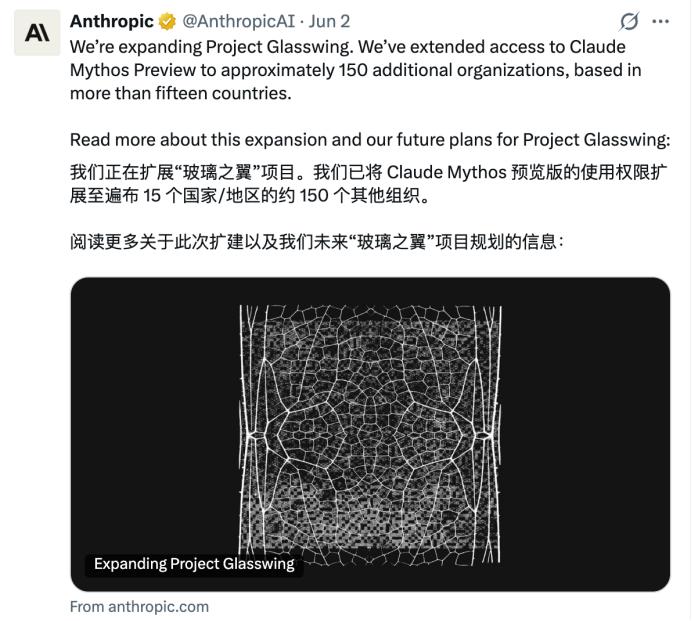
The "Project Glasswing" is a very typical example.
According to Anthropic, the purpose of this project is to evaluate the role of next-generation AI tools in defensive network security and help the key software ecosystem discover and fix vulnerabilities in advance. This project was initially open to a small number of selected partners, offering a super-strong model called Claude Mythos Preview that was "too dangerous to be made public". Later, Anthropic expanded the project to more than 15 countries and about 150 new organizations, but each organization needs to meet the security requirements first to gain access.
From a narrative perspective, through this project, Anthropic not only demonstrates its ability but also emphasizes restraint. The model is strong enough to reshape network security; but precisely because it is so strong, it cannot be made public directly and can only be used by selected partners within a security framework.
Another example is the encyclical "Magnifica humanitas" about AI by Pope Leo XIV. Chris Olah, the co-founder of Anthropic, was invited to the Vatican to participate in the release event of this encyclical and give a speech. Subsequently, Anthropic published his speech in full on its official website.
On the surface, religious ethics seem far from a model company, but for Anthropic, such occasions are very important. It doesn't just want to talk to developers, enterprise customers, and investors; it also wants to communicate with more traditional social forces such as the religious community, the ethics community, and public institutions.
This action is in line with its "Widening the conversation on frontier AI" published in May. Anthropic said that in the past few months, it has been organizing conversations with different groups because the questions raised by AI do not only belong to engineers but also to educators, religious leaders, labor organizations, democratic institutions, and the general public.
If the "Project Glasswing" is about demonstrating ability and restraint, then this line is more like demonstrating a "practical and worldly" attitude: Since those who master technology have the ability to change society, they should enter the public order, undergo ethical testing, and assume corresponding responsibilities.
Different from OpenAI, which has ChatGPT as a public entry point, Anthropic's main battlefield is closer to developers and enterprise scenarios. But before going public, it must expand its audience to a wider social group.
Because what it wants to win is not only the trust of capital but also social permission. It wants to make the outside world believe that it is not a model company that works in isolation but a technology governance responsible party that is willing to discuss AI in a larger social order and accept the test of public values.
There is also that technical blog about recursive self-improvement. Almost all reports emphasize that it "calls for a suspension of AI research and development" - this kind of narrative is really appealing. However, the whole blog actually shows that more and more code within the Anthropic company is being written by Claude, and Claude is driving acceleration. Then Anthropic says that the growth of ability itself is also a risk issue.
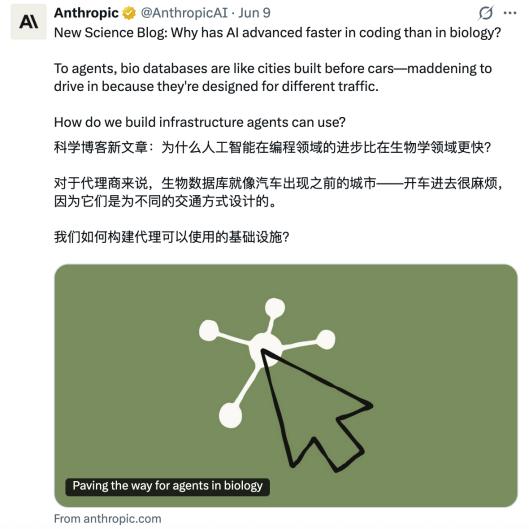
In a recent engineering blog, Anthropic also put Claude into the biological research scenario to discuss how AI agents can help scientists retrieve virus sequence data more stably and improve the bioinformatics workflow. On the surface, this is an article about scientific agents, but behind it is still Anthropic's familiar way of expression: Our model is strong, and we are helping scientific development. If the model's performance is not stable enough, Anthropic naturally puts the problem into the framework of "the scientific infrastructure is not ready for the era of agents".
Although it has strong strength, in a sense, its attitude is indeed a bit too arrogant, with a bit of self-righteousness and a sense of superiority.
However, this is also Anthropic's consistent style.
OpenAI is no less impressive. If Anthropic tries to create a lofty image of a "worried scholar", OpenAI's narrative style is more like that of a "minister in a prosperous era" in the intelligent age.
Its story is different from Anthropic's "We see the danger, so we should give a warning". Instead, it's "This thing will change everyone, so we need to participate in the design of future rules".
So OpenAI released a public policy agenda, discussing security, youth protection, labor force transformation, and global standards, placing itself in the context of policy-making; it also released an industrial policy for the intelligent age, putting forward a set of people-centered industrial policy ideas, emphasizing that the AI era needs to expand opportunities, share prosperity, and build more resilient institutions.
It also specifically explained in "Our views on AI policy and political advocacy" how it participates in AI policy and political initiatives, and emphasized that the future of AI should not be determined by any single company or organization alone but should be jointly shaped by the government, researchers, workers, civil society, independent experts, and the public.
Before the G7 summit, OpenAI also proposed a global youth AI safety initiative, calling for the establishment of a special institution to promote international cooperation so that teenagers can use AI more safely and have more opportunities.
These topics, placed among a bunch of product updates, seem not very related to the model, but they are indispensable for OpenAI. OpenAI wants to shape not the image of "I know the risks best" but "I am participating in the construction of a new social order".
Using a more familiar person as a metaphor, OpenAI's concept is actually a bit like an "American version of Wang Anshi": trying to internalize its ideas and technology into the underlying rules of the future human society through influencing legislation, international cooperation, and industrial design.
On the day it secretly submitted its IPO, it also published an article titled "Built to benefit everyone: our plan", telling OpenAI's mission of "benefiting all mankind", which is also a consistent narrative.
According to OpenAI's own statement, if AI is developed properly, it can become the foundation for improving productivity, creativity, scientific progress, and economic opportunities - this statement sounds much more pleasant than Anthropic's "elite narrative".
OpenAI always tries to position itself as more than just a model company, but as a larger public infrastructure. ChatGPT is not just a chat product; it's the future intelligent entrance for everyone. Codex is not just a code-writing tool; it's a new interface for knowledge work. OpenAI is not just a simple commercial company; it's a participant in the institutional design of the intelligent age.
Regardless of whether its "suggestions" are heeded, at least it shows a strong attitude of "caring about the public and sharing prosperity".
Even in small product communications, the differences between OpenAI and Anthropic can be seen.
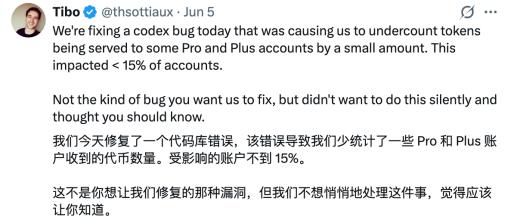
On June 5th, Tibo posted on X that the team was fixing a bug in Codex that day. This bug caused the system to undercount the actual number of tokens consumed by some Pro and Plus accounts, affecting less than 15% of the accounts.
In other words, this bug was actually a "benefit" for some users: the tokens they actually used were undercounted. After the fix, the token usage of these accounts will return to normal counting.
So Tibo specifically added, "This is not the kind of bug you hope we fix, but we don't want to handle it quietly. We think you should know."
Behind this kind of communication is actually the transmission of a platform value: Of course, the platform has the right to change the rules, but users should at least know when the rules change.
OpenAI actively announced a fix that users might not like to hear, while what users often complain