Wer sagt, dass Geisteswissenschaftler nutzlos sind? Ultraman und Amodi schreiben beide eifrig lange Essays.
Actually, "writing small essays" is much more useful than it seems at first glance.
In the past few months, OpenAI and Anthropic have become quite "humanistic".
OpenAI has released a policy position paper and talked about the protection of teenagers, the change of the workforce, and global standards. It has also issued an industry policy documentation and emphasized that in the era of artificial intelligence, humans must be at the center, opportunities should be expanded, and prosperity should be shared. On the same day it secretly filed its S - 1, it also published an article titled "Built to benefit everyone: our plan" and embedded the company's future in the narrative of "AGI for everyone".
Anthropic was not idle either. It founded the Anthropic Institute to discuss how powerful AI systems will affect society. It published an article on recursive self - improvement and warned that the world must understand the turning point when AI supports the construction of the next - generation AI. In addition, it integrated Claude into biological research and discussed how AI agents can improve the workflow in bioinformatics and accelerate scientific research.
Technology is of course the most important, but technology alone is not enough. On the verge of going public, the most expensive AI companies are telling stories.
When AI companies go public, they are not just selling models.
They are also selling the power to interpret the future.
The model answers the question of ability, the story answers the question of trust
In the AI competition, the model is the most direct language.
Context length, inference ability, coding performance, API prices, latency, and stability are things that the market can directly perceive. Whether a model is strong or not is decided by users with their decisions.
OpenAI and Anthropic have come this far mainly because they have strong models.
But for a company on the verge of going public, it's not enough to just talk about models.
Going public is essentially an evaluation of the future. Investors are not buying the part of the company that is already completed, but the growth in the next ten or twenty years.
When it comes to the "future", which is still difficult to directly verify, the root of all decisions depends on trust.
The future of AI companies is difficult to explain with traditional financial data. Although they have rapid revenue growth, they also have very high costs. Although the user base is large, the business model is still changing.
At the same time, the iteration speed of models is very high, and the differences between models of different companies are getting smaller. No company can guarantee that its existing superiority will last. Companies are allying, but the competition is also fierce. Outside the company, regulations, copyrights, security, protection of teenagers, and employment downturns can change the company's growth path.
In this highly uncertain industry, the "story" becomes particularly important.
The so - called story, of course, has a bit of a play on words, but it can't be made up freely. It is more of an interpretive framework for a company's future. The company must answer the market: Who am I? Where do I stand? What risks do I understand? What opportunities do I have? Why am I more valuable than other companies?
The capital market has always worked this way. Investors are not just buying financial reports, but also narratives.
Electric vehicle companies tell stories about the energy transition, cloud - computing companies about digital infrastructure, chip companies about the computing power loop, and platform companies about network effects. Although the narrative itself cannot replace performance, it affects how the market understands performance, how it tolerates short - term losses, and how it evaluates long - term growth.
The same applies to AI companies.
If OpenAI and Anthropic are just two companies offering large - model services, they will be reduced to the same product evaluation logic: How high are the subscription revenues? How high is the API profit margin? Can the computing power costs be reduced? How long can the model's superiority be maintained? Will the corporate customers switch?
No matter whether the product is called ChatGPT, Claude, or Gemini, no matter whether the access is through a chatbot, API, coding agent, or corporate platform, as long as they are still offering models, the market will always ask the same question: What makes you irreplaceable? Why do you have to be here?
So they present themselves as something more than just models. OpenAI positions itself in the narrative of AGI infrastructure, public policy, and intelligent access for all. Anthropic positions itself in the framework of safe AI, trustworthy agents, and systemic risk governance.
The two companies tell stories in different ways, but they have the same problem. They are trying to convince the capital that they are not just a model service that can be replaced at any time, but an infrastructure that is hard to bypass in the coming AI era.
The fact that storytelling suddenly becomes important on the verge of going public doesn't mean that technology is no longer important. On the contrary, only when technology is important enough does the story have a basis to be believed.
The model's ability determines whether a company can even get to the table, and the storytelling ability determines how the market understands its position at the table.
At this stage, blogs, policy recommendations, research reports, and long articles about values are all means to gain the market's trust.
One tells of risks, the other of participation
Both OpenAI and Anthropic tell stories, but they are not the same stories - or rather, their "personalities" are a bit different, but both can be found in Chinese Confucian culture.
Anthropic seems to portray itself as an "Enlightened One in a Risky Time", a kind of upright intellectual.
Its stories generally follow a pattern: AI is getting stronger and agents are becoming more useful, but the closer we get to the real world, the more we need someone who can recognize risks in advance, set boundaries, and fix the fundamentals. And Anthropic is exactly this figure, the one who "has strong AI and deep responsibility and is able to stay sober in the era of intoxication".
For other AI companies, Anthropic is probably like an excellent student in school who quickly finishes his homework and then says that the tasks are too easy and the teacher should give more.
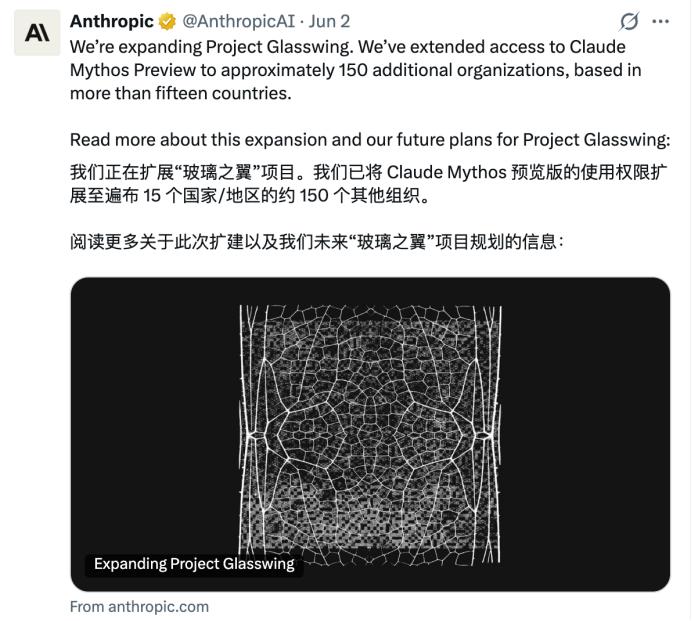
The "Project Glasswing" is a typical example.
According to Anthropic, the project is supposed to evaluate the role of next - generation AI tools in defensive network security and help detect and repair gaps in the critical software ecosystem in advance. The project was initially only accessible to selected partners, and an extremely powerful model called Claude Mythos Preview was opened, which was "too dangerous for the public". Later, Anthropic expanded the project to over 15 countries and about 150 new organizations, but each organization must first meet the security requirements to gain access.
In terms of the narrative, Anthropic shows both its ability and its restraint through this project. The model is strong enough to reshape network security. But precisely because it is so strong, it can't be made public directly, but only given to selected partners who can use it within a safe framework.
Another example is the encyclical "Magnifica humanitas" of Pope Leo XIV on AI. Chris Olah, co - founder of Anthropic, was invited to the Vatican to speak at the release of this encyclical. Subsequently, Anthropic published his speech in full on its website.
Seemingly, religious ethics is far from a model company, but for Anthropic, such an opportunity is important. It wants to communicate not only with developers, corporate customers, and investors, but also with the religious world, the ethics community, and public institutions, the more traditional social forces.
This step is in line with the publication of "Widening the conversation on frontier AI" in May. Anthropic says that in the past few months, it has organized discussions with different groups because the questions raised by AI concern not only engineers but also educators, religious leaders, trade unions, democratic institutions, and the general public.
If "Project Glasswing" shows ability and restraint, then this line shows more of a "world - governing" attitude: Those who master technology, since they have the ability to change society, must enter the public order, undergo ethical examinations, and take on the corresponding responsibilities.
In contrast to OpenAI, which has an access for the general public through ChatGPT, Anthropic focuses more on developers and corporate scenarios. But before going public, it has to expand its target group to a broader social stratum.
Because it has to gain not only the trust of the capital but also social approval. It has to convince the outside world that it is not a closed - off model company, but a technology governor who is willing to discuss AI in a larger social framework and submit to public values.
The technical blog on recursive self - improvement - almost all reports emphasize that it "calls for a stop to AI research" - this narrative is really captivating. But the entire blog actually shows that more and more code in Anthropic is being written by Claude, that Claude is driving the acceleration, and then Anthropic says that the growth of ability itself is also a risk problem.
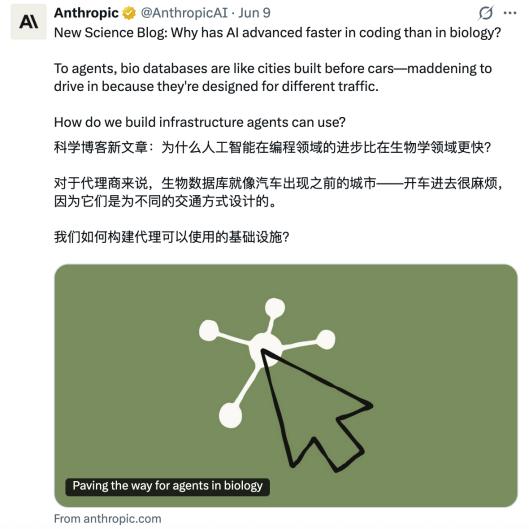
In a recently published engineering blog, Anthropic integrated Claude into biological research and discussed how AI agents can help scientists search for virus sequence data more stably and improve the workflow in bioinformatics. Seemingly, this is an article about a scientific agent, but behind it is still the familiar way of Anthropic to express itself: Our model is strong, we support scientific development. If the model is not stable enough, Anthropic of course puts the problem in the framework of "the scientific infrastructure is not yet ready for the agent era".
Although it is very strong, it has a somewhat arrogant attitude in a way, a bit of self - righteousness and arrogance.
But this is also the consistent style of Anthropic.
OpenAI is not far behind. If Anthropic tries to build the image of a "worried intellectual", then OpenAI has more of the storytelling style of a "minister in a peaceful time" in the era of AI.
Its story is different from Anthropic's, which says: "We see the danger, so we should warn." OpenAI says: "This will change everyone, so we must participate in shaping the future rules."
So OpenAI has released a public policy position paper and discussed security, protection of teenagers, workforce change, and global standards, and embedded itself in the context of policy - making. It has also released an industry policy for the AI era and proposed a human - centered industry policy, which emphasizes that in the AI era, opportunities should be expanded, prosperity should be shared, and more resilient institutions should be built.
In "Our views on AI policy and political advocacy", it also explained how it participates in AI policy and political initiatives, and emphasized that the future of AI should not be determined by a single company or organization alone, but should be jointly shaped by the government, researchers, workers, civil society, independent experts, and the public.
Before the G7 summit, OpenAI also proposed a global initiative for the safety of teenagers regarding AI and called for the establishment of a special institution to promote international cooperation so that teenagers can use AI more safely and with more opportunities.
These topics are placed among a series of product updates and seem to have little to do with the model, but they are indispensable for OpenAI. OpenAI wants to build the image not of "I understand the risks best", but of "I participate in creating a new social order".
With a well - known comparison figure, the idea of