Raised 81.3 billion yuan in financing with a valuation of 300 billion yuan, this AI company was founded just one year ago
Prometheus, an AI company secretly founded by Jeff Bezos, the founder of Amazon, has just completed a $12 billion financing round (equivalent to approximately 813 billion RMB), and the company's valuation has reached $41 billion (equivalent to approximately 295 billion RMB).
This is also one of the largest AI financings globally since 2026. The investors include top financial institutions such as JPMorgan Chase, BlackRock, Goldman Sachs, and DST Global.
Prometheus hopes to enable AI to design aircraft engines, medical devices, automobiles, batteries, chips, and even factory production lines like top engineers.
Bezos publicly stated that they aim to increase the development speed of complex industrial products by more than 10 times.
A Tycoon's Startup with a $6.2 Billion Beginning
The financing speed of Prometheus is quite rare even in the AI industry.
The company was founded in 2025 and was officially known to the outside world in November last year. By then, it had already received $6.2 billion in early - stage funding, a significant portion of which came from Bezos himself. A few months later, the media reported that it was completing a new financing round of approximately $10 billion, with a valuation of about $38 billion. By June 11th, the new official statement publicly disclosed by Prometheus was: a $12 billion Series B financing, with a valuation of about $41 billion.
Prometheus currently has about 150 employees. Its headquarters is located in San Francisco, and it also has teams in London and Zurich.
Why has its valuation soared to $41 billion in such a short period?
The first reason, of course, is Jeff Bezos.
Bezos is not an ordinary entrepreneur. He founded Amazon, turning e - commerce, logistics, cloud computing, and enterprise management systems into global infrastructure. He also founded Blue Origin, with long - term exposure to rockets, aerospace, manufacturing, and high - end engineering. These experiences make him well - suited to tell the story of Prometheus: using AI to transform complex industrial systems.
More importantly, Bezos is not just an investor but serves as the co - CEO. To the outside world, this means that he is not just casually investing in a company but getting directly involved. Since stepping down as the CEO of Amazon in 2021, Bezos has rarely operated a new company in the role of CEO. Prometheus is an exception.
The second reason is the co - founder Vik Bajaj. Bajaj is not a traditional Internet entrepreneur. He has a background in physics, chemistry, and life sciences and has worked at institutions such as Google X, Verily, and Grail. Google X conducts cutting - edge technology experiments, Verily focuses on life sciences, and Grail works on early cancer screening. These experiences are quite similar to what Prometheus aims to do: not just pure software but combining AI, science, engineering, and real - world data.
When a "tycoon" like Bezos starts a second business, it's not about him seeking money. Instead, it's about whether the money has enough "face" for him to accept it.
Thirdly, and more importantly, Prometheus has caught up with a new stage of the AI capital market.
In the past two years, funds have mainly flowed into basic model companies such as OpenAI, Anthropic, and xAI. Investors were betting on "who can create the most powerful brain." Now, as the capabilities of large models continue to spread, capital is starting to look for the next batch of high - value scenarios: code, healthcare, drug discovery, robotics, autonomous driving, industrial design, and manufacturing.
Prometheus is telling exactly this story: if AI can not only answer questions but also participate in designing an engine, a chip, or a production line, then it is not targeting the office software market but the global industrial R & D system.
Even a Small Piece of the Market is Worth Trillions
The industrial AI market is huge. Global manufacturing, aerospace, automotive, semiconductors, medical devices, consumer electronics, and drug R & D are all trillion - dollar - level large markets.
The common problems they face are: long R & D cycles, high trial - and - error costs, a shortage of expert experience, and data scattered across different systems. If AI can truly increase the engineering R & D speed, even if it only improves efficiency to some extent, it will generate huge commercial value.

AI - driven simulation of aircraft engine design. Source: Public information
Prometheus may not just sell software in the future. It may have several business paths.
The first is to create an enterprise - level AI engineering platform and sell it to large manufacturing enterprises to help them with design, simulation, and R & D management.
The second is to conduct in - depth project cooperation with aerospace, automotive, chip, and medical device companies, charge by project, and help customers shorten the R & D cycle. The third and more substantial approach is that it may directly invest in or acquire some manufacturing enterprises, integrate AI into the real production processes of these enterprises, and obtain returns through efficiency improvement.
The third path is the most substantial but also most in line with Bezos' style. Amazon doesn't just operate a website but is involved in warehousing, logistics, cloud computing, and advertising. Blue Origin doesn't just design rockets but builds a complete aerospace system. If Prometheus only develops an "industrial AI software," its growth potential is limited. If it can enter the real manufacturing system, master data and scenarios, the story will be much bigger.
This is also why it needs so much money.
AI companies burn money on three things: computing power, talent, and data. Industrial AI has an additional cost: real - world testing and engineering verification. You can't just generate a solution on a computer and claim it's usable. Engines need to be tested, medical devices need to be verified, automotive parts need to undergo durability tests, chip designs need to be taped out, and materials need to be experimented on. All these are very expensive.
Industry Giants Compete for Physical AI
Currently, funds are looking for ways for AI to enter the physical world. For example, yesterday, the robotics company Neura Robotics received $1.4 billion in financing.
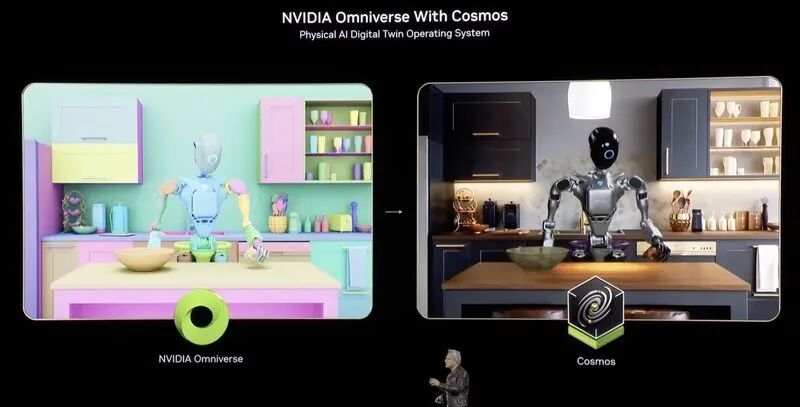
NVIDIA Omniverse and Cosmos Physical AI Platform. Source: Public information
However, this path is much more difficult than office AI.
Firstly, industrial data is difficult to obtain. The most valuable data is often the core asset of enterprises, involving process secrets, supply - chain relationships, and safety responsibilities. Customers won't easily hand it over to external AI companies.
Secondly, the tolerance for errors in industrial scenarios is low. Chatbots can change their answers, but engineering systems can't afford to "trial and error" casually. Industries such as aerospace, healthcare, automotive, and semiconductors have strict certification and supervision. Even if an AI - generated design performs well in simulation, it must go through a long - term verification process.
Thirdly, industrial processes are highly fragmented. Each company has different equipment, software, processes, and historical data. It's difficult for AI products to be replicated as quickly as general - purpose office software.
This is also the most observable aspect of Prometheus. It currently has capital, the reputation of its founders, and top - notch talent, but it hasn't proven three things to the outside world:
First, whether it can obtain high - quality industrial data; second, whether it can truly embed model capabilities into the engineering process rather than just staying at the demonstration level; third, whether it can find a replicable business model rather than turning each customer into an expensive consulting project.
This article does not constitute any investment advice.
This article is from the WeChat public account "Pencil News" (ID: pencilnews). The author is Huang Xiaogui, and it is published by 36Kr with authorization.