618 Chaos: The "Hundred Billion Subsidies" Controversy, as "Shake It" Morphs into "Rotate It"
On June 11th, the Beijing Market Supervision and Administration Bureau summoned five platforms, including Taobao (Tmall), JD.com, Pinduoduo, Douyin, and Xiaohongshu, and informed them of the second batch of typical problems in the special rectification of "involution - style" competition, including false publicity, opaque rules, and missing merchant information.
On June 9th, the Information and Communication Administration Bureau of the Ministry of Industry and Information Technology named and shamed the chaos of apps during the "618" period: splash screens and pop - ups inducing clicks, and high - sensitivity "shake - to - jump" mis - touch jumps. According to the on - the - spot test by Qiangdiao Next today, there are still many "shake - to - jump" ads.
The two regulatory actions once again remind platforms of the importance of orderly competition, aiming to curb various forms of illegal promotions: when the user traffic dividend is exhausted, e - commerce platforms are shifting their ways of maintaining growth from creating value to "transferring costs" and "creating intentions".
The summoning is to correct deviations. What really needs to be corrected is the underlying logic that gives rise to these problems.
01.
"Hundred - billion" marketing, the involution of "being generous with others' money"
"Hundred - billion subsidy" was originally a brand label of Pinduoduo. Around 2019, it was still a subsidy project with a specific fund pool and verifiable, used to enter the market of genuine branded products.
Later, JD.com, Taobao, and Douyin successively followed suit, and these four words began to lose their original meaning: from a product name to an industry label, and then to an emotional term.
Therefore, when the regulators asked "how much is the specific 'hundred - billion'", the embarrassing situation in the notice emerged. The response methods of each platform have clearly exposed the hollowness of the "hundred - billion subsidy".
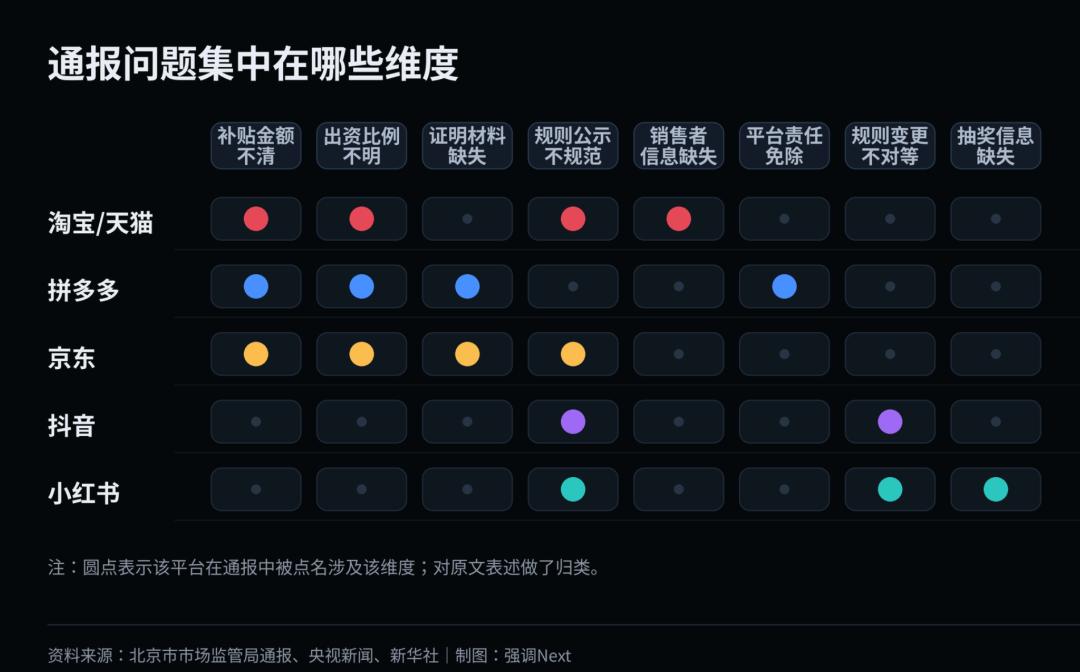
Taobao's handling best illustrates the problem: it repeatedly refused to provide data. This is not just being tough, but may also be an internally consistent legal logic. Once the "hundred - billion subsidy" is defined as a long - term activity name rather than a specific amount commitment, there is no "data" in the legal sense to provide.
Pinduoduo's problem is that even if there is a subsidy, where does the money actually come from (it cannot prove the contribution ratio)? The promotion rules state that for any disputes related to the goods, the platform can provide assistance within the legal scope, but will not assume the responsibility related to the goods. The regulators have determined that this unilaterally exempts the platform from its legal responsibilities.
JD.com has gone even further. It didn't even publicize the promotion period in the activity rules, and the "Hundred - billion Supermarket" simply has no activity rules.
Douyin's problems mainly focus on the platform's hegemonic thinking. The platform directly notifies merchants of the adjustment of activity rules, without a public consultation process.
Xiaohongshu's scale is not large enough to support a "hundred - billion subsidy". However, the problems discovered by the regulators are also significant. In addition to the missing key information, the more crucial issue is the "overbearing clause": the platform can change and adjust the rules at any time, and consumers "are deemed to agree if they continue to participate".
Liu Xiaochun, the director of the Internet Rule of Law Research Center at the University of Chinese Academy of Social Sciences, pointed out that irrational large - scale subsidies distort the market price mechanism. Some platforms even stipulate that the subsidies are fully borne by merchants. Merchants are caught in a dilemma of having no traffic if they don't reduce prices and incurring losses if they do, and their profit margins are severely squeezed.
This is the truth of "involution - style" competition.
The platform charges merchants through advertising slots, commissions, and traffic fees, and then takes a part of it to return to consumers in the name of "subsidies". Traffic is the real commodity sold by the platform. Merchants are the real payers of this business.
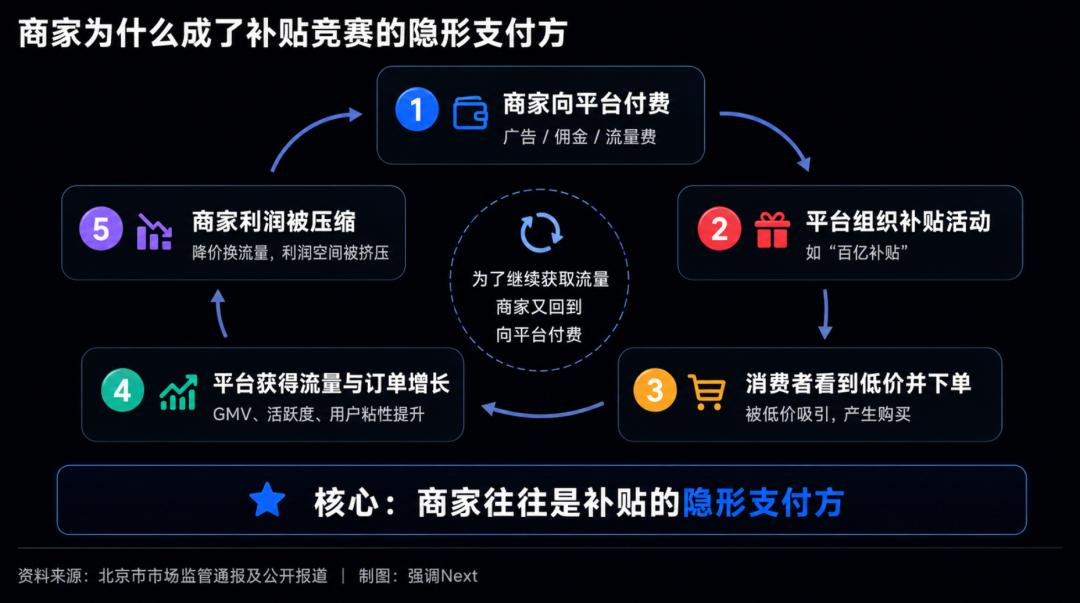
The sustainability of this cycle is limited. When the merchants' profits are compressed to a certain extent, they will reduce SKUs, lower the quality, and abandon R & D investment. Ultimately, what is damaged is not only the merchants' profit statements, but also the quality baseline of the entire commodity ecosystem. This is the real cost of "involution - style" competition.
02.
The traffic anxiety behind the "shake - to - jump" ads
Two days before the market supervision bureau's summoning, another ministry also took action.
The Ministry of Industry and Information Technology found that some apps use illegal methods to induce clicks in splash screens and pop - ups, or mislead users to trigger jumps through high - sensitivity "shake - to - jump", and stated that it will carry out regular detection and monitoring.
Qiangdiao Next opened the iQiyi app and NetEase Cloud Music today (the 12th), and there were still "shake - to - jump" ads of Meituan and Taobao. The trigger action of JD.com's ads on Tencent Video and QQ Browser has been changed to "flip the phone". According to our on - the - spot test, in the splash - screen ad state, the phone only needs to change its angle slightly to automatically jump, which is essentially still a "shake - to - jump".
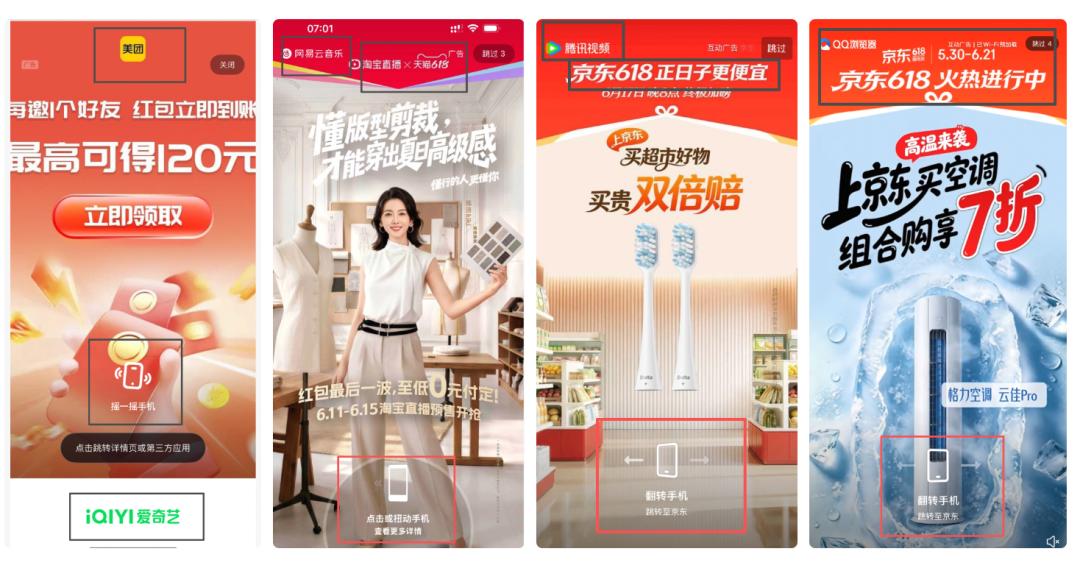
The "shake - to - jump" ad jumps have actually been rectified for many years. This persistence also shows that as long as there is traffic pressure, it is difficult to completely eliminate the temptation of illegal access.
Behind this is a changing user growth strategy. Platforms are finding it increasingly difficult to find spontaneous consumer willingness, so creating intentions has become a means for platforms to attract traffic.
But in fact, how much real conversion can the data brought by this "mis - touch" achieve? It's just a waste of advertising fees by the advertising placement teams of e - commerce platforms.
The Beijing Market Supervision Bureau proposed during the summoning that the focus should be shifted from "competing on subsidies and prices" to "comparing innovation and service". In fact, without the push of regulators, the market has already started moving in this direction during this year's 618.
03.
The competition map of 618 has changed
In 2025, the total online sales volume during the 618 period reached 855.6 billion yuan, but major platforms collectively stopped disclosing GMV and instead showed the order volume and the number of users. In 2026, JD.com's 618 promotion lasted for 46 days, with a "triple - promotion and five - wave" model, extending from one day to nearly two months. The GMV is no longer mentioned, and the promotion period is getting longer and longer. The logic of boosting GMV through subsidies and accumulating traffic through large - scale promotions has already reached its ceiling.
The first significant change is that instant retail platforms such as Meituan and Taobao Flash Shopping participated in the 618 promotion on a large scale for the first time this year, featuring the express experience of "30 - minute delivery". This means that 618 is no longer just the home ground of shelf e - commerce. The Research Institute of the Ministry of Commerce estimates that the scale of instant retail will exceed 1 trillion yuan in 2026, reach 2 trillion yuan by 2030, and the average annual growth rate during the 14th Five - Year Plan period will exceed 12%.
Meituan Flash Shopping has covered nearly 3,000 county - level administrative regions across the country, with an average daily number of on - sale products exceeding 1 billion; Taobao Flash Shopping has been designated by the core management of Alibaba as a "milestone - significance battle for the group", and it does not need to bear the profit - making pressure within three years; JD.com's instant delivery integrates hour - delivery and home - delivery services, relying on its supply - chain advantages to stabilize the basic market of supermarket categories.
The category boundaries are also shifting. Gree Electric Appliances has reached a strategic cooperation with Meituan Flash Shopping and plans to fully settle its 13,000 stores across the country before the end of July 2026; Xiaomi's large home appliances were launched on instant retail for the first time, specializing in categories such as air conditioners and monitors, and more than 10,000 stores have settled in. The home - appliance category, which traditionally belongs to shelf e - commerce, is being taken away by instant retail. When consumers can receive an air purifier within 30 minutes, "arriving tomorrow" is no longer a competitive advantage.
04.
AI: It has been implemented on the B - side, while still in training on the C - side
During this year's 618, AI was the most frequently mentioned word in the promotions of various platforms. Taobao has two - way access to the AI shopping assistant Qianwen, and Doubao has full access to the Douyin Mall, supporting dialogue - based product selection, product card recommendation, and in - app closed - loop ordering.
However, the AI shopping entrance on the C - side is currently mainly for training. According to Qiangdiao Next's on - the - spot test, the real shopping experience processes of Qianwen and Doubao are not smooth enough. In the first quarter of this year, nearly 80 million users of JD.com used the AI assistant "Jingyan" to assist in shopping, with a year - on - year increase of more than 200%. Although the numbers look good, users' actual decision - making paths are still in the comment section, live - streaming rooms, and content recommendation.
The trust basis for asking AI to choose a refrigerator is different from asking a shopping guide. The migration of the consumer decision - making entrance will not be completed in one 618, but the trend will not change.
What is really implemented faster is on the B - side. JD.com's AI design tool "Jingdiandian" helps merchants shorten the content production time by 90% and reduce the cost by 99%; Alibaba has upgraded its AI customer service Dianxiaomi, and after merchants connect to it, the rate of transferring to human customer service has decreased by 45%; the penetration rate of AI customer service in the e - commerce industry has reached 60% - 75%. The digital - human live - streaming is more mature, and 68% of small and medium - sized merchants are already using AI live - streaming tools, with the average single - store operation cost reduced by 72%.
What B - side AI can do is to substantially reduce the merchants' operation costs without increasing subsidies. This is exactly the opposite of the logic of "hundred - billion subsidy": one transfers the cost to the merchants, and the other helps the merchants reduce the cost.
This is also the specific form of "comparing service and innovation" mentioned by the regulators in practice.
05.
Conclusion
The summoning regarding the "hundred - billion subsidy" and the naming and shaming of the "shake - to - jump" ads represent that the old competition methods are gradually coming to an end.
In the past decade, the core logic of Chinese e - commerce has been traffic: if there are enough users, deep enough subsidies, and loud enough advertising, the business will come. This logic was effective in the incremental era because the market itself was growing, and the one who ran faster would win.
After the incremental era is over, the same logic has become a zero - sum game. The "hundred - billion subsidy" of a platform either comes from the merchants or from the investors, and someone has to pay the bill. The regulators' action is to draw a line when this zero - sum game becomes too rough.
However, drawing a line does not mean changing the logic. The real shift is that new competition dimensions are being formed: instant retail competes in terms of warehouse network density and fulfillment radius, AI tools compete in terms of merchants' operation efficiency, and content platforms compete in terms of users' stay time. These are all accumulated advantages that cannot be reversed by a single large - scale promotion.
It takes more than a year to build 50,000 Meituan lightning warehouses; and it is not possible to catch up with JD.com's logistics super - brain large model running in 1,000 supply - chain scenarios just by burning money.
After this year's 618, what really needs to be focused on is who has built real barriers in the new battlefield after the old battlefield is cleared.
This article is from the WeChat official account "Qiangdiao Next" (ID: leo89203898), written by Xin Jian and edited by Xiao Bai. It is published by 36Kr with authorization.