When AI replaces intellectual labor, it is time to consider "universal dividend"
This week, the South Korean Composite Stock Price Index is destined to resemble a fluctuating electrocardiogram.
Early in the morning on June 8th, Jensen Huang announced a historic cooperation worth hundreds of billions of dollars with SK Hynix in South Korea. However, the South Korean stock market immediately plunged by 8%, directly triggering the circuit - breaker mechanism. On Tuesday, June 9th, the market rebounded sharply and triggered an upward circuit - breaker, as if the panic of the previous day was just a false alarm. By Wednesday, there was another 5% intraday plunge that triggered a temporary trading halt.
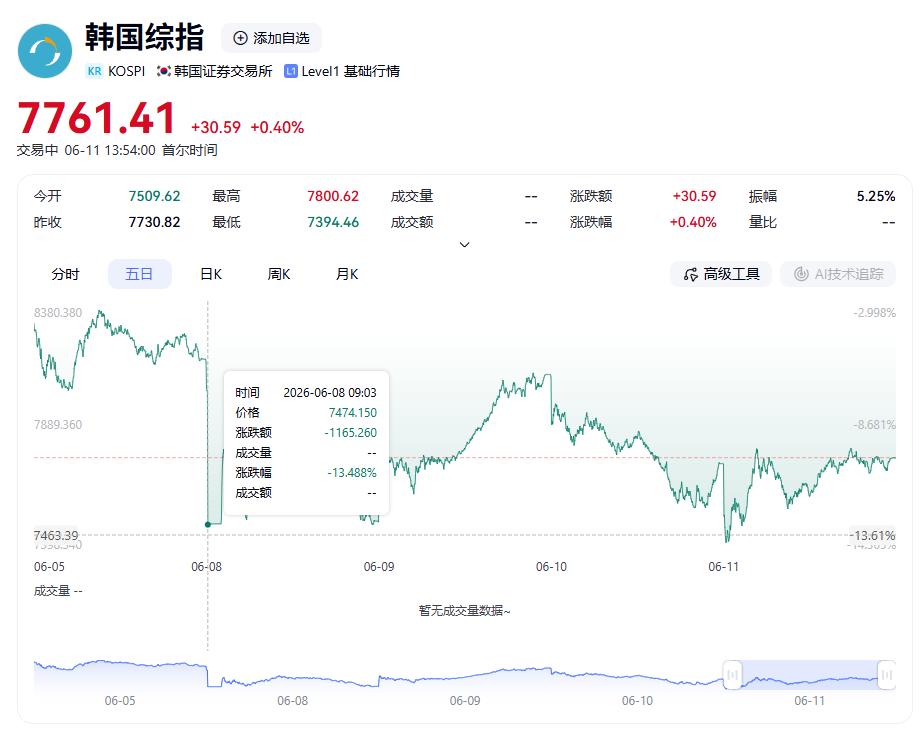
Of course, the South Korean stock market is just the most typical example due to the presence of Samsung and SK Hynix. In fact, global stock markets have recently been experiencing a rapid decline after the AI wave reached its peak.
From Broadcom's under - expected performance, to the disagreement over the sustainability of the memory cycle, to the "curse" of the listings of giants like OpenAI and Anthropic, and to Buffett's record - high cash reserves... Participants in the capital market are at another moment of faith - testing.
However, the daily joys and sorrows in the stock market are the least important things in this AI technological revolution. Those retail investors and leveraged players who flood into the stock market may just be driven by the immediate wealth effect. But their collective actions actually reflect the anxiety of being left behind by the times in the face of change.
As Elon Musk is on the verge of becoming the first person in human history with personal wealth exceeding $1 trillion, and as stock market speculation has become an effective means of getting rich for a large number of people, the real question that human society faces is: how should the huge wealth created by AI be distributed?
If we don't make a major revision to the existing economics and allow the Matthew effect of wealth distribution to expand rapidly, it's likely that no one will be a winner in the AI era.
01
The Seoul Stock Exchange is Crowded with "Ants"
The South Koreans call retail investors "ants". This term is almost brutally accurate. Ants are numerous, hard - working, crowded together, and can carry objects much heavier than themselves, but it's difficult for them to change the overall landscape.
In the past few years, a large number of South Korean retail investors have entered the stock market. This is not just a financial phenomenon but a social landscape.
According to data from the South Korean Securities Depository, by the end of 2025, the number of shareholders of South Korean listed companies reached about 14.6 million, of which more than 99% were individual investors. For a country with a population of about 50 million, this means that stock trading is no longer just a financial activity for a small number of middle - class people but a national lifestyle. Samsung Electronics alone has about 4.6 million shareholders, which means one in every ten South Koreans is a Samsung shareholder.

In the Netflix Korean drama "The Glory", 8 - year - old Ha Yi - seol (left) asks for Samsung stocks.
Tens of millions of ordinary people open stock accounts and buy stocks of Samsung, SK Hynix, US technology giants, and AI - themed ETFs. They are not all gamblers. Many of them have simply made a simple and desperate judgment: it's difficult to keep up with asset prices with wages, hard to resist inflation with savings, and almost impossible to achieve class mobility through normal career paths.
Due to the presence of the two major memory giants, South Korea is obviously one of the countries that have benefited the most from the AI boom. In May this year, South Korea's export volume increased by 53.2% year - on - year.
However, the booming economy doesn't benefit everyone. The "Household Trend Survey" report released by the South Korean National Statistical Office in May shows that in the first quarter of 2026, in terms of household disposable income, the income of the top 20% high - income group in South Korea was 6.59 times that of the bottom 20% low - income group, reaching the highest level since 2020. The income growth rate of the former was 4.2% year - on - year, while that of the latter was only 2.7%.
In the first quarter of this year, South Korea's nominal GDP increased by 10.5% year - on - year. Even the top 20% of households couldn't outperform the GDP growth, which means more money was earned by a smaller number of people.
In fact, in the total export volume of South Korea in the first quarter of this year, the top five enterprises, including Samsung and Hynix, accounted for 43.5% of the share, an increase of 14.8 percentage points compared with the same period last year. Each employee of SK Hynix is expected to receive a bonus of about 700 million won (about 3.2 million yuan) this year, and it may double next year.
On the other hand, ordinary South Korean workers are worried about their retirement life.
As a developed country, the absolute income level of South Koreans is not bad, but the retirement replacement rate has been relatively low for a long time, about 31%, while the average in OECD countries is about 50%, and in China it is about 45%. Therefore, there is a peculiar phenomenon in South Korea, that is, a large number of people over 60 borrow money to invest in the stock market.
When labor income grows slowly and asset prices rise in the long term, ordinary people will naturally have a fear of being left behind. The rising housing prices make homeownership an increasingly distant goal; the costs of medical care, education, old - age care, and child - rearing are constantly squeezing household cash flows; a high - level education no longer guarantees high income, and a stable job no longer guarantees a stable life. At the same time, people can see another world every day: the market values of technology companies are setting new records, the wealth of entrepreneurs is multiplying, stock options are creating millionaires, employees of core enterprises are receiving huge bonuses, and a small number of investors are achieving wealth leaps by betting on a market trend.
The stock market has become an alternative social elevator, the last hope for the "ants" to catch up with the "elephants".
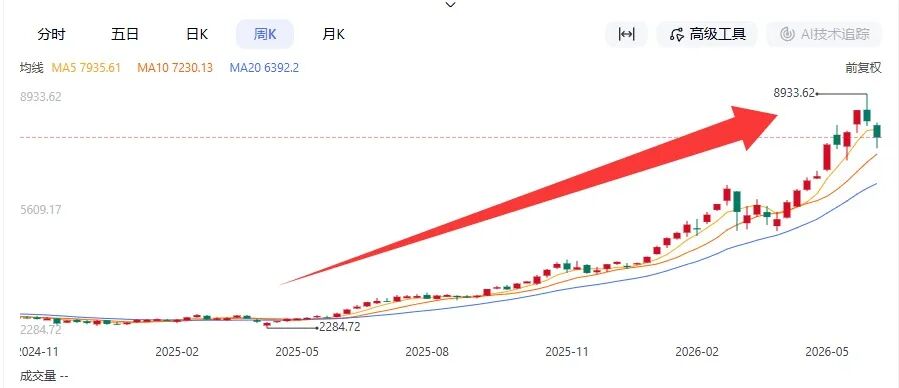
The South Korean Composite Index rose from 2300 points to around 9000 points in just one year.
But the problem is that this elevator doesn't really belong to them.
Since its inception, the capital market has been a place where institutions gradually eliminate retail investors. The development of AI technology itself means that large professional institutions will have greater investment advantages than ordinary people.
The more ordinary people participate in the secondary market, the more likely they are to be the ones at the end of the technological dividend and at the forefront of risks.
02
Will Technology Create New Jobs but Not New Middle - Class?
There is a cliche that when a technological revolution eliminates old jobs, it will definitely create more new jobs.
In the short term, this argument is applicable because the boundaries of AI's capabilities are still clearly visible, and it still needs human beings to operate.
However, when Anthropic calls for a halt to the development of cutting - edge AI, who can guarantee how long this situation will last?
Don't get me wrong. I'm still a progressive, believing that AI can create a better world, but this doesn't necessarily mean creating more and better jobs.
To understand why AI is different, we must first understand the relationship between technological revolutions and human society in the past two centuries.
The Industrial Revolution destroyed many traditional handicrafts but also created factories, railways, coal mines, steel, machinery, shipping, and urban service industries. Electrification changed the way of production organization. The automobile industry created large - scale manufacturing jobs and also gave rise to the oil, highway, logistics, insurance, retail, and suburban economies. The computer revolution eliminated typists, some clerks, and traditional office processes, but it created jobs such as programmers, system administrators, product managers, digital designers, financial engineers, consultants, data analysts, and Internet operators.
Each technological revolution is cruel, but they generally follow a unified logic: old jobs are replaced, new jobs are created; low - skill labor is compressed, and high - skill labor is rewarded; machines take on repetitive work, and humans turn to more complex, creative, and high - income tasks.
But this logic is not perfect. The early Industrial Revolution was accompanied by sweatshops, child labor, slums, and extreme exploitation. The computer revolution also created new inequalities, allowing highly educated people to get higher wages and forcing low - skill workers to face outsourcing, automation, and global competition. But overall, humans are still the masters above all tools and a necessary part of the production process.
Nearly two hundred years ago, Marx divided people into the bourgeoisie and the proletariat, but he also realized that there was an "intermediate class" such as engineers, teachers, accountants, and small business owners between them. This is essentially because human intelligence levels are relatively evenly distributed. No capitalist can manage a large - scale production process alone. They have to let more high - skill workers operate the production tools and pay them.
With the further complication of industrial production, developed countries in the 20th century even formed a relatively large middle - class, which blurred the distinction between the bourgeoisie and the proletariat to some extent. Compulsory education, urbanization, trade unions, the welfare state... Human society generally showed a progressive picture.
But the underlying problems of capitalism are being magnified by AI.
Because AI doesn't just replace manual labor or repetitive physical labor. It is entering the refuge that humans used to escape from the impact of automation: intellectual labor.
AI is first approaching offices rather than mines and docks.
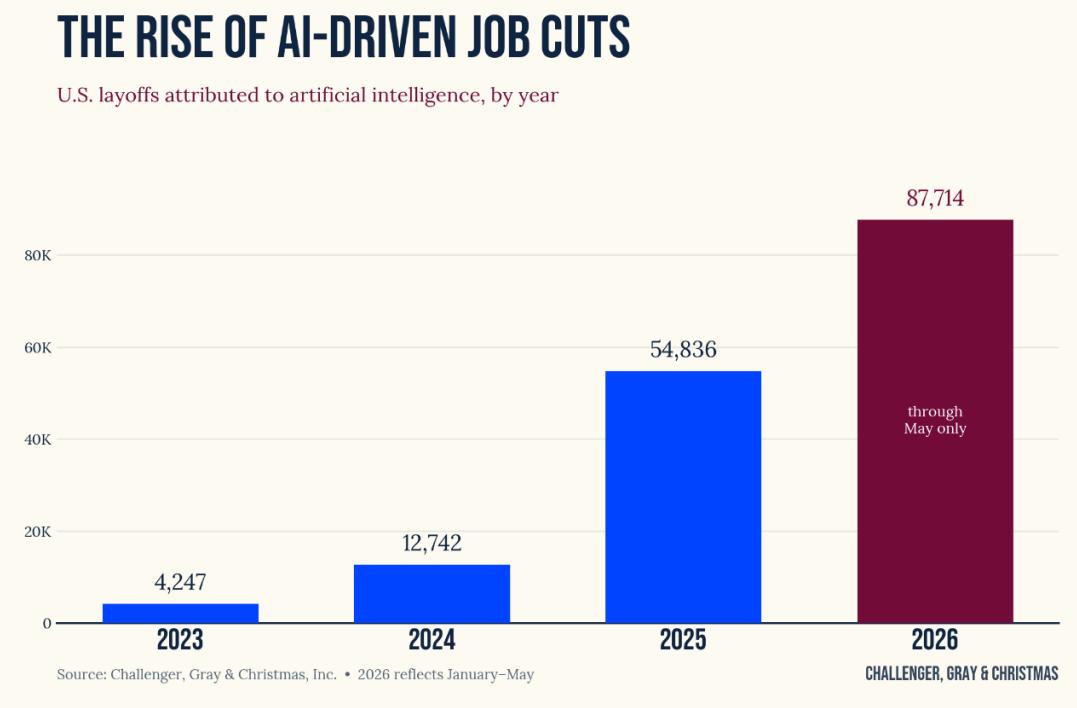
From January to May 2026 alone, 87,714 people in the United States were laid off due to AI - related reasons, far exceeding the total number in 2025. Image from the human resources company Challenger, Gray & Christmas.
It can write code, read contracts, summarize meetings, generate market reports, design advertising copy, make PPTs, handle customer service, complete preliminary financial analysis, write news summaries, generate legal memos, assist in medical image judgment, complete translations, edit videos, generate pictures, and even simulate expert conversations. Moreover, it is very likely to eventually surpass human experts intellectually.
Many people are already discussing that the most jobs created in the AI era will be blue - collar jobs rather than white - collar jobs. However, from the perspective of developed countries, they often fantasize that blue - collar workers can get higher pay than white - collar workers. After all, the bonuses at Hynix cover all employees from security guards, canteen staff to bus drivers.
But such a scenario may only appear in the organizations that monopolize the highest - value part. Globally, the vast majority of blue - collar workers in developing countries have never and will hardly participate in it in the future.
From the overall human picture, intellectual labor is more valuable than physical labor. Once humans are squeezed into the physical labor field, the scarcity of laborers is likely to decline significantly. Especially considering the potential development of robot technology.
This is the biggest difference between the AI era and previous technological revolutions: it may create more wealth, but it may not create more middle - class.
In the past, people believed that education could resist automation. But if AI enters the field with the highest educational returns, then the traditional path of "studying more, learning more, and improving skills" is no longer enough. It is still important, but it can't guarantee that the majority of people can share the technological dividend.
03
AI Revives the Ghost of Insufficient Consumption
AI is one of the greatest inventions in human history. We raise the above questions not to oppose the development of AI technology but to explore how humans should deal with the challenges of AI.
Our concern that AI won't create better job opportunities doesn't mean we think AI won't create a better life - as long as we change the economic distribution method and make the distribution less strongly tied to work.
Throughout the industrial era, although human society generally followed the distribution method based on the ownership of means of production, due to the importance of workers' skills, social distribution was not overly imbalanced.
However, in the AI era, those who own advanced chips have the foundation for training and deploying large - scale models, and thus have the most powerful intellectual labor skills.
The ownership of means of production and labor skills has never been so unified, and it is in the hands of the owners of AI giant enterprises.
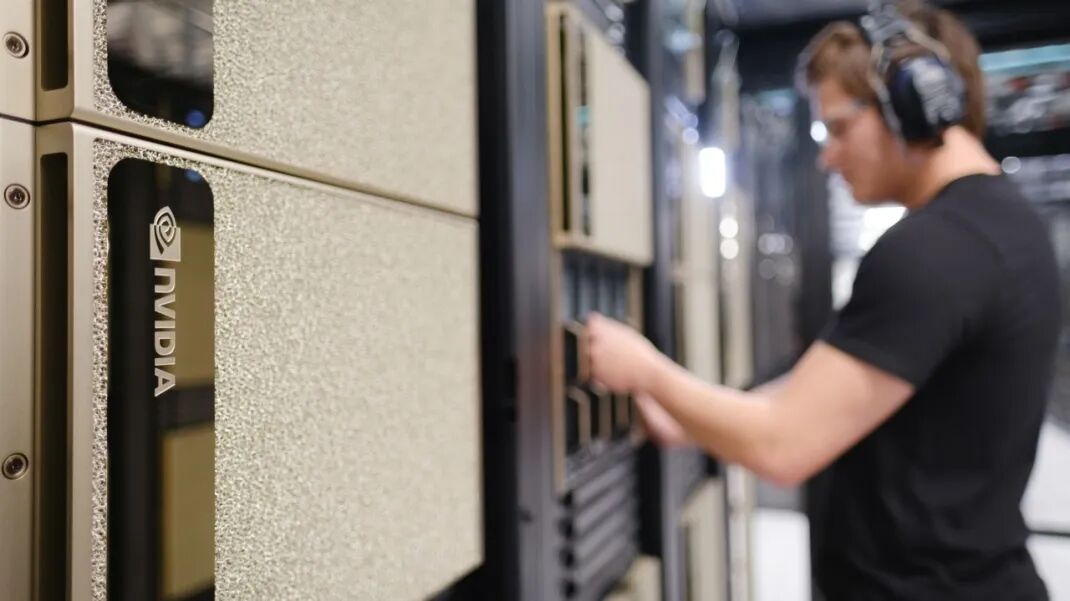
In order to suppress China, the US government once banned the export of NVIDIA's H200 chips to China. Image from NVIDIA's official website.
NVIDIA, Microsoft, Amazon, Google, TSMC, Samsung, SK Hynix, Broadcom, and key enterprises in the data center, power, and chip equipment industrial chains form the asset map of the AI era. The early benefits of the technological revolution are first reflected in the market values, profits, stock options, and shareholder returns of these companies.
This is why retail investors around the world are desperately trying to buy their shares.
Rather than preventing retail investors from investing in stocks, a more fundamental solution is to re - discuss the profit distribution methods of these enterprises.
This doesn't mean that enterprises shouldn't make profits, nor does it mean that capital shouldn't get returns. Without long - term investment, risk - taking, and engineering organization, the AI infrastructure wouldn't exist. The problem is that every penny of profit comes from corresponding consumption. Protecting consumption ability is essentially protecting profits.
Economics has long concluded that the proportion of assets used for consumption by the rich is necessarily lower than that of the poor. This is one of the theoretical pillars of Marxism - the polarization between the rich and the poor will reduce the overall social consumption ability, lead to insufficient demand, and thus trigger an overall economic crisis.
At that time, even the most powerful means of production will become worthless.
The polarization between the rich and the poor, the most fatal ghost of capitalism, was once covered up by previous industrial revolutions, but now it is being revived.
Whether in a voluntary form or in the form of national coercion, rewriting the distribution method based on the ownership of means of production is an issue that contemporary economics can no longer avoid.
04
How Should Public Resources Be Priced?
The AI revolution is often packaged as a victory of entrepreneurship and market competition. But the reality is that AI is not an industry completely spontaneously completed by the free market.
Advanced - process chips require huge capital investment, long - term R & D, geopolitical protection, and supply - chain coordination. Data centers need land, power grids, water resources, and energy planning. Cloud