Why does OpenAI set two CMO positions?
Recently, OpenAI has recruited a world - class veteran in B2B brand marketing to take on the position of "Chief Marketing Officer (CMO, Business)".
This veteran is named Colin Fleming.
He worked at Salesforce for 13 years and was promoted all the way to Executive Vice President (EVP) of Global Marketing. Subsequently, he served as the CMO at ServiceNow for two years, achieving remarkable results. With a solid resume, he is good at packaging complex products into brand stories and continuously converting them into business performance.
Behind this personnel adjustment is actually a shift in OpenAI's marketing logic. Specifically, why does OpenAI set up two CMO positions? Is it just a coincidence or a strategic move that has to be made?
01
OpenAI's Marketing Power is Divided into Two
At the end of 2024, OpenAI first pushed "marketing" to the center of the company's strategy.
Kate Rouch, a former marketing veteran from Meta and Coinbase, parachuted in to become the company's first global CMO. In the following time, she built a marketing team from scratch and led global brand activities. She even spent a fortune on advertising during the Super Bowl, firmly establishing ChatGPT in the global public's mind.
However, after the brand was established, commercialization became a new issue.
In the past few years, OpenAI has been in a state of rapid expansion. On one hand, the user scale has been continuously growing; on the other hand, the training and inference costs have been rising. How to convert the huge traffic into a more stable source of income has become a problem that the company must face.
In this context, in January 2026, ChatGPT's free version introduced an advertising model. This seems to be a regular Internet monetization move, but when it comes to generative AI, the situation is much more complex. For social media, advertising affects the user experience; for search engines, advertising affects clicks; for AI products, advertising is most likely to touch on users' trust in the answers.
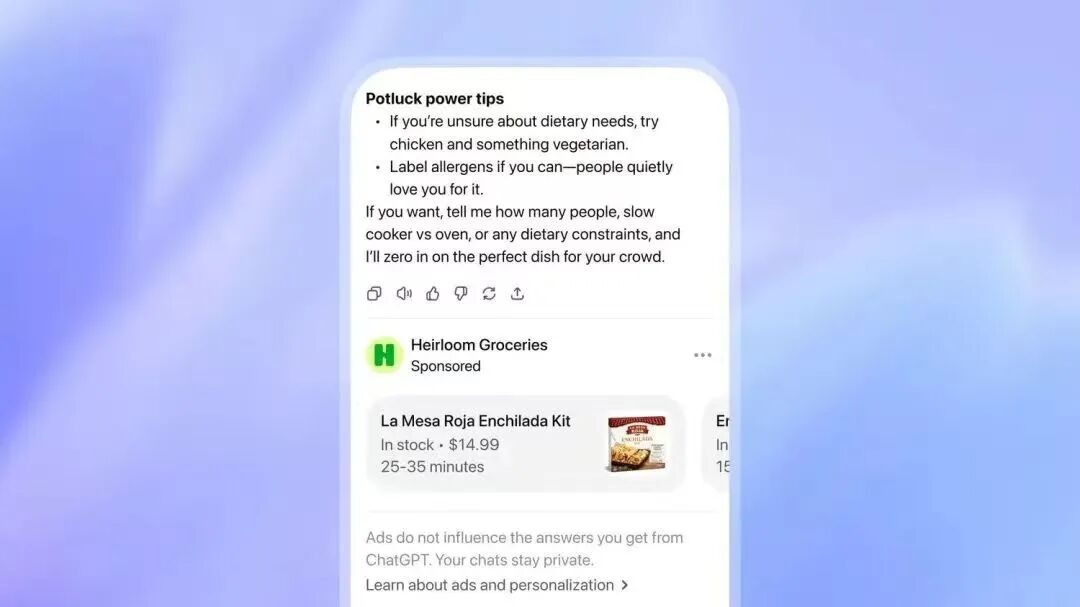
Therefore, despite OpenAI's repeated emphasis that advertising will not affect the model output, the focus of market discussion quickly shifted to another question: When commercial interests and content generation appear on the same product interface, how should an AI platform maintain its neutrality and credibility? It is reported that in a Harris Poll survey a few days before the launch, 75% of American respondents said that if there was sponsored content in the AI's answers, their trust in AI shopping suggestions would decline.
Just as the exploration of commercialization was just beginning, a new variable emerged within OpenAI. Rouch left the CMO position due to health reasons. It was later learned that she had been fighting advanced breast cancer during her 18 - month tenure.
For a rapidly expanding company, the departure of a core executive means an adjustment period. At that time, OpenAI was also in the most frequent stage of organizational change: The COO moved to a vaguely defined "special project" position, the product leader went on medical leave, and a group of core researchers left one after another. Although the marketing system had been established, it lost its most important coordinator. In this situation where the organizational fluctuations were not yet stable, the company was preparing for an IPO on one hand, while expecting to face a loss of up to $14 billion by the end of 2026 on the other.
Meanwhile, as the brand, commercialization, and organizational management all entered the adjustment period simultaneously, the original marketing structure began to seem a bit strained.
Finally, from May to June 2026, OpenAI chose to completely restructure its marketing system. The new structure no longer has one CMO in charge of all business, but is split into two independent fronts: the consumer side and the business side. The consumer - side CMO continues to be responsible for the user growth and brand building of ChatGPT; the business - side CMO is taken up by Fleming, focusing on expanding the enterprise market.
02
The Two Narratives are Incompatible
In fact, Fleming's resume is almost impeccable. The two most important stops in his career are Salesforce and ServiceNow. For the enterprise software industry, these two companies have a common feature: They both sell enterprise - level trust.
After all, few enterprises will hand over customer data, sales processes, and operating systems to a company they don't trust. Therefore, brand reputation, service capabilities, and long - term reliability are often as important as the product itself.
And this is exactly the area where Fleming excels. For example, how to persuade the procurement committee, impress the CFO, respond to the doubts of the legal and IT departments, and build brand reputation that can support multi - year contracts.
Many people attribute Salesforce's success to its product capabilities, but in fact, in the Marc Benioff era, Salesforce established a mature enterprise trust system earlier - a clear market positioning, continuous brand awareness, distinct brand assets, and a steady stream of customer success stories.
Fleming grew up in such a system. Later, when he moved to ServiceNow, he adopted a similar approach. Therefore, he knows very well what enterprise buyers want to hear and how many times they need to hear it before making a decision. So, in terms of resume matching, OpenAI can hardly find a more suitable candidate. However, the problem is that OpenAI is not Salesforce.
The enterprise customers of Salesforce and ServiceNow don't need to worry about the company operating a free product used by hundreds of millions of users on the other side, nor do they care whether the advertising business will affect the platform's development direction.
OpenAI's consumer business and enterprise business are sharing the same technology base. When ChatGPT starts exploring the advertising model, it may just be a commercial attempt; but for enterprise customers, they see another problem: What will be the company's priorities in the future?
What's more troublesome is that the competitors are approaching rapidly.
Anthropic has almost put all its chips on the enterprise market. It is growing faster, has a clearer path, and is gradually gaining an advantage in industries with higher regulatory requirements, such as finance, healthcare, and law. These are also the areas where large - scale enterprise orders are most concentrated and the "trust" factor is the most important. According to the card - swiping data of payment startup Ramp, the proportion of enterprises that choose Anthropic for their first AI purchase is three times that of OpenAI. Although an OpenAI spokesperson later argued that this statistic was inaccurate, the fact that this statement was widely spread represents the market's anxiety and a reversal of the narrative.
On the other hand, Google Gemini is competing for the developer ecosystem and mind - share through a price - cut strategy. Fleming is entering a market where he cannot rely on brand dividends, but a melee happening at the levels of technology, products, and business models.
Anthropic is seizing the enterprise customers' minds with the positioning of "safer and more reliable"; Google is constantly lowering the competition threshold by relying on its models, cloud computing, and developer ecosystem. For OpenAI, the biggest challenge may not be a single competitor, but the loss of its previous "dominant" narrative advantage.
03
Conclusion
In the past few years, OpenAI's greatest asset was its leadership. When the industry was still discussing the future of large - scale models, it already had ChatGPT; when competitors were still looking for product forms, it had established a global user base. Many growth problems could be covered up by technological leadership.
However, as AI enters the industrialization stage, the rules of the game are starting to change.
Enterprises will not sign multi - year contracts just because a model is 5% more advanced, and developers will not abandon a lower - cost solution just because a brand is more well - known. Technological advantage is still important, but it is no longer the whole answer.
This is why almost all of OpenAI's personnel changes in the past year have pointed in the same direction: from a research institution that creates technological breakthroughs to a platform company that needs to continuously manage customer relationships, partner relationships, and business reputation.
Fleming's joining happened right at this turning point. If the most important question for OpenAI in the past few years was "how to get more people to use AI", then in the next few years, the question it needs to answer may be: After AI becomes the enterprise infrastructure, why will customers still choose OpenAI?
Obviously, the answer to this question cannot be solved just by releasing the next - generation model.
This article is from the WeChat official account "wj00816" (ID: Morketing), author: Fangli Wen. It is published by 36Kr with authorization.