At this World Cup, Chinese small commodity business owners might be working harder than the players.
Before the opening match of the FIFA World Cup jointly hosted by the United States, Canada, and Mexico kicked off in the early morning of June 12th Beijing time, Chinese factories had been busy for months.
As the tournament drew closer, Jin Yikui became even busier than in the previous months. The Yongkang Langxin Industry and Trade Co., Ltd., founded by him, has 16 years of experience in sports goods production, mainly producing fan cheering horns.
According to past patterns, even in years with World Cup orders, factories generally start to get busy from May of the previous year. This is because World Cup - related orders are mainly concentrated in countries and regions such as Brazil, Argentina, and Europe, where there are more concentrated fans and greater demand for World Cup - related merchandise.
For this year's FIFA World Cup in the United States, Canada, and Mexico, in addition to these places, orders from the host countries and China have also skyrocketed.
"This year's orders are almost four times the volume of previous World Cups. And if there are dark - horse teams, there may be urgent orders in June," he told Jiemian News. He thought he could take a short break, but in late May, new orders poured in. This time, they were not from overseas but from Chinese beverage and beer brands. These brands ordered cheering horns with their logos and flags, with a minimum order quantity in the tens of thousands.
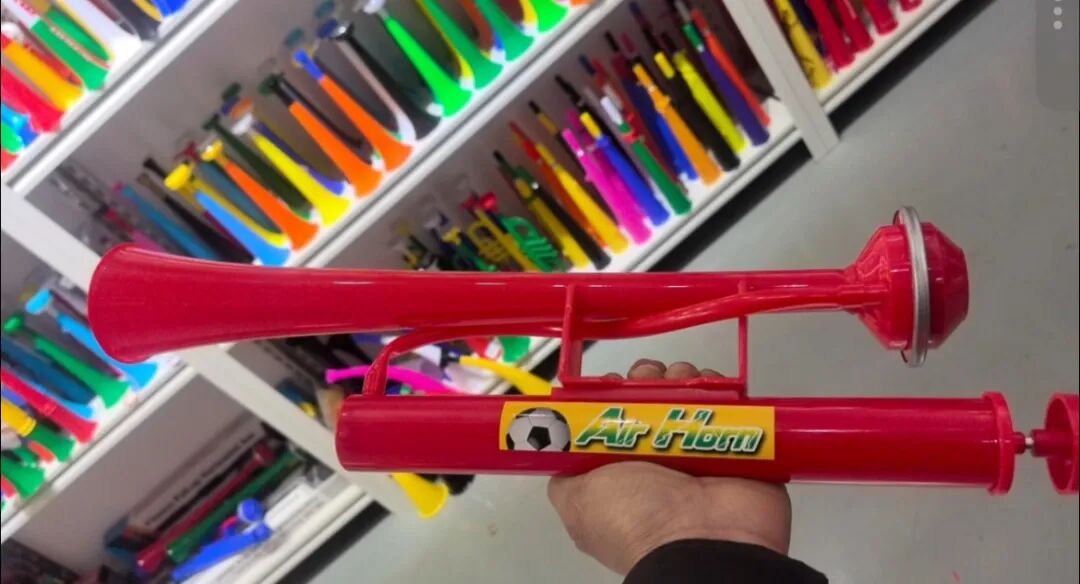
Cheering horns produced by Langxin Industry and Trade Co., Ltd. (Photo source: provided by the interviewee)
According to his analysis, perhaps due to the pandemic during the previous World Cup, consumer brands were less enthusiastic about leveraging the event for marketing. However, in this World Cup, the number of participating countries has increased from 32 to 48, expanding the market scope. Some Chinese consumer brands eager to boost sales through the World Cup are showing unprecedented enthusiasm for marketing this time.
"Because the orders are urgent, some orders were airlifted to Beijing a few days ago," Jin Yikui showed Jiemian News videos of his factory's production line and shipping process.
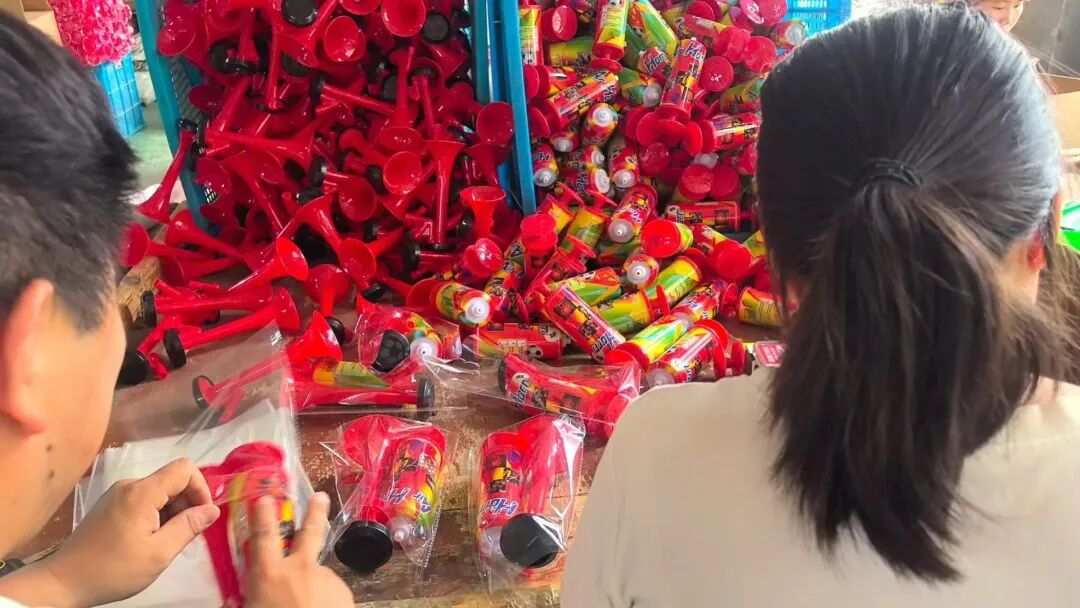
The production workshop of Langxin Industry and Trade Co., Ltd. (Photo source: provided by the interviewee)
Behind the World Cup - related products, "Made in China" is no longer a "supporting role." In fact, China accounts for about 70% of the market share of World Cup - related merchandise.
According to the estimate of the Yiwu Sports and Fitness Products Industry Association, "Made in Yiwu" accounted for nearly 70% of the market share of merchandise related to the Qatar World Cup. From the flags of the 32 participating teams to footballs, jerseys, from the replicas of the FIFA World Cup Trophy to fan horns, Chinese enterprises can be found in almost every category of World Cup - related products. Although there is no exact estimate for the FIFA World Cup in the United States, Canada, and Mexico, the data from Yiwu Customs confirms the market's enthusiasm. In the first quarter of this year, the export value of sports goods and equipment from Yiwu reached 2.83 billion yuan, a year - on - year increase of 12%.
The significance of the World Cup economy for Chinese factories is not just the soaring orders. More notably, the World Cup dividend is becoming a "catalyst" for the transformation of Chinese manufacturing enterprises, driving innovation and change in the industry.
In Huadu District, Guangzhou, Chen Gangqiang, the founder of Jiahui Mei Textile Co., Ltd., has felt similar changes. He owns a factory of over 5,000 square meters and a trading company, and his products cover various customized categories such as fan scarves and fan jerseys.
"This year's orders are generally on the rise compared to the previous World Cup," said Chen Gangqiang, who has been in the textile business for 32 years, to Jiemian News. Relying on the service reputation built over the years, "old customers who cooperated in the previous World Cup have all come back this year and brought many new customers."
This is inseparable from Chen Gangqiang's continuous upgrade of the factory's technology.
Chen Gangqiang introduced to Jiemian News that the company was an early adopter of robotic embroidery machines. The most obvious change is a significant improvement in product precision and consistency: "Traditional embroidery machines rely on experienced masters to manually adjust the needle positions, and human performance can fluctuate. The machines are fully digitally controlled, and the position and strength of each stitch are precisely set by the program. The consistency of the products made is much better."
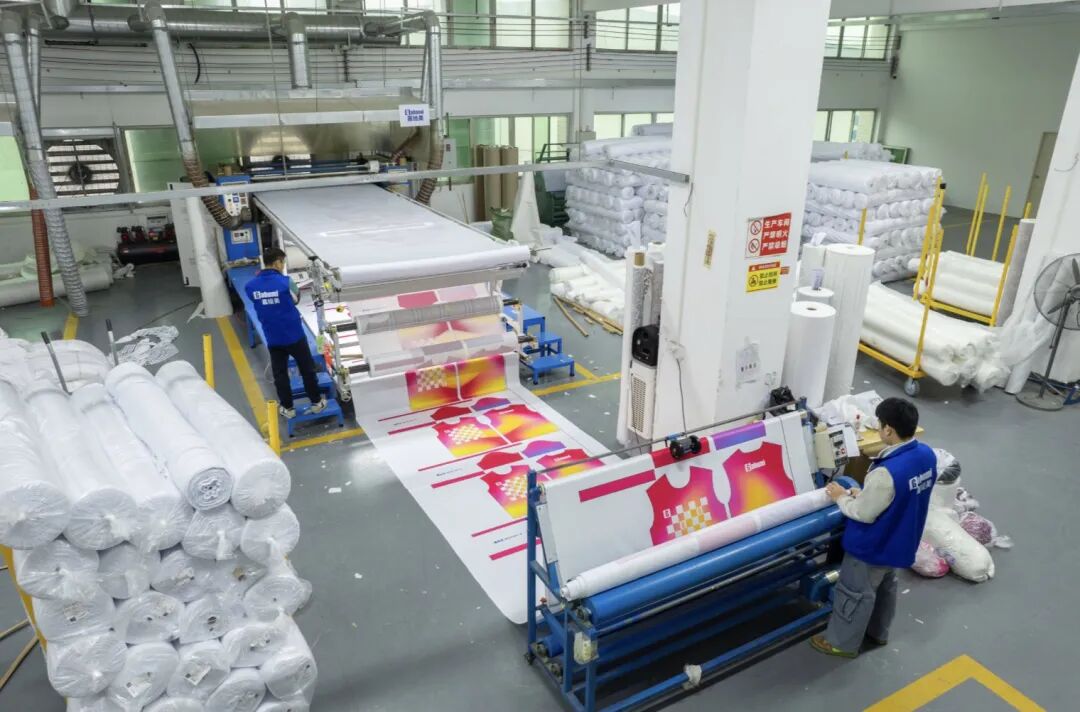
The production workshop of Jiahui Mei Co., Ltd. (Photo source: provided by the interviewee)
For example, this year, a customer ordered fan scarves with very thin gradient - colored stripes in the team logo. In the past, with traditional equipment, it was okay to make 10 samples, but it was difficult to ensure the same effect for each of the 1,000 - piece batch production.
"Now, with the intelligent embroidery machine, as long as the program is confirmed during the sample - making stage, no matter how many pieces are made later, the effect will be exactly the same as the sample," he told Jiemian News. "Moreover, the current equipment has automatic positioning and alignment functions. Once the fabric is placed on the machine, it can find the correct position, eliminating the trouble of manual repeated alignment and improving efficiency significantly."
The different demands of different markets are also forcing Chinese factories to refine their fine - management capabilities.
Chen Gangqiang told Jiemian News that the US market has relatively high requirements for quality. They prefer slightly thicker scarves that feel substantial in hand. They also care about the fabric feel, embroidery fineness, and packaging details, and are relatively less sensitive to price. Mexican customers, on the other hand, are extremely particular about colors. The saturation of the green, white, and red colors of the national flag must be precise, "even a slight deviation is not allowed."
In addition, Chinese factories can also well meet the market demand for small - batch and multi - batch orders with their flexible production capabilities and years of accumulated craftsmanship experience.
Chen Gangqiang told Jiemian News that the peak period of large - volume World Cup orders has basically passed, and most of the large - scale goods have been delivered before the start of the tournament. Currently, there are two types of orders. One is urgent orders. For example, during the progress of the tournament, when some teams perform better than expected, customers add orders temporarily. These orders are small in quantity but have very urgent delivery times. The other type is regular orders from the domestic market, which are not affected by the World Cup cycle and are produced stably throughout the year.
The enthusiasm for World Cup orders also reflects the structural upgrade of China's light manufacturing industry. In this wave of foreign trade for the World Cup, original design and independent innovation have become prominent features.
During the interview, Jiemian News found that many merchants from Yiwu and Guangzhou are no longer simply taking on low - end overseas orders. Instead, they are actively exploring market demand and launching differentiated and creative new products. For example, new - format products such as pet jerseys, themed figurines, and customized cultural and creative products are widely favored in both domestic and overseas markets. The order volume of some high - quality merchants in the IP - authorized field has increased several times.
In this regard, Juxing Power, a company engaged in IP cultural and creative products, is a typical example. Its CEO, Luo Bin, revealed that as a partner with official IP authorizations from multiple national football teams, they sell cultural and creative products with emotional value, such as the lamb doll paying tribute to Messi as the "Greatest of All Time," the rooster IP dolls of the French team, pet jerseys, and infant mini - jerseys. The first - batch order amount of Juxing Power this year has exceeded 100 million yuan.
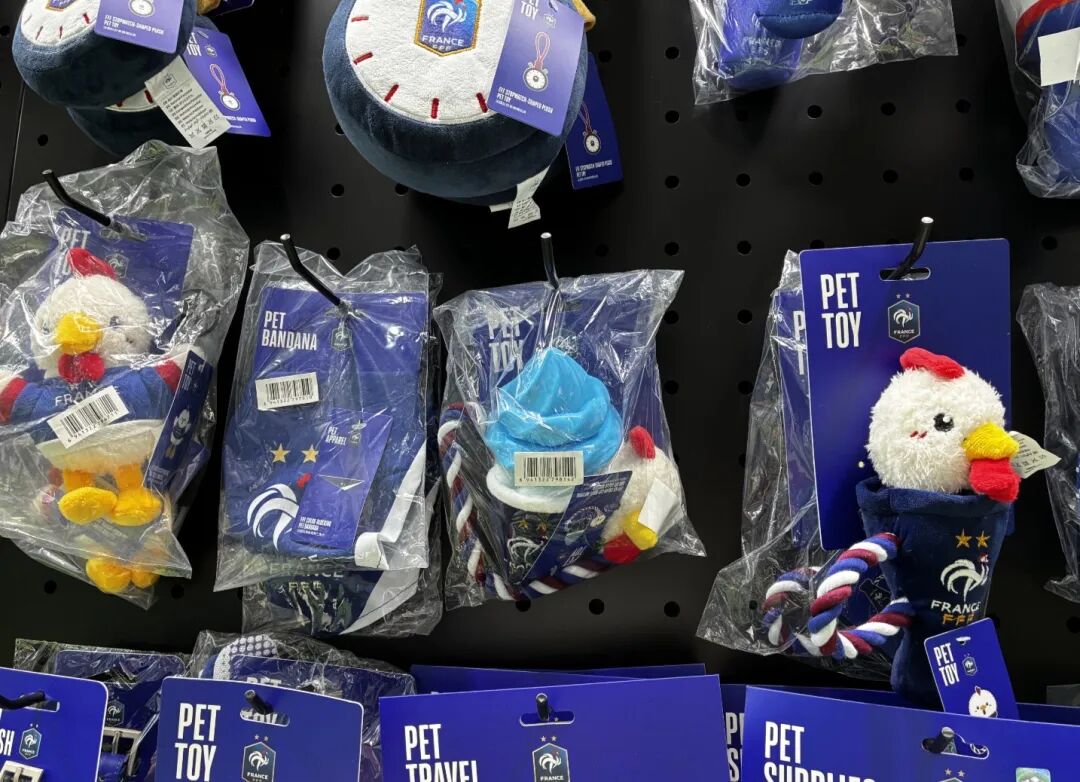
The "Rooster IP doll" of the French team in the store of Juxing Power in the atrium of a shopping mall in Beijing. (Photo taken by: Jiemian News, Zhao Xiaojuan)
Chen Gangqiang also secures stable domestic orders through exclusive copyrights.
He told Jiemian News, "In our factory, the production lines for the World Cup have been gradually freed up, and the production capacity is starting to shift to domestic orders and daily foreign trade orders. In the domestic market, cloth bags and T - shirts with cultural and creative texts have been selling well. We have been doing this category for several years. We have our own design team and copyright library, which are not dependent on the sports event cycle and have stronger risk - resistance capabilities."
For Chen Gangqiang, this ability can not only meet the needs of the World Cup but also flexibly meet the customization needs of various domestic and international sports events, helping him find more business opportunities and gain differentiated competitiveness in the once volume - based small - commodity market.
This article is from the WeChat official account "Jiemian News". Author: Zhao Xiaojuan, Editor: Ya Hanxiang. Republished by 36Kr with permission.