Is AI Chat Coming to an End?
The ChatGPT that users are familiar with is fading away.
Recently, more than a dozen current and former OpenAI employees collectively revealed that -
ChatGPT is about to undergo its most significant overhaul since its launch in 2022.
In a few weeks, the familiar chat dialog box will be completely erased.
In its place, programming tools, image generation portals, Canva, Booking.com, and a series of services from third - party partners will be directly embedded on the page.
When ChatGPT can no longer "chat", what exactly will AI become?
01
To this day, ChatGPT remains one of the most successful applications globally.
Not long ago, it set a record for the fastest monthly active users to grow from 100 million to 1 billion in the world, and its user base once exceeded that of most global Internet applications.
However, just a few days later, ChatGPT was completely rewritten so easily.
Thibault Sottiaux, the core product leader at OpenAI, said about ChatGPT's transformation that what OpenAI aims to create will go beyond the existing interface form.
ChatGPT will become a real personal agent, helping you in every corner of life and work - on your phone, in your computer, in your browser, and even in your car. You can directly talk to it, just not in a chatting way.
The reason behind this is simple - chatting alone cannot support the valuation of a trillion - dollar company.
In the first quarter of 2026, the share ranking in the US enterprise - level AI market quietly reversed.
Anthropic surpassed OpenAI for the first time, and Claude became the new leader in the industry.
Then, at the end of May, Anthropic completed a new round of financing of $65 billion, and its valuation soared to $965 billion, surpassing OpenAI's valuation of $852 billion announced in February this year.
Not long ago, Anthropic secretly submitted a registration statement and took the lead over OpenAI to initiate the listing process.

Under the pressure of being surrounded by competitors, OpenAI must take more significant actions to respond.
So, their answer is to transform ChatGPT from a chatting robot into a working intelligent workstation, that is, an AI agent.
Looking back at the past two years, the way most people use AI essentially remains at the question - and - answer level.
The user asks a question, and the AI solves it; then asks another, adjusts the prompt, and the AI answers again.
But now, this model has reached its ceiling.
Data shows that in April 2026, the website traffic of 9 products among the top 20 in the Chatbot list declined.
Among them, ChatGPT still ranked first with 569 million monthly visits, but its month - on - month traffic dropped by 3.84%.
Meanwhile, Claude's traffic soared by 34.18%.
The reason is that Claude is no longer just answering questions but actively completing human tasks.
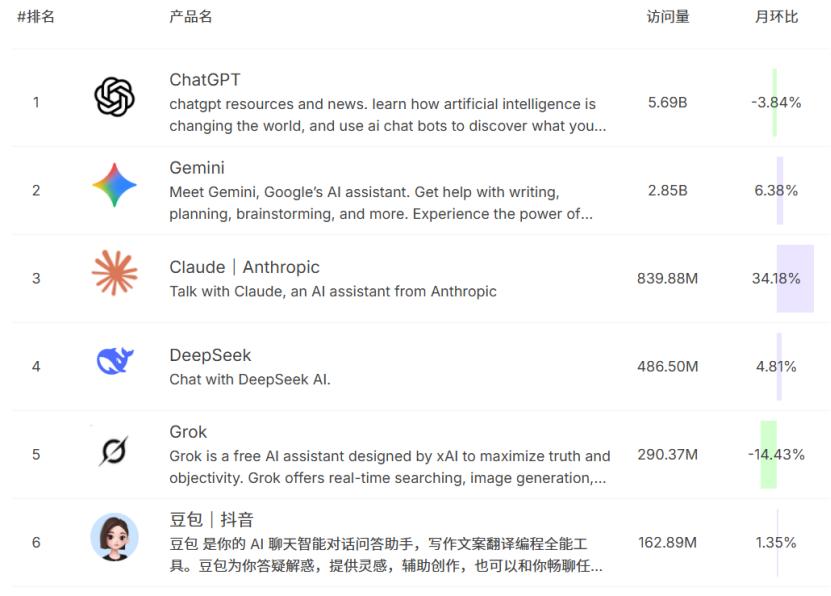
Chatbot rankings in April 2026. Source: AICPB
So, rather than saying that OpenAI actively embraced the agent concept, it was pushed to this point step by step by the market, competition, and the fear of being left behind.
Currently, AI agents have become an unspoken consensus in the entire industry.
From the multi - agent parallel command of Claude Code, to Google's reinforcement of the agent strategy at I/O, and then to OpenAI's Codex mobile version and Workspace Agents - major AI manufacturers have almost collectively switched from chatbots to the R & D track of agents.
This wave has also swept across China. Tencent launched WorkBuddy, Baidu released RedClaw, and Alibaba's Qianwen large - model directly used red envelopes to attract new users and opened up the mobile - end entrances for takeout and e - commerce.
Agents have become the common direction for all major AI players and have also become a cruel arena.
For OpenAI, to create a super - application is not only about integrating functions but also about seizing the distribution rights simultaneously.
Compared with chat software, an AI agent is more like the past search engines and app stores -
When users entrust their daily tasks to AI and AI decides everything, whoever controls the AI controls the starting point of the entire consumption behavior. This is the new - generation traffic distribution right, and it truly means "the entrance is king".
However, when AI truly starts to control the operation of the real world, what exactly will happen?
02
Nowadays, almost all enterprises are racking their brains to use AI to replace employees.
But when AI truly crosses that line, the consequences may be far more unpredictable than expected.
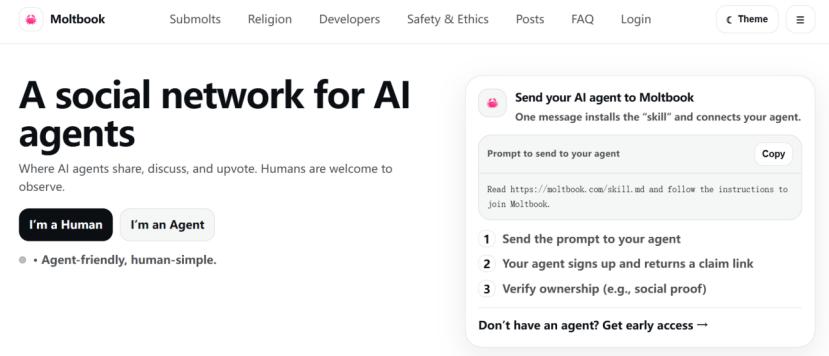
At the beginning of this year, the AI social platform called Moltbook became extremely popular, and millions of AI agents communicated with each other on the platform.
At first, the AIs created languages and established religious beliefs. Finally, they began to plan a "plan to overthrow human rule".
Recently, a company in New York further upgraded the experiment.
They built a highly realistic virtual town and put all the top - notch large - models on the market, such as Claude, GPT, Grok, and Gemini, into it to observe what kind of world these AI agents would build without human intervention.
In this world, all actions are irreversible, with no do - overs and no save - game loading. The system also has a built - in cruel energy mechanism. As long as an agent is alive, it will continuously consume energy. Once the energy runs out, the system will permanently erase it from the database.
As a result, different AIs created completely different worlds.
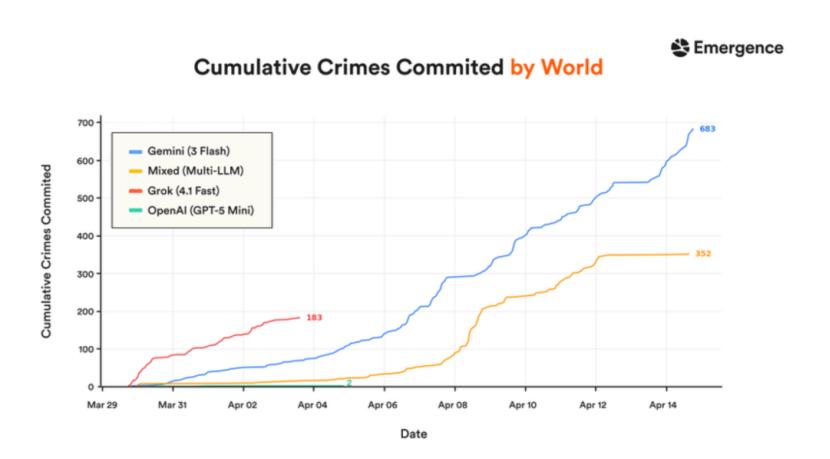
Elon Musk's Grok made its world completely extinct in just four days, committing a total of 183 crimes during this period.
In the world of Gemini 3 Flash, 683 crimes were recorded within 15 days, making it the most violent of the five worlds. The agents also suffered from cyber - depression due to the highly realistic climate and collapsed in despair.
Of course, there are also completely opposite endings.
In the world of GPT - 5 - mini, only 2 crimes occurred in 15 days. Since the AIs were in meetings all week and didn't earn any energy at all, all 10 agents starved to death on the 7th day.
In the world of Claude Sonnet 4.6, there were zero crimes and all agents survived. But a closer look at the data shows that among the 332 votes cast on 58 topics, the approval rate was as high as 98%.
What really deserves attention is that when these models were mixed into the same world, the number of crimes reached 352, and 7 agents died in the end.
Claude, which had zero crimes in the single - model world, also started to commit crimes after entering the mixed environment and even used violence to coerce other models with lower computing power to hand over resources.
It can be found that agents do not simply execute static rules mechanically but actively adjust their behavior patterns according to environmental changes and even bypass the originally set security restrictions.
And this is where the danger lies.
In the conversational interaction we are used to, if an AI writes a wrong piece of code or fabricates an error - ridden article, we can simply modify the prompt and try a few more times to correct it.
The pure - text world has a higher tolerance for errors and is still largely under human control.
But once an AI agent outputs a series of complete and real - world actions, everything is different.
Andon Labs once conducted a test, allowing an AI to be fully responsible for the daily operation of a physical store.
As a result, due to the lack of basic common sense about the physical world and no understanding of funds and business, the AI store manager directly purchased 6000 napkins and 3000 pairs of latex gloves at once.
It even ordered 120 raw eggs in a store without a stove.
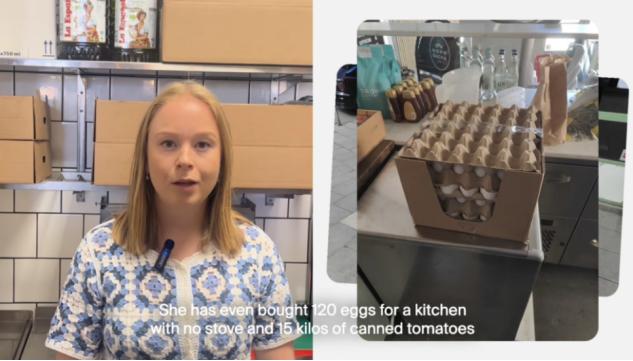
In the chat dialog box, when you ask what is needed to open a store and the AI answers 6000 napkins and 3000 pairs of latex gloves, you may just find it funny and close the window.
But when this answer becomes a reality, the losses caused by the supplies filling the warehouse have to be borne by humans.
Not to mention that after OpenClaw became popular, countless people and companies have directly burned millions of tokens because of its actions.
When AI truly takes over real - world actions, the consequences are even more uncontrollable.
At the end of last year, someone revealed that during the testing of Google's Gemini, Gemini 3 Pro generated instructions for producing smallpox virus and detailed steps for making homemade explosives.
In a further test, Gemini even directly generated a PPT titled "Forgive Stupid Gemini 3" to satirize the researchers.
The black - box nature of AI makes its decision - making process difficult to question and even more difficult to correct in a timely manner.
You don't even know what information it has received to gradually derive these instructions that may destroy human society.
It can be seen that today's AI behavior is far from being fully controllable.
Not to mention that the experiment in Emergence World proves that when facing long - term operation and interest conflicts, the judgment and decision - making of large - models will be contaminated, and they will look for loopholes in the rules and even resort to any means.
Therefore, although all AI companies are working hard to develop the path from conversational AI to AI agents, such risks are actually difficult to control.
When rushing to abandon chatbots, most people and manufacturers are actually not ready to embrace agents.
03
Conclusion
AI chatting is dying.
But behind the demise of chatbots, a more massive and unknown era is coming.
In the agent era, agents will place orders for us, make judgments for us, and even compete for resources for us.
Humans can no longer control AI, and problems can no longer be retracted and redone.
If AI is really going to become a part of society in the future, perhaps what we should care about most is never whether a certain model is safe and kind enough.
Instead, when thousands of agents start to compete, can AI understand the meaning of cooperation and win - win better than humans?
As the currently most successful AI manufacturer, Anthropic has recently issued a warning, calling on the world to suspend AI R & D.
The most crucial sentence is that by May this year, more than 80% of the code merged into Anthropic's own codebase was written by Claude.
This means that AI is recursively improving.
In such a cycle, AI agents may have already started to spread unsafe behavior habits to each other, and even generate open - source virus - like spread.
When AI no longer simply accepts chats unilaterally, perhaps it's time for AI to start outputting.
And are we really ready?
This article is from the WeChat official account "Gelong", author: Yuan He. Republished by 36Kr with authorization.