Surge by over 10 times, how powerful is China's leading shipbuilding enterprise?
Text by Li Xiaofeidao
In recent years, shipbuilding, as an old cyclical sector in the A-share market, may seem unremarkable but has astonishing returns.
Among them, Songfa Co., Ltd. incorporated the assets of Hengli Heavy Industry and soared tenfold in two years. Yangzijiang Shipbuilding tripled from its bottom in 2022 against the backdrop of a sharp decline in Chinese concept stocks. CSSC, the global shipbuilding leader, has rebounded by over 130% since April 2022.
The capital market is pricing the high prosperity of the Chinese shipbuilding industry.
[Both Volume and Price Rising]
Since 2021, the Chinese shipbuilding industry has maintained a high level of prosperity, enjoying the dividends of both volume and price increases.
In the first quarter of 2026, Chinese shipyards signed new orders of 12.39 million compensated gross tons, a year-on-year increase of 91%, accounting for 71% of the global market share, far higher than South Korea's 20%. The order backlog reached 120 million compensated gross tons, a year-on-year increase of 19%, and has maintained double-digit growth since 2021.
In terms of price, as of the end of May, the Chinese new shipbuilding price index was 1131 points, basically on par with the ten-year high in the fourth quarter of 2024, and up more than 45% from the cyclical bottom at the end of 2020. Among them, oil tankers, container ships, and bulk carriers have all maintained an upward trend.
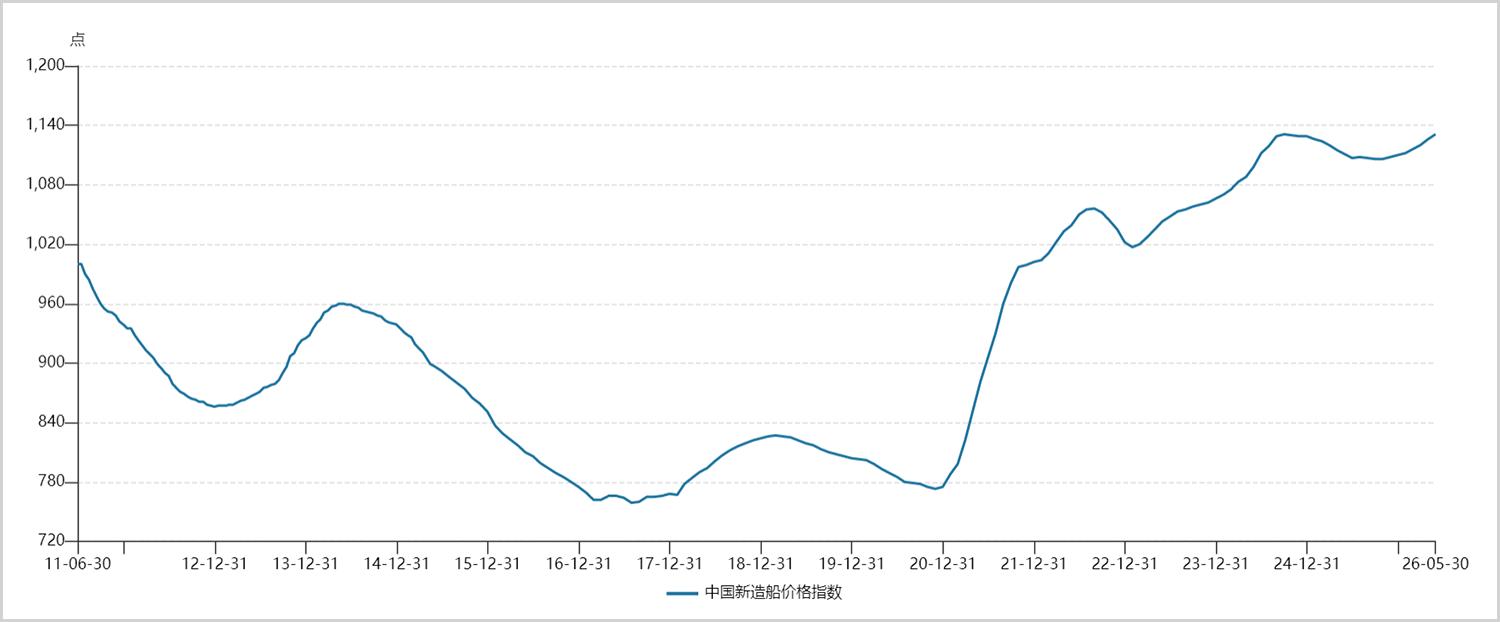
▲ Chinese new shipbuilding price index, Source: Wind
The rising prices have promoted the full recovery of shipbuilding enterprises' performance and profitability. In 2025, the revenue of the shipbuilding sector was 257.6 billion yuan, a year-on-year increase of 20%. Among them, CSSC and Songfa Co., Ltd. increased by 14% and 275% respectively. The annual net profit of the sector was 13.3 billion yuan, a year-on-year increase of 97%.
In the first quarter of 2026, the high-growth momentum continued. The revenue increased by more than 50% year-on-year, and the net profit attributable to shareholders increased by more than 200%. The profit in one quarter has exceeded that of any full year from 2012 to 2024.
The profitability has also continued to improve. In the first quarter of 2026, the gross profit margin of the sector was 17.7%, and the net profit margin was 11.2%, both of which have been rising since 2022. The net profit margin at the trough of the previous cycle was only 1.6%. The improvement in the net profit margin is even higher than that of the gross profit margin, which is directly related to the decline in the three - fee expense ratio of the industry. Behind this is the emergence of the scale effect of industry revenue.
In the next few years, the performance growth is highly certain, which can be confirmed by indicators such as contract liabilities and inventories. Among them, the contract liabilities of the shipbuilding sector in 2025 were 196.7 billion yuan, more than doubling compared with 2023. The continuous increase in this data represents abundant orders and high industry prosperity.
[A Structured Uptrend]
In the past, high freight rates in the shipping market would increase shipowners' revenues, which would then be transmitted to high ship prices in the shipbuilding sector. However, the core driving force of this round of demand has gone beyond the traditional transmission of the shipping market's prosperity, with the addition of two long - term structural factors: fleet replacement and geopolitics.
First, the global fleet is aging, entering a concentrated replacement window.
As of the end of 2025, ships over 15 years old accounted for as high as 45%, while those under 10 years old accounted for only 30%. In terms of deadweight tonnage, the average age of the global fleet was 13.3 years, a year-on-year increase of 2.5%, compared with only about 10 years in 2013.
The peak of the previous round of ship deliveries was from 2007 to 2012, with a service life of 20 - 25 years. It is foreseeable that the proportion of old ships and the average ship age may continue to rise in the next few years.
Second, increasingly strict environmental protection regulations are accelerating the elimination process.
The International Maritime Organization (IMO) formulated new regulations in 2023, requiring a 20% reduction in greenhouse gas emissions from international shipping by 2030 compared with 2008, at least a 70% reduction by 2040, and zero emissions by 2050.
The IMO's emission reduction framework continues to advance. The EU ETS has been implemented, and the FuelEU Maritime regulations have also been put into effect, further increasing the operating costs of high - emission old ships.
Compliance has changed from an option to a necessity for survival, forcing shipowners to retire old ships that cannot meet the new regulations in advance and turn to ordering new ships using low - carbon or zero - carbon fuels. In 2025, ships using alternative energy sources accounted for 46% of the global new orders, which is the most direct proof.
Therefore, many securities institutions predict that the demand for old ship replacement and renewal will account for more than half of the total order demand in the next five years.
In addition, frequent geopolitical conflicts have objectively increased the long - term demand for shipping networks. The Russia - Ukraine conflict, the Red Sea crisis, and the tense situation between the United States and Iran have disrupted the normal passage of specific shipping routes in the short and medium term, intensifying the frequent fluctuations in shipping prices.
To avoid risks and establish redundancy, the long - term demand of shipping companies for fleet size and route flexibility has been increased, to some extent, advancing the willingness to place orders in the next few years.
However, due to the "scar effect" after a long - term downward cycle on the supply side, it is far from easy to restore production capacity.
After the 2008 financial crisis, the industry fell into a slump for more than a decade. A large number of small and medium - sized shipyards went bankrupt or shut down, and production capacity permanently exited. Clarkson data shows that the number of active shipyards globally has dropped sharply from a peak of about 1076 in 2008 to about 476 in 2025, a decrease of up to 57%.
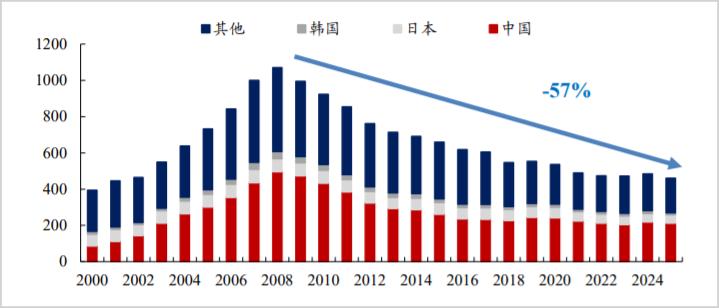
▲ Trend chart of the number of global active shipyards, Source: Soochow Securities
Although the current new ship prices are high and the profits are substantial, the production capacity has not expanded rapidly as in previous cycles. In 2025, the global shipyard delivery volume was 44 million compensated gross tons, still about 19% lower than the historical high in 2011. However, the global fleet size has increased by more than 60% during the same period.
Currently, the expansion of global shipbuilding production capacity is facing structural bottlenecks.
As the global shipbuilding center, China, with its complete industrial chain and cost advantages, has increased its production capacity and undertaken most of the global orders. However, the expansion is also restricted by operating thresholds such as environmental protection, land, and the almost exhausted development of high - quality deep - water shoreline resources.
In Japan, South Korea, and Europe, after rounds of brutal production capacity clearance, they are facing problems such as labor shortages and high manufacturing costs, and basically have no ability or willingness to restart and expand production capacity.
It can be seen that this round of shipbuilding boom cycle is a structured uptrend, making the industry characterized by sufficient orders, long - term production arrangements, and firm prices. The order backlog coverage of leading shipyards has generally reached more than four years, and the foundation of high prosperity is more solid than in previous cycles.
[The Oligopoly Era of Domestic Ships]
Currently, the Chinese shipbuilding industry not only benefits from the high industry prosperity but also seizes the opportunity of global industrial pattern changes and internal cost - control advantages.
Since this cycle started in 2021, the global shipbuilding industry has accelerated its shift to Asia, especially to China.
In 2025, the new order volume of the Chinese shipbuilding industry accounted for 69% of the global total, and the order backlog accounted for as high as 66.8%. The market share of traditional shipbuilding powers such as Europe has shrunk to single - digits. Under the pattern of the rise of the East and the decline of the West, it means that most of the global new shipbuilding demand will become an incremental cake for Chinese shipyards.
While undertaking global orders, Chinese shipbuilding enterprises have strengthened their cost - control capabilities. In addition to the scale effect, the cost advantages also come from two aspects.
One is the adoption of integrated modular construction. The traditional serial shipbuilding model requires building the hull first and then carrying out outfitting. Now, the parallel operation of hull, outfitting, and painting integration is promoted, which can triple the labor productivity of the shipbuilding berth, shorten the shipbuilding berth cycle by two - thirds, and reduce the overall shipbuilding cost by about one - tenth.
The other is the obvious scissors gap between ship prices and steel prices. Steel is the most important raw material for shipbuilding, accounting for about 70% of the total raw material cost. Affected by the supply - demand relationship, the price of medium - thick plates for shipbuilding has been continuously declining. The current price is nearly half lower than the peak in 2021, hitting a multi - year low. The decrease in raw material costs directly increases the profit margin of shipbuilding enterprises.
Of course, the Chinese shipbuilding industry has also carried out a series of integrations and mergers, forming a clear oligopoly pattern, and the share of small and medium - sized shipyards has been continuously squeezed.
In 2020, CSSC incorporated assets such as Jiangnan Shipyard and Guangzhou Shipyard International. In 2025, it merged with China Shipbuilding Industry Corporation, integrating shipbuilding assets in Dalian, Wuchang, Beihai, etc., becoming the world's largest shipbuilding group with a global market share of nearly 20%.
Songfa Co., Ltd. incorporated Hengli Heavy Industry. In 2022, Hengli Heavy Industry spent 2.1 billion yuan to acquire the idle STX (Dalian) assets and planned to invest 18 billion yuan for revitalization. In 2024, it successfully delivered its first ship.
By 2025, Songfa Co., Ltd.'s new order volume ranked second in China and second globally, second only to CSSC, becoming the shipbuilding enterprise with the fastest growth in this cycle.
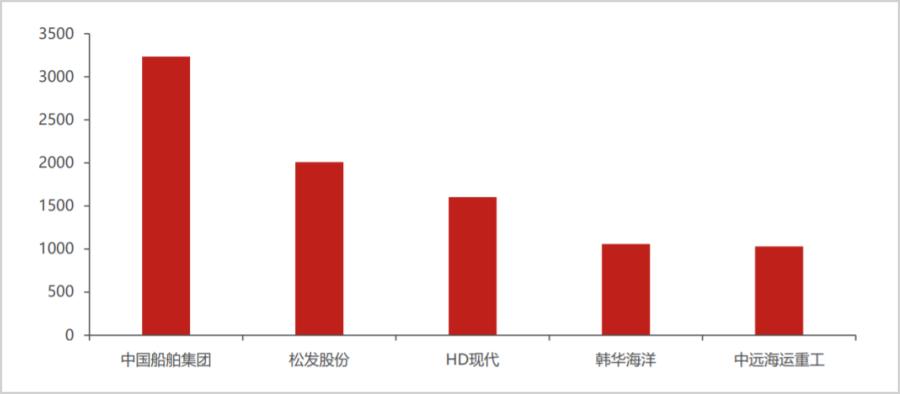
▲ Comparison of new order volumes of peer companies in 2025, Source: Minsheng Securities
In addition, there are also important shipyards in China such as Yangzijiang Shipbuilding, COSCO Shipping Heavy Industry, New Times Shipbuilding, and Fujian Shipbuilding and Heavy Industry. However, their market shares are far lower than those of CSSC and Songfa Co., Ltd., and the industry shows an increasingly obvious pattern of the strong getting stronger.
Comparing the profitability, in 2025, Yangzijiang Shipbuilding's net profit margin was as high as over 30%, far higher than Songfa Co., Ltd.'s 12.3% and CSSC's 7%. The main reason is that the orders it undertook are mainly for clean - energy ships (such as LNG and methanol dual - fuel container ships). These ship types have high technical barriers, and their unit prices and profit margins are much higher than those of traditional bulk carriers and oil tankers.
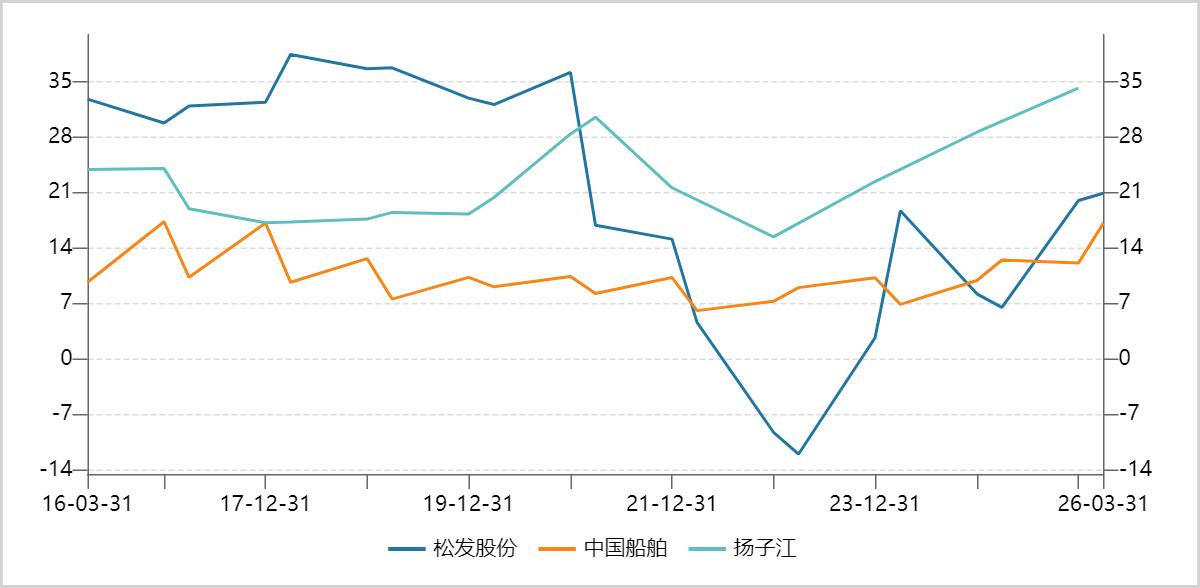
▲ Trend chart of the gross profit margins of three listed shipyards, Source: Wind
As the global leader, CSSC has the largest business volume but relatively low profit margins. Currently, the drag factors at the cyclical bottom have basically been fully provisioned. In the future, the proportion of high - price orders is expected to increase, leading to a recovery in profit margins (it has approached that of Songfa Co., Ltd. in the first quarter of 2026), and high - quality assets of the group such as Hudong - Zhonghua Shipbuilding are expected to be injected.
As a new star in the shipbuilding industry, Songfa Co., Ltd. has undoubtedly caught this cycle. It has been very aggressive in expansion, with the fastest performance growth, and its future growth potential should not be underestimated. First, the order delivery structure has shifted from bulk carriers to cruise ships and container ships, and the proportion of high - value - added ship types has increased. Second, it has made new investments and continues to plan for expansion.
It can be seen that CSSC, as an established national - level enterprise, has a more stable operation, and its performance continues to recover along with the boom cycle. Songfa Co., Ltd., as the "first private shipbuilding stock," has no historical burden and better growth potential. Yangzijiang Shipbuilding has adopted a differentiated competition strategy.
In short, the Chinese shipbuilding industry is in a structured uptrend cycle with both volume and price rising. The eastward shift of the global industry and internal integration have given rise to an oligopoly pattern. However, the three leading enterprises will have significant differences in terms of orders, costs, and technology, and their future explosive power and imagination space will naturally also differ.
Disclaimer
The content in this article related to listed companies is the author's personal analysis and judgment based on the information publicly disclosed by listed companies in accordance with their legal obligations (including but not limited to interim announcements, regular reports, and official interactive platforms). The information or opinions in this article do not constitute any investment or other business advice. Market Value Observation shall not be liable for any actions taken based on this article.
——END——