Oracle plummets? The fatal flaw that AI infrastructure cannot fix: high interest rates, massive debt, and dying software.
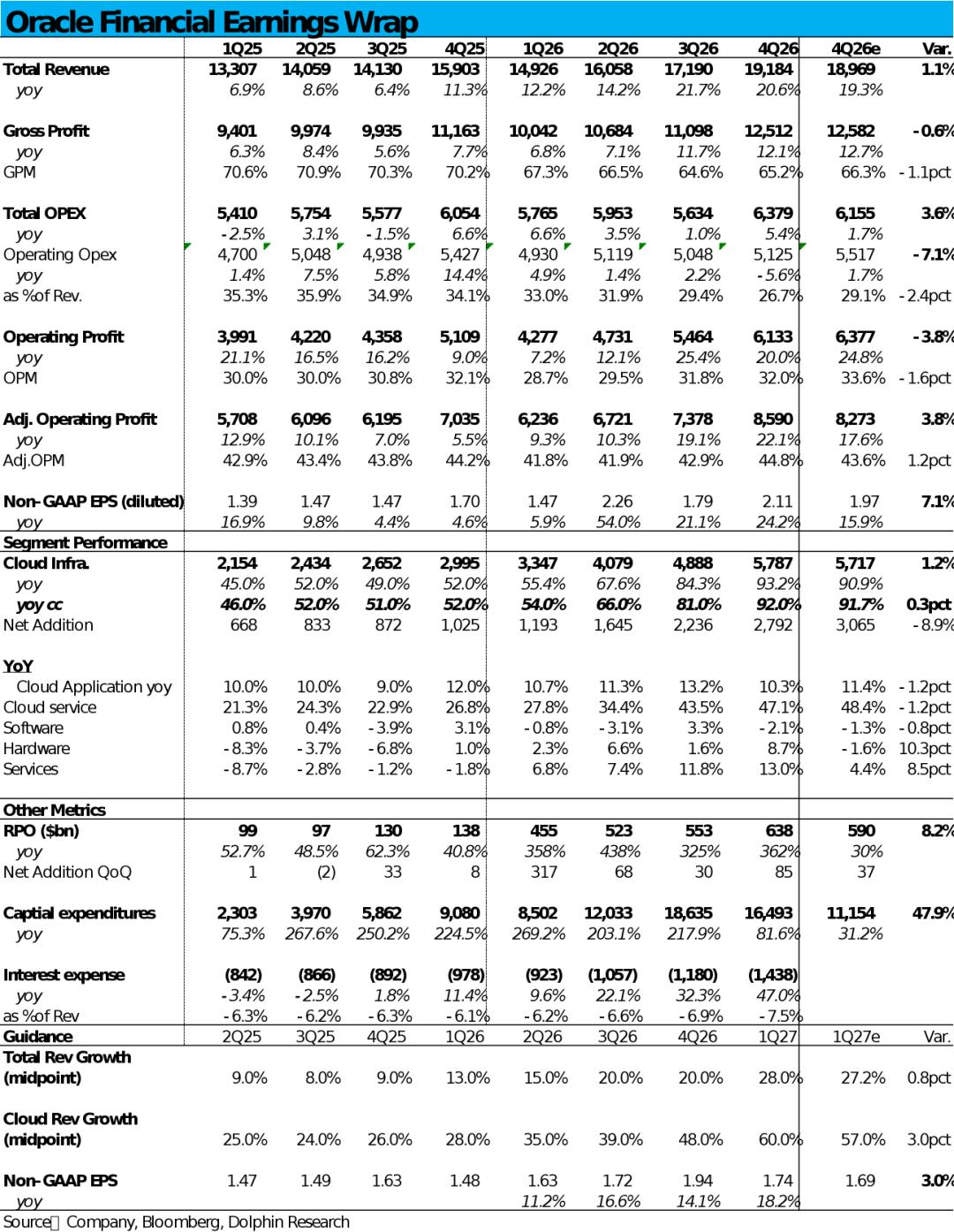
The most watched and controversial Oracle in the new cloud released its financial results for the fourth quarter of fiscal year 26 ending in late May after the U.S. stock market closed on June 11. Overall, this quarter's performance was a mixed bag. For example, while the OCI business accelerated its growth, the traditional general software business showed weaker growth. Also, although the gross profit margin improved quarter-on-quarter, hitting the bottom, it still significantly underperformed expectations. Although the guidance for the next quarter was better than expected, the guidance for the whole of fiscal year 27 was relatively conservative. Therefore, the overall performance this quarter was relatively mediocre. Specifically:
1. Core business - OCI accelerated growth as expected: Under the cloud segment, the revenue of the IaaS - type OCI business this quarter was nearly $5.8 billion, a year - on - year increase of about 93%. After excluding the favorable exchange rate impact, the actual growth rate was 92%, continuing to accelerate as expected compared with 81% in the previous quarter, but the acceleration amplitude slowed down. And the actual growth rate was basically in line with expectations, with no pleasant surprises.
In other words, although the absolute growth rate was strong, from a relative perspective, the performance of the most critical OCI business this quarter was not "good".
2. The gross profit margin hit the bottom quarter - on - quarter but was still below expectations: This quarter, the combined gross profit margin of the cloud + software business was 68.8%, showing signs of a bottom - up recovery compared with 68.2% in the previous quarter. Although the year - on - year decline was still 6.8 percentage points, it also narrowed compared with the previous quarter.
However, since it includes multiple businesses such as OCI, SaaS, and traditional software, it cannot be directly determined whether it is due to the stop of the decline in the OCI gross profit margin or the increase in the gross profit margin of the general software part.
From the perspective of the expected difference, the market expected the overall gross profit margin to be above 66%, but the actual figure was 65.2%, still below expectations. Therefore, overall, the gross profit performance this quarter was still slightly negative.
3. New RPO orders exceeded expectations, and the Capex sharing model was implemented: The unfulfilled contract balance RPO, which reflects the demand for new orders, actually increased by $85 billion quarter - on - quarter, and the total RPO reached $638 billion. Since there were no rumors or reports of the company signing large new orders before the earnings release, the market's expectations were not high, only about $590 billion. Combining with recent news reports, it may be from the newly announced government orders.
It is also worth noting that the company said that currently, about $75 billion worth of orders are based on the Capex sharing model - that is, part of the Capex requirements corresponding to the orders are borne by the customer's prepayment or self - procurement of hardware. This is good news for the company's cash flow and asset - liability structure.
4. Capex was higher than expected, but the cash flow improved significantly: Correspondingly, this quarter's Capex was nearly $16.5 billion, a decline compared with $18.6 billion in the previous quarter. The market's expectation of $11 billion was "mechanically" derived from the annual Capex guidance of $50 billion, which seemed to be far above expectations, but had little reference value.
More importantly, the sharing model covered about $4.6 billion of Capex expenditure this quarter. As a result, the company's free cash flow improved from an outflow of $10 billion per quarter before to a net outflow of $1.9 billion this quarter, and the company's cash flow pressure was indeed relieved.
5. Has the financing demand also decreased?: The company said that in fiscal year 27, it will conduct debt and equity financing of $20 billion respectively, totaling $40 billion (previously disclosed), less than the total financing quota of about $48 billion in this fiscal year. It has locked in the source of funds for most of the Capex investment in the next fiscal year.
Moreover, Dolphin Research and the market originally expected the free cash flow gap in 27 to be generally over $50 billion. We believe that it is very likely that because part of the capital demand is shared by customers, the company's own financing demand has decreased.
However, although the long - term logic is positive, the current pressure is still high. This quarter, the actual interest expense reached $1.44 billion, a nearly 22% increase quarter - on - quarter, and the proportion of interest expenses in total revenue also increased to 6%.
6. Other businesses further weakened: The traditional segment, which still accounts for about 75% of the total revenue, performed worse. Among them, the revenues of the SaaS and software businesses increased by +10% and - 2% respectively. The growth rates slowed down quarter - on - quarter and were both lower than market expectations. Although the growth of hardware and service revenues was significantly better than expected, the combined revenue of these two businesses accounted for only a little over 10%, with limited impact.
7. Overall performance
This quarter, the company's overall revenue increased by 20.6%. After excluding the exchange rate impact, the real growth rate was 20%, a slight acceleration of 2 percentage points compared with the previous quarter.
Due to the significant year - on - year decline in the gross profit margin mentioned above, the year - on - year growth rate of the overall gross profit was 12%, still significantly lower than the revenue growth rate and slightly lower than market expectations.
Fortunately, after excluding the one - time expenses caused by layoffs, only looking at the three regular operating expenses, the actual expenditure this quarter decreased by about 5.6% year - on - year, 7 percentage points lower than the market - expected growth rate. Under strict cost control, although the gross profit margin declined significantly, this quarter's adjusted operating profit margin stopped falling year - on - year and returned to positive growth of about 0.5 percentage points, better than market expectations.
Finally, the adjusted operating profit was $8.6 billion, a year - on - year increase of about 22%. In the case where the gross profit underperformed expectations and revenue, the profit growth outperformed both revenue and expectations.
Dolphin Research's view:
1. Currently, the market's focus on Oracle's short - and medium - term performance still mainly includes: a. The release speed and acceleration amplitude of OCI revenue, which is behind the smoothness of the speed and rhythm of computing power construction. In contrast, the recent attention to newly signed orders (i.e., RPO) is not high; b. Has the problem that the higher the revenue scale of the AI business, the lower the profit margin, changed?; c. The investment and ramping - up rhythm of Capex and the situation of obtaining corresponding financing.
However, the attitude has changed from being somewhat averse before (not liking high Capex and worrying about ROI) to being more positive (high Capex means fast progress in computing power construction).
Corresponding to the above concerns, the answers from this quarter's performance are:
a. The OCI business did accelerate its growth as expected, but the acceleration amplitude was exactly in line with expectations, so it was not outstanding. At the same time, while OCI benefits from AI, the currently larger - proportion traditional general software business is logically a "victim" of AI. Therefore, Oracle cannot be regarded as a pure "AI - beneficiary stock".
b. The gross profit margin did show signs of hitting the bottom, but on the one hand, it is temporarily impossible to accurately attribute the cause, and it is still lower than market expectations. It is necessary to observe for a few more quarters whether the bottom - hitting of the gross profit margin is temporary or a real trend - turning point.
Since the profit margins of Amazon and Google's cloud businesses have not actually declined significantly in recent quarters, there are already doubts about whether the "underlying assumption" generally accepted by the market that the profit margin of the AI cloud business will be significantly lower than that of the traditional cloud business really holds. However, for NeoCloud companies like Oracle, the situation where the higher the proportion of the AI business, the lower the gross profit margin is more obvious. Oracle's performance this time also makes this issue more worthy of discussion.
c. The most positive signal this quarter is actually that the company has significantly reduced the pressure and risk of bearing huge Capex investments and computing power construction for downstream AI customers with its own cash flow and balance sheet through the Capex sharing model with customers in the long - term logic.
Dolphin Research believes that this is a major logical change. However, in the short and medium term, the company's net debt and interest expenses will probably continue to rise. It is necessary to pay attention to how much of the Capex can be shared with customers in the future.
2. In terms of investment logic, as we commented last time, after successfully completing $50 billion in equity + bond financing, the concern about whether the company can obtain funds to continue large - scale computing power construction has been alleviated. In addition, with the soaring Token/computing power consumption of Agent, the market's concern about whether there may be over - construction of computing power and perhaps insufficient terminal demand has also significantly decreased.
With the improvement of the above two issues, Oracle's investment logic has reversed to some extent. The company's stock price has rebounded by more than 40% from the low point in early April, and at the same time, macro risks and market fluctuations have risen again recently. Therefore, before the earnings release, investment banks generally believed that this time, funds would have relatively high requirements for the performance.
Therefore, this mixed performance will indeed disappoint the funds with high expectations.
In terms of guidance, the company expects the median growth rate of the cloud segment (including IaaS and SaaS combined) in the next quarter to be 60%, continuing to accelerate quarter - on - quarter, slightly exceeding the market's expectation of 57%. The median Non - GAAP EPS in the next quarter is guided to be $1.74, implying a year - on - year increase of 18%, also slightly exceeding the market expectation by about 3%.
However, while the guidance for the next quarter is good, the company maintains the full - year revenue guidance of $90 billion for fiscal year 27 unchanged. The newly updated full - year Non - GAAP EPS is $8.05, which is also just in line with the current market. The full - year guidance is mediocre, so the market cannot give too much "reward" for the good next - quarter guidance.
In this regard, Dolphin Research speculates that it is very likely that the company itself is not yet clear about the full - year performance outlook, so it just follows the market expectation.
In recent developments, Oracle has been relatively "low - key" since the last earnings release, without any particularly significant new actions/news. However, there are still two trends worthy of attention:
a. Introducing AI into the software business: Recently, the company has had few developments in the IaaS business, but it has successively introduced AI functions into its SaaS and database businesses, launching Fusion Agent Application and Agentic AI for Database respectively.
Dolphin Research believes that this is a typical defensive move. After all, as of fiscal year 26, the revenue of the OCI business that directly benefits from AI accounts for only about 25% of the company's total revenue, and the larger part comes from software, SaaS, and databases, which are regarded as "victims" that may be replaced by AI. However, from the example of Salesforce, the positive effect of introducing AI functions into traditional businesses does not seem to be very obvious. Whether it can help traditional businesses maintain the current growth or even accelerate again needs to be carefully observed.
b. Promoting government cooperation: In late March and early May, Oracle successively announced contracts with U.S. federal agencies and the Department of War, providing various services including OCI, AI Database, and Enterprise AI. Before the earnings release, the market generally believed that compared with the orders of hundreds of billions of dollars from the enterprise side, the actual impact of government cooperation on performance might be limited. However, at present, it seems that the actual order amount contributed by the government may also be in the tens of billions. And the significance of government orders may not really lie in the actual performance contribution. It reflects the government's support attitude towards the company, which will also be a positive factor for market sentiment.
3. In terms of value analysis, it can be viewed from two perspectives: one is the short - and medium - term valuation that fluctuates with the company's quarterly performance; the other is the valuation based on the company's long - term prospects, or the valuation in a steady - state situation, which will not change much with short - term performance as long as the logic does not change significantly or the company does not adjust its long - term guidance.
From a short - and medium - term perspective, the market generally prices the company directly based on its Non - GAAP EPS in fiscal year 27. In other words, the company can already be supported by its recently visible performance. Even without increasing the valuation, it can bet on the return space brought by the increase in performance/profit.
However, Dolphin Research still prefers to calculate based on the long - term steady - state situation. After a significant rebound from the bottom, the current valuation has relatively neutrally reflected the company's medium - and long - term performance space as guided by itself. So it is reasonable for the stock price to fall after the not - so - good performance.
Of course, the implied multiple of this valuation is still not high. And the reduction of the company's own cash flow demand and financing debt pressure conveyed this time may fundamentally improve the company's logical narrative. As long as there are no systematic problems in AI, Dolphin Research believes that although Oracle is not a highly certain top choice at present, it is worth paying attention to.
The following is a detailed review
I. Introduction to Oracle's business and revenue classification
As a "veteran" in the software industry established in the 1980s, Oracle's core business in history has mainly been database and software services (traditional license model). However, in recent years, with the company's cloud transformation efforts and the explosion of AI, cloud services have taken the lead and become the most important and most watched segment.
In the new fiscal year 26, the company just adjusted the financial reporting disclosure caliber, clearly dividing the business and revenue into four major segments: cloud business (Cloud), software (Software), hardware (Hardware), and service (Service). Further details are as follows:
a. Cloud business: It can be subdivided into two business lines: OCI of the IaaS type and OCA of the SaaS type. Among them, OCA mainly includes general management tools such as SaaS - based ERP/CRM/ERP and some vertical industry tools. And OCI mainly includes the company's characteristic database services and computing power leasing business.
In the early years, OCA accounted for a higher proportion in the cloud segment. In the past 1 - 2 years, with high - speed growth, the proportion of OCI has gradually exceeded that of OCA.
b. Software: That is, the traditional software business deployed and managed by customers themselves. It was originally the segment with the largest revenue share of the company, but has been overtaken by the cloud segment.
It can be divided into two main parts - one - time license sales revenue (Software License) and associated continuous service support revenue (Software Support), such as providing usage support and daily update and maintenance.
c. Hardware: Similar to the software business, it also includes one - time sales of hardware such as servers and associated hardware maintenance & support revenue. It has the smallest revenue share.
d. Service: Other service businesses outside the above software and hardware businesses, including consulting services or other customized services. In recent years, the revenue share has been in the high single - digit percentage.