AI organizational transformation: "Shoot first, aim later" — what are the odds of success?
Every time a major new thing emerges, there is always a chaotic period at first. This was the case with the Internet, the mobile Internet, and today, it's the same with AI. Concepts are flying everywhere. Some people see new productivity and business opportunities, while others just use a new set of jargon to continue selling old products.
Everyone is afraid of missing out. Bosses are worried that their companies won't make it to the game, senior executives are afraid of falling behind the changes, and employees are concerned that their jobs will be replaced. So, training programs are launched, projects are initiated, case studies are collected, and all employees start learning. It seems that everyone in the reporting materials has already started using AI.
Many companies have entered a familiar pattern: shoot first, then aim.
This approach has helped many founders win in the early stages of entrepreneurship. Today, when facing AI, the situation is quite similar. No one really knows the answers to questions like how the industry will be restructured, when the application scenarios will mature, how jobs will change, and what the organization will look like. Since they can't figure it out, they just start doing it.
This certainly makes sense. But for companies in the growth or maturity stage, will "shoot first, then aim" still be as effective as before? Will the organization fire randomly? If the shots miss the target, who will bear the cost?
These questions may be more worthy of discussion than "whether companies should embrace AI."
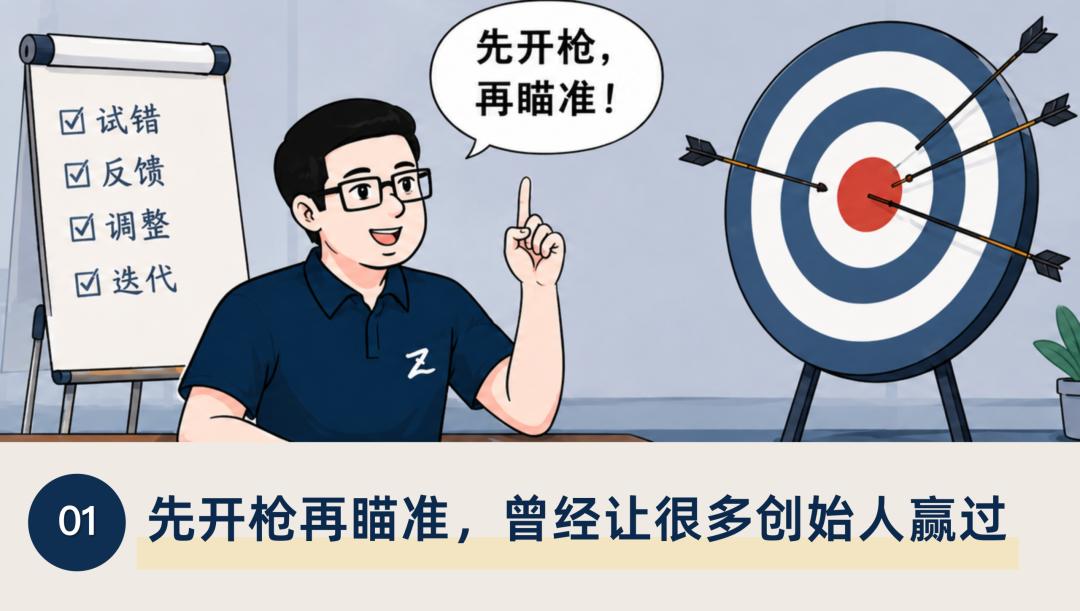
In the early stages of entrepreneurship, founders don't make decisions after having full information. Instead, they have to make decisions even when the information is insufficient. The opportunity window is short, resources are limited, and customer needs are constantly changing. By the time everything is figured out, the opportunity may have already disappeared.
Most of the time, real market judgment comes from feedback after taking action. Enter the market first, then understand it; develop the product first, then improve it; find the customers first, then adjust the strategy. The early success of a company often comes from trial and error rather than planning.
In a startup team, the communication radius is short. The founder is close to the customers, the product, and the real feedback. When the founder says "give it a try," a few team members will immediately take action. If it's wrong, they'll correct it right away; if it's right, they'll increase the effort; if the direction changes, they'll turn around flexibly.
The advantage of a startup team lies not only in fast action but also in fast feedback and adjustment. The founder doesn't just shoot randomly. He can also quickly see where the bullets land and re - aim based on intuition. This is the real reason why "shoot first, then aim" is effective.
Today, when facing AI, companies in the growth or maturity stage should not lose this entrepreneurial spirit. Many AI application scenarios cannot be discussed and determined in high - level meetings. They can only be tested out in real business.
So, "shoot first" is definitely not a problem. In fact, it's a must. The real problem is whether the company can still quickly see where the bullets land and re - aim, just like in the early stages of entrepreneurship.
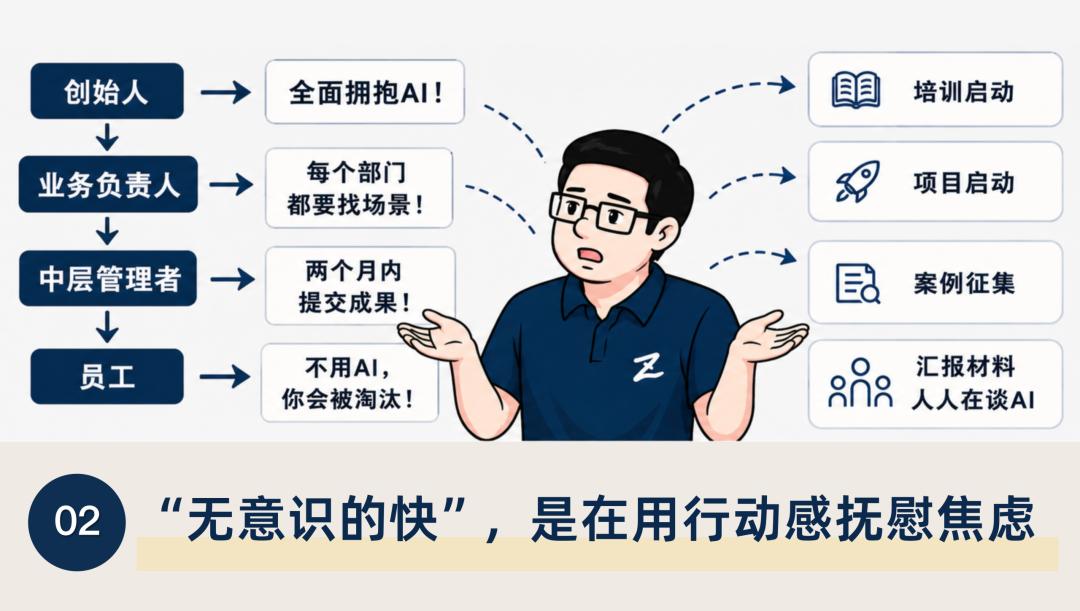
In a startup team, "shoot first" means firing one or a few shots. But in a company in the growth or maturity stage, the consequences of "shoot first" are completely different.
The founder says "fully embrace AI," conveys a sense of crisis, and points out the general direction. When it reaches the business leaders, it becomes "every department must find AI application scenarios"; when it reaches the middle - level managers, it becomes "every team must submit results within two months"; when it reaches the employees, it becomes "if you can't prove that you can use AI, you may be eliminated."
What the founder throws is just a spark. After being passed down through the organization, it may turn into a fire alarm. Originally, it was just about firing a few shots to see where the bullets land, but in the end, it becomes everyone firing randomly at birds.
This kind of "busyness" gives leaders a sense of comfort: there are training programs, projects, and case studies, and everyone talks about AI in meetings. Facing an uncertain future that they're afraid of missing out on, taking quick action at least makes people feel that they're not sitting idle.
But taking action doesn't mean making progress. The number of training sessions, projects, and case studies only proves that the organization is in motion, not that the company is getting closer to the answer.
Which attempts have improved customer value? Which are just using new tools for old jobs? Which are worth continuing to invest in? Which have no value? If no one answers these questions, the organization is just firing randomly.
What's more troublesome is that real feedback often has a hard time reaching the decision - making level. The front - line may have found that a certain tool is not useful, and the project team may know that a certain scenario has limited value. But when the information is passed up layer by layer, it often becomes "the overall progress is smooth, and only some local aspects need to be optimized." No one wants to be the first to say that a project highly valued by the leadership is not worth continuing.
The company organization thus falls into an "unconscious rush." It's not that the action is too fast, but that no one seriously looks at the results after taking action. The organization seems to be getting busier, but it may not be getting closer to the answer.
"Shoot first" was originally for exploration, but in the end, it becomes using the sense of action to soothe anxiety.
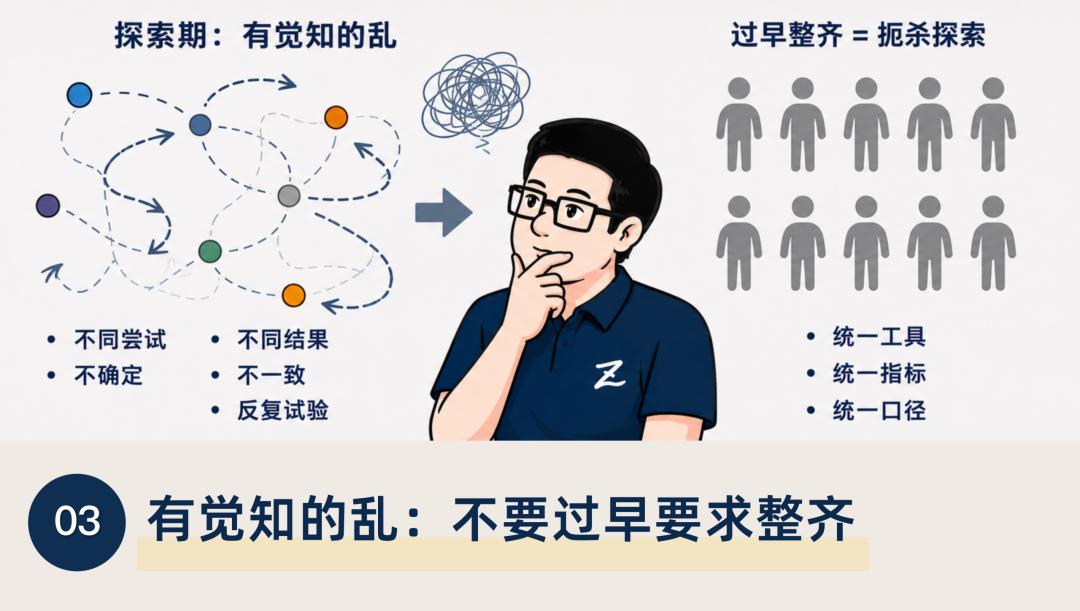
After shooting, the old judgments start to loosen, and new judgments haven't formed yet. Different teams will use different tools, try different scenarios, and come to different conclusions. Some teams quickly find value, while others keep making trial - and - error attempts; some processes are suitable for AI, while others are not worth changing for now. At this stage, the organization doesn't look very orderly.
Once the organization is not orderly, senior management is likely to feel out of control. Managers will instinctively want to unify things quickly: unify tools, methods, milestones, and evaluation criteria. So, an exploration that should have been about finding answers quickly turns into a planned economy.
Some companies are eager to see results: they demand increased efficiency as soon as the experiment starts; they expect successful case studies as soon as employees start learning; they link the results to performance evaluation, staff reduction, or even elimination before the direction is verified. In the end, the organization does become orderly quickly, and everyone submits similar case studies and reports similar results.
Employees will soon figure out what actions are the safest: don't challenge the direction already determined by the leadership, don't choose attempts that are likely to fail, don't report disappointing real results, and just do things that are easy to show and hand in.
In fact, to move from "shooting quickly" to "re - aiming," there must be a period of "conscious chaos."
The so - called "conscious chaos" doesn't mean deliberately making the organization chaotic, nor is it an excuse for extensive management. It just acknowledges that in the stage when the old answers start to fail and new answers haven't formed yet, local uncertainty, inconsistency, and repeated trials are inevitable.
What really tests leaders is not whether they can quickly restore order, but whether they can resist the impulse to achieve order too early. Unifying tools too early may just unify wrong answers; setting indicators too early may only force the organization to produce false results; eliminating people who haven't achieved results too early may also drive out those who are truly willing to explore.
Being conscious doesn't mean letting things go. The core business cannot be randomly disrupted, customer commitments cannot be used as experiments, data security and compliance bottom - lines cannot be breached, and the basic fairness of employees cannot be sacrificed. Leaders should know where different attempts are allowed, where stability must be maintained, how long the exploration period should last, which failures can be accepted, and which losses the organization cannot bear.

AI - driven organizational transformation is essentially organizational learning.
Just because each individual in the organization is learning doesn't mean the organization has completed the learning process.
A startup team can rely more on the founder's intuition to re - aim. A company in the growth or maturity stage cannot rely solely on one person's feeling. It needs to form an organizational way of aiming - the organization should see the facts, correct judgments, stop mistakes, and gradually find the directions worth amplifying from real - world actions.
The first difficulty lies in whether the organization can see the truth.
If bad news is modified layer by layer, what the senior management sees is not what's really happening at the front - line, but a report that everyone can accept. If bad news can't reach the senior management, the company naturally can't re - aim.
Seeing the truth also means that the organization needs to change the way it measures progress.
It's not about how many training sessions are held or how many tools are launched, but about whether the processes are redesigned, whether the efficiency is truly improved, whether the customers get more value, and whether these changes are worth continuing to invest in.
What's even more difficult is whether the organization can admit that it has aimed wrong.
It's not difficult to stop a project when it just starts. But as resources are continuously invested, the project is repeatedly emphasized by the senior management, and the person in charge makes public commitments, it becomes more and more difficult to admit that the direction is wrong. The organization would rather continue to invest than publicly admit that this path won't work.
Re - aiming has two levels. The first level is to adjust the shooting technique while the target remains the same. The deeper level is to question whether the target itself is correct. The former is to improve actions under established assumptions, while the latter will touch on the company's original goals, rules, and the managers' own judgments. What's really difficult for an organization is often not improving the shooting technique, but admitting that the target may have been set wrong from the beginning. This requires not only ability but also courage.
Organizational aiming also includes amplifying the right things.
Some teams may have found truly valuable AI scenarios, but the results are still just individual employees' experiences. If the company just invites them to share once, compiles it into an excellent case study, and then does nothing more, the good experience will still remain in a showcase.
Gold - panning is not about bringing all the sand back to the headquarters. It requires a sieve. Truly effective exploration needs to gradually become team methods, work processes, and replicable tools, and finally become the organization's real capabilities.
In short, we don't demand that every aim be correct, but that the company has the ability to re - aim again and again.
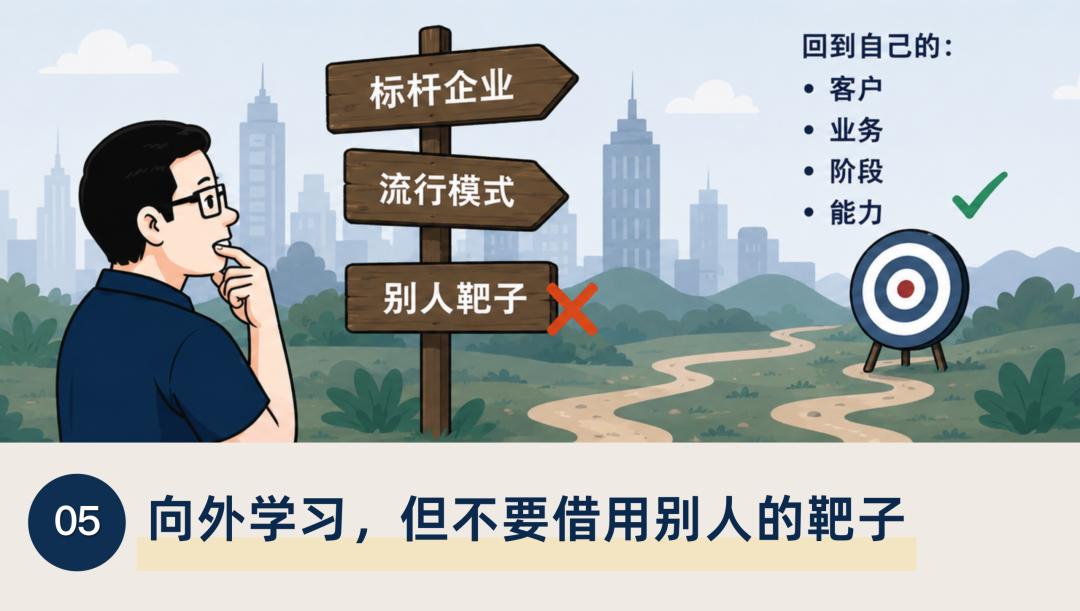
In the process of AI - driven organizational transformation, there is a common practice: benchmarking against leading companies.
Silicon Valley companies, AI - native organizations, small teams, high - efficiency teams, super - individuals, and one - person companies (OPC) are all worth paying attention to. They do represent some new possibilities and inspire us to re - understand organizations, human efficiency, and production methods.
Learning from the outside is very important, but don't mistake benchmarking for aiming and following for judgment.
What seem to be small teams, high - efficiency, and AI - native today may be based on years of accumulated product architecture, engineering culture, data foundation, talent density, technology ecosystem, and business models.
These organizational forms are the fruits, not the seeds.
Just because you see others having small teams, you think you should also break your team into smaller ones; just because you see others reducing staff, you think you can also quickly downsize; just because you see others being AI - native, you think all your businesses should be restructured - this is taking others' evolutionary results as your own organizational answers.
Benchmarking can help companies open up their imagination and ask better questions, but it can't replace the company's aiming process.
The biggest risk is not only failing to re - aim after shooting but also borrowing others' targets from the start and thinking that you've already aimed.
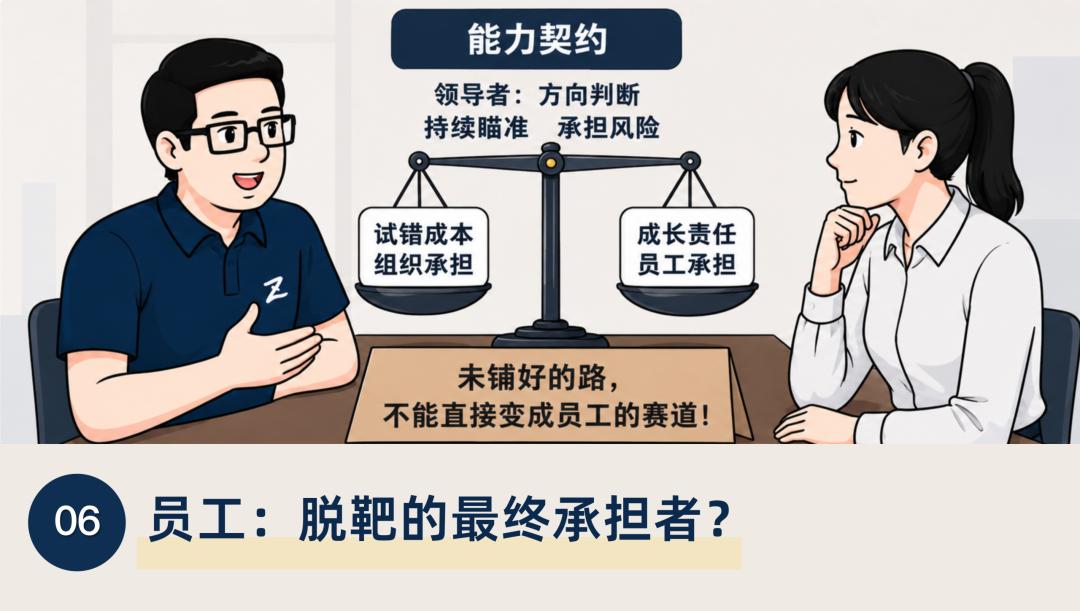
Different roles in the organization bear different risks. Leaders set the direction and change it, while employees are responsible for taking action, learning new tools, and adjusting their work methods. If the experiment is successful, it's easy to be regarded as the company's transformation achievement. But if it fails, it may be interpreted as employees' lack of ability, low learning willingness, or poor execution.
It's not wrong for the company to require employees to learn and try actively. But employees shouldn't be the ultimate bearers of the company's inaccurate aiming. When the direction is not clear, tools, data, processes, and permissions are not ready, and there is no consensus on what exploration is worth encouraging and what failure can be accepted, but employees are already required to produce results quickly, and even the transformation results are linked to their job security. In this case, employees are bearing not only the learning responsibility but also the company's unresolved uncertainties and experimental risks.
You can't turn an unfinished road into employees' race track. Nor can you ask employees to shoot boldly while blaming them for every missed shot.
If the company does this, employees will quickly learn to protect themselves: choose safe, easy - to - show, and easy - to - hand - in actions, and avoid truly risky and valuable attempts. It seems that everyone is embracing AI, but in fact, everyone is just coping with it.
So, in the process of AI - driven organizational transformation, the company and employees need to rebuild a contract. Employees should take the responsibility of self - evolution; the company should create the conditions for action and bear the reasonable cost of trial and error; leaders should take the responsibility of direction judgment, continuous aiming, and risk.
