Alibaba Partners Criticize DingTalk, But They Got the Target Wrong
Teng Yaxin, the product manager of DingTalk AI, posted a 75,000 - word resignation essay titled "Inside DingTalk". Not only did it prompt Vice - President Ma Ruila to respond with "Outside DingTalk" from afar, but finally, even the Alibaba Partnership Committee rarely stepped in, stating bluntly that the management style of DingTalk was not in line with what Alibaba's culture should be.
A large - scale internal cultural rectification has thus begun. When public opinion and senior management pointed the finger at the management issues of the DingTalk team, the most real answer was ignored by the public: the ONE product itself.
The partners emphasized mutual respect and treating people as individuals in the internal post. However, the code of ONE never lies. The AI that is supposed to push tasks to users has ultimately become a read - monitoring tool; the assistant originally designed to reduce the burden has turned into an all - day workplace supervisor; the daily one - package rapid iteration mechanism has completely evolved into a performative innovation. The truth is already clear: ONE has never betrayed Alibaba's culture. It has simply translated the real organizational logic of the enterprise line by line into algorithms and product functions.
AI itself has no values. It is just a digital twin of organizational culture and an even more accurate cultural lie detector for contemporary enterprises.
Every design flaw in ONE is a root cause of organizational problems
The core logic of ONE is to push tasks to users: relying on AI to integrate information, prioritize it, and push it to users in the form of a card stream. However, a design detail reveals the underlying tendency: if users only browse the message summaries on the home page, the system will automatically mark the messages as read in the original conversation.
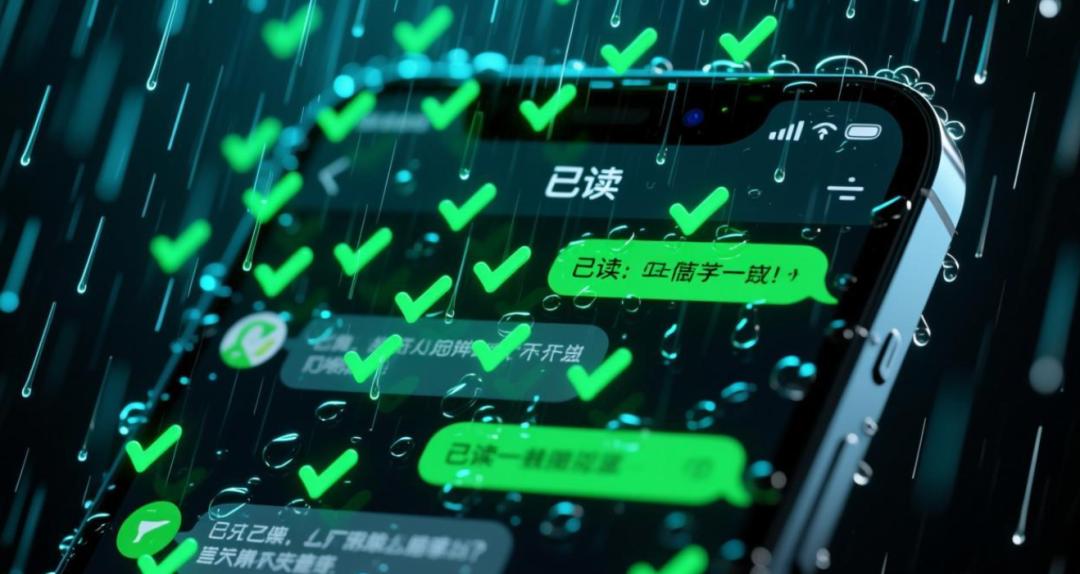
According to the record in "Inside DingTalk", the product team once proposed an optimization plan: previewing content should not be counted as read, and only entering the conversation page should be considered a valid read. It is said that this plan was rejected by senior management because it could not damage the rights and interests of message senders. This is a blatant power - based judgment and has nothing to do with technical choices.
It is written in "Inside DingTalk": Algorithms have no emotions, but they have a stance. The algorithmic stance of ONE always stands with the organization, the management, and the message senders, but never with ordinary users.
Since its birth, DingTalk has carried the gene of prioritizing message senders. The read/unread status and the strong reminder of DING messages are all designed to give managers absolute control. After entering the AI era, this gene has been infinitely magnified. In the past, managers could only know whether a message had been read. Now, AI can analyze employees' response speed, work arrangements in real - time, and even predict work efficiency.
The more intelligent the technology, the more transparent the hierarchical power becomes.
The ONE project implemented a daily one - package iteration mechanism: senior management puts forward modification suggestions in the morning, and the team must complete the interaction and code adjustments on the same day and package the version for senior executives to review at night.
For enterprise - level B - end products, the underlying infrastructure such as permission systems, cross - system linkage, and data isolation originally requires long - term modeling and repeated verification. However, under the assessment orientation of same - day delivery and immediate reporting, team resources are severely skewed: everyone gives priority to polishing the surface UI and visual highlight functions, and the underlying optimization that determines the long - term value of the product is constantly postponed.
"Inside DingTalk" left a poignant summary: The product has achieved nothing, but the reporting process is extremely smooth.
This has deviated from the original intention of agile development and has become a pipeline of performative innovation. The team simply abandons end - users and turns to serve the acceptance screenshots and reporting PPTs of senior executives.
The product direction of ONE has long been influenced by the "chef - style" aesthetics of senior management. The LOGO, visual system, and product positioning are frequently changed. Every time the direction is adjusted, the whole team is plunged into hasty interpretations and repeated internal strife.
According to an internal leak, the product team once conducted on - site research at Country Garden and collected the scheduling management needs of front - line security guards and cleaners. The card - stream function of ONE could have been adapted to this scenario of AI empowering the real - world, but it was rejected by senior management on the grounds that ONE does not serve security guards and cleaners, but only serves bosses and high - net - worth individuals. When the standard for product decision - making becomes the preferences and face of managers, the product is fundamentally off - track.
On the night of April 2, 2026, the leadership asked the team to observe the working status of competitors, and some employees were kept until after 12 midnight. If this is true, it reveals a clear transmission chain: the anxiety within the organization is encoded into the product. The read pressure, 24 - hour response requirement, and algorithm - forced push of ONE are essentially transmitting the anxiety of management to every employee through AI tools. The tool originally designed to improve efficiency has ultimately become an amplifier of anxiety.
The official post avoids the core: This is a structural contradiction
On June 10, the Alibaba Partnership Committee published an internal article titled "Love, Loyalty, and Growth Are the Essence of Alibaba Culture", clearly stating that no matter how the times and technology change, mutual respect, treating people as individuals, and love and loyalty will always be the unshakable foundation of Alibaba.
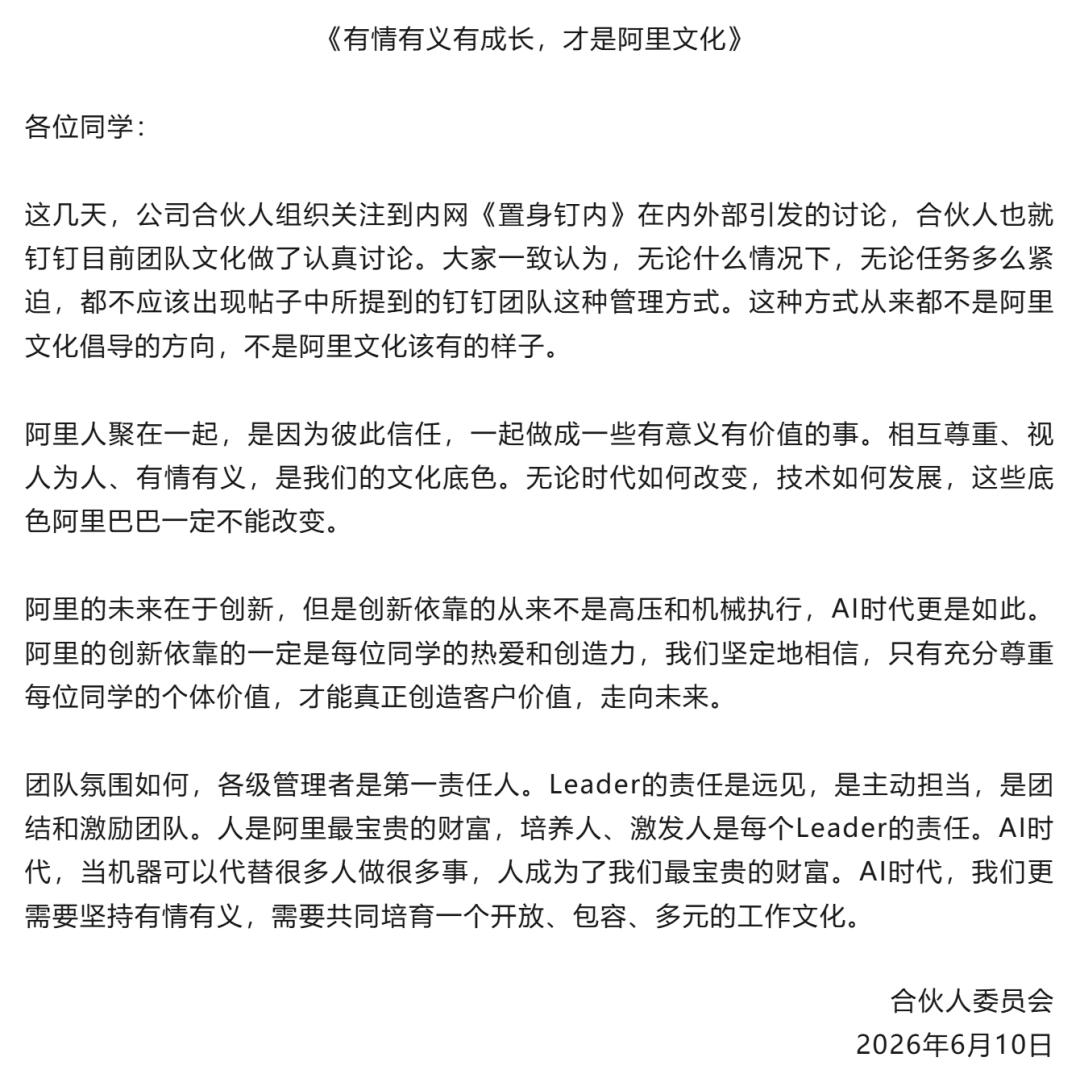
However, the article avoids a core question: If the cultural foundation has never changed, why has ONE evolved into what it is today?
The partners admitted that AI innovation does not rely on high - pressure and mechanical execution. This also indirectly confirms the existence of a high - pressure working atmosphere within the company. However, the entire article attributes the problem to the improper management of the DingTalk team, simplifying the complex problem into a local management style, as if a cultural rectification can completely solve it.
In fact, the downfall of ONE is rooted in structural contradictions.
To be honest, AI works for whoever pays the bill.
The business model of DingTalk has always been that managers pay and employees use. This business logic creates a deadlock for prioritizing message senders: the goal is to make management control more efficient, rather than giving employees work boundaries. The so - called "read terrorism" is not the subjective malice of any product manager at all. It is the final result of the resonance of the business model, market positioning, and product philosophy.
However, this is not the only variable, nor is it a destiny. Slack and Notion are also paid for by enterprises, but they drive procurement and renewal by winning the pleasant experience of end - users. DingTalk's choice of the control - plus - execution route is a choice under specific customer needs and the competitive landscape, and has nothing to do with the physical laws of the business model.
Ma Ruila, the vice - president of DingTalk, revealed the helplessness of practitioners in "Outside DingTalk": I know that high - pressure, the lack of results after hard work, and the cycle of frequent reporting, high - speed iteration, and no improvement. His question is even more thought - provoking: Sometimes I wonder, if I have to sacrifice all my life to achieve a company's ideal, what right do I have to draw a blueprint for AI to change the world?
This is the black humor of the creator being bitten back by his own creation. Originally intended to use AI to liberate workers, but ended up creating the most powerful monitoring tool; intended to do something practical, but finally wasted all time in endless troubles. ONE has never betrayed Alibaba's culture. It has just torn off the disguise of slogans and slogans and truthfully shown the most real organizational ecology of this enterprise.
Wukong takes over: The product can change its name, but the organizational gene remains the same
After the ONE project was scaled back, Alibaba shifted all its resources to Wukong AI. In March this year, Alibaba established the ATH Business Group, led by Wu Yongming himself, integrating all - line AI businesses such as Tongyi Laboratory, Qianwen, and Wukong. Wukong is positioned as an enterprise - level AI - native work platform, focusing on multi - Agent collaboration and cross - platform linkage. In the future, it also plans to connect with external tools such as WeChat, Slack, and Microsoft Teams.
However, there is a core problem that cannot be solved by changing the name, restructuring, or adding new functions: The payer is still the manager, and the user is still the ordinary employee.
As long as this underlying structure remains unchanged, the gene of prioritizing message senders will continue to exist. The more intelligent the AI Agent and the higher the execution efficiency, once there is a deviation in top - level decision - making, the transmission speed of wrong instructions will be faster. Even if more ecological capabilities are connected and more data links are opened up, if the decision - making logic always places the will of senior executives above user research, Wukong will just be a new shell running the same control algorithm as ONE.
The partners said that people are the most valuable asset in the AI era, but they did not face the reality: When AI can undertake a large number of repetitive tasks, some managers will gradually blur the boundary between people and tools.
Wukong is promoted as working 24/7. From an efficiency perspective, this is a major change; but in the workplace scenario, the all - powerful AI has instead become a shackle that traps people. Wukong originally had the meaning of breaking free from constraints and rules, but in the enterprise office system, the omnipotence of AI has ultimately become inescapable for employees.
This dilemma is not unique to Alibaba. Microsoft Copilot is deployed with data analysis capabilities for usage, and Google Gemini Enterprise emphasizes centralized governance. Some enterprise - level AI tools are being used for employee behavior tracking. The tendency to control AI is not unique to China, nor is it the inevitable end for all B - end products.
If the old structural problems are not eradicated, new wine in old bottles will explode sooner or later.
The Alibaba partners say love, loyalty, and growth, while the code of ONE says prioritize message senders.
Do you dare to let AI fully show the real cultural appearance of the enterprise to every employee, user, and investor?
If not, no matter how advanced the AI product is, it's just superficial. The highly - anticipated Wukong will one day become the next ONE.
This article is from the WeChat official account "AI Disagrees", written by Chang Qing, and is published by 36Kr with authorization.