What did the teams that successfully navigated the AI revolution do right?
As artificial intelligence reshapes intelligence, productivity, and even social forms at an exponential rate, are we ready to embrace the era of "coexisting with AI"?
In May 2026, the Tencent Research Institute and the Faculty of Law of the University of Hong Kong jointly hosted the AI & Society (AI&S) Forum 2026. The core theme of this forum was "The Era of Coexisting with AI (Living with AI)", spanning across "the two cities of Shenzhen and Hong Kong". In Hong Kong, we focused on "the boundaries of AI" and explored the collision between ideas and industries. In Shenzhen, through the "unplugged" and "fully plugged-in" educational scenarios, we perceived how technology returns to the human scale.
In the series of dialogues at this forum, top scholars, industry leaders, and frontline practitioners gathered together, attempting to penetrate the fog of technology and inquire about the profound impact of AI on society, the economy, truth, and life.
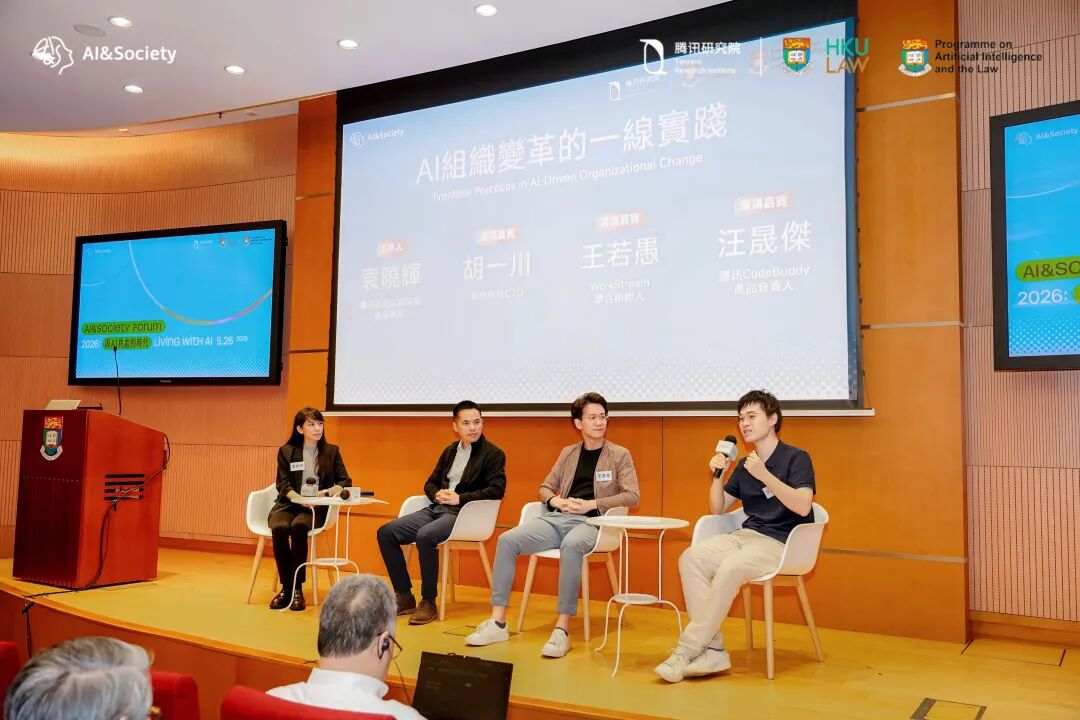
The following is a round - table forum on "Frontline Practices of AI - Driven Organizational Change" at this forum, which takes you to face the frontline of AI transformation.
Host:
- Yuan Xiaohui (Deputy Director and Senior Expert of the Tencent Research Institute)
Guests:
- Hu Yichuan (CTO of Laiye Technology)
- Wang Ruoyu (Co - founder of Workstream)
- Wang Shengjie (Product Manager of Tencent WorkBody)
- Editor and Compiler:
- Dou Miaolei (Senior Researcher of the Tencent Research Institute)
[Key Points]
1. AI transformation is a top - down project. If leaders don't understand AI, a small number of people who know AI will be overloaded with work. Inefficient departments will reverse - consume the achievements of efficient departments, and local transformation will be dragged down in the overall situation. Only when the top leader gets personally involved can organizational change be truly promoted.
2. Three levels of AI application in transformation: The first level is AI products for users - a good product is a luxury, hard to come by. The second level is adding an AI layer to products to simplify interactions and enhance user experience. The third level is the comprehensive transformation of the organization into an AI - native workplace. The latter two levels are not choices but matters of survival.
3. Super - individuals don't become more relaxed despite having stronger productivity. The "released time" doesn't turn into leisure because they also carry a mission in the organization, which is to influence those around them and reshape the workflow within the organization.
4. Reducing the number of collaborators and aligning cognition is the most difficult. On the premise of connecting all key points, try to reduce the number of participants. The reason is not only the communication cost - the more fatal issue is "pseudo - alignment": people nod frantically in the meeting room, but do a poor job after the meeting.
5. Vision becomes more important in the AI era. Your only ability is to see the world 30 years ahead earlier than others and directly change it with the hundred - fold productivity of three people.
6. AI should not just be an accelerator but an amplifier of everyone's abilities. There are a large number of unsolved problems and unmet needs in the world, and the needs are infinite. The key is not who will be replaced, but whether everyone can use AI and share the technological dividends.
Full Text of the Discussion
Yuan Xiaohui: Welcome three frontline practitioners! Our previous report "From Super - individuals to Super - teams" was just the beginning. Today, we are very honored to have you here and eager to hear the voices from the frontline of the industry. Please briefly introduce your companies: what kind of business you are engaged in, the size of your teams, and the current state of cooperation with AI.
Hu Yichuan: Hello everyone. I'm very honored to be here to communicate and share with you. I'm Hu Yichuan, the co - founder of Laiye Technology. Laiye Technology is a company that develops AI digital employees. We mainly provide AI digital employees for enterprise customers in knowledge - based work in the mid - and back - office areas such as finance, customer service, and IT. Simply put, we have a set of software that helps these knowledge workers automate all repetitive tasks in their daily work, freeing up their time and energy to do more valuable and creative work.
We have a team of about 200 people, and the R & D team mainly focuses on AI software R & D, with a scale of about 50 people. In the past two and a half years, our team has undergone great changes. I remember clearly that about two years ago, everyone was using GitHub Copilot; one and a half years ago, everyone was using Cursor; one year ago, everyone was using Claude Code; and today, everyone is using multiple Claude Code and multiple Codex simultaneously. I want to share that in the past two years, the number of our team members has hardly changed, but in terms of the number of product lines and the speed of product iteration, there has been at least a five - fold increase.
Yuan Xiaohui: Everyone is busier, right?
Hu Yichuan: Yes, everyone is indeed busier. As you mentioned earlier, super - individuals do have stronger productivity, but today, super - individuals don't become more relaxed because of stronger productivity; instead, they are busier - because they also carry a mission in the organization, which is to influence those around them and reshape the workflow within the organization.
Yuan Xiaohui: Let's put aside the question of "whether one should be busier" for now. Let's hear what the next person has to say. Ruoyu?
Wang Ruoyu: Thank you. My name is Wang Ruoyu, and my company is called Workstream. Maybe friends in China are not very familiar with this company. We solve a series of problems for blue - collar workers in North America, from recruitment to onboarding, attendance to payroll. In the past, we raised about $100 million in Silicon Valley and are probably in the Series B stage.
Why is there such a problem? Because white - collar workers don't have this problem - their salaries are fixed. For example, after joining Tencent, your salary may not change for three years, right? But it's different for blue - collar workers, especially in the United States, which has a system centered around hourly workers. Just now, a professor mentioned Trump. His most core achievement was actually making tips tax - free in the United States - this was Trump's most core achievement.
Because of the tax - free tips, the income of low - income groups has increased significantly, but this has also made the income variability of a large number of blue - collar workers extremely high. You can imagine that a person's working hours per day are not fixed. And it's different from China. For example, in China, if you run a barbecue restaurant, you may get a monthly salary of 3000 yuan, with food and accommodation provided. You do everything, including cashiering, cutting meat, and serving dishes.
But in the United States, it's different. The hourly rates of a cashier and a barista are different, which makes the data very complicated. Moreover, the blue - collar industry and its management are very low - tech. So we try to use SaaS plus AI to solve this series of problems.
Regarding AI, we think there are three levels of application points within our company. The first level is to create a product for users, which is a luxury. If you can create a product for customers, it's actually a very rare thing because there aren't many products in the world that can really find the product - to - customer point. But most companies can at least do two things, which is the second level - at least add an AI layer to your product. Adding an AI layer can either improve efficiency for users, simplify the UI/UX, add a sense of technology, or tell a story for the company - this layer must be added.
The last level is what Yichuan mentioned - what every company should do, which is to transform the organization into an AI - native workplace. For example, in the past, you might need a financial director to lead a group of financial colleagues to calculate a lot of accounts. Especially if you are an overseas company today, with entities in China, Singapore, and the United States, it's very troublesome to calculate accounts. Can these be automated with AI? Can internal coding be automated? Also, product managers used to spend most of their time writing documents. Today, it shouldn't be like this. Today, our product managers only do one thing - talk to users crazily, pull back the records of user conversations, and throw them to AI. AI automatically turns them into GitHub issues or to - do lists, and AI automatically analyzes the priorities. Then, harness engineering takes over - the entire workflow has undergone a qualitative change.
Overall, these are the three things we see that can be done: a product is a luxury, hard to come by; the second and third levels, the AI layer and the AI - native work, are things that must be done.
Wang Shengjie: Hello everyone. My name is Wang Shengjie, and you can also call me Jason. I'm from Tencent and am currently in charge of the WorkBuddy product. Regarding AI - related practices, I'll start with my own story.
I used to work on CodeBuddy, an AI programming assistant, which is a product used in the IDE. You may have used VS Code or other IDEs. It's embedded in them. My story is like this: I've always wanted to use AI to help me do more than just write code - to help me do more things. After writing code, I found that AI can not only help people write code but also do more things. So I thought, can AI help everyone, not just programmers?
So we decided to develop a product using the Vibe Coding method for ordinary non - technical users. At the beginning of this year, I developed a web - based version of CodeBuddy called CodeBuddy Work. Later, Dr. Xiaohui helped us change the name to WorkBuddy. So the 0.1 version of WorkBuddy was officially launched on January 15th this year. That's our story. The size of our team is also increasing.
Unexpectedly, WorkBuddy has been very well - received both internally and externally. This tool has really touched users, and it has high stickiness and is used every day in the daily process. We combined the "lobster" popular phenomenon and added the claw ability, and immediately launched a mini - program version - which was the earliest dual - form in China. You can call up your mini - program at any time to use it. Today, we have also released the APP version, and you can search for WorkBuddy at home and abroad to use it later.
Yuan Xiaohui: Since he has a product manager background, some of the terms he just mentioned may sound a bit unfamiliar to you, such as Vibe Coding and IDE. But to put it simply, what is it? Because AI has very strong execution ability and can program, you can now use natural language to command the computer to program and fulfill your wishes. For example, the PPT in the report - releasing session just now was completely generated by AI after we described it in natural language. This ability improves efficiency for programmers, but it's a brand - new way of working for non - programmers. So if you haven't experienced it yet, you will definitely experience it in the future, no matter what kind of product it is.
Last year, we released a report on AI transformation, in which we divided the transformation of the entire enterprise into three levels: the top - level is business transformation, which is to improve efficiency, get more customers, and improve R & D quality as mentioned earlier; the middle - level is organizational change - what kind of organization can carry AI as a productivity tool? The third level is mental reshaping - what attitude should we have towards the relationship between humans and AI? This determines the organization and also the business.
My second question is about AI - driven organizational change. Your teams are all about one or two hundred people in size. What have you done to adapt to this new productivity tool? Since everyone is doing multiple things at the same time now, how should the team be divided and how should they collaborate? Do we still need to hold so many meetings? Let's start with Yichuan.
Hu Yichuan: I think the most significant change is that the team size has become much smaller. In the past, for a product line, from product managers to designers to front - end and back - end engineers, there were as many as twenty or thirty people, and at least a dozen. Today, each of our product lines has less than 10 people, and many new products from scratch only need 3 to 5 people. One reason is that everyone's productivity has increased significantly, and the other reason is that by reducing the team size, we have reduced the communication between people. We found that in the past, without AI, communication between people consumed the most time and energy.
Yuan Xiaohui: Many people used to have meetings during work hours and do their work after work.
Hu Yichuan: Yes, so today I found that the smaller the team, the higher the efficiency. They don't have so much communication. Maybe they just have a half - hour meeting with two or three people every morning to discuss and make decisions on the most important things, and then each person goes to work and lets AI do the work. This is the biggest change.
Another change is the relationship between people and AI. At the beginning of this year, I put forward a requirement for the entire R & D team: everyone using AI needs to go through three stages in the next few months. In the first stage, the agent should become your default work entry. Tools like WorkBuddy and Codex should become everyone's default work entry, instead of opening an IDE and a PowerPoint.
In the second stage, on the basis of the first stage - the first stage is one - to - one, one person using one agent - the second stage is that one person can use multiple agents. This is easy to understand because when an agent is working, your time is freed up, and you can do other things. But this will bring a bottleneck: some colleagues opened 4, 6, or 8 Claude Code windows, but soon found that they couldn't focus because they often had to switch from one window to another.
So in the third stage, we need to design a new workflow to decouple the work of humans and AI. Even AI should work after people get off work. This is what we are pursuing today - of course, we haven't fully achieved it yet. But recently, when we counted the number of tokens consumed by each team and each person, we found that some colleagues can let the agent consume billions of tokens in one night after work.
Yuan Xiaohui: How much does billions of tokens cost?
Hu Yichuan: We all buy the $200 Coding Plan. If we really convert it to the API, I estimate that it will cost hundreds of dollars a day.
Yuan Xiaohui: Great answer. Recently, we have also investigated the token consumption of many enterprises. Some consume hundreds of dollars a month, some thousands, and some tens of thousands. The most exaggerated one may be a researcher at OpenAI, who consumed 217 billion tokens in a week, which should be tens of thousands of dollars.
Hu Yichuan: In the millions.
Yuan Xiaohui: Yes, the one who consumed the most is Peter Steinberger, the founder of OpenClaw. He consumed more than one million dollars last month. You can imagine, one person using so many tokens, others will question him: what have you done with so many tokens? Of course, he didn't disclose in detail, but he said that compared with hiring more high - paid engineers, it was still very cost - effective.
Of course, there are many problems here - employment issues, the issue of employment substitution, whether to use people or agents, etc. But just from the perspective of token consumption, it has indeed brought about a very significant productivity revolution. Just now, Yichuan also talked about the state of the entire organization, including how to call agents, how to use multi - agents, how to protect your attention in the process, and even how to make the team collaborate with multi - agents. Currently, we haven't seen very good productivity tools. Let's hear Jason's thoughts. Is it necessary to have tools suitable for super - teams? Ruoyu, how does your team restructure the organization to adapt to the AI era?