Nameq International has signed a USD 50 million strategic investment letter of intent with ARC Group International, to accelerate the global expansion of China's AI-powered international supply chain and fintech industries.
After a large commodity transaction is completed, the buyer and seller often spend weeks confirming one thing: who actually has the goods.
This is not an isolated case. In China's commodity circulation market worth trillions of yuan, there have long been three barriers: opaque information, weak industrial chain collaboration, and low fulfillment efficiency.
In the past decade, B2B platforms have solved the problem of finding goods. Buyers and sellers can find each other online, but this is just the first step. What really gives people headaches is "the journey" after finding the goods.
After the order is signed, the buyer starts to worry: Is the quality of the goods up to standard? Will they be misappropriated? The seller is also worried: Will the payment arrive on time? Will the price be forced down midway? The logistics provider has its own troubles: What if the warehouse refuses to recognize the receipt when the goods arrive? Banks are even more cautious: Has this batch of goods already been pledged?
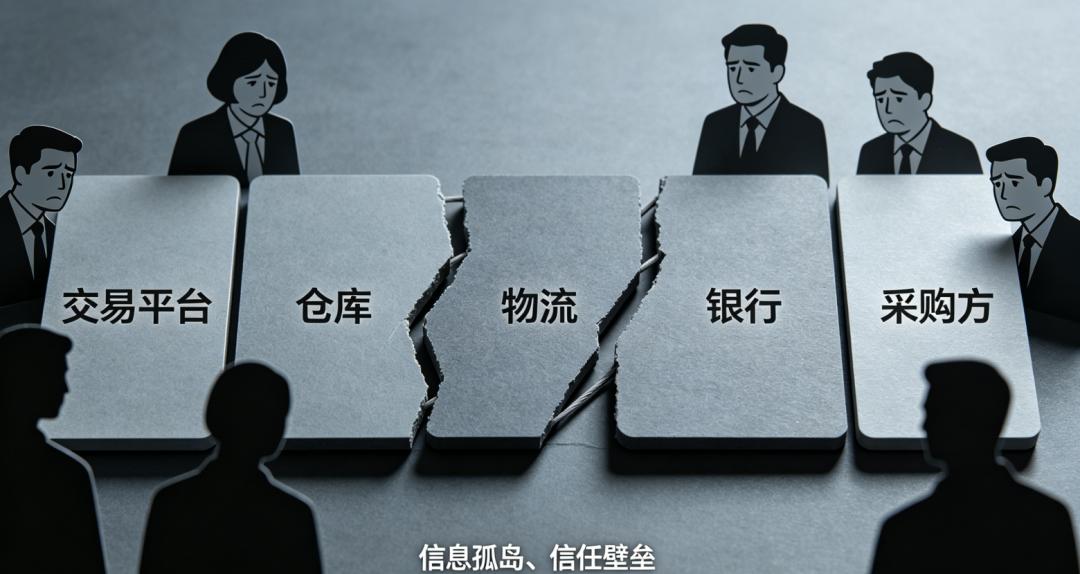
Everyone is on the defensive, and everyone's concerns are reasonable. Transactions become slow, expensive, and fragile in this atmosphere of mutual distrust.
Therefore, after the traffic dividend fades, the core proposition of the industrial Internet is gradually becoming clear: How to make every step of the transaction, from display to delivery, credible, efficient, and low - cost.
This proposition has attracted a large number of companies to enter the market. Some are developing electronic signatures, some are building logistics tracking platforms, and some are offering supply - chain finance SaaS. Each company approaches from a different angle, but most can only solve problems in one particular link. When information becomes transparent, collaboration still gets stuck; when collaboration goes smoothly, fulfillment is still slow.
Among these startups, a company called NashiKe (Wuxi) Smart Technology Co., Ltd. aims to build a comprehensive system and technological foundation covering transactions, fulfillment, the Internet of Things, and data.
Recently, NashiKe received a letter of intent for a $50 million investment from ARC Group International. For NashiKe, this strategic investment not only brings in funds but also accelerates overseas market expansion through ARC Group's cross - border network.
ARC Group is a global investment bank and management consulting firm focusing on connecting Asian and Western markets. Its services cover a full range of financial solutions such as IPOs, M&A, financing, venture capital, and SPACs. The company has an independent consulting department dedicated to helping enterprises address the unique challenges they face in operating in Asian and Western markets. Since its establishment in 2015, ARC Group, with its headquarters in Hong Kong, China, has set up offices in the Chinese mainland, the United States, Malaysia, Indonesia, Vietnam, India, Sweden, and the United Arab Emirates, accumulating profound cross - border financial and advisory service capabilities. In 2024, ARC Group won the Frost & Sullivan Company of the Year Award and the M&A Worldwide Deal of the Year Award, further consolidating its leading position in the financial services industry.
Behind the capital market's optimism and the company's prestigious titles, what's more worthy of attention is NashiKe Technology's solution for the industrial Internet.
1. Tear Down the "Three Barriers"
The starting point for NashiKe Technology to tackle this issue comes from a very specific confusion:
The founding team used to work at a leading trading platform in the domestic stainless - steel field. At that time, they found that the platform's transaction data and the customers' own management software were independent. If customers wanted to use the financial services provided by the platform, they had to connect to another system.
For each additional function, a service provider from a new field needed to be involved. For example, connecting to bank payments, integrating logistics tracking, and adding inventory management led to high development costs and long iteration cycles. Even after the system was launched, the user experience was not necessarily good because no single supplier could truly understand the entire business picture.
It was during this period that the NashiKe team realized that what the industrial Internet lacked was a foundation to piece together these business fragments. After clarifying the idea, the first thing to do was to break through the three barriers in the industry one by one.
Let's first look at the first barrier, opaque information. For ordinary people, when buying something on an e - commerce platform, once the express delivery arrives, the goods are yours without any dispute. However, the trading logic for commodities is completely different. A batch of steel may be pledged, resold, or delivered in installments from the time it enters the warehouse until it leaves. Who has the ownership of this batch of goods? Sometimes, even the warehouse administrator can't answer this question.
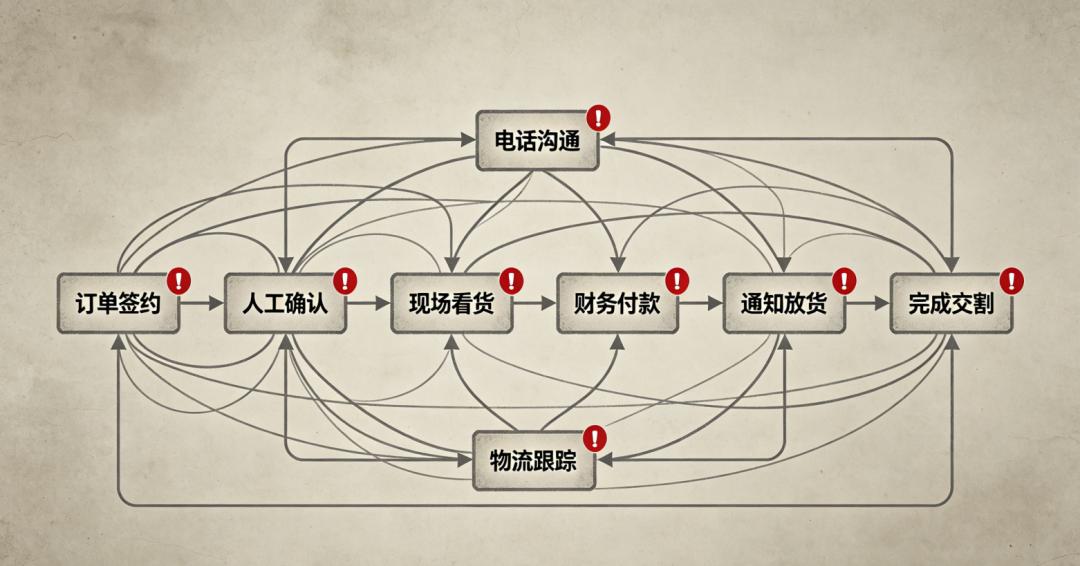
Moreover, this is not a problem of a single company. In the stainless - steel field alone, the entire industry has been using the technical underlying logic from more than a decade ago. The various modules of the system have long been fragmented: order data is on the trading platform, inventory data is in the inventory management system, capital data is at the bank, and logistics data is with the transportation company. Due to the lack of system interoperability, sales representatives spend a lot of time every day making phone calls, sending messages, filling out forms, and reconciling documents.
On average, an order goes through seven or eight roles and more than a dozen rounds of communication from signing to completion.
The second barrier is weak industrial chain collaboration. When a customer wants to change an order specification, the order - follower may need to modify the contract, notify production, and update the customs declaration form. There is no linkage between the systems, and everything relies on manual transmission.
The third barrier is low fulfillment efficiency. After the contract is signed, information about when the goods will be shipped, when they will arrive, and when the payment will be settled is sometimes as out of control as a kite with a broken string. The buyer has to send someone to the site to inspect the goods and then notify the finance department to make the payment; the seller notifies the warehouse to release the goods after receiving the payment. The turnover rate is incredibly low.
Many companies have tried to tear down these three barriers, but most solutions are piecemeal. Solving one problem often leads to the emergence of another.
Based on their long - term practice at the previous platform, the NashiKe team concluded that instead of continuously adding single - point functions, it is better to build a modular technology middle - platform. This can not only connect the data foundation but also make the system architecture more versatile.
NashiKe Technology's solution starts from this judgment. The trade supervision system is the first cornerstone of this foundation. It requires that all transaction data be fully traceable. The five lines of contracts, payments, invoices, logistics, and information are automatically reconciled and verified in the system. Only when the information is transparent will banks be willing to lend and customers be willing to place orders.
In addition, NashiKe Technology's modular technology middle - platform does not replace the customers' existing systems. Instead, it builds an "intermediate layer" on top of them, enabling independent software to "communicate" and connecting transactions, warehousing, finance, and logistics. This reduces the need for a large amount of manual intervention in the process linkage.
The smart warehousing system extends its reach into the physical world. Infrared recognition, industrial cameras, RFID tags, and intelligent weighing equipment are deployed in the warehouse. Digital vouchers are automatically generated when goods enter the warehouse, and permissions are automatically verified when they leave.
This industrial Internet system is not only for large state - owned enterprises. Private warehousing and logistics providers can become part of the smart financial warehouse network by connecting basic Internet of Things devices at a relatively low cost. For example, after a stainless - steel warehouse joins, other steel trading platforms can automatically authenticate and use it.
By combining these three solutions, information becomes transparent, systems are connected, and fulfillment is visible. The three barriers are torn down simultaneously.
2. Root in the Industry and "Polish" the Technological Foundation
Having a solution is not enough; one also needs the ability to implement it. NashiKe Technology's capabilities come from the cooperation of two subsidiaries: Xinjiedian focuses on the technological foundation, and Qiyoutong is responsible for scenario operation. One writes code, and the other runs the business; both are indispensable.
Xinjiedian has built a six - in - one platform architecture, including spot trading, order systems, BOSS operations, data analysis, data monitoring, and artificial intelligence assistance. Each module solves a specific problem and can be applied individually or in combination.
The competitive barrier in the industrial Internet largely depends on in - depth understanding of the business. During the architecture design process, NashiKe's engineers stay at the customer's site for a long time, working with warehouse administrators on daily tasks such as order processing, reconciliation, and exception handling. They also follow logistics vehicles to understand the operational difficulties in the transportation process. The problems reported by sales representatives in using the system directly serve as the basis for process optimization.
For example, engineers found that warehouse administrators spent two hours manually entering in - and out - of - warehouse documents every day and often made mistakes because the original system interface was too complex with too many fields. Based on this, NashiKe Technology redesigned the mobile - terminal entry interface, reducing the number of fields from thirty to eight. With the automatic recognition function of the barcode scanner, the entry time was reduced from two hours to fifteen minutes, and the error rate almost dropped to zero.
These seemingly minor improvements accumulate to bring about a qualitative change in efficiency.
Another advantage of the modular design is flexibility. 60% - 70% of a new customer's needs can be quickly met through the combination of existing modules, and the remaining 30% - 40% can be addressed through customized adjustments or the addition of new functions.
NashiKe has thus avoided two "start - up traps." One trap is developing standard software that cannot adapt to industry differences; the other is engaging in pure custom development, where each project starts from scratch, and the company loses the prospect of universality and scalability. The modular middle - platform allows NashiKe to meet each customer's customized needs while maintaining delivery efficiency.
Smart Internet of Things and digital warehousing are another aspect of NashiKe Technology. The three - layer linkage from devices to platforms to data upgrades traditional warehouses into smart financial warehouses, enabling remote monitoring, dynamic authorization, and connection to financial services. Since not all warehouses can afford expensive automated equipment, NashiKe's solution is to implement the system in layers, providing a full - set solution for large warehouses and basic configurations for small and medium - sized warehouses. This minimizes costs while ensuring that the functions are sufficient.
The data middle - platform and the industrial decision - making engine are the third piece of the puzzle, including capabilities such as commodity price trend models, enterprise credit scoring, industrial chain supply - demand forecasting, and fulfillment exception identification to help enterprises with dynamic pricing and risk control early - warning.
Based on Xinjiedian's six - in - one architecture, Qiyoutong transforms the technological foundation into executable solutions for vertical scenarios, such as the centralized procurement platform for petrochemical equipment, the material supply platform for shipyards, and the cross - border e - commerce platform for industrial products. The technological foundation provides general capabilities, and the scenario operation completes the "last - mile" adaptation.
It can be seen that the digital technology of the industrial Internet is not created out of thin air. The most important thing is to stay grounded and immerse in the industry.
3. Move Beyond Digitalization and Advance towards Intelligence
After tearing down the three barriers, NashiKe Technology is moving towards a higher dimension: making artificial intelligence the new engine of the industrial Internet. The $50 million investment NashiKe received this time will be mainly used for AI R & D and overseas expansion.
In the integration of AI and the industry, there is a general consensus that the implementation of general large - scale models in industrial scenarios is still a long way off.
The reasons are quite realistic: There is currently no recognized leader in the field of AI large - scale models for industrial scenarios. Limited data sources, high industry confidentiality, and difficult testing and verification are all objective obstacles.
Therefore, NashiKe does not plan to develop a large - scale, all - encompassing industry model. Instead, it focuses on tool - based applications in specific scenarios. After moving away from the "chasing - the - trend" narrative, NashiKe found that AI cannot be a "cure - all" in the industry. However, in many enterprise daily operation scenarios with clear rules and sufficient data, it can bring quantifiable efficiency improvements.
The first entry point this company found is the order - following process in foreign trade and trading companies.
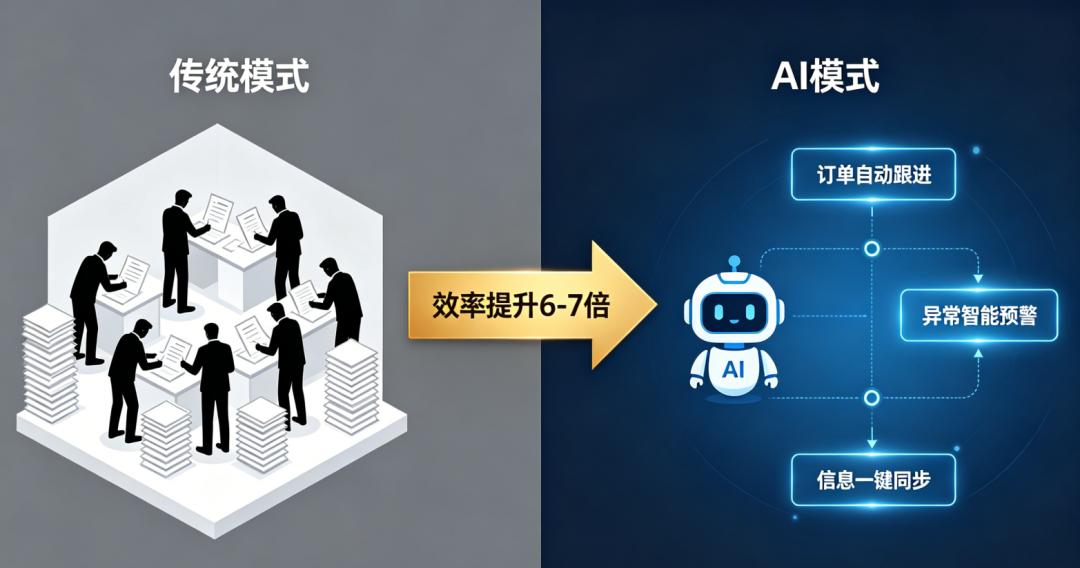
In these companies, order - following, order scheduling, and sales follow - up consume a large amount of human resources. The NashiKe team observed that these tasks are highly repetitive and rule - based but require a lot of manual coordination. AI can handle these tasks efficiently. Internal tests show that after an employee uses NashiKe's intelligent tools, their efficiency is equivalent to that of a six - to seven - person team. People's energy is liberated, allowing them to make more valuable business decisions and communicate.
NashiKe's intelligent strategy is to first achieve quantitative changes. When more people in the industry start using AI, it will look for qualitative changes. The deliberate slowdown in the commercialization rhythm is also aimed at collecting more high - quality data and feedback to form a competitive barrier.
This pragmatic attitude is even rarer in the current large - scale model bubble.
From an industry trend perspective, the application of artificial intelligence in the B2B circulation field is just beginning. Different from the standardized scenarios in the consumer Internet, each link in the industrial scenario may require customized AI capabilities.
Therefore, NashiKe's approach provides a new idea: Start with high - frequency, low - complexity tasks such as order - following and order scheduling to let users experience efficiency improvements, and then gradually extend to higher - value links such as pricing and risk control. This approach not only follows the law of technological maturity but also conforms to the rhythm of enterprises' acceptance of new tools.
As for how to make AI run "faster and more stably" in the soil of the industrial Internet, serving local government platform companies may be an important breakthrough.
In many third - and fourth - tier cities in China, industries are highly concentrated. A district may have only one or two leading industries. Leading enterprises and local governments are actively open to AI applications but may lack the delivery capabilities for professional scenarios.
Companies like NashiKe, from the perspective of comprehensive technology service providers, can help local industries identify pain points in intelligent transformation, provide AI foundations and technical solutions, and drive medium - sized and long - tail enterprises in a region to quickly enter the service system, gradually transitioning to the transformation of the entire industrial chain.
The overseas market is another important strategic direction for NashiKe. The degree of digitalization in China has increased exponentially in the past three years. NashiKe plans to export its mature digital experience to overseas markets. It is not simply selling software but making adaptations according to local industrial characteristics. Going global, orders from financial institutions, and AI tool - based applications together form the three strategic pillars for NashiKe in the next two to three years.
Another direction that NashiKe is eyeing is going global. In the past three years, the density of industrial digitalization in China has increased very rapidly. Compared with five years ago, the degree of digitalization may have increased by more than ten times.
Online transactions, full data traceability, and automatic system verification have become the infrastructure in China thanks to the efforts of companies like NashiKe. However, in many overseas markets such as Southeast Asia, the Middle East, and Africa, supply - chain management still remains at a relatively primitive stage of using paper documents and phone communication.
This gap represents a huge opportunity. NashiKe plans to export the digital experience accumulated in China to overseas markets. The form of going global is not selling software but strengthening local adaptation. Going global in the industrial Internet is a direction that requires long - term in - depth development, and NashiKe has listed it as one of its core strategies for the next two to three years.
An irreversible trend is that the industrial Internet will quickly move from digitalization to intelligence in the next three years. Digitalization solves the problem of moving information from offline to online, while intelligence solves the problem of moving from data to decision - making. What NashiKe wants