Li Auto and NIO are in a heated dispute: Is 48V more advanced than 800V?
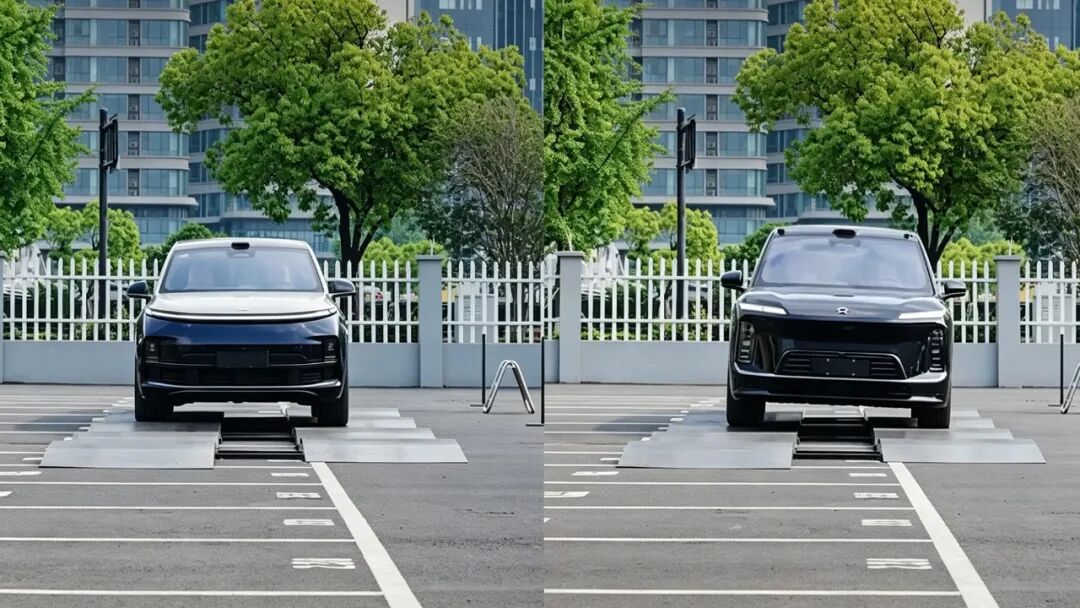
On the morning of June 5th, a video titled "Real - world Test Comparison: Li L9 Livis vs NIO ES9 on Wavy Roads" suddenly appeared on Li Auto's official mini - program. Two cars were taken to a wavy paved road, and their suspensions were adjusted to the firmest and softest settings to see which one could pass more steadily. Before noon, the video was quietly taken down.
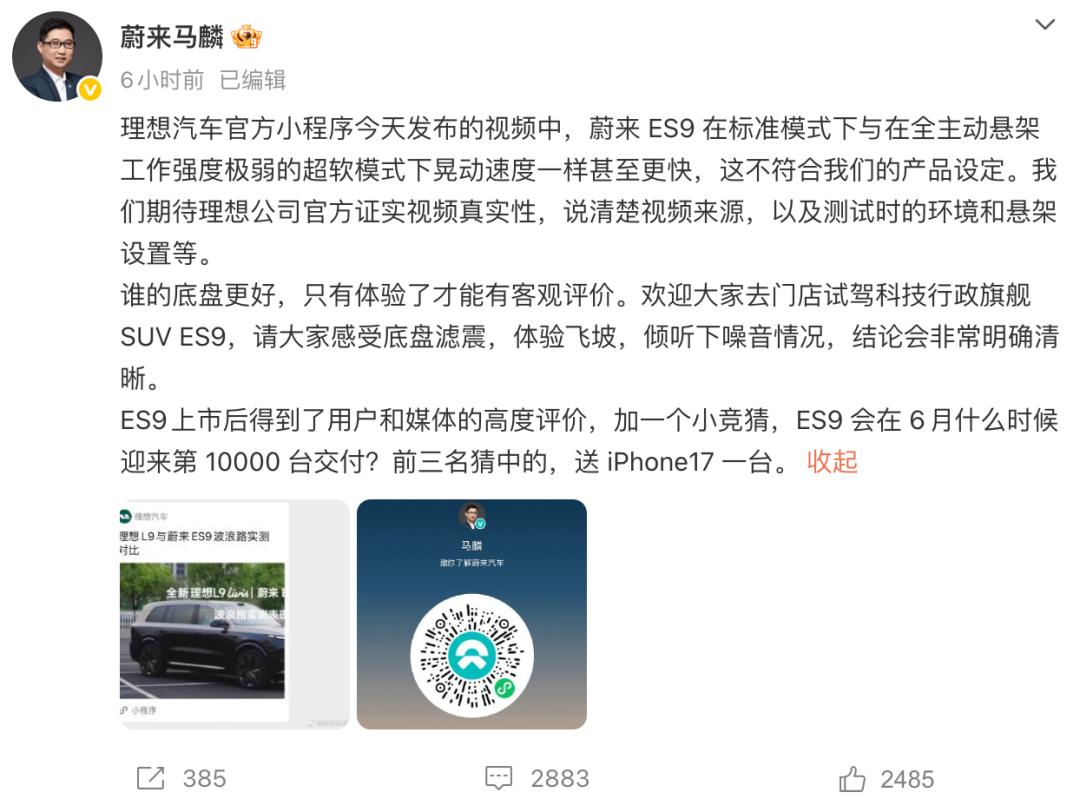
Image source: Weibo
But the situation was out of control. At 2 p.m., Ma Lin, the vice - president of NIO, posted a message questioning the authenticity of the video. At 4 p.m., Tang Jing, the president of Li Auto's first product line, responded, "The video is internal learning material, aiming to understand why Mr. Li Bin said that 48V is more advanced than 800V."
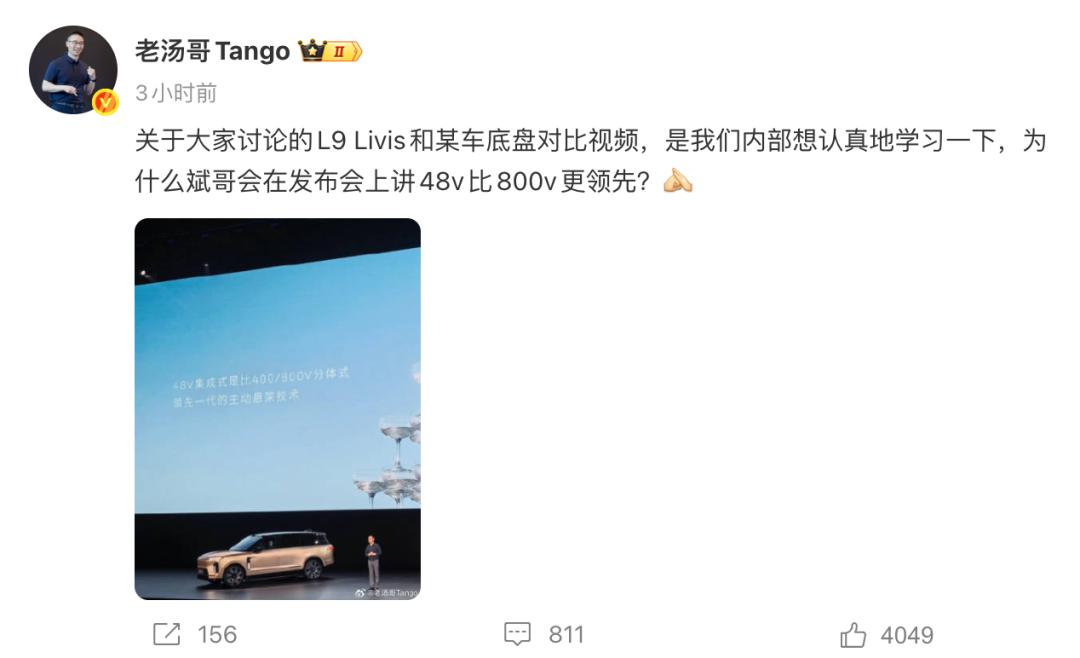
Image source: Weibo
A "suspension battle" between car manufacturers broke out.
The onlookers found it quite exciting, but many people didn't notice a key detail - Li Auto didn't start this fight. Five days ago, on May 27th, at the launch event of the NIO ES9, Li Bin publicly stated in front of the audience, "The 48V integrated system is one - generation more advanced than the 400V/800V split systems." His words implied that Li Auto's technical route was inferior to NIO's.
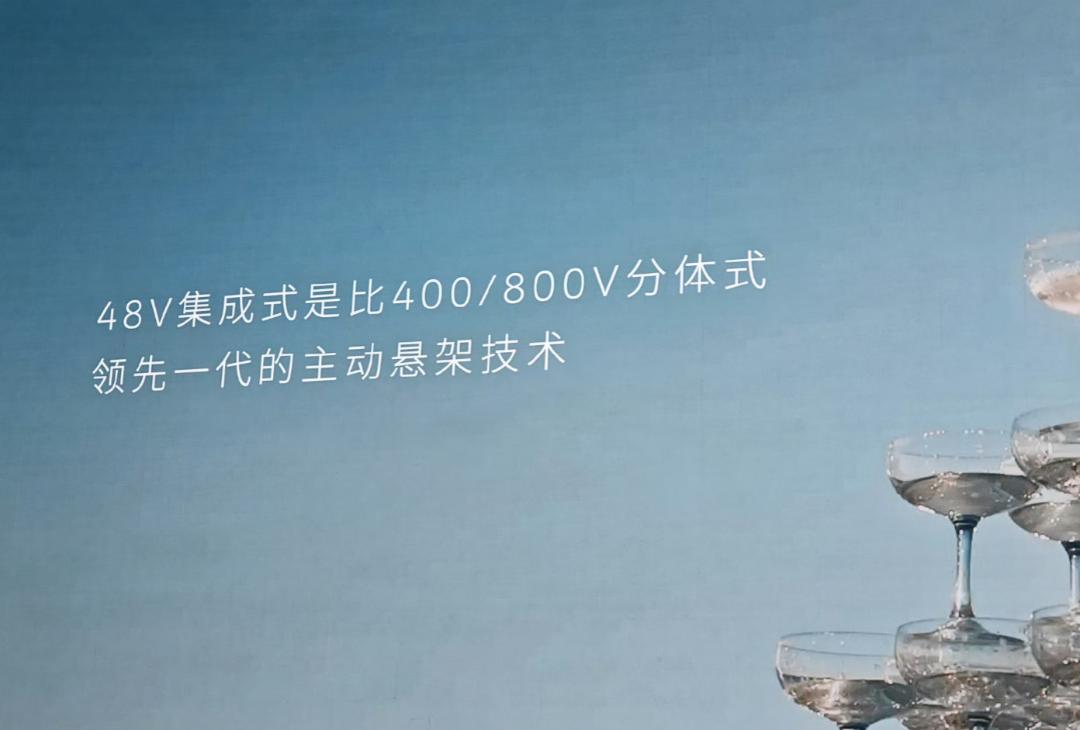
Image source: Internet
If you were Li Auto, could you bear it?
So, the truth of the matter is: Li Bin fired the first shot, and Li Auto responded later. The way Li Auto responded was indeed unseemly - the official directly produced a comparison video of competing products, acting as both the athlete and the referee, which was a loss of grace. However, Li Bin publicly belittled the competitor's technical route at the launch event, which was also not a kind move.
Moreover, there is a detail worth pondering. Li Bin said "one - generation more advanced than the 400V/800V split systems" - deliberately lumping 400V and 800V together. Why mention 400V? Because there is indeed a 400V split - system solution in the industry, but the Li L9 Livis uses an 800V system. By packaging 400V and 800V together as a target, Li Bin made his statement seem more comprehensive and weakened the uniqueness of Li Auto's 800V solution. This is a very shrewd marketing tactic, but in the eyes of industry insiders, it's a bit of a sleight - of - hand.
If Li Auto really wanted to respond gracefully, the best way would be to follow NIO's example - let third - party media conduct the tests instead of producing the video itself. The cross - evaluation live - stream on May 31st has proven that both cars have their own advantages and disadvantages, and neither can completely outperform the other. Li Auto could have cited third - party data to counter Li Bin's claim of "one - generation more advanced" without leaving any room for criticism. Unfortunately, they didn't choose this path.
Li Bin Fired the First Shot, and Li Auto Responded Later
Let's clarify the timeline.
On May 27th, at the launch event of the NIO ES9, Li Bin introduced NIO's 48V integrated fully - active suspension on stage. He was very confident, saying, "Compared with the 400V/800V split - system solutions, the 48V integrated system is a one - generation more advanced technology."
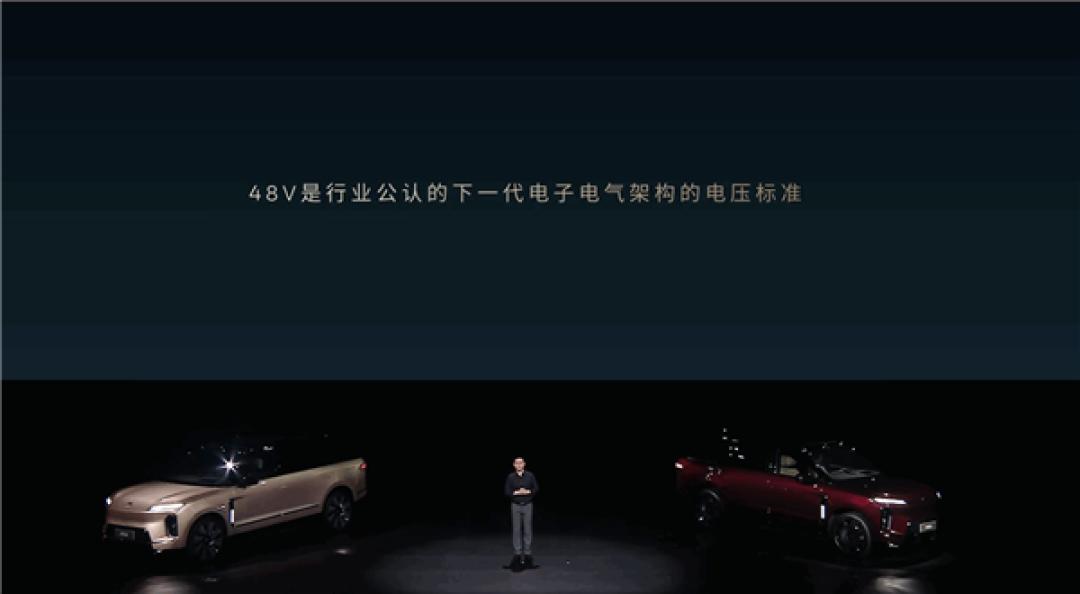
Image source: Internet
People present understood his subtext. At that time, Li Auto had just launched the new - generation Li L9 Livis on May 15th, which was equipped with an 800V split - type active suspension. Li Bin's words were like directly saying that Li Auto had chosen the wrong technical route. You can talk about your own products at the launch event, but why do you have to step on the competing products? This is not a technical explanation; it's a targeted attack.
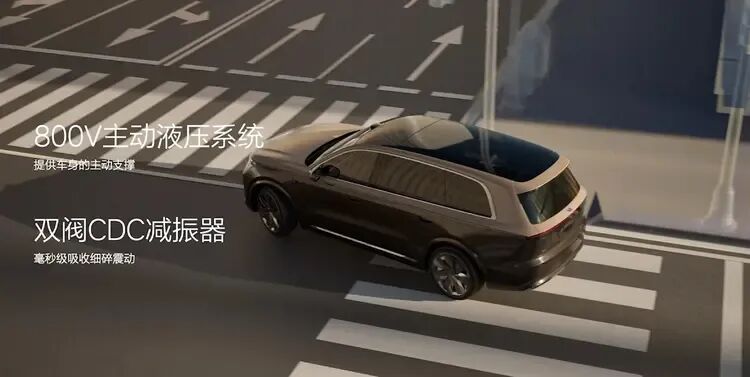
Image source: Internet
To put it simply, Li Bin understands communication well. The four words "one - generation more advanced" are more effective than listing a hundred parameters. They set the tone for NIO's products and labeled the competitors. As an industry insider said, "It's not illegal to belittle competing products at the launch event, but it's very unseemly."
What was Li Auto's reaction?
Tang Jing first replied on the social platform, "We won't engage in empty talk." It seemed that he wanted to endure. But five days later, on May 31st, a major media conducted a cross - evaluation live - stream of the suspension of the Li L9 Livis and the NIO ES9. The results showed that both cars had their own advantages and disadvantages. Although the cross - evaluation didn't determine a winner, Li Bin's claim of "one - generation more advanced" had been fermenting in the public opinion for several days.
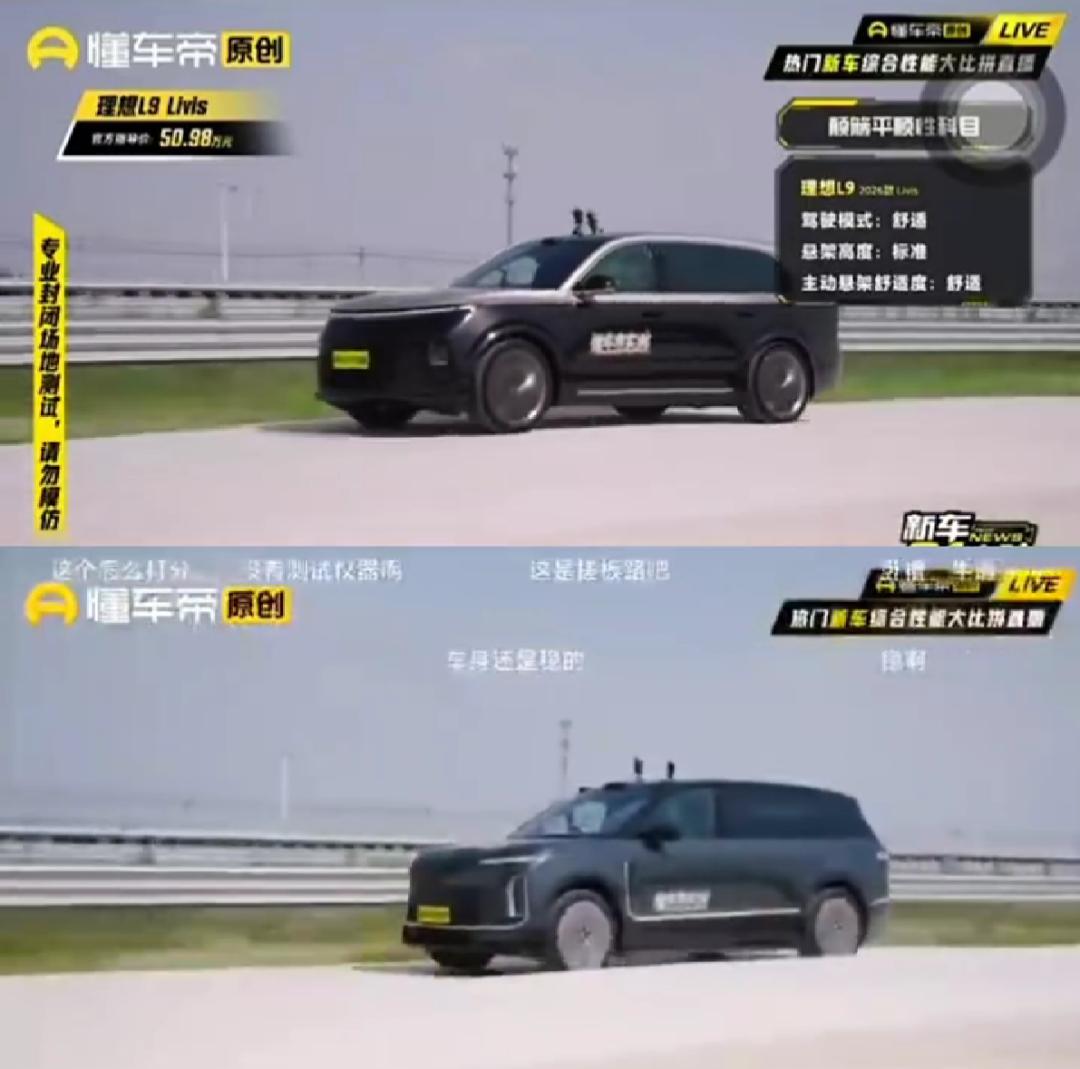
Image source: Internet
So, there came the video on June 5th.
Li Auto released a comparison test video on its official mini - program. The video was shot in Li Auto's internal parking lot, testing the performance of the cars on wavy roads with the suspension set to the firmest and softest settings. It was released in the morning, deleted at noon, and NIO caught hold of it in the afternoon.
Ma Lin's doubts were quite accurate: In the video, the shaking speed of the NIO ES9 in the standard mode and the ultra - soft mode was almost the same, which didn't conform to the product settings. Moreover, the NIO ES9 uses a steer - by - wire system, and there is no mechanical connection between the steering wheel and the steering wheels. In theory, the body shaking should not be significantly transmitted to the steering wheel - but in the video, the steering wheel was shaking exaggeratedly. In addition, the postures and forces of the drivers of the two cars holding the steering wheels were completely inconsistent, and the most basic variable control was not achieved.
These flaws are indeed conclusive evidence. Conducting the test in its own parking lot, having its own people drive and edit, and with such rough variable control, this is no longer a matter of professionalism; it's like going out without any intention of being reasonable.
However, NIO also has its own flaws. Li Bin's claim of "one - generation more advanced" at the launch event was like a fuse. Without this statement, Li Auto might not have been in such a hurry to produce this video. Although Ma Lin's response was restrained in wording, the last sentence "Welcome everyone to test - drive the NIO ES9 at our stores" seemed magnanimous but was actually a smart marketing move taking advantage of the crisis - both sides are engaged in a public opinion war, and neither can claim innocence.
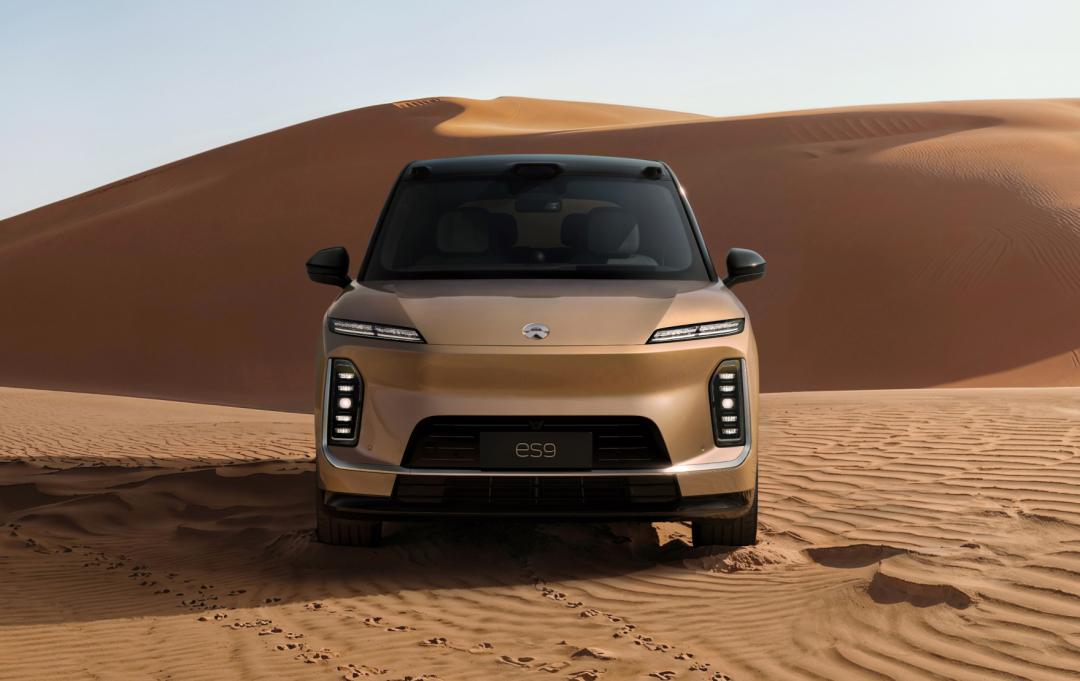
Image source: Internet
It's quite normal for car manufacturers to conduct mutual research and benchmarking tests in the industry. Buying competing products for disassembly, testing, and research is acceptable, as it's a necessary step for product iteration. However, packaging these contents as a "real - world test comparison" and publicly releasing them completely changes the nature - you are both the athlete and the referee.
Li Bin fired the first shot, and Li Auto responded later. The way Li Auto responded was bad, but the one who fired the first shot was not a peace - maker either.
Ultimately, everyone wants to gain the first - impression advantage in the market's reputation because most users won't spend a lot of time researching specific technical routes and parameter comparisons, as the decision - making cost is too high. However, car - buying decisions largely depend on the users' impressions.
Of course, our chief will try to explain today: What are the differences between these two suspension technologies?
48V vs 800V: Leather Shoes vs Sports Shoes, Not a Duel, but a Shoe Selection
Let's put it this way. A traditional passive suspension consists of a spring and a shock absorber. When the road is bumpy, the spring bears the impact, and the shock absorber absorbs it, and that's it. A fully - active suspension is different. It has an independent energy and drive unit and can actively exert force like human muscles - not just passively bear the impact but actively push back. In simple terms, it's like equipping each of the four wheels with a thinking "electronic muscle".
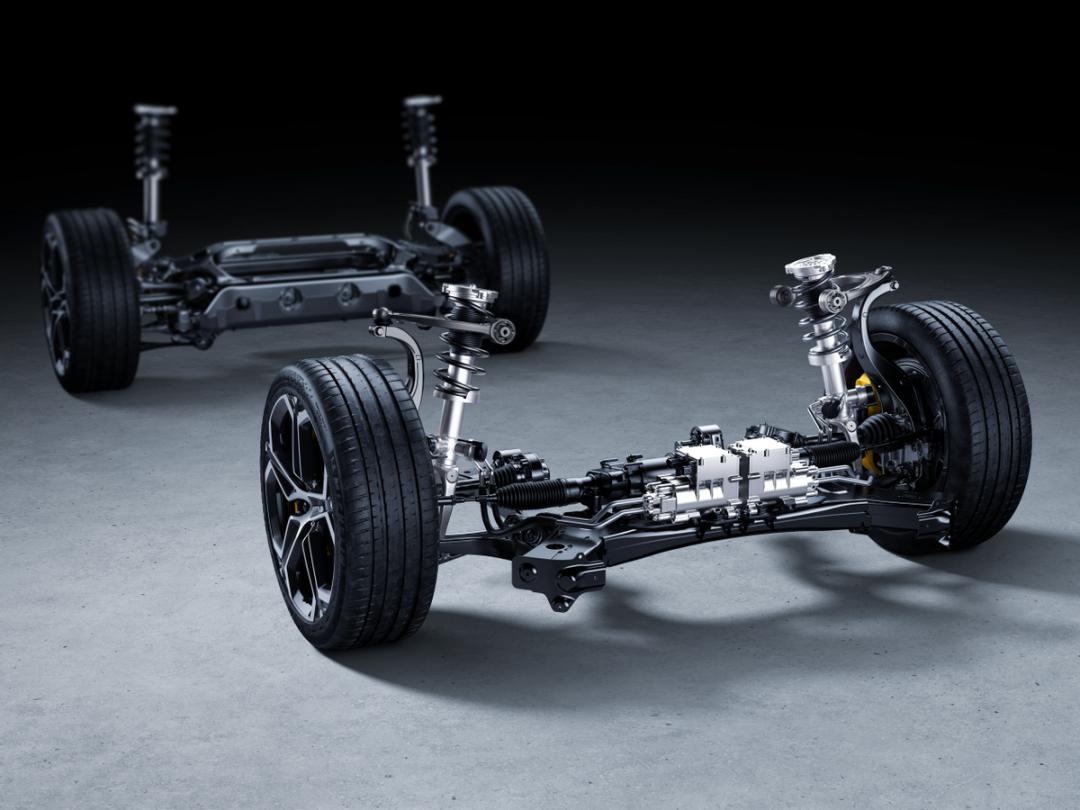
Image source: Internet
Starting from this goal, NIO and Li Auto have taken two different paths.
NIO's 48V integrated system has a compact structure. It combines four functions into one, takes up less space, and has a clean wiring layout. Li Bin's confidence in claiming "one - generation more advanced" comes from its high integration. The characteristics of this system are clear: It focuses on the stability and comfort of the vehicle on daily roads, making your buttocks feel less pain when passing over speed bumps. It's like wearing leather shoes - stable, decent, and suitable for most occasions.
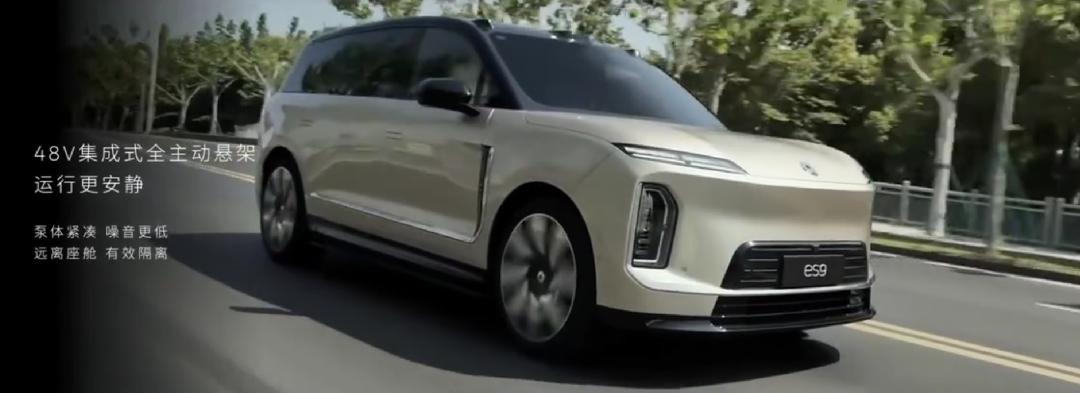
Image source: Internet
Li Auto's 800V split - type system equips each wheel with an 800V hydraulic pump, and each wheel can provide an active support force of over 10,000 Newtons. It cancels the traditional anti - roll bar, and the four wheels are completely decoupled. Its focus is on handling - even a large vehicle over five meters long and weighing over two tons can give you confidence when driving on mountain roads. It's like wearing sports shoes - flexible, powerful, and daring to perform on the field when necessary.
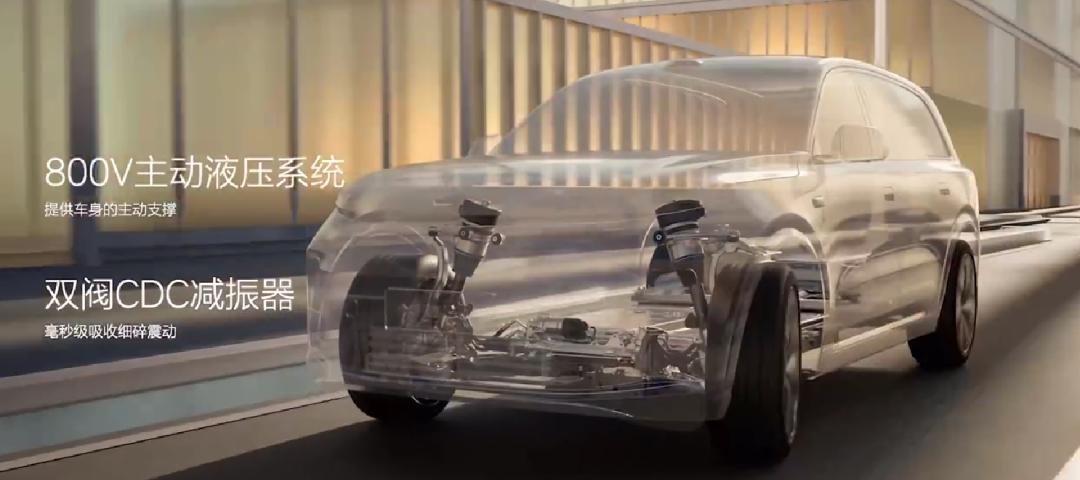
Image source: Internet
A very important point is the judgment of a chassis engineer with many years of development experience: "There is no superiority or inferiority between these two technical routes; it's just a different choice of car companies based on their product positioning."
This sentence can be translated as: Stop arguing; both are right.
Li Auto emphasizes that "even large cars can have good handling" because full - size SUVs like the L9 are naturally at a disadvantage in terms of handling. Without some hardcore technology, the lateral tilt during cornering can make the rear - seat passengers dizzy. NIO focuses more on the subtle comfort on daily roads, which may be more perceptible to users. The fully - active suspension field is currently in a stage of "a hundred flowers blooming", and no one can claim that their route is the standard answer. It's a bit like when smartphones first emerged. Some bet on large screens, and some bet on stylus pens. In the end, what matters is not who started the project first but who truly delivers a solid user experience.
Moreover, don't forget that Li Bin's claim of "one - generation more advanced" has some exaggeration. Although the integrated system has a more compact structure, the split - type system has a greater power output and more precise four - wheel independent control. The efficiency advantage of the 800V voltage platform is not imaginary - it has a smaller current, lower heat generation, and more stable long - term high - load output. Li Auto's official statement that "the best active suspension solutions in the industry are moving towards the 800V platform" may seem self - promoting, but it's not groundless from an engineering perspective.
Digging deeper, the choice between 48V and 80