Lotus halts its pure-electric sports car project and shifts focus to a profitable model targeting 30,000 annual units.
When top sports car brands such as Ferrari, Porsche, and Bentley have successively adjusted their timetables for full electrification and embraced internal combustion engines and hybrid power again, this collective shift in the global ultra-luxury car market is no longer just a sporadic signal. In June 2026, Lotus, a well-established British sports car manufacturer, officially launched the "Focus 2030 Strategy" and announced that it would become the world's first top sports car brand to achieve full coverage of three major power systems: fuel, pure electric, and super hybrid. At this strategic communication meeting, Feng Qingfeng, the CEO of Lotus Group, elaborated on the business logic and technical path behind this decision to the media, including Caijing.
This is not simply an expansion of the power route. From announcing in 2018 that the Emira would be the last fuel-powered car to clearly abandoning the research and development of pure electric sports cars now, Lotus' strategic wavering is itself a microcosm of ultra-luxury brands' arduous exploration in the wave of electrification. The difference is that Lotus chose to publicly admit that its previous judgment needed to be revised and provided a clear solution based on financial discipline and group synergy.
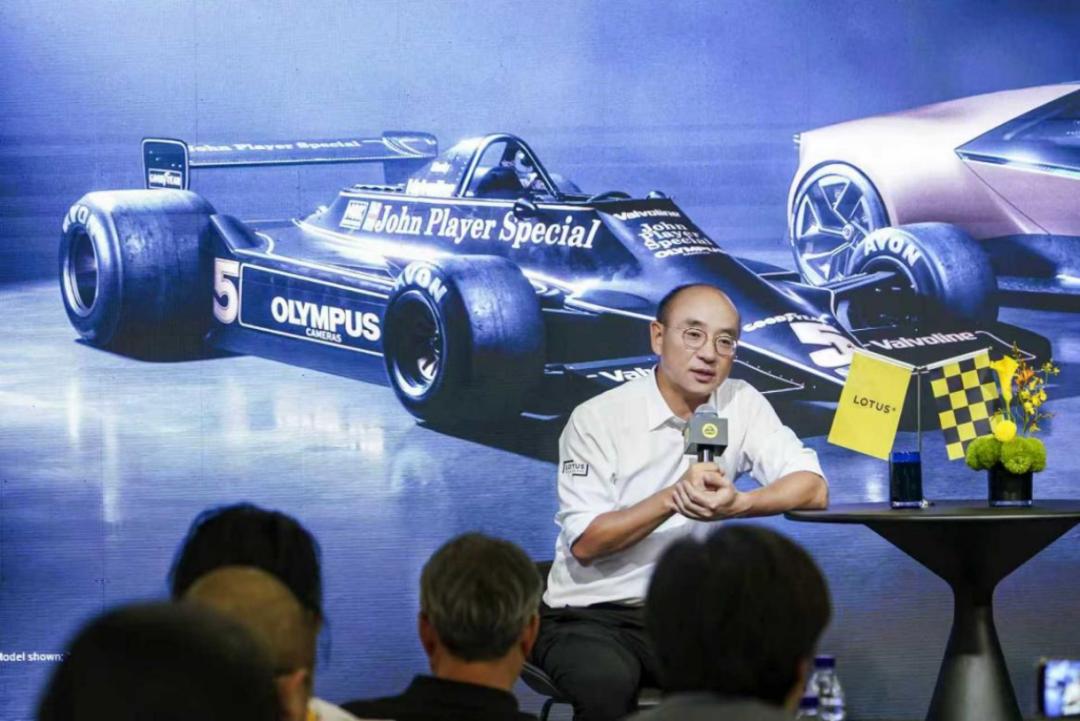
Feng Qingfeng, CEO of Lotus Group. Image source: The company
1
Halting the Development of Pure Electric Sports Cars
Feng Qingfeng said bluntly at the communication meeting that although Lotus started early in the field of luxury car electrification, the Evija pure electric supercar achieved an engineering feat of 2000 horsepower and a vehicle weight of 1.6 tons, and the Eletre and Emeya have also entered the market respectively. However, from a business perspective, we haven't created a single big hit product.
Market data supports this judgment. It is understood that in 2025, among ultra-luxury models with a global selling price of over $80,000, the penetration rate of pure electric vehicles was only 7.3%, a slight increase of only 0.8 percentage points compared to 2024. Some analysts said that high-net-worth customers still have significant doubts about the emotional value of pure electric supercars. The mechanical texture and sound of the engine are regarded by this group as an inseparable part of the driving experience. In addition, the regional imbalance of the global charging infrastructure is still prominent. Feng Qingfeng gave an example at the communication meeting that the Italian market still lacks a high-power charging pile network, and the layout of charging facilities in the Middle East and some Asia-Pacific countries has almost stagnated. This makes the single pure electric route face real sales resistance in global operations.
Based on this, Lotus made a clear cut in the Focus 2030 Strategy. In the field of sports cars, the pure electric option has been completely halted. Feng Qingfeng said that we will rule out the path of pure electric sports cars and will no longer explore it. Sports cars will only be made with fuel and hybrid power. In the field of daily-use vehicles, pure electric power will still be the core pillar, and the product matrix composed of the Eletre, Emeya, and Evija will continue to serve daily driving scenarios.
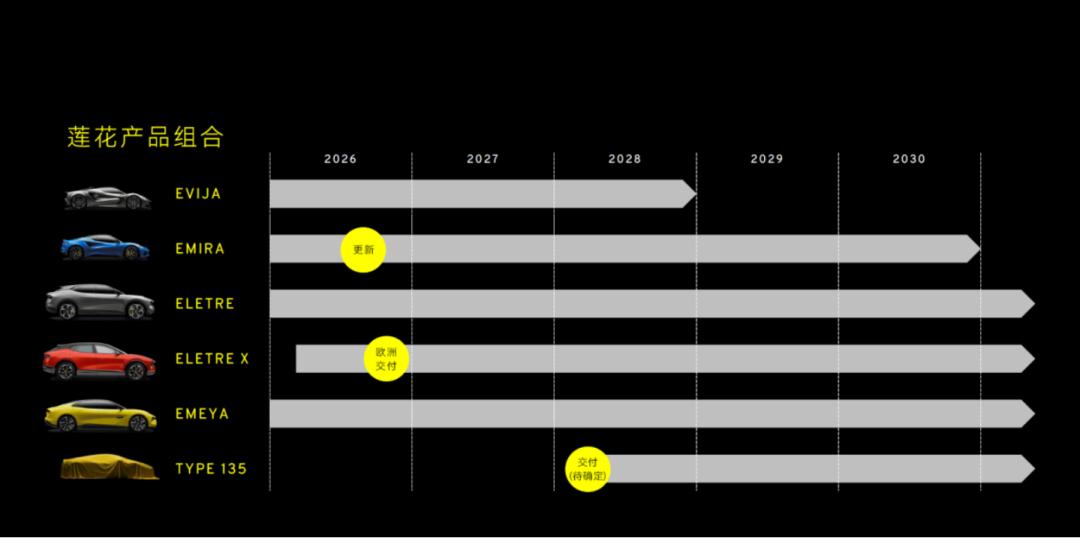
Image source: The company
What fills the power gap in sports cars is super hybrid technology. The Eletre X equipped with the Luoyao Super Hybrid Architecture will enter the European market in the summer of 2026. The total power of this model's system reaches 952 horsepower, and the comprehensive cruising range exceeds 1,400 kilometers. Even under the condition that the battery level is only 10%, the 0-100km/h acceleration can still be maintained at 3.5 seconds. More notably, Lotus announced that it will launch a new V8 hybrid supercar, the Type 135, in 2028, equipped with a new V8 hybrid unit jointly developed with the HORSE Powertrain Company within the Geely system, with the target rotational speed set above 10,000 revolutions per minute. These technical parameters are directly comparable to the top hybrid supercars of brands such as Ferrari.
2
The Financial Logic of the Profit Model for 30,000 Vehicles
Another core of this strategic adjustment is to lock the break-even point at 30,000 vehicles, which is a very low scale in the automotive industry.
For Lotus, which has long been troubled by the scale bottleneck of a niche brand, the achievement of this goal highly depends on the in-depth synergy with its controlling shareholder, Geely Holding Group. Feng Qingfeng summarized this relationship in one sentence: With Geely, Lotus has the ammunition to compete with Porsche.
The essence of synergy is a distribution mechanism of cost and capabilities. In areas with huge R & D investment and similar technologies, such as software, electronic and electrical architecture, and intelligent driving, Lotus directly accesses the Geely system to avoid duplicate investment. For example, for a company of Lotus' size, it is extremely difficult to independently bear the iterative speed of the electronic and electrical architecture and intelligent driving capabilities, and Geely's platform resources just fill this gap. On the contrary, in areas that constitute the brand's uniqueness, such as chassis tuning, aerodynamic design, lightweight materials, and power system calibration, Lotus maintains full autonomy and outputs these capabilities back to other brands in the group. The 6D chassis control algorithm used in the ZEEKR 001 FR and the carbon fiber body technology applied in Lynk & Co's pure electric models both come from Lotus Engineering's technology.
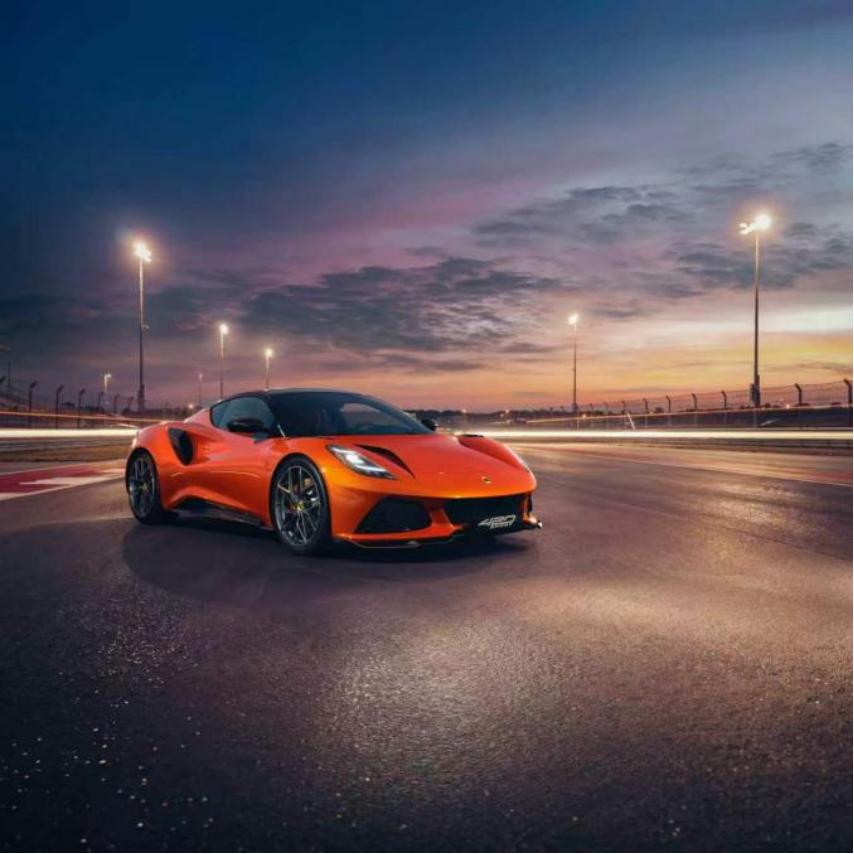
Emira 420 Sport. Image source: The company
This synergy has significantly reduced Lotus' break-even point from the original 50,000 or even 80,000 vehicles to 30,000 vehicles. In the automotive industry, this scale usually means losses, but Lotus' logic is to significantly compress shared costs through group synergy and concentrate resources on personalized technologies that can directly support pricing and premium capabilities.
Feng Qingfeng revealed that in the future sales structure, hybrid models will account for about 60% of the share, pure electric models will account for 40%, and traditional pure fuel vehicles will be mainly targeted at specific markets such as the Middle East. In an ideal state, the global sales geographical distribution is that the Chinese market accounts for 30%, Europe accounts for 30%, the United States accounts for 30%, and other regions account for 10%. However, due to the restrictions of the US ICTS Act on Chinese intelligent connected software and hardware, Chinese-made models such as the Eletre cannot enter the US market in the short term. Feng Qingfeng lowered the expected share of the US market to about 10%, and the difference will be shared between the Chinese and European markets.
3
Competing for the Pricing Power in the Million-level Market with Engineering Barriers
In the Chinese market, new energy vehicles with a selling price of over one million yuan have long faced the dilemma of lacking pricing power. Caijing learned that in 2025, among new energy vehicles with a selling price of over one million yuan in the Chinese market, the market share of domestic brands was less than 5%, and the vast majority of the share was still occupied by traditional brands such as Porsche and Mercedes-Benz. This shows that Chinese brands have not yet established an emotional value system beyond parameters and configurations in the market above one million yuan, which is the biggest gap between Chinese brands and established European luxury brands.
The path chosen by Lotus to break through this dilemma is to return to the deep end of engineering. Feng Qingfeng elaborated on the technical indicators of the V8 hybrid system that will be installed in the Type 135 at the communication meeting. The target rotational speed exceeds 10,000 revolutions per minute, paired with an MGU - K motor unit and a high-torque DCT dual-clutch transmission, while controlling the vehicle weight at the level of a traditional V12 flagship supercar. He admitted that even after large-scale production, the cost of the MGU - K motor alone is as high as about 500,000 yuan.
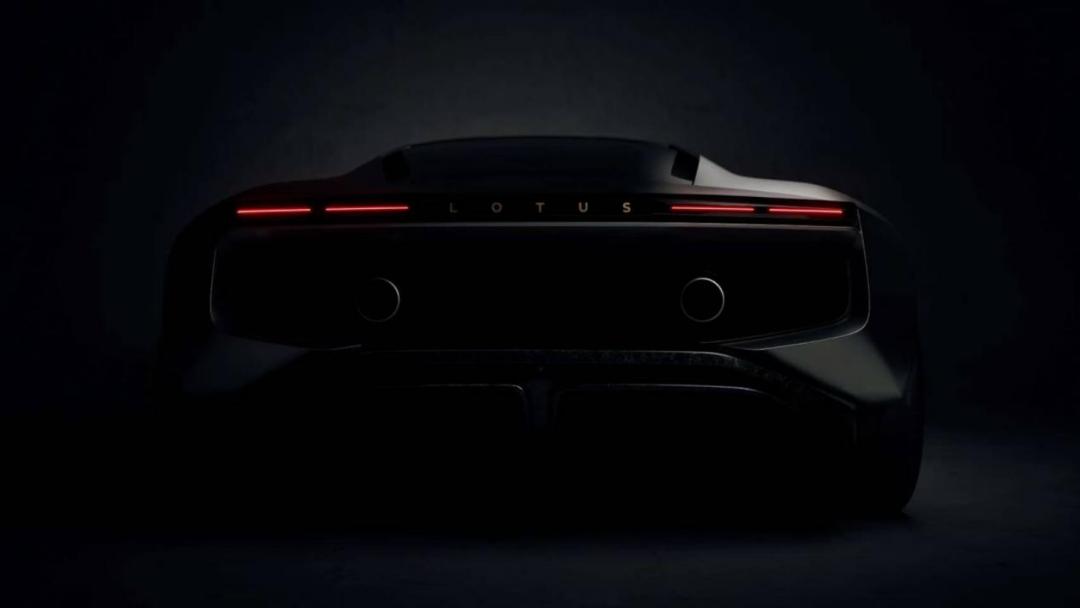
The new super hybrid supercar Type 135 will be launched in 2018. Image source: The company
The intelligentization of the chassis is another differentiating main line. Lotus is digitizing and softwareizing its decades of chassis tuning experience to make it have real-time adaptive adjustment capabilities. Feng Qingfeng described this technology as a "living chassis", that is, the vehicle can adjust the suspension response in real-time according to the road environment, driver behavior, and working conditions, rather than a single fixed setting after leaving the factory. The difference between this technology and the active chassis solutions adopted by most current car companies is that Lotus' tuning goal is not the presence or absence of functions, but the precision of the coordinated work of each active component. In Feng Qingfeng's words, the level of the conductor determines the level of the symphony.
The early sales data of the For Me model in the Chinese market has verified the effectiveness of this strategy to a certain extent. In the first month after the model was launched, more than 70% of the orders were concentrated in the mid - and high - end versions, and this proportion was highly consistent among new and old customers. There have also been notable changes in the customer group structure. The proportion of senior executives in the financial industry and senior corporate managers among new customers has increased significantly. The proportion of financial executives among small - order users has reached about 30%, and the repurchase rate of old customers is 20%. This shows that Lotus' product definition is reaching a wider range of high - net - worth professional people than the first - and second - generation entrepreneurs.
4
Brand Awareness Remains a Shortcoming in Global Expansion
Although a relatively complete logical closed - loop has been formed at the strategic, technical, and product levels, Lotus still needs to face a structural shortcoming: the lack of public brand awareness and communication potential.
In fact, Lotus' products attract a lot of attention on the road, but they have never achieved a communication effect from wide - spread publicity to in - depth discussion. Feng Qingfeng said that Lotus' past publicity was too precisely targeted, and not enough was done in wide - spread publicity. He also admitted that he hasn't learned how to ride on the wave of hot topics.
This shortcoming will become more prominent in Lotus' process of expanding the global market. It is understood that Lotus' brand awareness in the UK market is as high as 78%, but in core European continental markets such as Germany and France, this figure is only 22% and 18% respectively; in the Asian market, the brand awareness rate of Lotus is generally less than 15%, which is obviously mismatched with its technical strength and historical heritage.
Lotus' global channel layout also objectively requires it to accelerate brand building. As of now, Lotus has a total of 216 sales stores globally, including 67 in Europe, 63 in China, 48 in North America, and 38 in other regions. In 2026, the number of stores in China is planned to expand from 63 to about 80, basically the same as Porsche's network scale in China. The European market is about to enter important cities such as Berlin that were not previously covered. At the same time, Lotus is accelerating its entry into emerging markets. On May 6th, the first batch of 18 Eletre vehicles were shipped from Shanghai Port to Canada. Relying on the completed North American certification in advance, it became the first Chinese high - end electric vehicle brand to export to the Canadian market in batches after the tariff reduction. On May 27th, Lotus held a brand release event in São Paulo, Brazil, and entered the largest automotive market in South America with a full product lineup of the Emira, Eletre, and Emeya.
The expansion of these channels requires a strong brand pull as support, rather than just relying on the dealer network and precise marketing to reach the core circle. Lotus needs to find a balance between precise user operation and mass brand building, and racing culture may be one of the ways to achieve this. Feng Qingfeng said that the Lotus Cup race is positioned as an entry - level step for GT races, aiming to lower the threshold for participating in motorsports. However, he also admitted that the foundation of Chinese racing culture is still relatively weak. The number of racing tracks and other infrastructure is small, and the cost is high. There is still a long way to go to form a wide - spread public influence.
Looking at Lotus' "Focus 2030 Strategy", its core logic is very clear. By giving up the obsession with pure electric sports cars, it adopts a diversified power route to meet the fragmented needs of the global market; by deepening the synergy with the Geely system, it compresses the break - even point to 30,000 vehicles to achieve the financial sustainability of a niche brand; by relying on high - engineering barriers such as the V8 hybrid and intelligent chassis, it establishes a differentiated value in the million - level market; at the same time, it seeks incremental growth through global channel expansion and emerging market exploration.
The implementation of this strategy does not test Lotus' technical reserves. From the Evija's silicon carbide 800V platform to the Luoyao Super Hybrid Architecture, from the 6D chassis algorithm to the upcoming 10,000 - revolution V8 hybrid unit, Lotus' engineering accumulation is sufficient to support its product ambitions. The real test is whether a British sports car brand with a 78 - year history and a gene of racing and lightweight can achieve large - scale growth without sacrificing brand characteristics through precise business operations in the new industrial cycle.
This article is from the WeChat official account "Caijing Auto", author: Zhao Cheng. Republished by 36Kr with permission.