Ambitions Too Big for Phones Are Moving to Gaming Tablets | 2026 Gaming Tablet Usage Trend Observation

Open any social media platform and search for "mobile game devices," and you'll notice an interesting phenomenon: more and more young people are complaining about their phones - the screens are too small, they get hot after just a couple of rounds, they can't run open-world games at full frame rate, and their fingers cramp up when playing PUBG in the final circle... In the comment section, the most frequently mentioned solution is not to replace with a phone with better performance, but rather to switch to a professional gaming tablet.
Game players are undergoing a collective migration of "switching screens." This didn't happen out of thin air; it's an inevitable result of the upgrading of the mobile game market. In the past few years, not only have there been a constant stream of new mobile games, but blockbusters like "Honor of Kings," "Delta Force," "Genshin Impact," and "Ningchao," which top the revenue charts, are all approaching the standards of PC and console games in terms of graphics, maps, and operation dimensions. As games become more and more demanding, players' tastes have become increasingly sophisticated, and their requirements for immersion, operation precision, and frame rate stability can no longer be met by a small 6.7-inch screen.
Once the demand is expanded, it will look for a new container in return: the number of people using tablets to play games is visibly increasing. "Gaming tablets" are a new concept that has emerged in recent years. In the past, our functional positioning of tablets was limited to being a great tool for binge-watching dramas, online courses, and portable electronic notebooks. But now, more and more young people are starting to regard tablets as their portable game consoles - they have larger screens than phones, are more portable than handheld consoles, are more flexible than PCs, and can be stuffed into a commuting bag, allowing you to "play big or small" anytime, anywhere.
On the other hand, the optimization of tablet hardware is also experiencing a boom. In the past two years, mainstream manufacturers have collectively made "game-oriented" a new selling point: high-refresh-rate screens, independent heat dissipation modules, dedicated gamepads, cloud game adaptation, edge-side AI... New products such as the RedMagic Gaming Tablet 5 Pro, REDMI K Pad 2, iQOO Pad 6 Pro, Lenovo Legion Y700 5th Generation, and OnePlus Pad 3 Pro have entered the market in quick succession.
When supply and demand meet at the same time, the niche category of "gaming tablets" has been pushed to the forefront - JD.com data shows that since 2026, the sales volume of gaming tablets has increased by over 150% year-on-year.
So, the question is - how far has this "screen migration from phones to tablets" gone? Who is using tablets to play games? What games do they play, what do they value, and what features are they willing to pay more for? To figure out the real ecosystem of this generation of players, 36Kr, Houlang Research Institute, and JD.com's Consumption and Industry Development Research Institute jointly launched a "gaming device survey," and a total of 1,000 valid questionnaires were collected, with a male-to-female ratio of approximately 7:3. Combining macro data and survey results, we've summarized several key drivers for the explosion of gaming tablets.

Looking at the overall picture of the Chinese game market, mobile games are the absolute protagonists. According to the "Monthly Report on the Chinese Game Industry in April 2026" by the Game Work Committee of the China Audio-Video and Digital Publishing Association, the actual sales revenue of the Chinese game market in April 2026 reached 30.369 billion yuan, a year-on-year increase of 11.04%; among them, the actual sales revenue of the mobile game market was 22.430 billion yuan, a month-on-month increase of 0.71% and a year-on-year increase of 9.83%.
Converting this, the proportion of mobile games in the Chinese game market has been stable at over 70%. It can be said that the majority of the game market is defined by mobile game players. However, it's obvious that the small screen of a phone can no longer accommodate the ever-growing ambitions of game manufacturers.
Similarly, the number of game players is not only increasing but also becoming more "hardcore."
The mobile game revenue list for March 2026 released by Sensor Tower on April 8, 2026, shows that "Honor of Kings," "Peacekeeper Elite," and "Delta Force" topped the list of the top 3 mobile game revenues on the Chinese App Store. That month, 38 Chinese mobile game publishers collectively earned $2.11 billion. This list reveals a clear signal: the most profitable games are still those hardcore games that have extremely high requirements for screen vision, control precision, and visual performance.
FPS games require players to identify the enemy's position in milliseconds and make quick decisions. MOBA games require players to clearly see every possible enemy signal on the mini-map. Open-world games need to support increasingly detailed modeling and lighting - these requirements can be met by phones, but only with great difficulty. A hardcore FPS player wrote in the survey: "I can play on my phone, but it's not enjoyable. It often can't keep up with my reactions."
This gap between "being able to play" and "playing enjoyably" is the biggest driver for device upgrades and is also forcing hardware evolution in reverse. IDC data shows that the shipment volume of Chinese tablets in 2025 reached 33.76 million units, a year-on-year increase of 13.1%. Among them, the consumer market was the core growth driver in 2025, with a year-on-year increase of 14.4%.
More importantly - the growth of tablets is being deeply integrated with game scenarios.
According to the "2025 Survey Data on Chinese Cloud Game Consumption Behavior" by iiMedia Research, in the device usage proportion of Chinese cloud game users in 2025, tablets exceeded consoles for the first time and became the core gaming device after phones and computers. You know, five years ago, tablets were mainly promoted as tools for binge-watching dramas and learning aids. Now, they have quietly climbed to the third place among cloud gaming devices.
The explosion of cloud games has further enhanced the gaming attributes of tablets. In the context of cloud games, tablets don't need to compete in local computing power but rather in screen, battery life, heat dissipation, and network experience, which happen to be the strengths of tablets compared to phones. Tablets haven't become another phone; instead, they've evolved into a different form of portable gaming device.

In this gaming device survey, we deeply analyzed whether tablets have captured the market share of game users in addition to phones and whether they can stand out in the competition with other gaming device categories. The survey results were unexpected but reasonable.

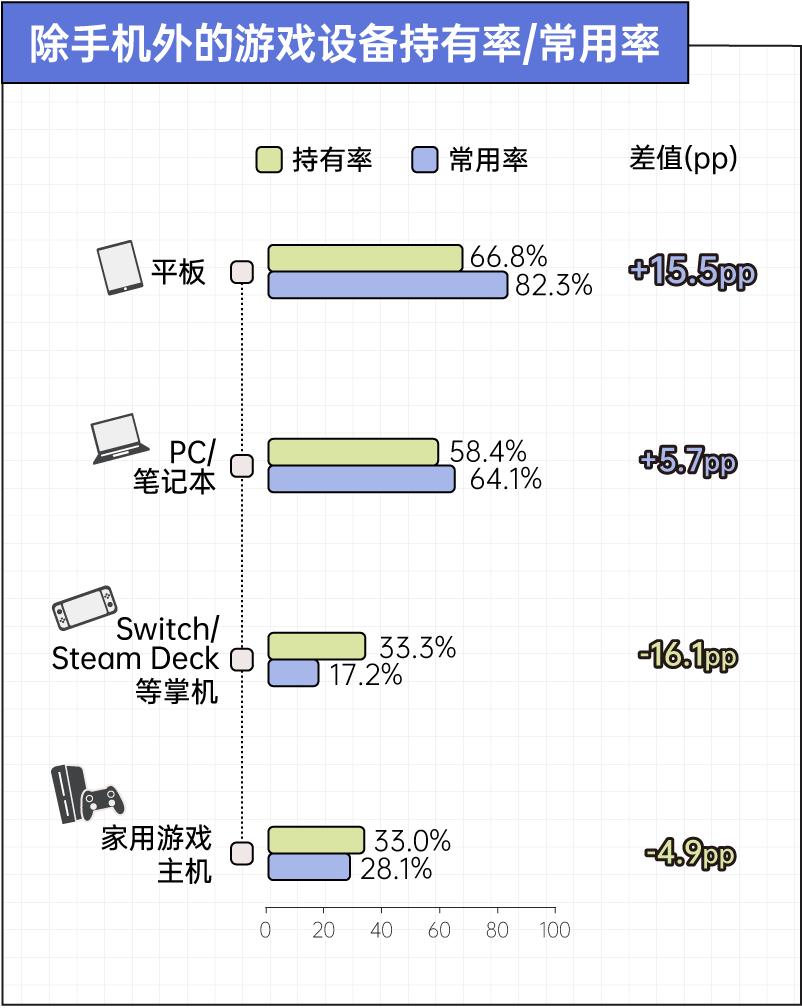
Except for phones, in this survey, tablets ranked first in terms of ownership rate and regular usage rate among gaming devices. Considering that PCs have always been regarded as the most hardcore and orthodox gaming devices, it's quite counterintuitive that tablets have surpassed them in regular usage rate.
Another notable point is that the regular usage rate of tablets (82.3%) is 15.5 percentage points higher than the ownership rate (66.8%). This means that even if many players don't have their own dedicated tablets, they may borrow tablets from their family members, roommates, or partners to play games. It seems that once you've experienced a large screen, it's hard to go back to the small screen of your phone.
Not surprisingly, the usage rates of handheld consoles and home game consoles still need to be improved. These types of devices often attract players' attention when new games are launched or popular games are released.
Among all those who "own a gaming tablet," 69.7% use it as their regular gaming device - that is to say, seven out of ten people who buy a gaming tablet actually use it to play games, with a very high conversion rate.

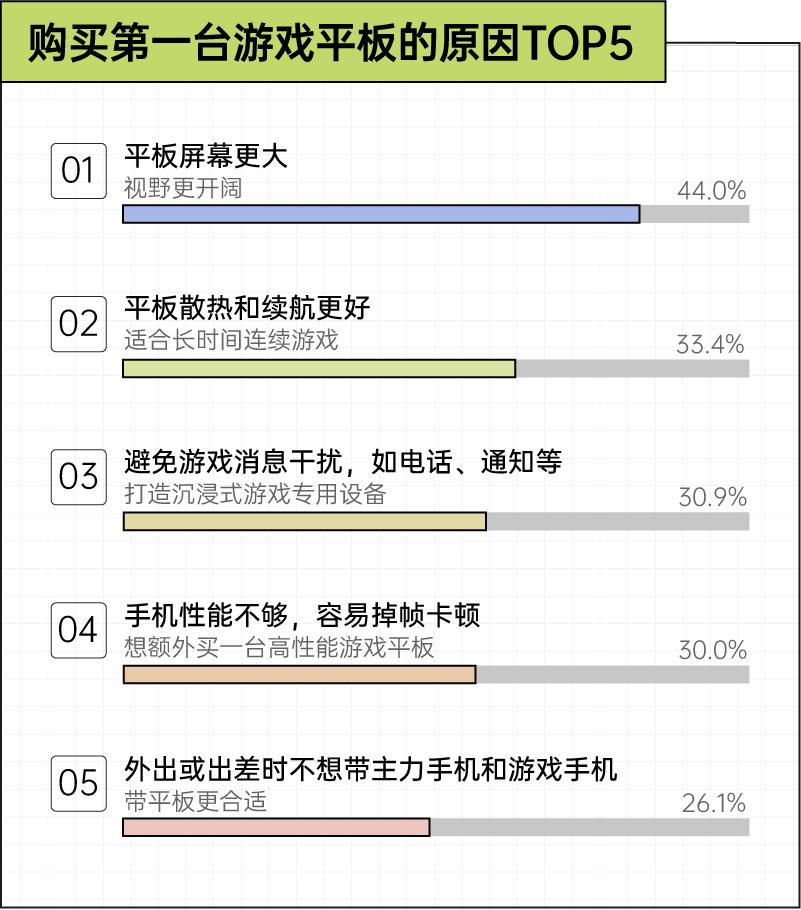
Digging deeper, we asked players what made them buy their first gaming tablet. In fact, this purchase decision was not influenced by the marketing of gaming tablets. Most people wanted to change their devices because their phones couldn't handle it anymore.
The survey shows that the top purchase drivers are almost all directly related to the poor experience of phones - phones getting hot, dropping frames, freezing, and having poor battery life after long-term use. When these pain points accumulate to a critical point, players finally decide to "get a bigger one." The factors that really attract them to make the final purchase are "large screen," "powerful performance," and "strong heat dissipation."

The popularity of gaming tablets as a new gaming device is also due to the collaborative efforts of mobile game manufacturers. In the survey, players cited three core factors for their dissatisfaction with existing devices: graphics quality, frame rate, and storage space occupied by game updates.
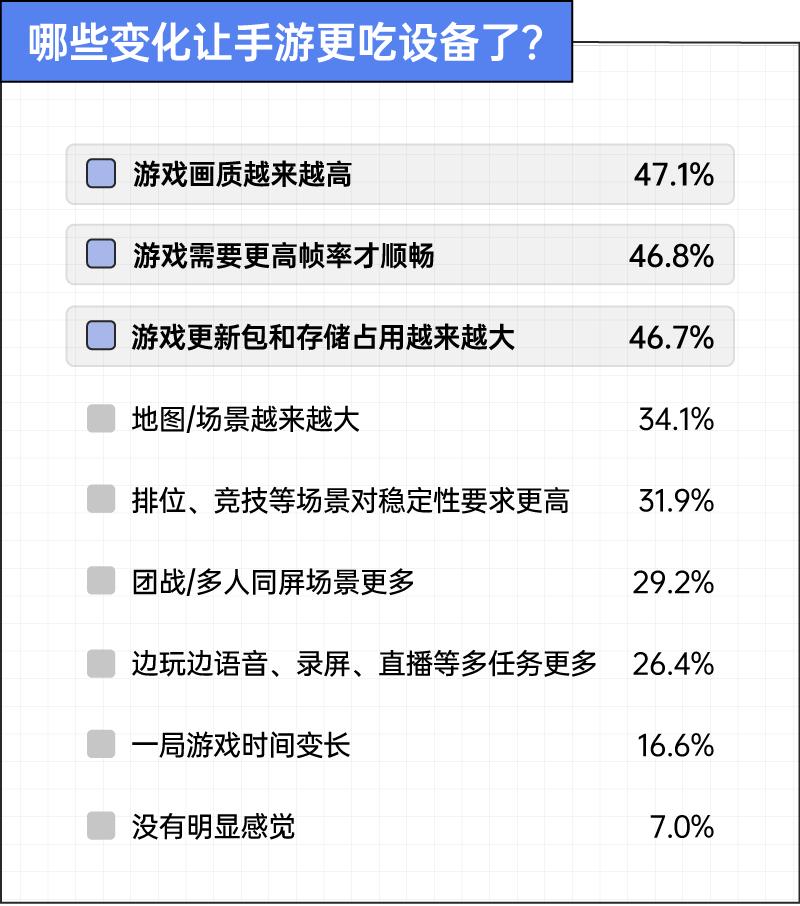
Mobile games themselves are evolving. With improved graphics, larger maps, more special effects, and even more players in team battles and increased operation dimensions... Over the years, mobile games have been able to achieve game performance comparable to that of PC/console games. This has more clearly exposed the fact that the hardware devices in players' hands can no longer keep up with the evolution speed of software.
Specifically for different game types, the survey further found that the most affected categories are almost all those with strong "competitive attributes":
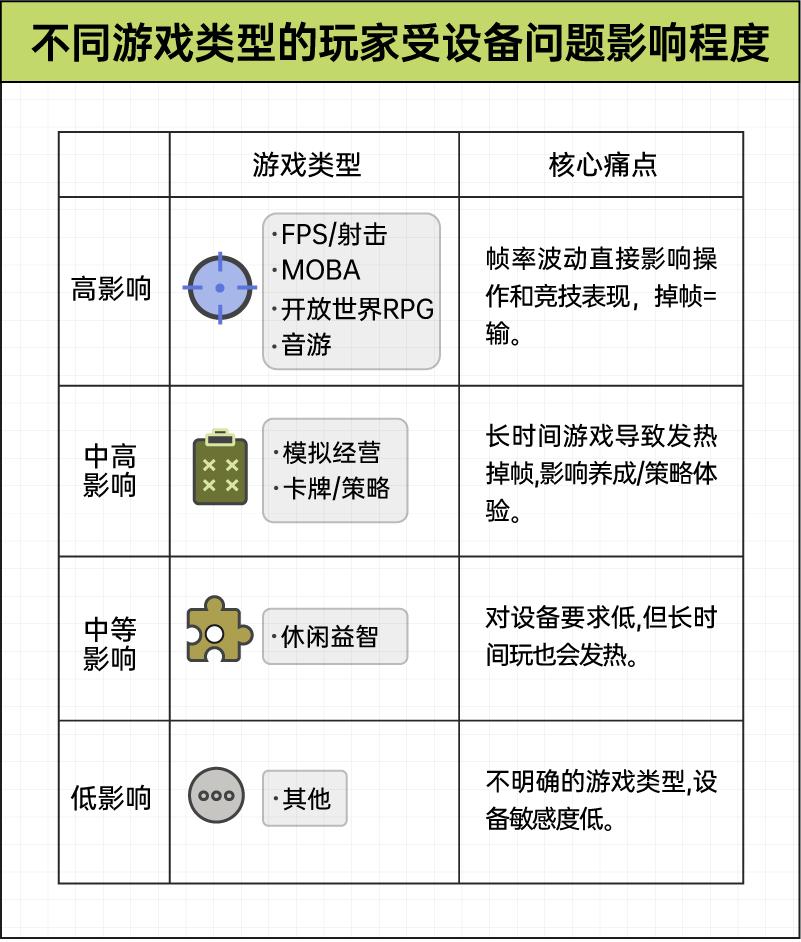
FPS/shooting players are the most affected. For this group of players, dropping a single frame means not being able to hit the target, and the sense of frustration will be infinitely magnified. MOBA and open-world RPG games follow closely. Long gameplay, high-quality graphics, and intense team battles - any lag in any aspect will bring a disastrous experience. Casual puzzle games are currently in a relatively safe zone, with only 20.2% of players "often encountering device problems," far lower than the 36.3% of FPS players.
So, the real variable is the "e-sports attribute" of the game. As long as there are rankings, wins and losses, and PKs, players' tolerance for device problems will drop sharply.
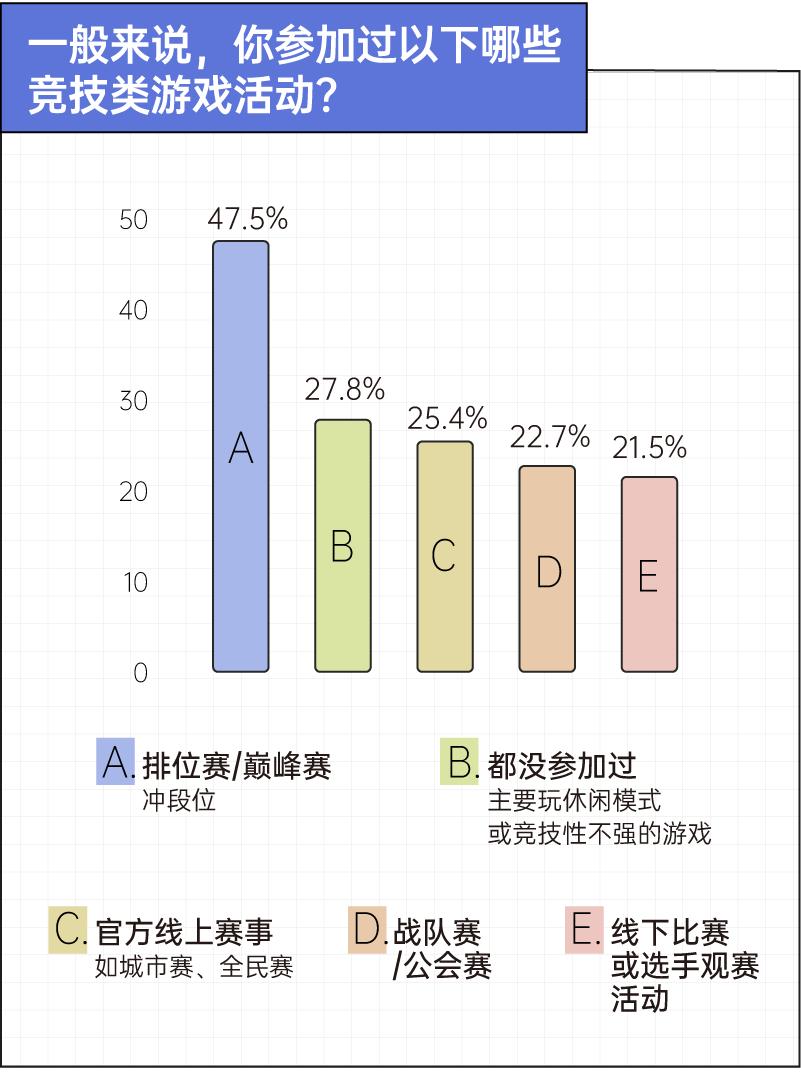
In the survey sample, the penetration of e-sports scenarios also confirms this - nearly half of the players have participated in ranking/peak matches, team/guild matches, and even 20% of them have participated in offline competitions. Only 27.8% of people do not participate in any competitive activities at all. In other words, players with a competitive spirit are the mainstream, and they are exactly the group of people who are the most sensitive and anxious about devices. Game users can accept being outplayed by others, but they can't accept "losing to the device."