Filling the "AI Friend Circle" in Seven Days, WeChat Agents Still Need to Overcome Three Hurdles
On June 2nd, Tencent's Hong Kong - listed shares soared by over 10% in a single day, with its market value skyrocketing by more than HK$400 billion, marking the largest single - day increase since January 2021. What triggered this frenzy was a piece of news about the upcoming launch of an AI agent embedded in WeChat.
The reaction of the capital market is always straightforward - this is Tencent's most important card in the AI era, and there is no other. It directly determines whether it can secure a ticket for the next decade.
Within a week after the news was announced, Meituan and JD.com successively announced their access to the system. Five major mobile phone manufacturers followed suit simultaneously, and the access guidelines for millions of mini - program developers were also officially released. Mobile phone manufacturers, local - life giants, e - commerce platforms, and brand merchants were incorporated into the same ecological map within just seven days. The rapid formation of the alliance has filled the market with high hopes for the future of the WeChat AI agent.
However, the official announcement is just the first step. How can this rapidly assembled alliance be truly implemented? Who will bear the computing power cost? How will the interests of all parties be distributed? How can the user experience be kept consistent under the complex multi - layered nested system? Behind each question lies a difficult problem to be solved. The answers to these questions directly determine whether the WeChat AI agent can become Tencent's real ace in the hole.
The WeChat AI agent completed its ecological assembly within a week
On June 1st, Wang Xing, the CEO of Meituan, announced at the earnings conference that Meituan's AI assistant, "Xiaomei", would be connected to Tencent's Yuanbao, kicking off the concentrated debut of the WeChat AI agent ecosystem.
Just one day later, the news disclosed by the Financial Times pushed the market sentiment to a climax: Tencent had completed the prototype test of the AI agent embedded in WeChat and would start the compliance approval process as early as June. On the same day, WeChat confirmed that it was collaborating with all major mobile phone manufacturers such as Huawei, Xiaomi, Honor, OPPO, and vivo to launch the A2A assistant capability.
On June 7th, JD.com and Tencent announced in - depth cooperation around the AI Agent. Relying on JD.com's commodity supply chain and fulfillment service capabilities and Tencent's ecological entry advantages, they will jointly create a new paradigm of cross - scenario intelligent services.
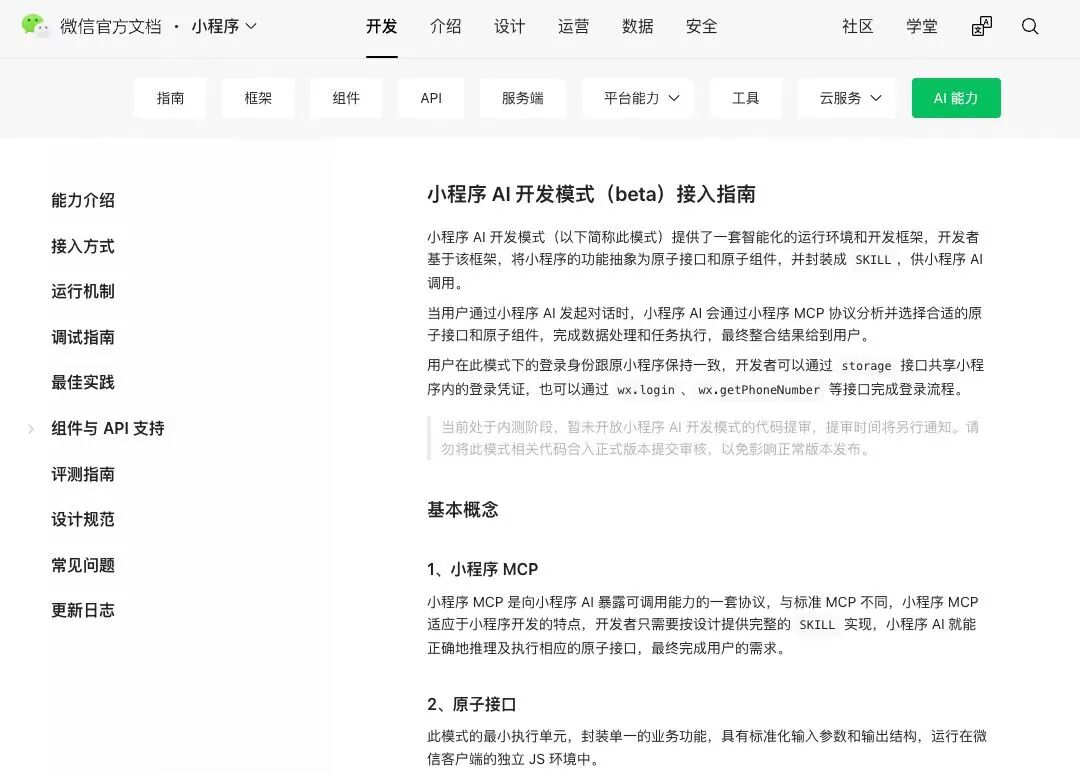
After securing external entry points and leading platforms, Tencent opened the door of the AI agent ecosystem to all developers. On June 8th, WeChat released "Guidelines for Developers to Access the WeChat AI Ecosystem" through its official public account "WeChat Open Class", offering two access options: "Automatic mode" and "Development mode". The guidelines clearly state the rules: only mini - programs that have completed the access can be recommended and called by WeChat AI, and the current capabilities are still in the internal testing stage.
Subsequently, Meituan confirmed to the media that as a member of the first - batch internal testing team, it had completed the test access and would continue to expand more business scenarios in the future. The last piece of the ecological puzzle came from a vertical platform. On June 9th, Dewu App announced its access to the WeChat AI Agent ecosystem, becoming the first vertical e - commerce platform to do so.
Within just seven days, the business ecosystem of the WeChat AI agent has begun to take shape, much faster than the market expected. Mobile phone manufacturers, local - life giants, e - commerce platforms, and millions of mini - program merchants have been successively incorporated into the same map, with clear division of labor and close interconnection among all parties.
The WeChat AI agent is at the center, responsible for understanding user intentions, disassembling tasks, and scheduling execution. The execution layer is divided into two categories: one is the self - operated mini - programs of brand merchants, and the other is platform - type service providers such as Meituan and JD.com that access through the A2A protocol. The voice assistants of mobile phone manufacturers such as Huawei, Honor, and Xiaomi provide another access path outside of WeChat - users can express their needs directly in WeChat or issue instructions through the mobile phone assistant, which will then be transferred to WeChat for execution via the A2A protocol.
Liu Chiping accurately summarized this positioning as "AgentOS" at the Q1 earnings conference. What WeChat aims to do is not to seize a new entry point in the AI era, but to reconstruct what it already has with AI: a national - level mobile life entry point for 1.4 billion users, a mini - program business ecosystem covering 108 sub - industries, and a deeply integrated WeChat payment system. The role of AI here is to enable the intelligent scheduling of this existing infrastructure.
This is not a battle starting from scratch, but a move to enter the AI era with the ecological partners accumulated over 15 years.
On the eve of the reconstruction of traffic entry points, half of the Internet is joining forces
The reason why e - commerce platforms such as Meituan, JD.com, and Dewu, and mobile phone manufacturers such as Huawei and Xiaomi announced their alliances with WeChat within a week is due to a common industry anxiety: AI is reconstructing the pattern of traffic entry points, and independent service platforms face the risk of being cut off by upstream AI assistants.
For Meituan and JD.com, the threat comes from the completed ecological closed - loops of their competitors. According to QuestMobile's Q1 2026 data, Doubao has a monthly active user base of 345 million, backed by ByteDance's complete local - life and e - commerce system; Alibaba's Qianwen has a monthly active user base of 166 million, supported by Alibaba's e - commerce, flash - purchase, and logistics ecosystem.
More importantly, both are investing real money to cultivate users' AI consumption habits - Doubao is connected to Douyin e - commerce, using red - envelope subsidies to guide users to place orders directly in the dialog box; Qianwen is connected to Taobao Flash - purchase, and the daily service - related dialogue volume has reached hundreds of millions. This means that users are being systematically trained to adopt a new consumption path.
Alliance with WeChat is a defensive move in this battle for entry points - WeChat's 1.4 billion user base and mini - program ecosystem are currently the only traffic pools that can rival the leading AI ecosystems. This is far from being optional for them: WeChat mini - programs have long become an indispensable second growth curve for Internet platforms.
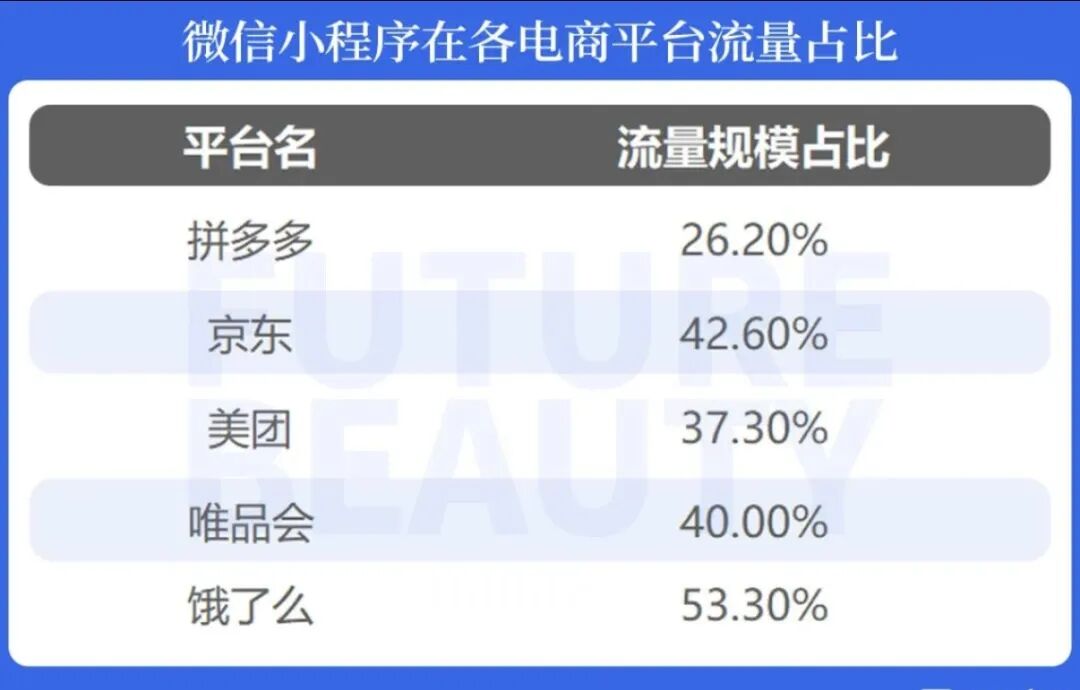
Data source: "QuestMobile 2023 China Mobile Internet Annual Report"
According to the "QuestMobile 2023 China Mobile Internet Annual Report", as early as November 2023, WeChat mini - programs contributed 42.6% of JD.com's total traffic, 37.3% of Meituan's total traffic, and 26.2% of Pinduoduo's total traffic. QuestMobile's data in March 2026 showed that the WeChat mini - program of JD.com Shopping increased by 18.3% year - on - year, and the WeChat mini - program of Meituan Takeaway increased by 14.4% year - on - year, with growth rates exceeding those of their respective main apps.
The WeChat channel has long been a core traffic source that these two platforms cannot afford to lose. Only by holding on to this can they maintain their basic market share.
According to industry news, ByteDance's second - generation Doubao AI mobile phone in cooperation with ZTE will be unveiled at the end of the year. It will no longer rely on the pure simulated - click solution and will shift to a hybrid model of "API first + A2A interconnection + simulated - click backup". The AI assistant will become the center of the entire interaction logic. This is undoubtedly a devastating blow to other mobile phone manufacturers - when the Doubao mobile phone can complete all AI tasks in a smoother, safer, and more in - depth way, what reason do users have to wake up Xiaoyi or YOYO?
For mobile phone manufacturers, a deeper threat lies in the loss of data control: once most of the user's interaction behavior data flows to AI assistants such as Doubao and Qianwen, the data dimensions mastered by mobile phone manufacturers will be significantly reduced. They will degenerate from "data nodes" that master all - round user behavior data to carriers that mainly provide hardware basic capabilities.
Cooperating with WeChat to launch the A2A capability is an active defense before the full - scale roll - out of the second - generation Doubao mobile phone - to ensure that they remain the first contact point for users to interact with AI.
Three hurdles to overcome before implementation
It is the common enemy that has brought all parties with potential interest conflicts together quickly. However, this is an ecological alliance based on common defense needs, rather than a strategic integration based on long - term consistent interests.
How far this alliance can go depends on whether Tencent can answer three questions simultaneously: Who will bear the operating cost of this system? Will platform - type partners still be willing to cooperate deeply after the interests are redistributed? Can the WeChat AI agent maintain users' trust in it during the commercialization process? These three questions correspond to the three hurdles that the WeChat AI agent must cross.
The first hurdle: Who will pay the computing power bill?
Once the WeChat AI agent is fully opened to 1.4 billion users, the computing power consumption will be astronomical. For an Agent task like "Help me order a meal", from intention recognition to task disassembly, then to multi - step mini - program calls and result summarization, every step costs money, and the cost is far higher than that of ordinary AI conversations.
It is unlikely that the bill will be passed on to users. A more realistic approach is to charge the scheduled merchants, similar to a traffic fee: the AI agent helps you complete a transaction, and a service fee is charged proportionally. However, there is a core contradiction that cannot be avoided: Should WeChat AI pay the platform for fulfillment, or should the platform pay WeChat AI for traffic?
In the past, Meituan and JD.com paid WeChat an entrance fee for the nine - grid on an annual basis. WeChat brought users to them, and the jump was to the platform's own app. The transaction closed - loop and user data were still in the hands of the platform. Now, the value of the platform's traffic entrance has been weakened, but it still has to bear a share of the computing power cost - everyone has their own calculations in mind.
Taking takeaway as an example, if the daily average number of Agent orders reaches tens of millions, Tencent will need to incur huge additional computing power expenses every year, and the takeaway business already has a single - digit profit margin.
Moreover, pricing the computing power itself is a problem without precedent. If the charge is too high, merchants will be less willing to access; if it is too low, the computing power cost cannot be covered. There is currently no industry experience to refer to for finding this balance point, and it can only be calibrated through trial - and - error in actual operation.
The second hurdle: How to balance openness and interest?
The A2A model proposed by Wang Xing is a defense line designed by the platform to avoid being pipeline - ized. In this mechanism, after the WeChat AI understands the user's intention, it wakes up Meituan's internal AI agent, "Xiaomei", which takes over all subsequent interactions and executions. WeChat is only responsible for transmitting instructions and final results. In this way, Meituan and JD.com retain control over their own data and services, and the user's behavior data still settles on the platform side.
However, the A2A model brings new problems - different AI agents have different interaction styles and ability boundaries, and there is currently no unified industry standard for A2A communication. When information is transmitted between multiple large models, a slight understanding deviation may be introduced each time. By the time it reaches the final executing AI agent, it may be far from the user's original demand.
Moreover, the A2A model cannot solve a more fundamental competitive dilemma: When a user says "Help me order takeaway and see where it's cheaper", should the WeChat AI wake up Meituan or JD.com? The two are now in direct competition in the takeaway and flash - purchase businesses, and both want to be the default scheduling object of the WeChat AI.
Once WeChat gives a preferential answer, it means taking sides between the two; if it lets the two bid for ranking, it will return to the old path of pay - per - click advertising, and the neutrality of the recommendation results will immediately be in question.
Tencent is caught in the middle. It has to maintain the openness of the ecosystem and balance the interests between leading platforms. This coordination cost will increase sharply as the number of accessing platforms increases.
Moreover, for Meituan, JD.com, etc., the real danger is that the combination of the WeChat AI agent and merchants' mini - programs may undermine the platform - type companies.
Most well - known chain brands, such as McDonald's, KFC, Luckin Coffee, and Haidilao, basically have their own WeChat mini - programs. However, users will not actively search for brand mini - programs, and the platform's aggregation entrance is still irreplaceable.
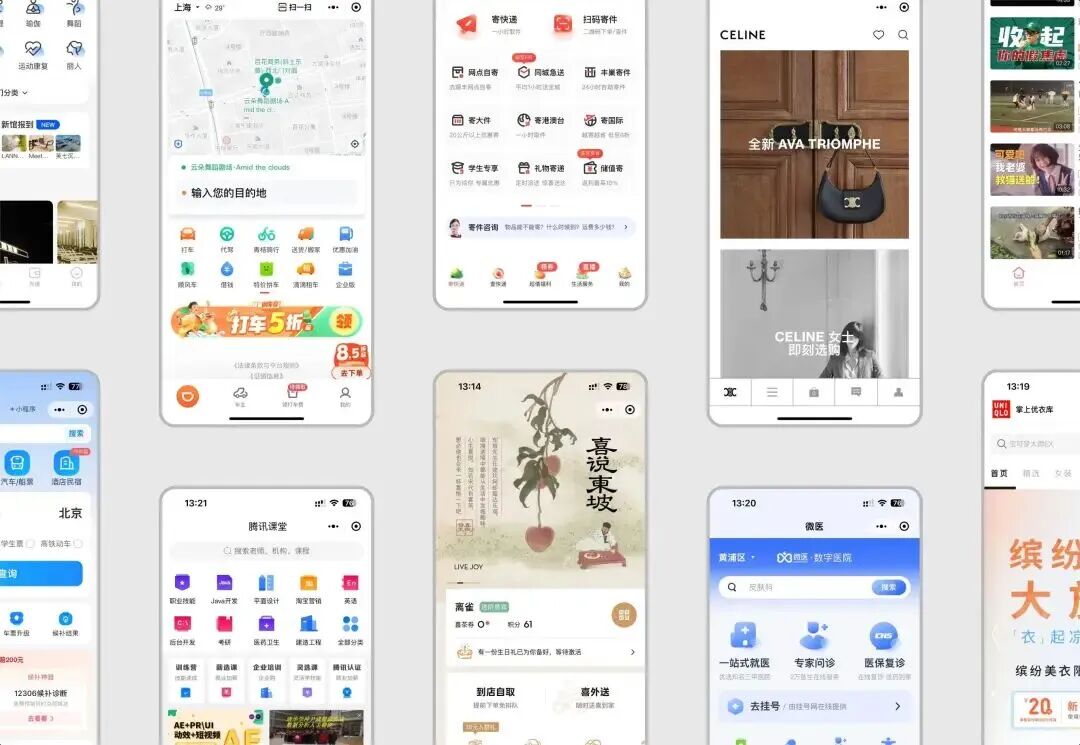
The emergence of the WeChat AI agent may change this ecological situation. When a user says "Help me order a cup of Luckin Coffee", the AI agent directly schedules Luckin's self - operated mini - program to complete the transaction - the user does not need to open Meituan to search, and the platform's discovery and diversion links are completely skipped. Self - operated mini - programs do not have platform commissions, and merchants have sufficient motivation to offer the most favorable prices and the most complete experience here. For the first time, merchants have the ability to reach users directly without going through the platform.
For platform - type companies, this is a dilemma: if they do not access the WeChat AI ecosystem, they will gradually lose traffic during the migration of user habits; if they access it, they will hand over the consumption decision - making entrance, and the fulfillment business already has a single - digit profit margin, and they also have to share a part of the service fee with WeChat.
How to find a balance between traffic dependence and platform autonomy is an account that every accessing platform must calculate by itself.
The third hurdle: How to resolve the contradiction between user trust and commercialization?
The deepest dilemma of the WeChat AI agent lies in the seemingly insoluble gap between recommendation neutrality and commercialization.
The value of the WeChat AI agent is based on a basic judgment of users: the recommendations it gives are "the most suitable for me", rather than "the ones with the most merchant payments". It is this trust that makes users willing to hand over their consumption decisions to it.
However, once the AI agent becomes a real transaction entrance, commercial pressure will drive Tencent to introduce bid - ranking in the recommendation results. This is similar to the advertising space dilemma of search engines: users think they are using a neutral decision - making tool, but in fact, they are seeing a result page sorted by commercial interests.
What Tencent really needs to answer is how to make money without shaking the credibility of the recommendations after the WeChat AI agent is well - developed.
Of course, the WeChat AI agent also brings new possibilities. For chain merchants with strong brands such as Luckin Coffee and KFC, this is an opportunity to completely get rid of platform dependence - they no longer need to pay high commissions and can directly reach users by accessing the WeChat AI ecosystem.
For small and medium - sized merchants, AI recommendations break the traffic monopoly of traditional search bidding. As long as the service is good enough, they have a chance to be discovered by users. If WeChat can establish a fair and transparent ecological rule, it is entirely possible to redraw the entire Internet's commercial distribution pattern.
This high - stakes gamble of the WeChat AI agent is betting on the future of the entire WeChat ecosystem. If