AI kills India's most profitable business: 2 trillion
On June 3rd, India's IT sector crashed.
TCS plunged 9%, Infosys fell 4.3%, and Wipro dropped 3.7%. India's IT index tumbled 5.8% in a single day, hitting its biggest record in four months.
It's neither a financial report fiasco nor a sudden policy change. What panicked the market are just two words: AI.
In the past year, the world's attention has been on the United States and China—OpenAI, Anthropic, and DeepSeek have taken turns on the stage. However, it's India that has been the first to be hit by the blade of AI.
If AI can really write code, conduct tests, write documents, and handle customer service, what will happen to the country most reliant on "selling programmers" in the world?
India is the answer.
Multiple industry insiders told Pencil News: This drastic change suddenly accelerated in the second half of 2025, marked by the emergence of Agentic AI. AI can complete 70% to 80% of the work of a SaaS software for people.
Keoding Intelligence, an AI programming company that has completed three rounds of financing, told Pencil News: "The impact of AI programming on the IT outsourcing economy is not just an influence; it may be 'lethal'."
01
30 Years of National Fortune Hinges on a Line of Code
One industry has sustained India for 30 years.
Many people don't know that India's most profitable industry is neither manufacturing nor the internet. It's IT outsourcing.
According to data from the National Association of Software and Services Companies (NASSCOM) in India, in the fiscal year 2025, the total revenue of India's technology industry reached approximately $282.6 billion (about 2 trillion yuan), of which the revenue from IT services was about $137 billion, accounting for nearly half of the entire industry.
What's more important is exports. In the fiscal year 2025, the export revenue of India's technology industry reached $224 billion, accounting for nearly 80% of the total revenue.
What does this mean? Simply put, one of India's most profitable businesses is to work for American and European companies.
Luan Tianyi, CEO of Kedi Overseas, pointed out the essence: "Software outsourcing, in essence, is 'selling people'. It charges by the number of people and working hours, which is quite similar to the construction industry."
In the past 30 years, India has almost rewritten its national fortune with this industry. American companies need to develop software, European banks need to maintain systems, and global Fortune 500 companies need digital transformation. What to do? Assign the work to India, and India then organizes thousands of engineers to take on the orders.
Thus, a classic model has been formed: the more customers, the more projects, the more engineers, and the higher the income.
Today, several leading Indian IT service companies are representatives of this model.
In the fiscal year 2025, TCS's annual revenue exceeded $30 billion, and its employee scale was nearly 600,000; Infosys's annual revenue was about $19.3 billion, with more than 320,000 employees; Wipro's annual revenue was about $10.5 billion, with more than 230,000 employees.
These three companies alone have more than 1.15 million employees.
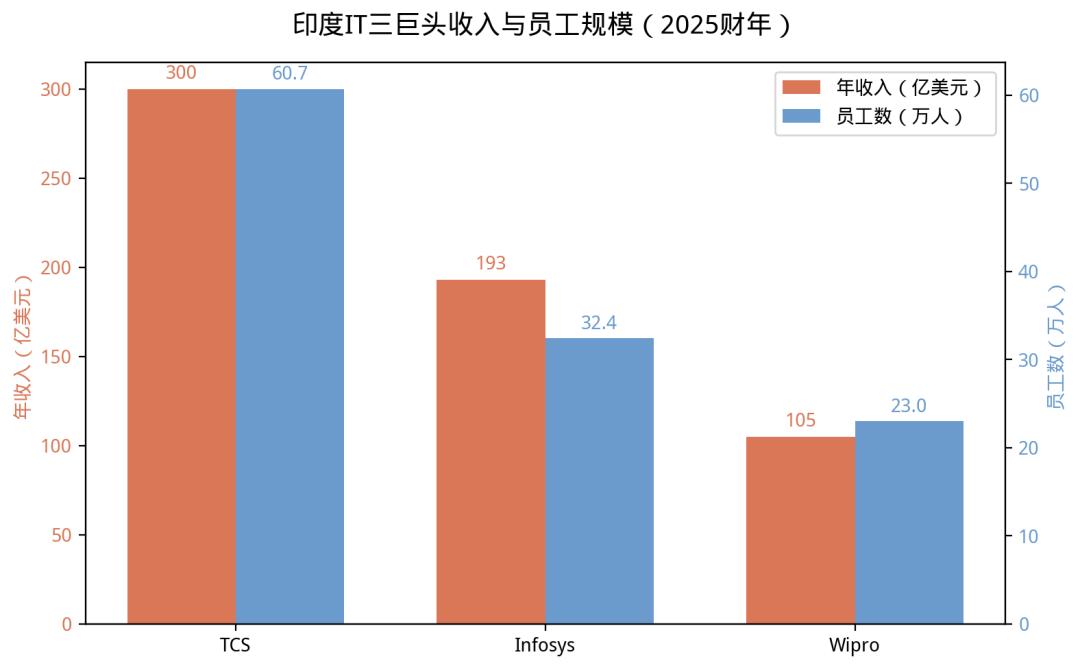
Revenue and Employee Scale of India's Three IT Giants (Fiscal Year 2025) Source: NASSCOM
More importantly, the growth logic of these companies has been highly consistent for a long time: recruit more engineers, take on more projects, and earn more income. In the past few decades, an important indicator for the capital market to measure Indian IT companies has not even been AI capabilities, but the number of employees.
According to Reuters data, the scale of India's IT industry has reached approximately $283 billion. Many international investors even call India the "world's backstage".
However, this logic is changing. A key factor is related to AI: the IT outsourcing business is being disrupted by AI programming.
Su Wen said: "New technologies rarely directly eliminate in the existing market. More commonly, they make you completely ineligible to participate in the incremental market. Just like the person who used to catch balls under the basketball hoop, is there still such a position now? No matter how well you catch the ball, it doesn't matter."
02
A One - Day Plunge of 5.8%: Capital Is Voting with Its Feet
Therefore, the capital market has begun to worry about one thing.
In February this year, the market value of India's IT sector evaporated by $22.5 billion (about 160 billion yuan) in a week. At that time, the market thought it was an over - reaction. But in June, the panic reappeared.
On June 3rd, India's IT index tumbled 5.8% in a single day, hitting its biggest decline in four months; TCS, India's largest software exporter, plunged 9% in a single day, Infosys fell 4.3%, and Wipro dropped 3.7%.

TCS Headquarters Building Source: Forbes India
What's more worthy of attention is that this is not an isolated incident. As of early June, India's IT index has fallen 22% since 2026; and it had already dropped 26% in the whole of 2025. In other words, this once - star sector that supported India's economic growth has become one of the worst - performing industries in the market for two consecutive years.
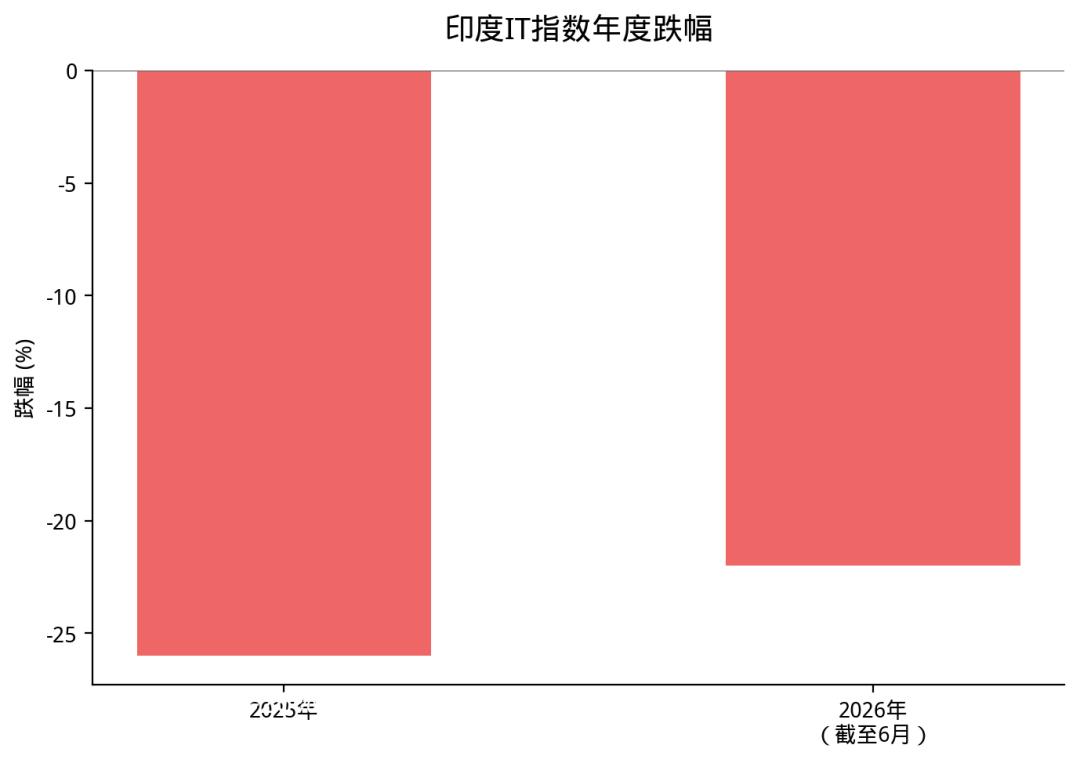
India's IT Index Has Plunged for Two Consecutive Years Source: Economic Times
The reason is simple. More and more investment institutions have begun to realize that what AI replaces is precisely India's core business. Such as writing code, testing software, providing operation and maintenance support, organizing documents, and providing customer service support. These jobs used to require a large number of engineers, but now more and more enterprises are starting to let AI complete them.
What's even more terrifying is that what the capital market is worried about is not "all programmers losing their jobs". Instead, it's that India's most profitable business model will fail.
In the past, the logic was: when a customer wanted to do a project, an Indian company would send 100 people and earn money from 100 people. In the future, it may become: when a customer wants to do a project, AI will complete 80% of the work, and only 20 people will be needed.
Keoding Intelligence, an AI programming company that has completed three rounds of financing, provided a set of data to Pencil News: a development team that used to require 100 people can now be completed by 2 - 3 people; in the past, developing an e - commerce website might cost hundreds of thousands or even millions of dollars, but now the cost can be reduced to $6 - 8.
What's even more terrifying is the average customer price. "The average customer price of software development companies may face a 70% - 90% decline," Su Wen told Pencil News.
Brokerage research reports show that the overall net profit margin of the software outsourcing industry has dropped from nearly 10% to about 0.1% (not just referring to India). This means that the profit margins of Indian IT companies are being squeezed by AI.
The global perspective is even more shocking.
Data from Mordor Intelligence shows that in 2025, the global IT outsourcing market scale was about $618 billion. Among them, about 40% - 60% relied on labor - intensive delivery, that is, about $250 - 450 billion—about 3 trillion yuan—was at risk of being directly replaced by AI or having its price significantly reduced.
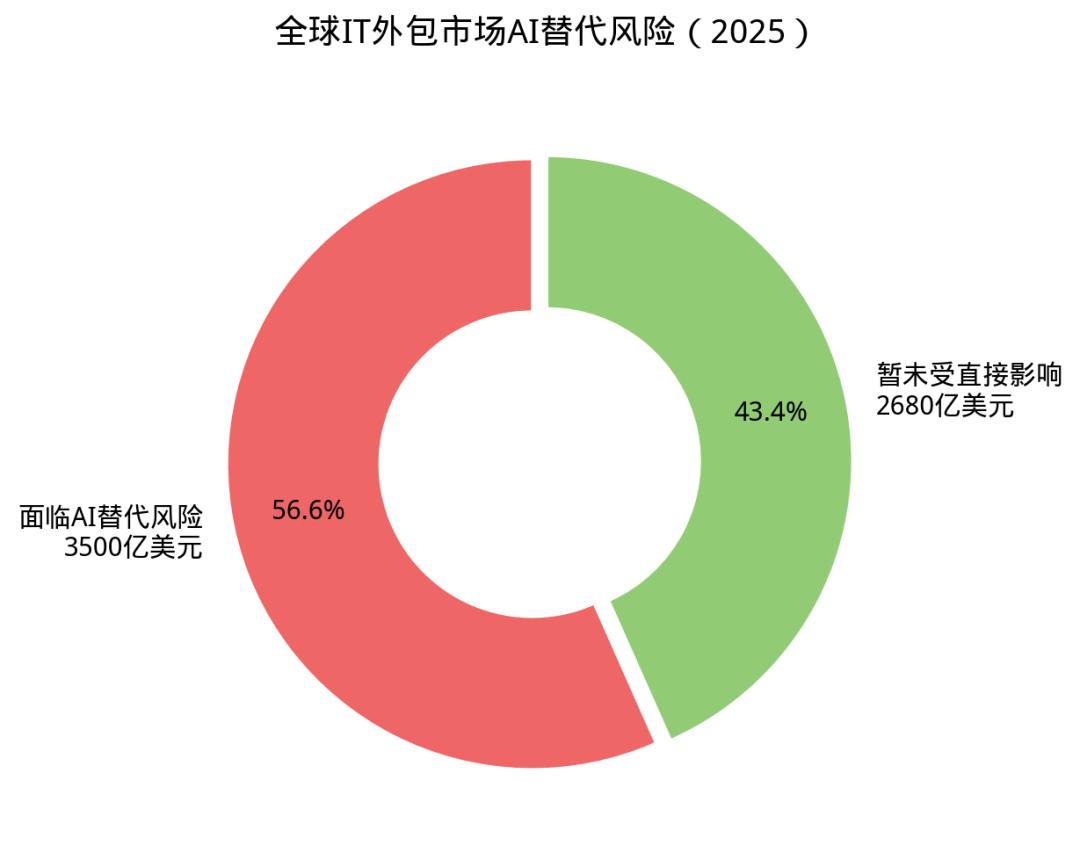
AI Replacement Risk in the Global IT Outsourcing Market (2025) Source: Mordor Intelligence
For an industry worth $280 billion, this is a nuclear - level alarm.
03
Leading Enterprises Are Laying Off Employees
An even more dangerous signal has emerged.
If it's just a stock price drop, it's not a big deal. What's really worth paying attention to is recruitment. A more direct change has occurred in the number of employees in leading companies.
Su Wen's judgment is more radical: "At least a 20 - fold reduction in engineering personnel is necessary."
Meisi, a senior programmer with more than a decade of experience in large companies, has a similar judgment: "The future trend is a 10:1 compression. An engineering team of two or three thousand people may eventually only need two or three hundred people."
TCS, India's largest IT service company, had about 607,000 employees in the fiscal year 2025, a decrease of about 13,000 compared with the previous fiscal year. Infosys had about 324,000 employees, a year - on - year decrease of about 15,000.
This is a rare phenomenon in India's IT industry in the past many years. In the past 30 years, the number of employees in these companies has almost only increased. Growth was the norm, and contraction was the exception. But today, this 30 - year - long growth curve is turning downward.
Lalit Ahuja, founder and CEO of ANSR, said bluntly: "There is a sense of caution in the market, and companies are reducing the number of recruitments."
The recruitment market in the entire Indian technology industry is shrinking rapidly. In June 2026, the number of active technology job vacancies in India had dropped to 93,000, the lowest in 28 months. The number of technical job vacancies for those with less than two years of work experience plunged 44% year - on - year—nearly half of the entry - level positions have disappeared.
Su Wen explained the underlying logic: "Development with a complexity below 4 points can be completely replaced. A team that originally needed 100 people now only needs 2 - 3 people."
In the past growth cycle, an increase in projects often meant an increase in recruitment; but now, the growth of revenue and the growth of employees are gradually decoupling.
The biggest worry of Indian technology companies used to be a shortage of people. Today, they are starting to think: are there too many people?
When leading enterprises such as TCS and Infosys start to "downsize" at the same time, the direction of an era has changed.
04
India Is Hit at the Core by AI
Why is India more at risk than others?
Because what AI hits in India is not a marginal industry but a core industry.
Take a simple example. If AI impacts an e - commerce company, the impact is limited. If AI impacts the advertising industry, the impact is limited. But in India, IT services are one of India's most important export industries. The total revenue of India's IT industry has exceeded $315 billion, accounting for more than 7% of India's GDP, and the number of employees has exceeded 6 million. Behind these 6 million people are 6 million families and the livelihoods of tens of millions of people.
More importantly, this is not an isolated industry. IT outsourcing sustains India's training industry, real estate industry (office buildings and residences in Bangalore and Hyderabad), service industry, and education industry. One IT job drives at least 3 - 5 surrounding jobs. This means that the impact of AI on the IT industry may ultimately affect the employment ecosystem of 20 - 30 million people in India.
And India itself is facing a more serious real - world problem. Reuters data shows that the urban youth unemployment rate in India is still as high as 13.6%.
A large number of young people are already looking for jobs. The unemployment rate of Indian university graduates has soared to 29.1%, and 40% of young graduates under the age of 25 cannot find jobs. More than 1.5 million computer science graduates enter the job market every year, but only 42.6% meet the employability standards of enterprises.
Now, AI is starting to squeeze the employment rate. Employment pressure + skill mismatch + AI replacement are not three independent problems but a mutually reinforcing death spiral.
Su Wen said cruelly: "The new market has bypassed you. You're not losing to your peers; this link has been erased by technology."
An analyst from Everest Group said bluntly: "AI will no longer need L1 and L2 - level engineers." And these L1 and L2 engineers are precisely the foundation of India's IT industry, the first stop for 1.5 million computer science graduates every year, and the gateway for millions of families to change their fates.
05
India's Opportunity: 80% of Employees Use AI, Ranking First in the World
Of course, India may also become the biggest winner.
The story isn't over yet. Because India has another set of data.
According to the latest report "AI at Work 2026" released by the Boston Consulting Group (BCG), India has become one of the most active countries in the world in AI application, ranking first in the world in terms of the AI usage rate of employees and managers.
Another survey, "People at Work 2026" released by ADP and covering 34 countries, shows that 80% of Indian employees use AI tools multiple times a week; 41% of Indian employees use AI every day; the global average is only 50% and 20% respectively.
That is to say, on average, about 1 in every 5 people in the world uses AI every day; while in India, about 2 in every 5 people use AI every day.
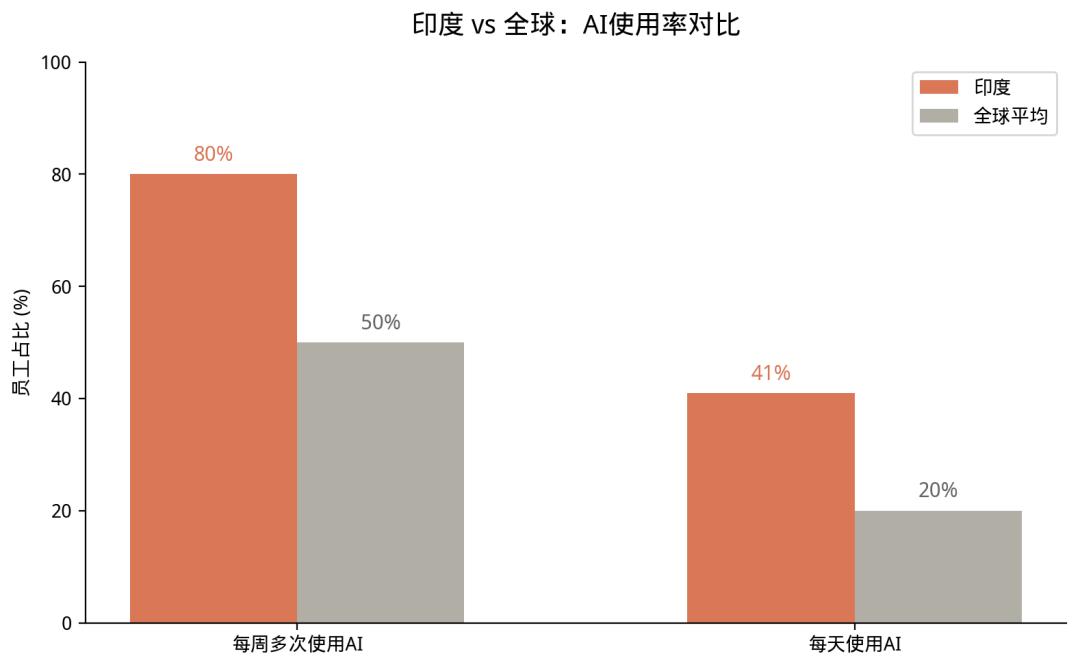
Comparison of AI Usage Rates between India and the World Source: BCG/ADP 2026
Not only are employees using AI, but enterprises are also deploying it on a large scale. At the end of May, Microsoft disclosed a set of data: TCS, Inf