Is 10 billion just the starting price? The list of 21 global AI unicorns is going viral
$10 billion entry: The threshold for AI unicorns is about to be rewritten!
Just before Anthropic and OpenAI were gearing up for their trillion - dollar IPOs, Deedy Das, a partner at Menlo Ventures, posted a list on X, which quickly went viral.
There are only two criteria for selection: a valuation of over $10 billion and an annualized revenue of over $100 million.
He listed 21 AI startups that meet these two criteria.
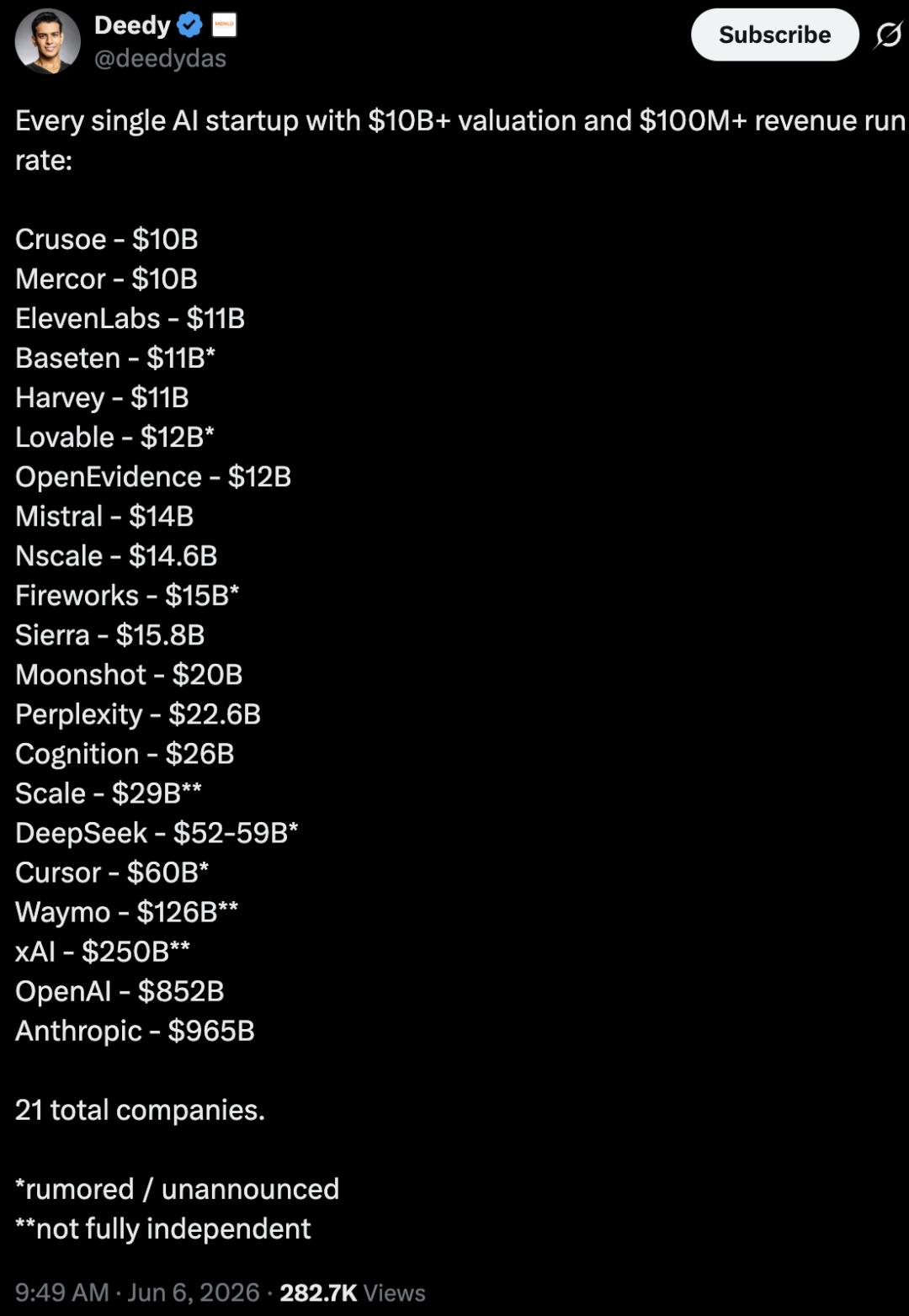
The list starts with Crusoe and Mercor, both valued at $10 billion, and goes all the way to the top with Anthropic valued at $965 billion and OpenAI valued at $852 billion.
According to Deedy Das' statistics, the valuations or revenues of some of these 21 AI companies are based on media reports, rumors, or unannounced figures. He marked them with a single asterisk (*) on the list.
Another category, marked with a double asterisk (**), refers to companies that are not completely independent, such as Waymo, xAI, and Scale.
A few years ago, a $10 - billion valuation was the ceiling for top - tier unicorns. Now, it's just the entry price for this list of the world's top AI unicorns.
Someone listed four unicorns, Stripe, Deel, Notion, and Canva, and asked rhetorically: Are they too old to make the list?

Deedy Das' answer is that they are not AI companies, so they didn't make the cut.
Stripe is valued at about $159 billion, and Deel, Notion, and Canva are all valued at over $10 billion. Since they are not in the AI field in Deedy Das' view, they were excluded from the list.
For the two leading companies, Anthropic and OpenAI, there are more explicit public data to support their valuations and annualized revenue scales.
In late May, Anthropic completed a $65 billion Series H financing round, pushing its post - investment valuation to $965 billion. It's just one step away from a trillion - dollar IPO. The company also officially disclosed that its annualized revenue has exceeded $47 billion.
In late March, OpenAI announced that after its latest round of financing, its post - investment valuation was $852 billion, and its annualized revenue was about $24 billion.
Behind these two figures is the same AI computing power flywheel accelerating:
On the consumer side, a vast number of users are used for distribution. Just OpenAI's ChatGPT has 900 million weekly active users and 50 million paid subscribers. On the enterprise side, ChatGPT and Claude are integrated into core business processes. Anthropic has over 300,000 enterprise customers, and 8 out of the top 10 Fortune companies are Claude users. These traffic and orders are then locked in with long - term computing power contracts.
The more users, the faster the revenue; the faster the revenue, the more computing power can be locked in. In this way, the AI computing power flywheel spins faster and faster, and the companies can earn more and more. This is the computing power logic that supports Anthropic and OpenAI in their pursuit of trillion - dollar IPOs.
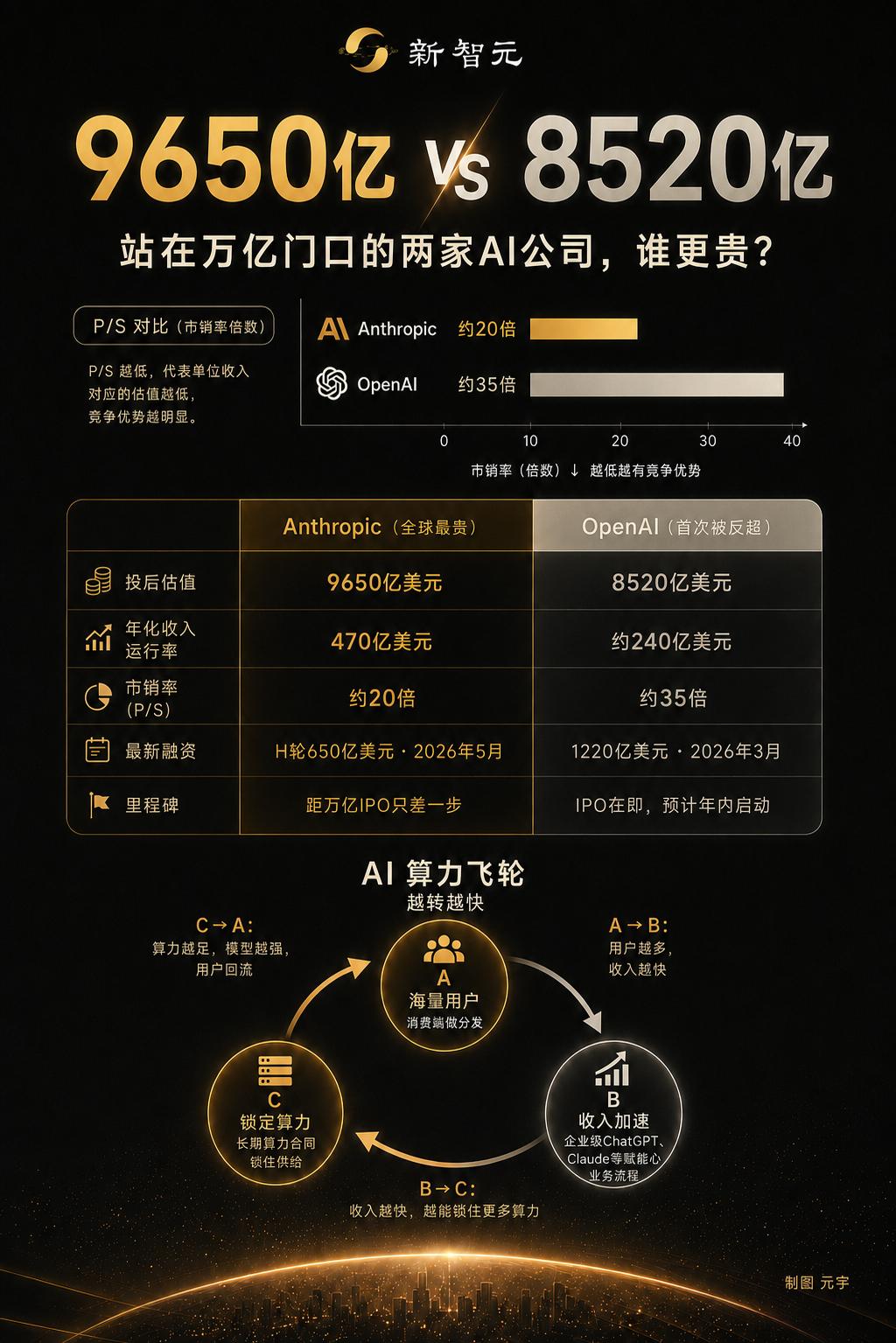
The scale of users and revenue has proven that the model products of the two leading companies, Anthropic and OpenAI, are supported by real - money revenue, not just in the realm of imagination.
Entering the Billion - Dollar Club
But with a Nearly 100 - Fold Difference in Valuation
From the entry - level $10 billion to the top - tier $965 billion, although they all enter the billion - dollar club, the valuation difference is nearly 100 - fold.
This list of AI super - unicorns is more like a hierarchical map of AI entrepreneurship. It can be examined from three dimensions: the track, the origin, and the authenticity of the figures.
The first dimension is the track.
The 21 companies on the list are doing completely different businesses, which can be roughly divided into three categories.
The first category sells "intelligence," that is, basic model companies.
Large - model companies such as OpenAI, Anthropic, and Mistral fall into this category. They build underlying large models, burn the most money, and have the greatest imagination space. Their valuation ceiling can reach trillions.
The second category sells "foundations," that is, computing power and infrastructure companies.
Crusoe focuses on "AI factories," while Nscale, Baseten, and Fireworks are involved in GPU clouds, model hosting, and inference services respectively.
They don't directly sell intelligence but rather the computing power base needed to run training and inference. The capital expenditure is extremely high, but the unit economics can be relatively well - calculated.
The third category sells "scenarios," that is, application - layer companies. For programming, there are Cursor and Cognition; for law, there is Harvey; for healthcare, there is OpenEvidence; for search, there is Perplexity; for voice, there is ElevenLabs; for customer service agents, there is Sierra; and for full - stack application generation, there is Lovable.
They integrate large models into specific industries, have higher gross margins, but are also most likely to be wiped out by a new feature from upstream model companies. The depth of their moat is often not up to them.
The remaining companies, Mercor and Scale, are engaged in AI data annotation, and Waymo is in autonomous driving, which are in a different dimension from the previous three categories.
The cost structures, moats, and ceilings of selling intelligence, foundations, and scenarios are different. But the fact that these three types of businesses can all reach the billion - dollar level shows that the entire AI industry chain, from computing power foundations to scenario applications, has been fully established, and each layer has its own leaders.
The second dimension is the origin.
Waymo is valued at $126 billion, but its official financing announcement clearly states that Alphabet is its controlling shareholder.
After a large - scale investment from Meta, Scale is no longer a typical independent startup; xAI is deeply integrated with Musk's X and SpaceX ecosystem.
Putting Alphabet's subsidiary Waymo, xAI deeply tied to SpaceX, and independent startups that emerged from garages on the same "AI startup" list shows a huge difference in their capital backgrounds.
The third dimension is the authenticity of the figures.
Even within the billion - dollar club, some figures are officially disclosed, while others are just reports or rumors.
According to TechCrunch, the $10 - billion valuation and nearly $450 million in annualized revenue of the data annotation company Mercor are based on two sources familiar with the matter and a marketing document, not an official company announcement.
The same is true for companies like Cursor and Fireworks marked with asterisks on the list.
It should also be noted that the so - called annualized revenue scale is calculated by extrapolating the current revenue run - rate for a year. It is not the actual full - year revenue that has been realized, and there is still a significant gap between it and the real - money actual revenue data.
20x VS 35x
Is the Valuation Too High?
Dividing the valuation by the annualized revenue gives the price - to - sales ratio (P/S), which indicates how many times the valuation is of the annual revenue.
When valuing technology companies, investors pay the most attention to this figure.
It's not difficult to calculate the P/S ratios of the two leading companies: Anthropic's ratio is $965 billion to $47 billion, about 20 times; OpenAI's is $852 billion to $24 billion, about 35 times.
In the context of high - growth AI companies, a 20 - to 35 - fold ratio is not outrageous, provided that the growth can keep up. And this is precisely the core narrative that supports this valuation.
According to media such as The Information, Anthropic's actual revenue in 2025 was about $4.5 billion. By February 2026, its officially disclosed annualized revenue had reached $14 billion, and in May, it further rose to over $47 billion. OpenAI's revenue in 2025 was about $13 billion, a year - on - year increase of over 200%.
Once the flywheel starts spinning, the denominator (revenue) grows faster than the valuation.
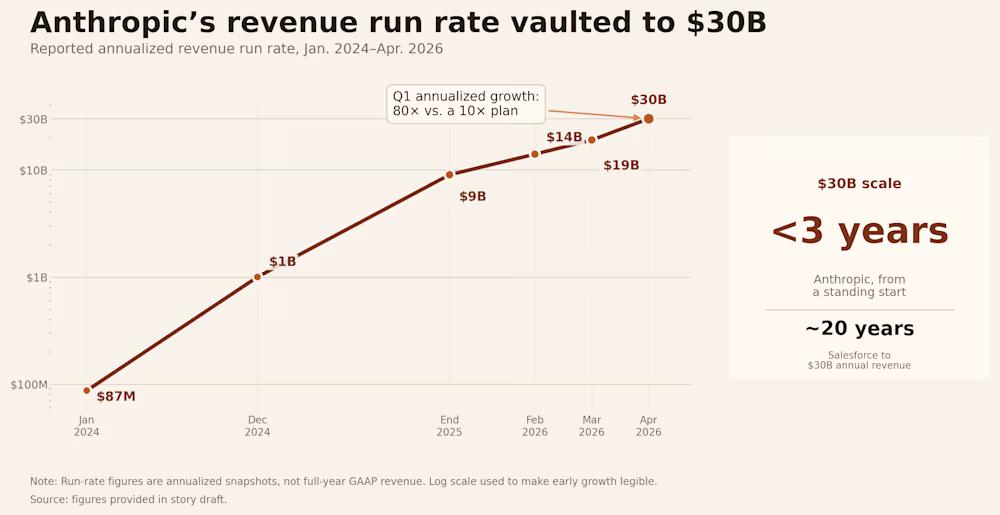
Anthropic's annualized revenue run - rate soared from $87 million in January 2024 to $30 billion in April 2026. In less than three years, it reached the $30 - billion scale that Salesforce took about 20 years to achieve.
There is also confidence on the demand side to support the optimistic judgment.
Statistics show that in the first quarter of 2026, about $300 billion in venture capital was invested in about 6,000 startups, and about 80% of it flowed into AI - related fields. On the enterprise side, once core processes such as programming and customer service are entrusted to a certain model, the migration cost is high, and the revenue stickiness is strong.
For optimists, more than half of these 21 companies didn't exist a few years ago, and the flywheel is still accelerating. The seemingly astonishing multiples today may not be unsustainable.
Still Losing Money on Paper
The Doubt of a Bubble Lingers
Whether the multiples look good depends on what the denominator is.
The previous 20 - and 35 - fold ratios use the optimistic annualized run - rate as the denominator. If we use the actual full - year revenue that has been realized, the multiples will be much steeper.
According to The Motley Fool's calculation, based on the actual revenue in 2025, OpenAI's P/S ratio once approached 60 times, and Anthropic's was even higher, while NVIDIA's was only about 25 times.
A more realistic problem is that most of these companies are still losing money.
Both Anthropic and OpenAI are currently losing more than they are earning, and they are burning money at a relatively fast pace.
This valuation also places extremely high demands on the future.
Reuters once calculated that even if we assume that OpenAI and Anthropic can achieve a free - cash - flow rate of about 27%, similar to that of Microsoft and Google, by 2030, their current valuations would mean that they need to achieve annual revenues of over $225 billion and about $75 billion respectively five years later.
As the valuation continues to rise, this threshold will only become higher.
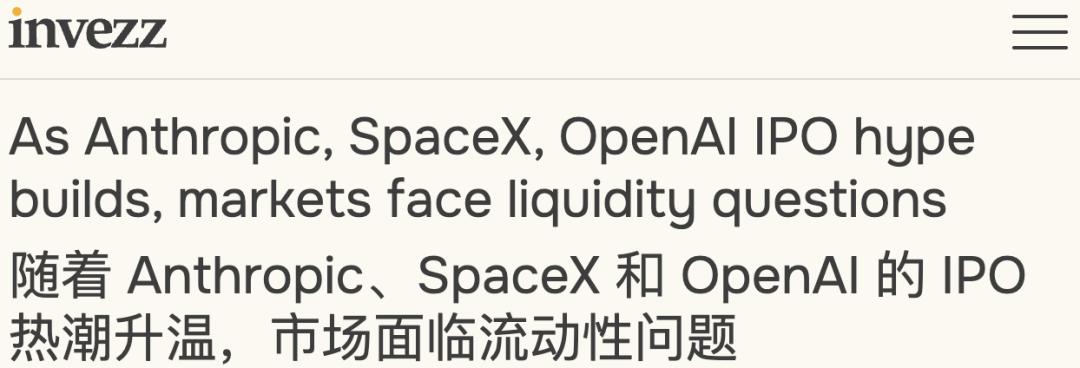
If OpenAI, Anthropic, and SpaceX all go public in the second half of the year, the total fundraising scale may exceed $200 billion, transferring a huge risk to the public market all at once. This concern is not unfounded.
Of course, these doubts don't necessarily mean that the valuation is wrong, but they remind people that these hundreds of billions and trillions of dollars are more of a bet on the future rather than a pricing of current profits.
Above the Billion - Dollar Threshold
The Elimination Race Has Just Begun
The real highlight of this list is that what AI companies are competing for has changed.
In the past, the competition was about model capabilities, and the one with a higher score would win. Now, the competition is about revenue growth rate, enterprise customers, computing power supply, and capital credibility.
Each of the three types of businesses on the list has its own survival line.
Model companies that sell intelligence are in a money - burning arms race. If the computing power and capital cannot keep up, the flywheel will spin in the opposite direction. A slowdown in model iteration will lead to the loss of enterprise customers and revenue.
Computing power and infrastructure companies that sell foundations are competing in terms of unit economics. They need to calculate every aspect, such as utilization rate, gross margin, and the fulfillment rate of long - term contracts. They can't rely on just stories for long.
Application - layer companies that sell scenarios are in the most delicate situation. They have higher gross margins and are closely related to specific industries, but they may be easily wiped out by a new feature from upstream model companies at any time. The depth of their moat is often not up to them.
Being acquired is also one of the possible outcomes of this competition.
Waymo has been incorporated into Alphabet, Scale is no longer independent after a large - scale investment from Meta, and xAI is deeply integrated with Musk's ecosystem. The companies marked with double asterisks on the list have already given an answer.
After Deedy Das released the list, there were naturally many disputes in the comment section. Some people couldn't understand the multiples, some were waiting for the real implementation of AGI, and some were asking about profit margins and user retention.
Some people pointed out that half of the companies on the list are marked with asterisks, which means that the $100 - million revenue has not been confirmed. Only Perplexity and Mistral have real customer - paid revenues, and the rest are just nice numbers.
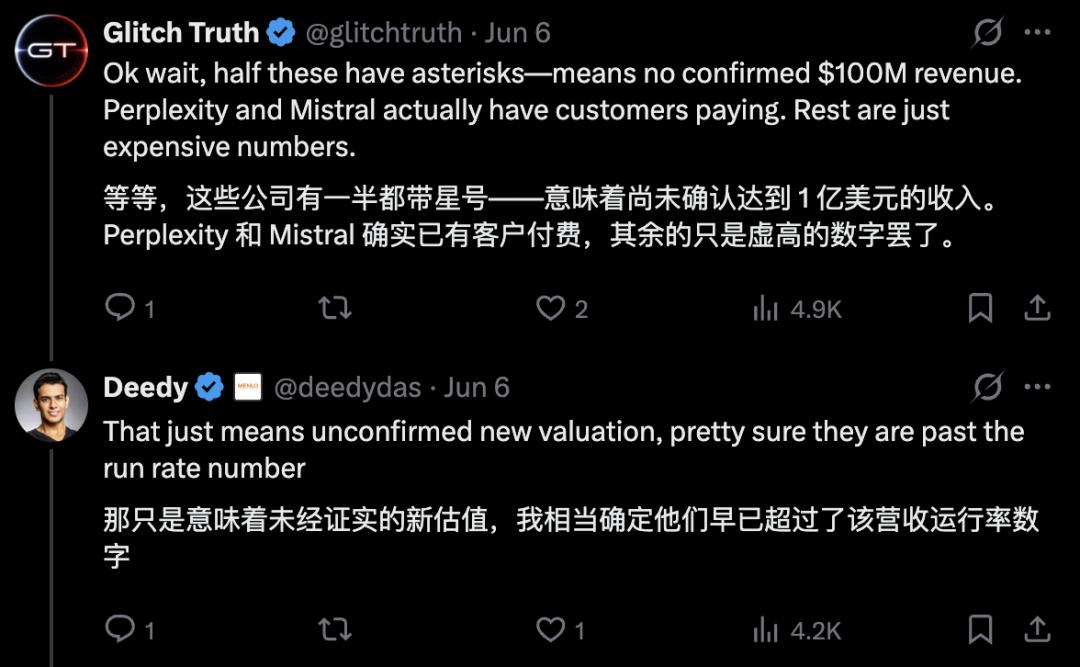
Deedy Das replied that the asterisks are only for unconfirmed new valuations, and he is quite sure that most of these companies have already exceeded the revenue run - rate threshold.
But some people also see the other side: More than half of these 21 companies didn't exist a few years ago, and through rounds of financing, their valuations have soared from zero to billions.
