Apple CEO Tim Cook's "Last Dance": Told New Stories, Left Old Problems
When Cook finished the opening of the 2026 WWDC keynote speech at Apple Park, the audience clearly understood what this moment meant.
Apple has officially announced that John Ternus, the current senior vice president of hardware engineering, will succeed as the company's CEO in September 2026. This year's WWDC is the last major product launch event that Cook will attend as Apple's CEO. Since taking over from Steve Jobs in August 2011, he has been at the helm of Apple for a full 15 years.
Over the past 15 years, Apple's market value has grown from approximately $350 billion to consistently stay above $4 trillion. During Cook's tenure, he led the launch of several products, including the Apple Watch, AirPods, M-series chips, and the Vision Pro, significantly enriching Apple's hardware ecosystem.
Different from the Steve Jobs era, during Cook's tenure, Apple's revenue structure has undergone a fundamental change. The service business, centered around the App Store, software subscriptions, and Apple Pay, has grown from a marginal department to the company's second-largest pillar. With a long - term gross profit margin higher than that of hardware, it is regarded by the capital market as the key to hedging against the iPhone cycle.
Looking back on Cook's journey as CEO, what he left for Apple is not a single new product but a new set of operating logics.
Coming from the supply chain background, he made inventory turnover, OEM negotiation, and locking of key components into industry benchmarks. He also led Apple's largest - scale stock buyback and dividend plan in history, with the cumulative return to shareholders approaching $1 trillion.
However, like anyone else, Cook's tenure has been accompanied by both praise and criticism.
Even though he has multiplied Apple's market value by 12 times in 15 years, towards the end of his tenure, he has faced intense external doubts. The Apple Vision Pro, which he strongly advocated for in hardware R & D, has not won market recognition. In the software field, since 2023, Apple has clearly lagged far behind competitors such as Google and Meta in the AI competition.
Especially after the release of Apple Intelligence in 2024, the long - awaited "new Siri" has become the most criticized topic about Apple. And the "hole" that has been dug for more than two years might finally be filled at this year's WWDC.
01
The secret of Apple filling the hole lies in this circle
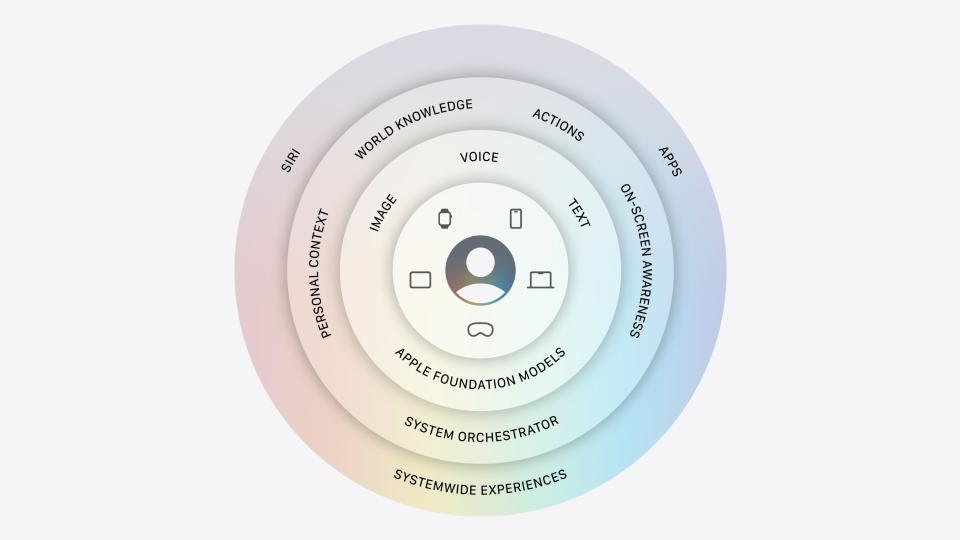
As the undisputed star of this year's WWDC, the new Apple Intelligence has arrived as scheduled. Apple has drawn five concentric circles, providing a detailed structural breakdown for this long - awaited AI architecture.
The circle centered around the user is the foundation of the new Apple Intelligence. This is what sets Apple apart from its competitors. They believe that AI should ultimately serve people.
The circle formed by Apple's hardware ecosystem is the first landing point for Apple's edge - side models. In this new AI architecture, the edge - side models remain the core of data exchange and information interconnection.
The circle formed by multi - modality is the tool for users to interact with artificial intelligence in Apple's AI ecosystem.
The circle composed of semantic understanding, world knowledge, behavioral operations, and screen perception is the means for users to communicate with the intelligent world.
The circle formed by Siri and software has become the key to unlocking the new Apple Intelligence.
Apple has given this architecture a new name, "Apple Foundation," and they have introduced a brand - new partner this year, Google Gemini.
Apple used the term "in - depth cooperation" in the keynote speech. Obviously, they have not given up the leading role in the architectural design of Apple Foundation. Just like the AI core architecture built when Apple released the first - generation Apple Intelligence in 2024, Apple Foundation still follows a "edge - private cloud - public cloud" implementation link. Apple has also emphasized again that its private cloud algorithm black box can be verified by any external testing institution to ensure the security of this link.
However, handing over a part of the underlying AI architecture to Google means that Apple has completely overturned the original design concept of a fully self - developed AI architecture proposed when they first introduced Apple Intelligence in 2024. Now they are shifting their focus to AI product and functional experience rather than the underlying models themselves.
This strategic shift is of far - reaching significance. In the AI competition, Apple is no longer trying to catch up with model capabilities from scratch. Instead, it is using Google Gemini to make up for its underlying shortcomings and leveraging its traditional advantages in software - hardware integration, privacy design, and user experience.
But obviously, this is not all of Apple Foundation. If it can only achieve this level, what's the difference between it and downloading Gemini from the App Store? Apple has placed more important roles on the outermost layer of the concentric circles.
02
One super APP, a bunch of super entrances
Before the official opening of WWDC26, a lot of information had leaked, indicating that the new Siri would receive a significant upgrade in capabilities. But perhaps no one expected that Apple, which was considered "lagging behind in AI," had such great ambitions.
The new Siri.
It is the first time that Apple has truly fulfilled its promise to upgrade the AI assistant since the announcement of the Apple Intelligence plan two years ago. With the capabilities of the Apple Foundation architecture, the new Siri has been comprehensively upgraded in terms of dialogue ability, multi - modality interaction, and system - level integration. The emergence of the new - version Siri also marks that Apple's AI strategy has entered a brand - new stage.
The brand - new Siri has a more expressive voice, and users can customize it according to speech speed, expressiveness, and accent. It can read screen content, deeply interact with applications on the device, answer factual questions based on web pages and personal data, and perform tasks such as writing emails and checking calendars.
Users can have a dialogue with Siri either by text or voice, share pictures and files for discussion. The conversation records are synchronized across devices via iCloud, so you can start a conversation on one device and seamlessly continue it on another.
Do you still remember the "pie" that Craig Federighi drew for users in 2024 when Apple released Apple Intelligence, about "using one sentence to autonomously call four apps to continuously handle complex tasks"? Two years later, we can finally take a bite of it.
Moreover, Apple has gone to great lengths to make Siri change the way users have used Apple smart devices in the past 20 years.
They have provided super entrances on all Apple devices that support Siri and Apple Intelligence.
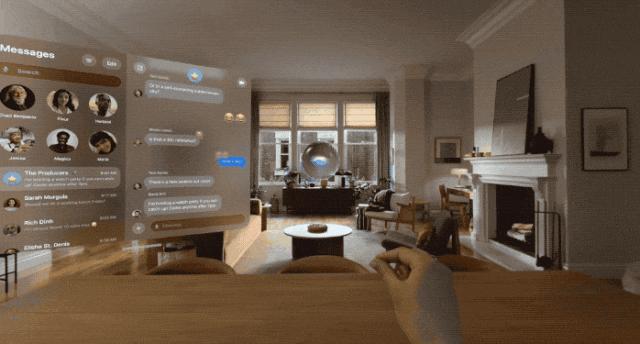
For example, iPhone users can directly wake up Siri by pulling down from the Dynamic Island. Mac users can call it in real - time through Spotlight. Vision Pro users can start a conversation just by looking at the floating light ball in their field of vision. You no longer even need the voice command "Hey, Siri" to activate it.
Siri even has an independent app for the first time. The interface is similar to mainstream AI chat apps such as ChatGPT and Claude, providing a complete conversational experience. All queries are processed on the device side or through Apple's private cloud computing, and privacy protection is integrated into every step of the design.
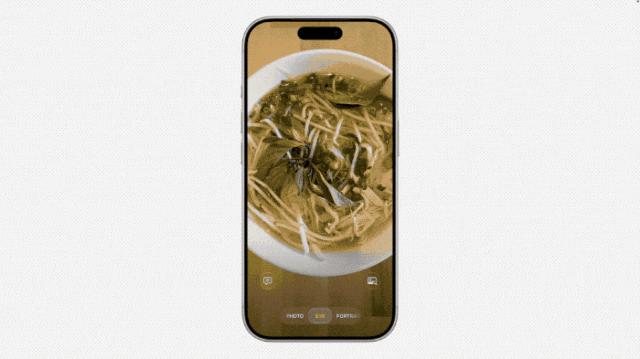
In addition, Siri can be combined with existing first - party apps. Apple demonstrated a new Siri mode in the camera app during the keynote speech. After enabling it, through the capabilities of lens shooting and image recognition, Siri can have a natural - language conversation with users and perform corresponding operations. For example, in a restaurant, a customer can point the camera at the bill, select the dishes they ordered, and then let Siri calculate the amount to be paid. On a Mac computer, users can select a certain area of content on the screen and use Siri to input text to ask questions about the selected part.
Through all these technology demonstrations, Apple is constantly telling the outside world that this time, they really want to get rid of the label of "lagging behind in AI."
Apple announced at the press conference that the new - version Siri will be officially open for developers to try today, and the public beta version will be launched later this year. However, there are still quite a few thresholds to use the new Siri. For example, it initially only supports English conversations and recognition, and the edge - side AI functions are only available on specific models: iPhone Air, iPhone 17 Pro, iPads equipped with M4 or higher - end chips and with a memory of no less than 12GB, and Macs equipped with M3 or higher - end chips and with a memory of no less than 12GB.
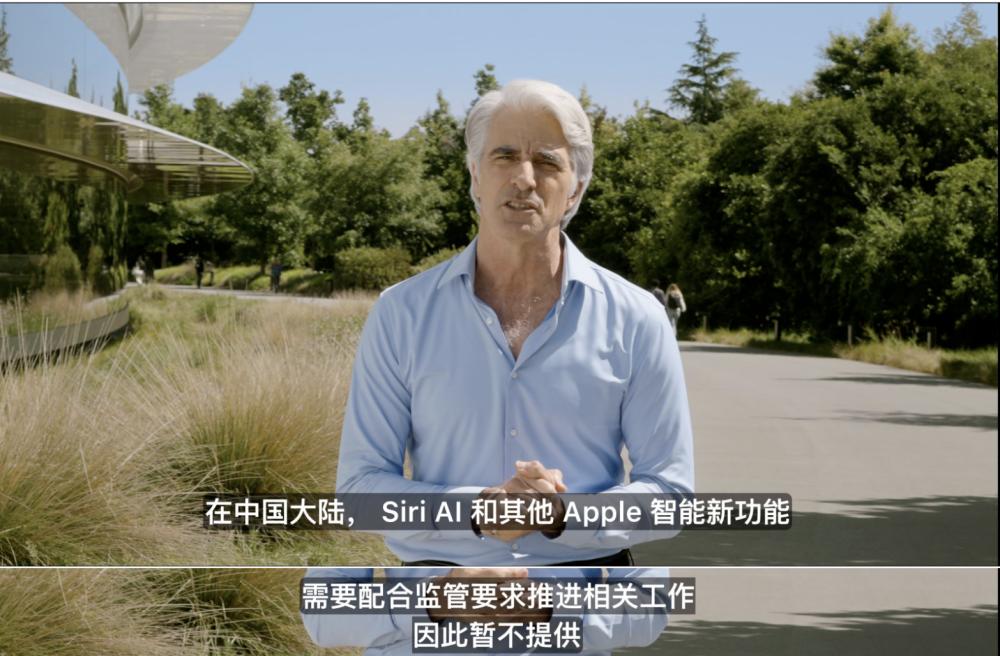
Oh, by the way. The new Siri will not be available in mainland China in the short term, which is directly related to AI regulation.
After the press conference, Apple's stock price turned from rising to falling. The arrival of the new - version Siri failed to arouse the capital market's expectations for Apple's new story. After the experience of WWDC in 2024, the outside world remains cautious about whether the new - version Siri under the support of Apple's Apple Foundation architecture can succeed.
03
There is an invisible "hidden line" in the new AI
If Siri is the absolute protagonist of Apple's AI narrative at this keynote speech, then there is a hidden line that echoes the original intention of the "Apple Worldwide Developers Conference."
In this year's keynote speech, Apple mentioned very little about the updates of the six major systems. Instead, it spent a lot of time emphasizing some positive changes brought by AI in the new systems.
First of all, Apple almost rewrote the key paths at the system's underlying level and quietly embedded machine - learning models into the most core scheduling part of the operating system.
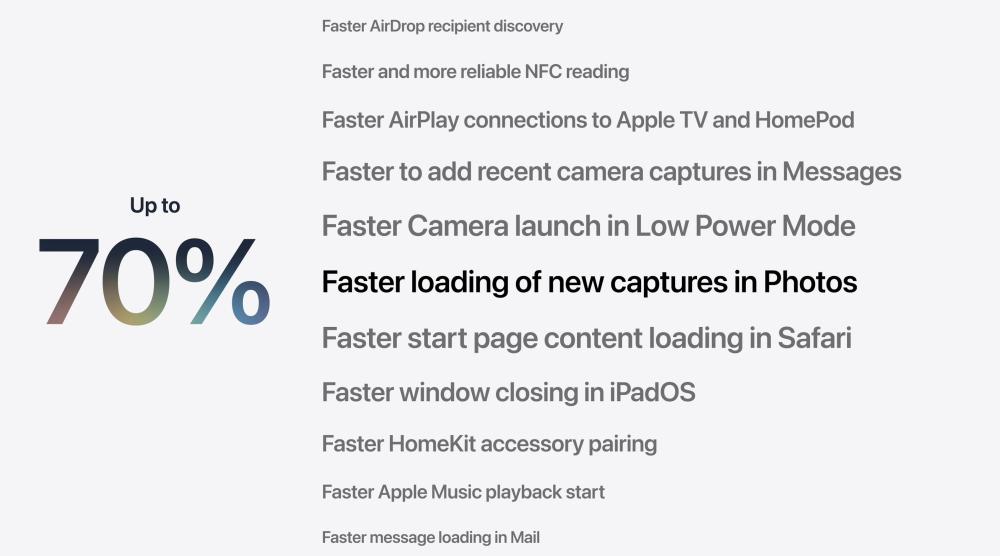
The official speed - up data almost covers high - frequency scenarios that users encounter every day: the startup of iPhone and iPad apps is up to 30% faster, the storage of newly taken photos is up to 70% faster, AirDrop transmission is up to 80% faster, the browsing and transmission of an iPad connected to an external hard drive are up to 5 times faster, and for the first time, it catches up with Mac Finder. Animations such as swiping on the home screen and switching in the Mac's Control Center have also become smoother. Behind these numbers is a comprehensive reconstruction of Apple's AI capabilities from "upper - layer applications" to the "system framework."
The most crucial change is the rewrite of the CPU scheduler. The new - version iOS has introduced "predictive scheduling" based on machine learning. The system will learn users' usage habits, predict in advance which app you might open next and which resources you might call, and thus complete memory pre - heating and background pre - loading before you click on the icon. This scheduling logic was previously expected to be an exclusive feature of new models, but Apple has done the opposite and extended it all the way down to the iPhone 11.
Apple said that the models supported by iOS 27 are exactly the same as those of iOS 26, making it the generation of iOS that covers the most users in history. For users who still hold old devices, this is one of the few real good news tonight. AI does not bring higher hardware thresholds but further squeezes out the potential of old devices.
The 70% speed - up of photo storage is due to the parallel processing of image recognition, face clustering, geographical tagging, Live Photo deduplication, and other processes by the edge - side neural engine. In the past, these tasks had to be queued in the background, but now they are completed in a single inference.
The 80% speed - up of AirDrop and the 5 - fold improvement of an iPad connected to an external hard drive are thanks to the AI - driven transmission prediction and file indexing algorithms. The system can dynamically adjust the buffering strategy according to the file type and usage pattern, reducing the waiting time from the source.
Apple has also completely rewritten the underlying search of Spotlight, Photos, and Mail and rebuilt the indexing architecture. The new - version Spotlight is no longer just about keyword matching. Instead, it uses Apple's foundation model to understand semantic intentions. You can use natural language to search for "the photo taken at the coffee shop last week" or "the email that mentions next Sunday's schedule," and the system will conduct semantic searches across apps. In essence, a small - scale AI model is embedded behind the search bar, making both "searchability" and "search speed" possible.
It is worth mentioning that almost all of these AI capabilities are run on the edge side. This not only means lower latency but also aligns with the concept of "centered around you and privacy - first" that Craig Federighi repeatedly emphasized in the keynote speech. The cloud only intervenes through Private Cloud Compute when necessary, and most of the acceleration occurs on the device in your hand.
If the brand - new Siri shows Apple's catching - up attitude in the AI product field, then this system - level speed - up is more like a return to Apple's familiar approach. Instead of piling up parameters or showing off concepts, Apple quietly weaves AI into every fiber of the operating system, allowing users to feel the difference in their most daily actions such as opening apps, transferring files, and searching for emails. What AI ultimately serves is not the exclamations at the press conference but the subtle feeling of "seeming to be more convenient than yesterday" every time you unlock the screen.
04
Cook's Highlight Moment, Leaving an Old Question
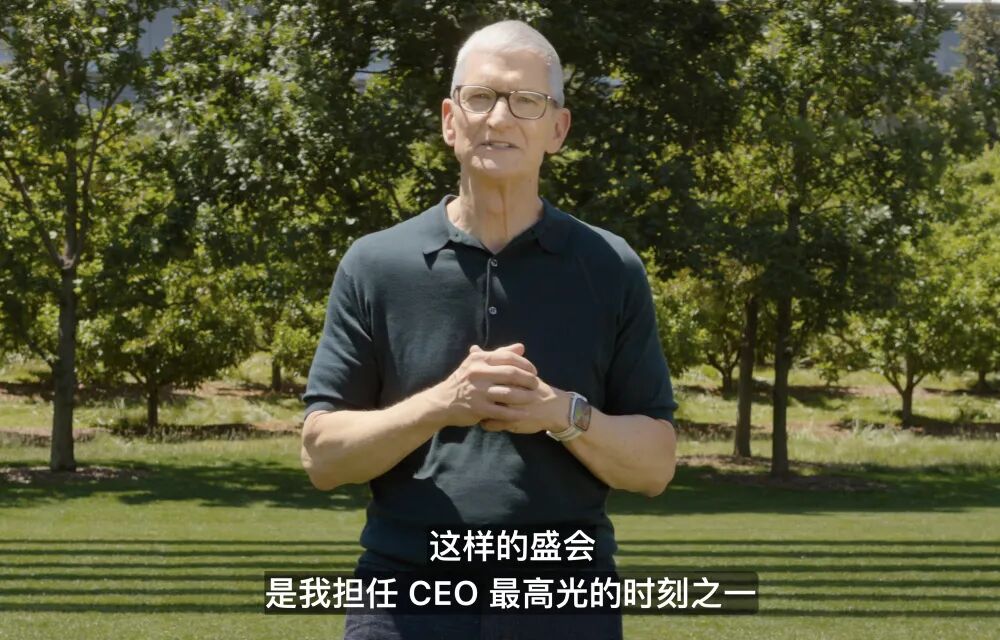
After the 75 - minute keynote speech, the glorious chapter of Apple under Tim Cook is officially coming to an end.
In the pre - recorded keynote speech video, Apple gave Cook two minutes to make his last confession during his tenure as Apple's CEO. Cook also said in the video that this was one of the most glorious moments of his tenure as CEO.
Looking back on Cook's tenure, he has presented a company report card with strong profitability, stable cash flow