Review of the Development of Top 100 Shopping Mall Enterprises: Who is Sprinting Ahead? Who is Falling Behind?
At the crossroads of scale expansion and quality upgrade, where is the shopping mall industry headed?
Recently, the China Chain Store & Franchise Association (CCFA) released the list of "Top 100 Chinese Shopping Malls in 2026", officially revealing the latest competitive landscape of the industry.
This list is not only an intuitive ranking of the annual comprehensive strength of leading commercial management enterprises but also an important indicator for observing the development trend of the industry.
Lianshang.com traced back the data of the list from 2023 to 2025. From multiple dimensions such as the expansion trend, scale pattern, and change in development logic, it dissected the new changes and core trends in the industry's development for industry exchange and reference.
Slower expansion speed and gradual shrinkage of project scale
In 2025, the top 100 Chinese shopping mall enterprises added a total of 123 operating shopping malls, with a newly added construction area of 4.55 million square meters. The growth rates decreased by 5 and 5.8 percentage points year-on-year respectively. The average single - project construction area dropped to 107,700 square meters, and the year - on - year decline increased by 8 percentage points.
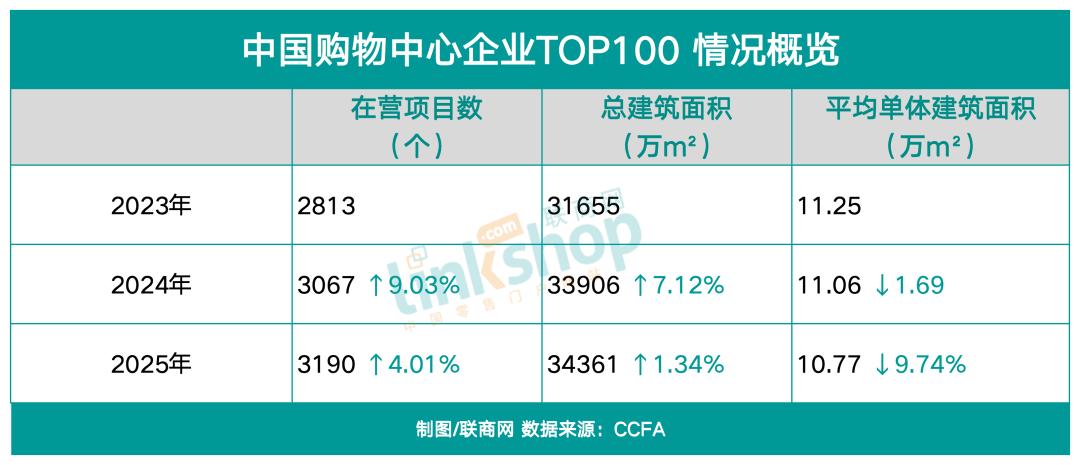
Note: Since 2026, the chronology of the Top 100 Chinese shopping mall enterprises has been adjusted to the release year, while the data sampling year remains the previous year. This article uses the data of 2025 for representation.
Overall, the industry still maintains an expansion trend, but the expansion pace has significantly slowed down, and the contraction of the single - project scale has increased.
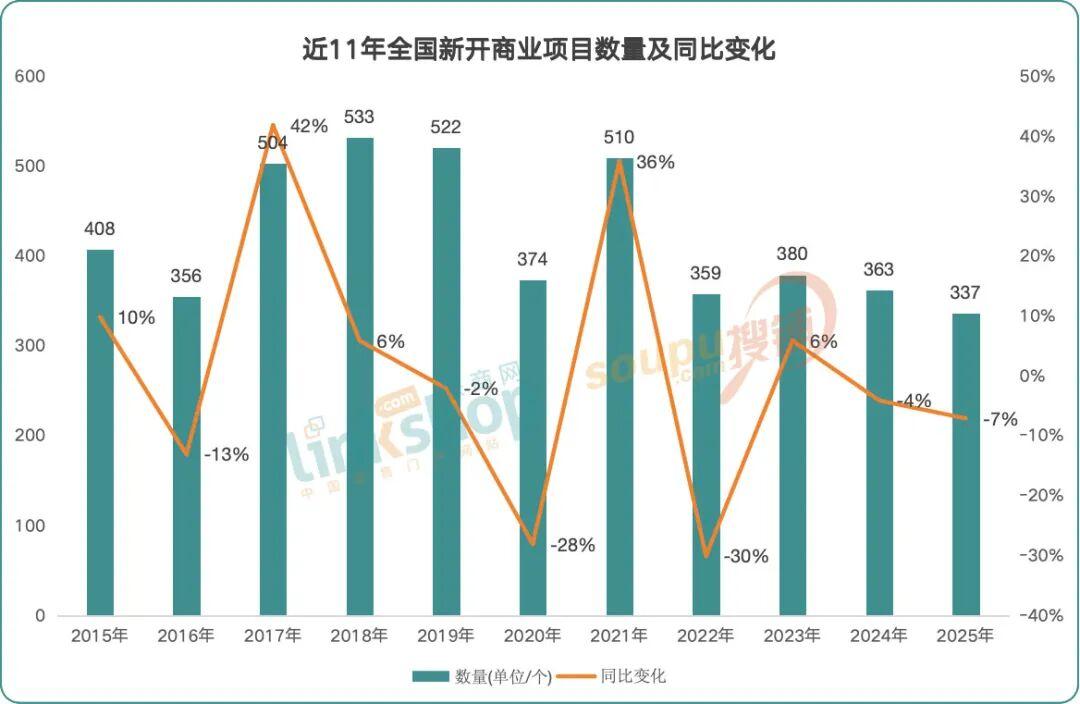
Another set of data also confirms this development trend. According to the statistics of Lianshang.com, in 2025, 337 new shopping malls were opened nationwide (excluding professional markets, hotels, and office buildings, with a commercial construction area of ≥ 20,000 square meters). The number of newly opened malls reached a new low in the past 11 years.
In terms of the volume structure, projects with a volume of less than 100,000 square meters accounted for more than 70%. Among them, community - type and refined projects with a volume of 20,000 - 50,000 square meters had the highest proportion, reaching 37%. The proportion of super - large urban complexes with a volume of more than 150,000 square meters was only 9%.
It is not difficult to see that the industry has bid farewell to the stage of large - scale concentrated construction, and miniaturization and refinement have become the mainstream choices for new project layouts.
Highly concentrated resources and deepening industry competition barriers
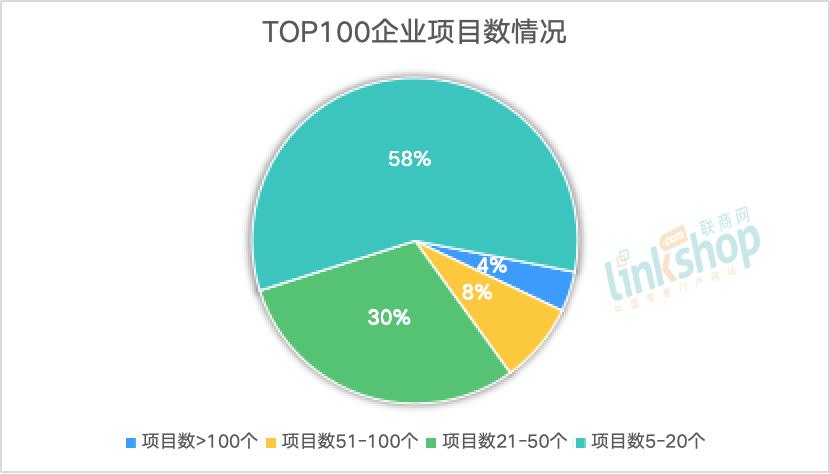
From the distribution of the number of operating projects of the Top 100 enterprises, the long - tail feature is significant. Nearly 90% of the enterprises operate less than 50 projects.
The industry data in the past three years shows that the market echelon pattern is stable, presenting a typical pyramid - shaped distribution: The number of operating projects of the top 4 enterprises exceeded 100; enterprises with 50 - 100 projects accounted for about 8%; enterprises with 20 - 50 projects accounted for 30%; and small and medium - sized commercial management enterprises with 5 - 20 projects accounted for as high as 58%. The overall pattern is " scarce at the top and concentrated in the middle and small".
In terms of industry concentration, the Matthew effect of leading enterprises continues to strengthen. The top 10 enterprises contributed nearly half of the projects and area. In 2025, the total number of operating projects of the Top 10 enterprises was 1,529, accounting for 47.9% of the total number of projects of the top 100 enterprises; the total construction area reached 165.14 million square meters, accounting for 48.1% of the total area of the top 100 enterprises. Compared with the previous year, the concentration at the top remained basically the same.
Raised entry threshold and new regional players filling in and advancing
1. The entry threshold for the top 10 continues to rise.
In 2023, Maoye International ranked last among the top 10 with 49 projects and a scale of 3.1 million square meters; in 2024, Wangfujing Group took the 10th place with 55 projects and 5.58 million square meters; in 2025, China Merchants Commercial Management entered the top 10 with 62 projects and 4.63 million square meters. Over the three years, the threshold for the number of projects in the top 10 has risen from 49 to 62, with a cumulative increase of more than 26%.
2. The overall threshold for the top 100 remains basically stable.
The enterprises that entered the list from 2023 to 2025 were Beijing Shangpin Commercial Development Co., Ltd., Shangpin Supply Chain Management (Tianjin) Co., Ltd., and Shanghai Huibai Smart Business Co., Ltd. The number of projects of the enterprises entering the list in the three years was 5, and the construction area increased after fluctuations, which were 170,000 square meters, 130,000 square meters, and 210,000 square meters respectively.
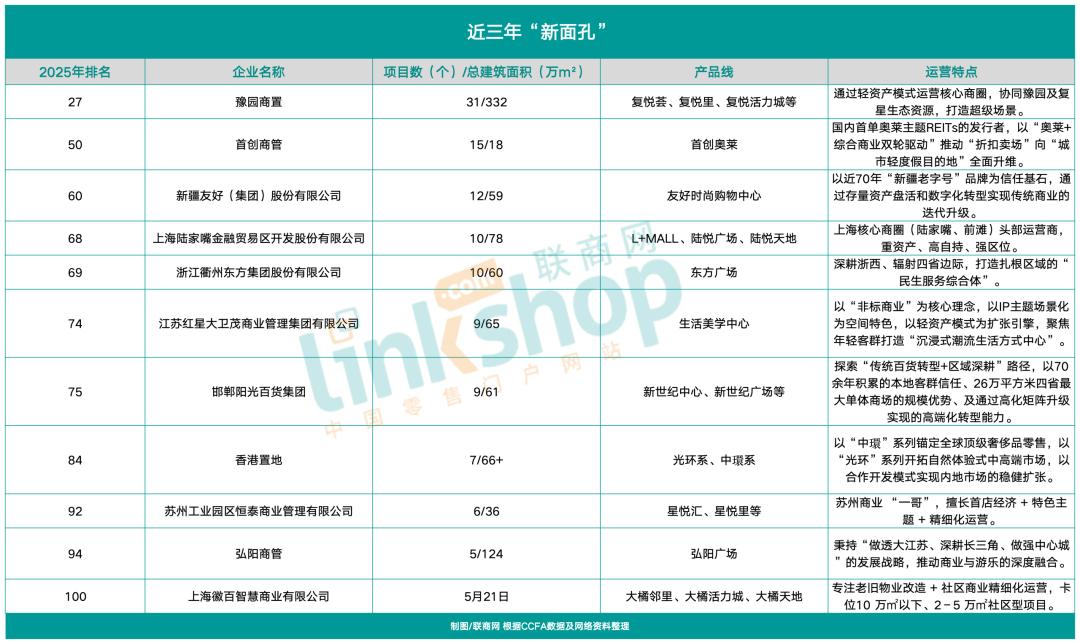
It is worth mentioning that compared with 2023 and 2024, 11 new players entered the top 100 list in 2025. Most of these newly - entered enterprises are regional enterprises that have long been deeply involved in one or a few core cities. Relying on their in - depth understanding of local consumption habits, customer group structure, and cultural preferences, they have achieved differentiated large - scale expansion.
In addition, the newly - entered enterprises generally adopt the "light - asset - driven" model, which is in sharp contrast to the traditional "self - built and self - held" heavy - asset model. They use methods such as brand output, entrusted management, and lease operation to leverage a large management scale with a small capital investment. This model not only reduces the financial pressure and expansion risk of enterprises but also enables them to seize opportunities more quickly during the market adjustment period.
Fixed positions at the top and reshuffle at the end of the top 10
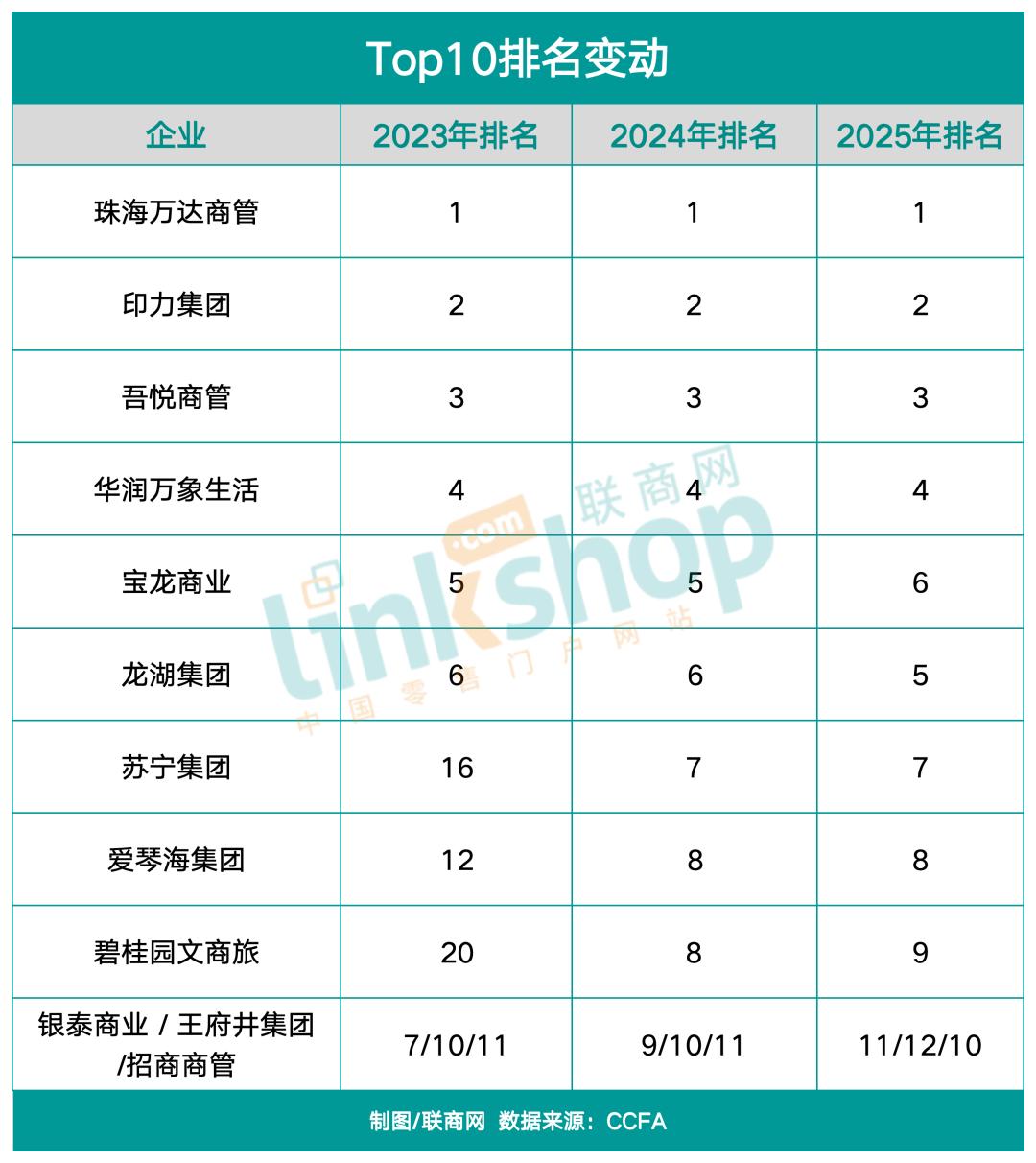
The positions of the first echelon in the industry are highly fixed. The rankings of the top 4 enterprises have remained unchanged for three consecutive years, namely Zhuhai Wanda Commercial Management, Yinli Group, Wuyue Commercial Management, and China Resources Mixc Lifestyle. Baolong Commercial and Longfor Group have always ranked fifth and sixth, and their positions have alternated from time to time.
Among them, Zhuhai Wanda Commercial Management has continuously ranked first in the industry. In 2025, the two core indicators of the number of operating projects and the total construction area were 2.3 times and 4.8 times those of Yinli Group, the second - ranked enterprise, showing a leading position with a significant gap, and its leading advantage is unshakable.
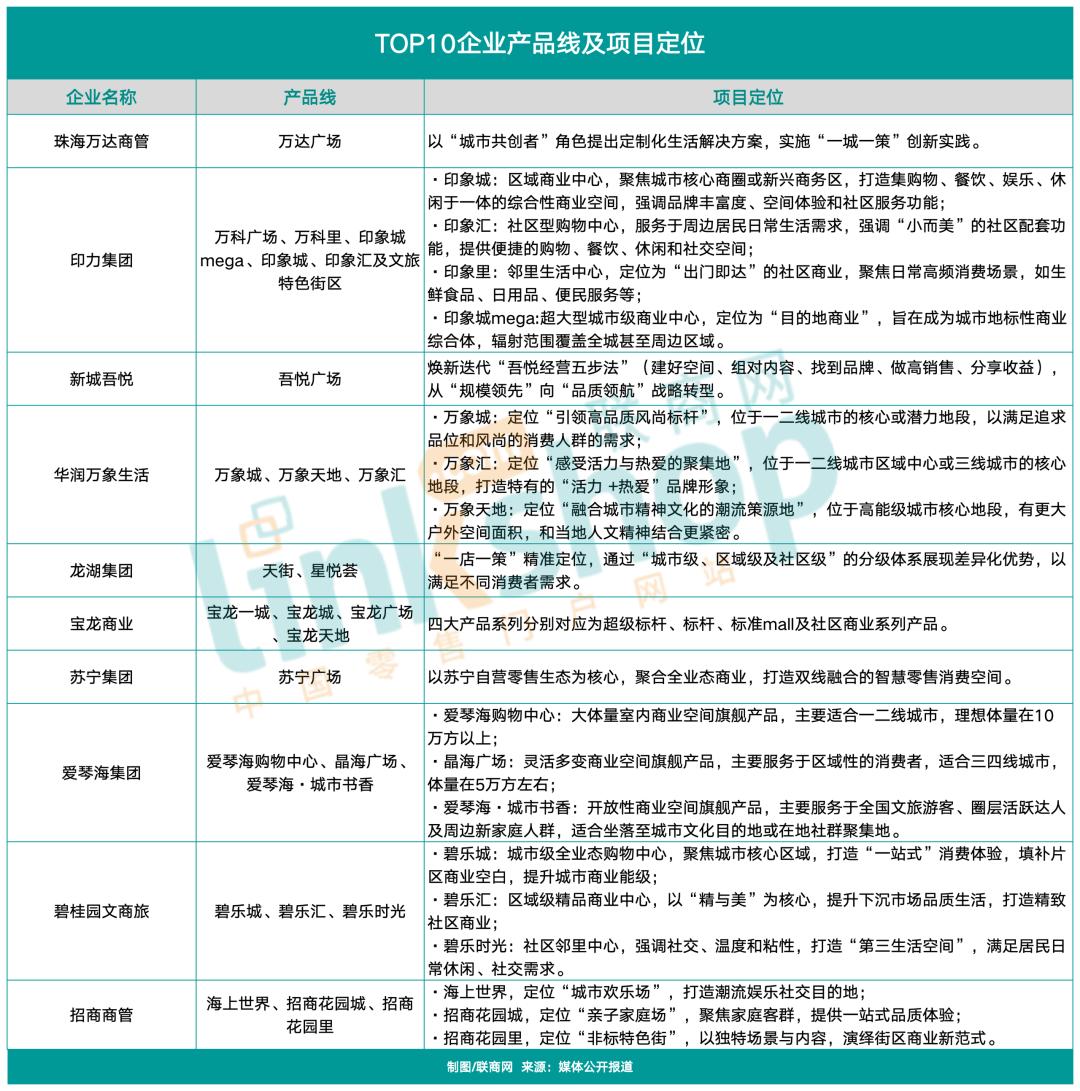
The positions at the back of the top 10 have undergone a reshuffle. Among them, Aegean Group rose from the 12th place in 2023 to the 8th place in 2025; Country Garden Commercial & Tourism broke through strongly, rising from the 20th place in 2023 to the 9th place in 2025; China Merchants Commercial Management successfully entered the top 10 after lying low for two years, rising from the 11th place.
There are both advances and retreats. Intime Retail, Hengtai Commercial, Century Jinyuan, and Maoye International, which were in the top 10 in 2023, have all fallen out of the top 10 in 2025.
The dividend of scale fades, and quality competition reshapes the order
First, the development logic of the industry has been updated, and "quality and efficiency first" has replaced "scale expansion" as the core consensus of the industry.
Leading commercial management enterprises have bid farewell to the extensive expansion competition, actively slowed down the opening pace, and turned to a refined development path of seeking stability, improving quality, and in - depth operation.
According to the statistics of Lianshang.com, in 2025, Wanda opened 20 Wanda Plazas throughout the year, all of which were light - asset projects with the cooperation party providing funds and Wanda providing full - scale management output. In 2026, it is planned to open 19 Wanda Plazas, reaching a new low in the number of openings in the past decade. Among them, light - asset trusteeship projects accounted for as high as 89%, with a clear orientation of risk control and efficiency improvement.
China Resources Mixc Lifestyle focuses on high - quality expansion. In 2025, it opened 17 commercial projects, and more than 60% came from the trusteeship and transformation of existing properties. Among them, the benchmark project, Zhuhai Mixc, adopted the whole - project light - asset entrusted operation model. After its launch, it added 500,000 new members, and the rent income of a single project increased significantly. In 2026, it is planned to open 20 projects, and light - asset projects accounted for more than 55%, continuously adhering to the development route of improving quality and efficiency.
Second, the market in first - tier cities is saturated, and the renovation of existing properties has become the key to tapping new growth.
At present, the renovation of existing properties has jumped out of the shallow - layer model of hardware renovation. Relying on a combination of precise project positioning, cross - border business format reconstruction, immersive space renovation, long - term operation upgrade, and digital technology empowerment, it can reshape the value of existing assets and drive the synchronous improvement of project passenger flow and business revenue. Moreover, the scope of renovation continues to expand, covering various non - commercial properties such as old factories, traditional vegetable markets, industrial parks, and urban underground spaces.
The statistical data of Lianshang.com shows that in 2025, about 70 existing property renovation projects were launched nationwide, accounting for more than 20% of the newly opened projects throughout the year. Among the commercial projects planned to open in 2026, there were 69 existing property renovation projects.
Third, the growth focus of the industry has shifted downward, and third - and fourth - tier cities and county - level cities have shouldered the banner of industry growth.
Lianshang.com found that among the 20 new Wanda Plazas opened in 2025, more than 70% were located in third - tier and lower - tier cities. Among its overall existing operating projects, projects in third - and fourth - tier cities accounted for 63%.
Among the opened Wuyue Plazas nationwide, 45% of the projects are located in fifth - tier and county - level cities, and the overall layout in the sinking market accounts for more than 60%.
About 40% of the operating shopping malls of China Resources Mixc Lifestyle are located in third - and fourth - tier cities with a permanent population of less than 3 million. Relying on Mixc and Mixc World to meet the consumption needs of prefecture - level cities, in 2025, the annual rent income of China Resources Commercial reached 30.7 billion yuan, a year - on - year increase of 16.9%. Among them, the rent growth rate of Mixc projects in sinking cities was significantly higher than the average of projects in first - tier cities.
Fourth, innovation in business content has become the breakthrough point to get rid of homogeneous involution.
The single shopping boundary of traditional shopping malls has been completely broken. The "cross - border integration of business formats + reconstruction of space scenarios" model integrates multiple experience contents such as art, technology, culture and tourism, ecology, and leisure into it, reshaping the core value of commercial space.
For example, the second phase of Shenzhen Bay Mixc, which opened in September 2025, added a 60,000 - square - meter cultural experience space and launched characteristic business formats such as art galleries, professional art curation centers, and cross - border designer collection stores, successfully creating an urban composite landmark of "business + high - end art".
Last year, Xincheng Wuyue invested 50 million yuan in the full - scale upgrade and transformation of Haikou Wuyue Plaza, breaking the traditional layout of the closed - atrium. It added public scenarios such as urban art galleries, stepped reading halls, and open - air performance stages, and regularly carried out characteristic activities such as cultural and creative markets and street performances, promoting the transformation of the shopping mall from a single consumption place to an urban public social space. After the transformation, the average stay time of customers increased from 45 minutes to 87 minutes.
Conclusion
Against the background of shrinking increments and competition in the existing market, the era of extensive expansion in the industry has officially come to an end. Commercial competition has completely bid farewell to the old logic of "judging success or failure by quantity and scale". Product quality and refined operation efficiency have become the new yardsticks for measuring the core competitiveness of shopping malls.
What is a high - quality shopping mall? Fan Weiming, the host of Lianshang.com's "Decoding Shopping Malls", put forward three core standards: brands are willing to enter, customers are willing to consume, and investors recognize the returns. This requires commercial projects to build a solid foundation for operation with high - quality product capabilities and empower long