With 44 million electric vehicles that never use gasoline, should their owners pay the road maintenance fee after all?
44 million new energy vehicles are running on Chinese roads, hardly consuming gasoline. Therefore, they cannot pay road maintenance fees through fuel taxes. This is a historical institutional gap, not a loophole. When the fuel tax system was designed in 2009, there were almost no new energy vehicles among household passenger cars. The logical premise of the entire mechanism was that "all vehicles consume gasoline." However, this premise no longer exists.
But this debt is piling up. What should we do? Hello everyone, I'm Wei Ming. Today, let's analyze this issue carefully.
01. The Origin and Development of Road Maintenance Fees: Why Are They Hidden in the Oil Price?
To understand the root of this problem, we must go back to 2009.
On January 1, 2009, China implemented the reform of refined oil price and tax, canceling six types of fees such as road maintenance fees and waterway maintenance fees, and incorporating them into the consumption tax of refined oil. After the reform, the consumption tax on gasoline and diesel included a special road maintenance income of about 1.52 yuan per liter.
The underlying logic of this institutional design is: "The more you use, the more you pay; the less you use, the less you pay." The more mileage a vehicle travels and the greater its load, the higher its fuel consumption, and the more road maintenance fees it pays. This is a relatively fair user - pays mechanism - Those who use the roads more should contribute more to road maintenance.
However, this system has an implicit premise: all vehicles consume gasoline.
At that time, electric vehicles were almost non - existent, and this premise was not questioned at all. But when the penetration rate of new energy vehicle retail sales exceeded 50% in 2025 and the national stock of new energy vehicles exceeded 44 million, this premise has completely collapsed.
Fuel - powered vehicles automatically pay road maintenance fees when refueling, while new energy vehicles have no such channel when charging - they do not participate in this system. This is an institutional gap left by historical technological limitations, not a situation where any party has bypassed the rules. Moreover, in terms of the overall vehicle stock, fuel - powered vehicles still account for the majority. You can check the data to confirm.
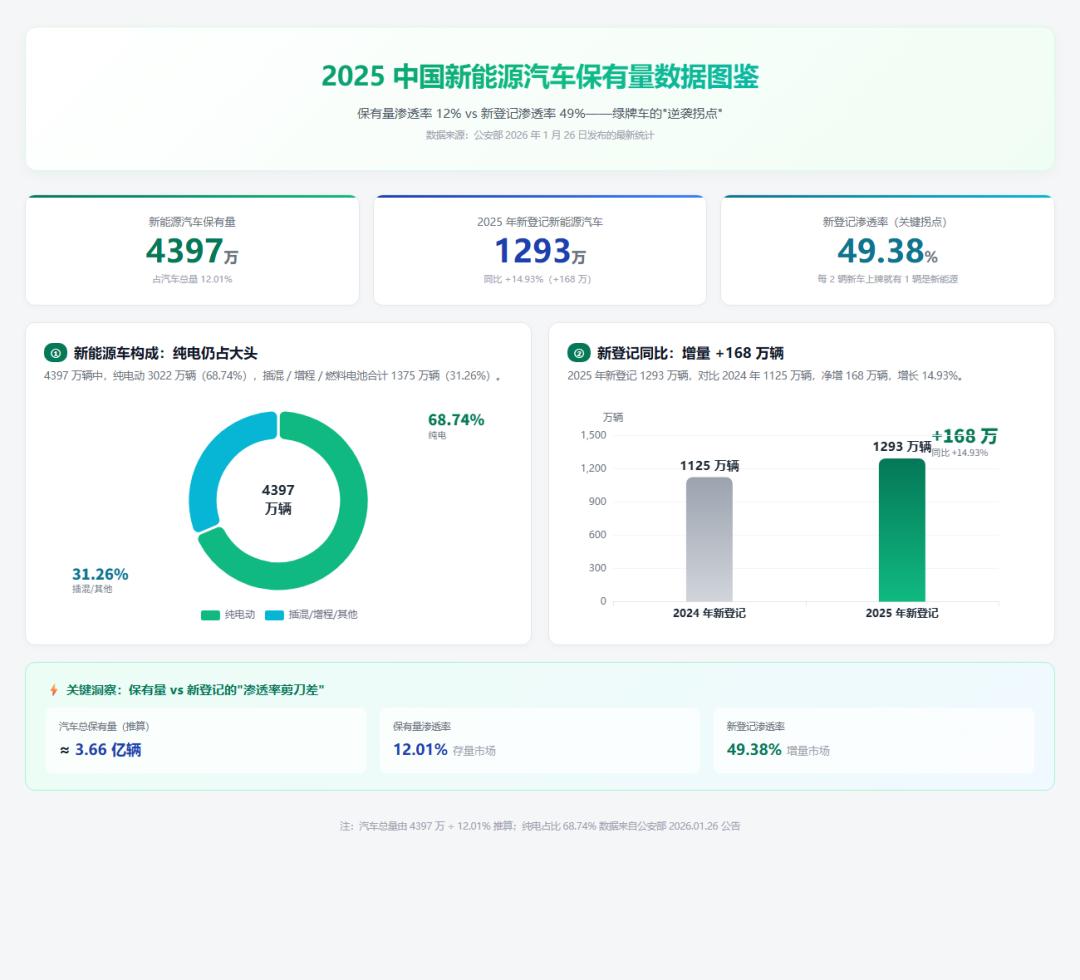
According to Xinhua News Agency, the Ministry of Public Security released the latest statistics on January 26. In 2025, the national vehicle stock reached 469 million, including 366 million cars. By the end of 2025, the national stock of new energy vehicles reached 43.97 million, accounting for 12.01% of the total number of cars; among them, the stock of pure electric vehicles was 30.22 million, accounting for 68.74% of the stock of new energy vehicles. In 2025, 12.93 million new energy vehicles were newly registered, accounting for 49.38% of the newly registered vehicles, an increase of 1.68 million compared with 2024, a growth of 14.93%.
I personally believe that when the stock of new energy vehicles exceeds 20%, this issue will sooner or later be put on the agenda. Let's not blame electric vehicle owners too much. I believe that most electric vehicle owners are willing to share reasonable costs and are just waiting for national policy arrangements.
However, there is a key institutional division of labor that most people are not clear about:
Road maintenance fees (fuel taxes) are not used for the maintenance of expressways or urban roads.
Expressways: Toll - based model - those who use pay, with independent accounting, completely separate from the fuel tax pool.
Urban roads: Urban maintenance and construction tax + local finance, not through the road maintenance fee channel.
Ordinary roads and rural roads: These are the main areas where road maintenance fees are used. For millions of kilometers of non - toll roads across the country, the main source of construction and maintenance funds is the fuel tax.
The regulations of the Ministry of Transport clearly state that road maintenance fees "should first ensure that roads meet the specified maintenance quality standards and ensure that a certain proportion is used for the maintenance of rural roads." This means that the non - payment of road maintenance fees by electric vehicles mainly affects the maintenance funds for ordinary and rural roads, rather than expressways or urban roads.
Source: Internet
So, why should electric vehicles bear road maintenance fees? Some people think that one of the reasons is that electric vehicles are heavier.
02. Do Heavier Electric Vehicles Really Cause More Damage to Roads?
This question needs to be carefully analyzed from a physical perspective, not answered emotionally.
Fact 1: Electric vehicles are indeed heavier.
Among vehicles of the same class, new energy vehicles are usually 400 to 700 kilograms heavier than fuel - powered vehicles because the battery packs themselves are extremely heavy (often hundreds of kilograms). Take the Li L9 and NIO ES9 as examples. These two large SUVs priced in the 500,000 - yuan range have a curb weight of over 2.5 tons, and some models are close to 3 tons.
Fact 2: The damage to the road surface increases exponentially with weight.
According to highway engineering research, road surface damage is proportional to the fourth power of the axle load - this is the well - known "fourth - power rule." That is to say, if a vehicle's weight doubles, the damage to the road surface is not doubled but increased by 15 times. This means that heavier vehicles cause far more wear and tear on roads and bridges than ordinary passenger cars.
Fact 3: Electric vehicles have larger tires, but this cannot completely offset the impact of weight.
To support the greater vehicle weight, electric vehicles are equipped with wider tires, higher tire pressure, and heavier tire weights. This disperses the ground pressure to a certain extent, but it cannot fundamentally change the physical law that "increased weight leads to accelerated road surface wear."
However, it should also be objectively pointed out that the damage to roads caused by the weight of passenger cars is far less than that of heavy - duty trucks. Comparing a 2.5 - ton electric vehicle with a 40 - ton truck, the latter causes thousands of times more damage to the road surface than the former. So, the weight issue of electric vehicles is real, but it should not be exaggerated.
Source: Internet
03. What Other "Policy Dividends" Do Electric Vehicles Enjoy?
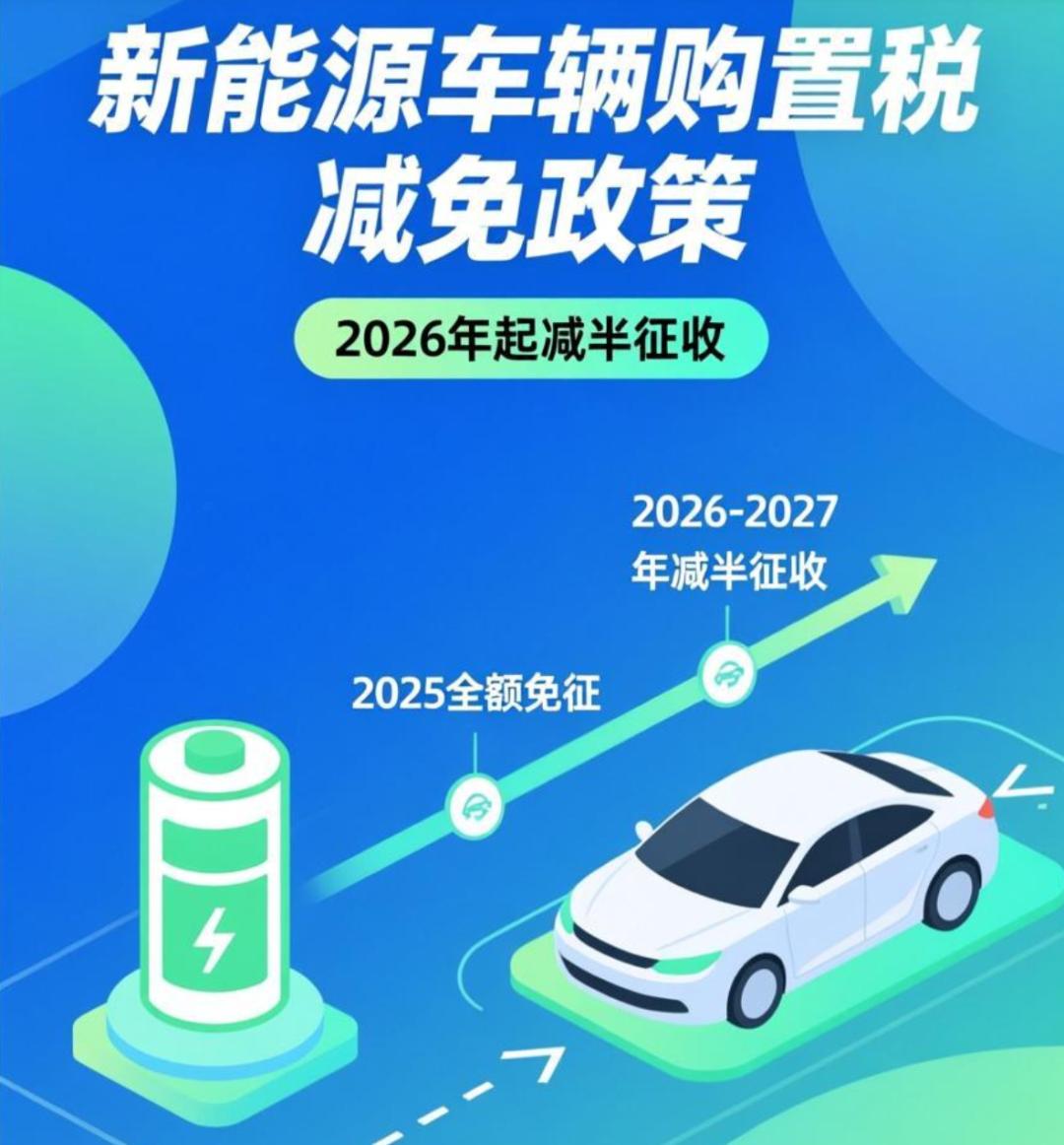
Road maintenance fees are just one of the many policy preferences that electric vehicles enjoy. The trajectory of the exemption of purchase tax clearly shows that the policy is gradually withdrawing:
From 2014 to 2023: New energy vehicles were fully exempted from purchase tax, with a cumulative exemption of over 150 billion yuan.
From 2024 to 2025: The exemption continued, with a maximum exemption of 30,000 yuan per vehicle.
From 2026 to 2027: The tax was halved (the purchase tax exemption policy officially declined).
From 2028 onwards: The full tax will be restored (unless the exemption is extended again).
Source: Internet
That is to say, since May 2026, the purchase tax exemption for electric vehicles has been halved, and the "era of full exemption" has officially ended. But even with the halving, electric vehicles still pay half less purchase tax than fuel - powered vehicles of the same price. For example, a 300,000 - yuan new energy vehicle still pays about 15,000 yuan less in purchase tax than a fuel - powered vehicle.
04. Why Haven't Electric Vehicles Been Required to Pay Road Maintenance Fees Yet?
There are three reasons.
First: The historical inertia of policy design.
The fuel tax reform in 2009 was aimed at the reality that all vehicles consumed gasoline at that time. In that era, no one could have foreseen that new energy vehicles would so rapidly disrupt the entire energy structure. The update of the system always lags behind technological breakthroughs, which is a common dilemma faced by new energy policies in various countries.
Moreover, as mentioned before, fuel - powered vehicles still account for the vast majority of the total vehicle stock.
Second: Supporting the industry remains the top priority.
China's development of new energy vehicles has two top - level strategic goals: one is to reduce dependence on imported oil (energy security), and the other is to promote carbon emission reduction (environmental protection). Both goals require the rapid popularization of new energy vehicles. If road maintenance fees are levied too early, it will increase the cost of using electric vehicles and objectively slow down the promotion speed of new energy vehicles, which will conflict with the national strategic direction.
Third: There is a lack of mature measurement methods in technology.
The road maintenance fees for fuel - powered vehicles are "hidden" in the oil price and are automatically deducted when refueling, which is simple to operate. However, there are a large number of electric vehicle charging piles with a wide distribution. How to accurately measure the road usage of each electric vehicle, how to avoid double - taxation, and how to protect the privacy of electric vehicle owners - these technological problems still do not have perfect solutions.
05. How Will the Fees Be Collected in the Future? What Do the Experts Think?
This is the most crucial question.
According to reports from many authoritative media such as Caixin and Securities Times, industry insiders point out that the simultaneous voices of People's Daily and CCTV are "sending a signal" that road maintenance fees will be levied on new energy vehicles in the future, and the charging method may refer to the vehicle's curb weight.
Experts have proposed three main solutions:
Solution 1: Levy Based on Charging Electricity
Add road maintenance fees to the electricity bill of public charging piles. A fixed amount is added to each kilowatt - hour of electricity, for example, 0.1 - 0.2 yuan per kilowatt - hour for road maintenance. The advantage of this solution is that the collection cost is low, the full amount is deposited into the treasury, and it cannot be evaded - electric vehicles must pay when charging.
However, this solution also has some problems. For example, some car companies use battery - swapping. Should the fees be added to the battery - swapping cost? In addition, many electric vehicles use home - charging piles, and it is impossible to increase the overall electricity price for ordinary residents. How should the fees be collected?
Solution 2: Levy Based on Driving Mileage
Similar to the mileage tax in the United States, the driving mileage is recorded through the on - board OBD system or mobile app, and a fixed amount is charged per kilometer. The advantage of this solution is that it truly achieves "pay according to road usage," with the highest level of fairness. However, the challenges are high data collection costs, privacy issues, high regulatory difficulty, and it requires vehicle owners to actively report or electric vehicle companies to collect data uniformly.
There is also a problem here. For hybrid vehicles, some mileage is driven with gasoline, and some is driven with electricity. From a fairness perspective, how to calculate this is a difficult problem.
Solution 3: Levy in a Tiered Manner Based on Vehicle Curb Weight
Different annual road usage taxes are set according to the vehicle's weight. Heavier vehicles pay more, and lighter vehicles pay less. This solution has precedents in European countries such as the UK and the Netherlands. The advantage is that it is consistent with the physical logic that "weight causes road surface damage" and is relatively simple to implement; the disadvantage is that electric vehicles of the same class are generally heavier than fuel - powered vehicles, which is not very friendly to electric vehicles.
This may be the most feasible solution in the short term, and it can unify the standards for fuel - powered and electric vehicles. However, the road maintenance fee part in the oil price needs to be removed.
06. The Dilemma: The Balance between Fairness and Development
This is the core contradiction of this issue.
From the perspective of fairness: 44 million new energy vehicles use the roads for free, while fuel - powered vehicles bear the road maintenance costs in the oil price every year - this is indeed a systematic unfairness. Moreover, electric vehicles are getting heavier, and the pressure on the road surface is also increasing. This sense of unfairness will become more and more intense as the stock of electric vehicles increases.
From the perspective of development: China is the world's largest new energy vehicle market, with a complete industrial chain and strong competitiveness. Maintaining leadership in this field is a national strategic choice. Policy support for electric vehicles aims to give the entire industry an edge in global competition. If the popularization speed of electric vehicles is slowed down due to the early levy of road maintenance fees, it is equivalent to sacrificing long - term strategic interests for short - term fairness.
As the People's Daily commented well: The essence of the problem is the "time difference between industrial transformation and institutional adaptation," and the controversy over tax fairness should not be simplified into a confrontation between fuel - powered and electric vehicle owners. Any policy adjustment needs to leave enough transition time for the industry and cannot be a one - size - fits - all approach.
Conclusion: The debt will have to be repaid sooner or later, but the accounts need to be calculated clearly.
The issue of whether electric vehicles should pay road maintenance fees is not about "should or should not," but about "how to collect, how much to collect, and when to collect."
From the policy direction, the exemption of purchase tax has started to decline (in 2026), and the levy of road maintenance fees will come sooner or later. However, the choice of the path is very important - whether it is based on electricity consumption, mileage, or weight? Whether it is a national unified policy or local pilot projects? Whether to levy the fees on electric vehicles separately or adjust them synchronously with fuel - powered vehicles?
Each option has its costs, but the cost of not making a choice is also significant.
I personally believe that if the fees are collected uniformly across the country and the funds are allocated uniformly, the weight can be used as a reference for charging because weight is one of the most core factors affecting road surface maintenance, and it can eliminate the interference of vehicle types. Otherwise, how can we calculate the balance among electric vehicles, extended - range vehicles, and fuel - powered vehicles? If there are new vehicle types in the future, the weight can also be used as a reference for collecting road maintenance fees.
However, if the fees are collected and used locally, each region needs to formulate detailed rules according to its own needs. For example, in some regions where the usage rate of provincial roads is low and the