The population flow has changed!
As the population data of various cities in 2025 have all been released, subtle changes are taking place.
A new round of population redistribution is taking place among cities. At the end of 2025, the top three cities with the largest increase in permanent population are Shenzhen, Dongguan, and Guangzhou. Shenzhen and Guangzhou have ranked among the top three for two consecutive years.
Against the backdrop of an overall population decline, the cross - city flow of the population, as well as the siphoning and diversion effects between cities, have become important variables affecting the future real - estate market.
01
Since the market does not solely rely on population data, this article focuses on the population scale and incremental changes of 29 cities with a GDP of over one trillion yuan for analysis.
At the end of 2025, Shenzhen ranked first among cities with a GDP of over one trillion yuan with a population increase of 259,000, and it was also the city with the largest population increase in the country, with the total permanent population reaching 18.2485 million. In the previous year, Shenzhen ranked second in the country with an increase of 199,400 people. In two years, Shenzhen has added a total of 458,400 people.
Following closely are Dongguan, Guangzhou, Changsha, and Jinan, all with an increase of over 100,000 people.
From a regional distribution perspective, among the top 10 cities with the largest population increase in cities with a GDP of over one trillion yuan, the Pearl River Delta occupies 4 seats, namely Shenzhen, Dongguan, Guangzhou, and Foshan. The four cities have a total net increase of 704,600 people. Looking at cities across the country, Huizhou in the Pearl River Delta also had a population increase of 76,200 in 2025, ranking seventh in the country.
In the Yangtze River Delta, the population increases in Hangzhou and Nanjing were 76,000 and 61,500 respectively. Relatively speaking, the Yangtze River Delta has a stable inflow of permanent residents.
In addition, Hefei in the Yangtze River Delta has not released its 2025 data. According to the data at the end of 2024, Hefei's population increased by 149,000, and its population scale reached over 10 million. Judging from the population growth rate in the past three years, it is highly likely that Hefei's permanent population increase in 2025 will exceed that of Hangzhou.
Looking at the changes in the ranking of population increase in cities with a GDP of over one trillion yuan, Shenzhen ranked first for two consecutive years. The most significant improvement in the ranking of population increase was Jinan, which rose 7 places and added 23,300 more people. In addition, Dongguan and Qingdao rose 6 places. Dongguan rose from the 8th place at the end of 2024 to the 2nd place, with an additional increase of 144,100 people.
From the 7th National Population Census to the end of 2025, in the past five years, Wuhan had the largest population increase, with an increase of 1.5349 million people. Hangzhou ranked second, with a population increase of 764,000 in the past five years. It added 76,000 people at the end of 2025, ranking first among cities in the Yangtze River Delta.
The "siphoning effect" of strong provincial capitals continues to be strengthened. Provincial capitals such as Changsha, Hefei, and Zhengzhou, which are developed with the full support of the province, are continuously siphoning the population from within the province. A typical example is Hefei. Although Hefei has not released the permanent population data as of the end of 2025, comparing the data at the end of 2024 with the increase since the 7th National Population Census, the population has increased by 632,100 in just four years. This is closely related to the explosive development of emerging industries such as new energy and semiconductors in Hefei in recent years. Industrial upgrading has driven the continuous inflow of the population from within the province.
Among the four first - tier cities, Shenzhen had the largest increase in the past five years, with an increase of 688,500 people. In 2025, it was also the "champion" in terms of population increase in the country. The population increase in Guangzhou was lower than that in Shenzhen, with an increase of 424,000 people in the past five years, about 260,000 less than Shenzhen.
02
Cities with a net inflow of population are enjoying the increasingly scarce demand dividend. This will be reflected in the sales of new and second - hand houses, the popularity of the land market, and the rental market.
Looking at the top 10 cities with the largest population increase in cities with a GDP of over one trillion yuan, cities in the Pearl River Delta are expanding their population scale at the fastest speed in the country. The demand foundation of the regional real - estate market is continuously being consolidated, and the market resilience is reflected in the data of the first five months of this year:
Guangzhou: In May, the transaction volume of new houses increased both year - on - year and month - on - month. The cumulative transaction area of new houses in the first five months has turned positive.
Shenzhen: Attracting high - end technology and financial talents, it has promoted the continuous hot sales of luxury and high - end improved products. In May, the transactions of new and second - hand houses both increased year - on - year and month - on - month. The unit - price ceiling in the core area is constantly being refreshed. Two projects, Xinyue Bay and Guanchao Mansion, were sold out on the opening day, sending positive signals. At the same time, the popularity of the land market in Shenzhen has also increased. The number of bidding rounds for a scarce land plot in Yuehai Street, Nanshan Science and Technology Park, was close to 300, with a premium rate of 150%, and the unit - price land king was refreshed.
Dongguan: Meeting the spill - over demand from Shenzhen, the transactions of second - hand houses increased both year - on - year and month - on - month in May. The transactions of second - hand houses in the first five months increased by 16% year - on - year.
However, the core problem faced by the real - estate markets of major cities in the Pearl River Delta at present is not insufficient demand, but a mismatch between supply and demand. The land in the core area of Shenzhen is extremely scarce, and the supply lags far behind the demand. Dongguan, Foshan and other cities that receive the spill - over demand face a temporary oversupply in non - core areas, with obvious de - stocking pressure.
The population growth in cities in the Yangtze River Delta is relatively balanced, and the gradient distribution among cities is reasonable. Typically, Hangzhou, Nanjing, and Suzhou have maintained steady growth, with population increases of 76,000, 61,500, and 60,700 respectively. The total net increase of the three cities is nearly 200,000 people. In the real - estate market, the market capacity of the above - mentioned cities is generally high, the market volatility is lower than that in the Pearl River Delta, and the demand structure of the real - estate market is balanced. The market space for improved and high - end products is continuously expanding.
However, similar to the Pearl River Delta, the population attraction in the Yangtze River Delta also tends to be concentrated in Shanghai, Hangzhou, Nanjing, and Suzhou, while the population increase in cities such as Jiaxing and Shaoxing is relatively limited.
In addition to the population increase, the total population and economic aggregate are the "foundation" of a city's market capacity. At the same time, the city's level, resource siphoning ability, and the wealth of residents have also become the key factors determining the "height" of the real - estate market.
Taking Shanghai as an example, its population increased by 51,500 in 2025, and its GDP reached 5.67 trillion yuan in 2025, ranking first in the country all year round. The real - estate market capacity has always been among the top in the country. Since 2024, the annual transaction area of new and second - hand houses has been maintained at over 20 million square meters for two consecutive years. In the first five months of 2026, it has reached 10.78 million square meters, and the housing demand has been continuously and stably released.
In addition, Chengdu, which ranks 4th in terms of total permanent population and 11th in terms of population increase, has ranked first in the real - estate market capacity in the country for many consecutive years. In the first five months of 2026, the total transaction volume of new and second - hand houses was 9.522 million square meters, ranking first. This shows that the consumption ability of the inflowing population in Chengdu is relatively high, which has a significant promoting effect on the release of housing demand.
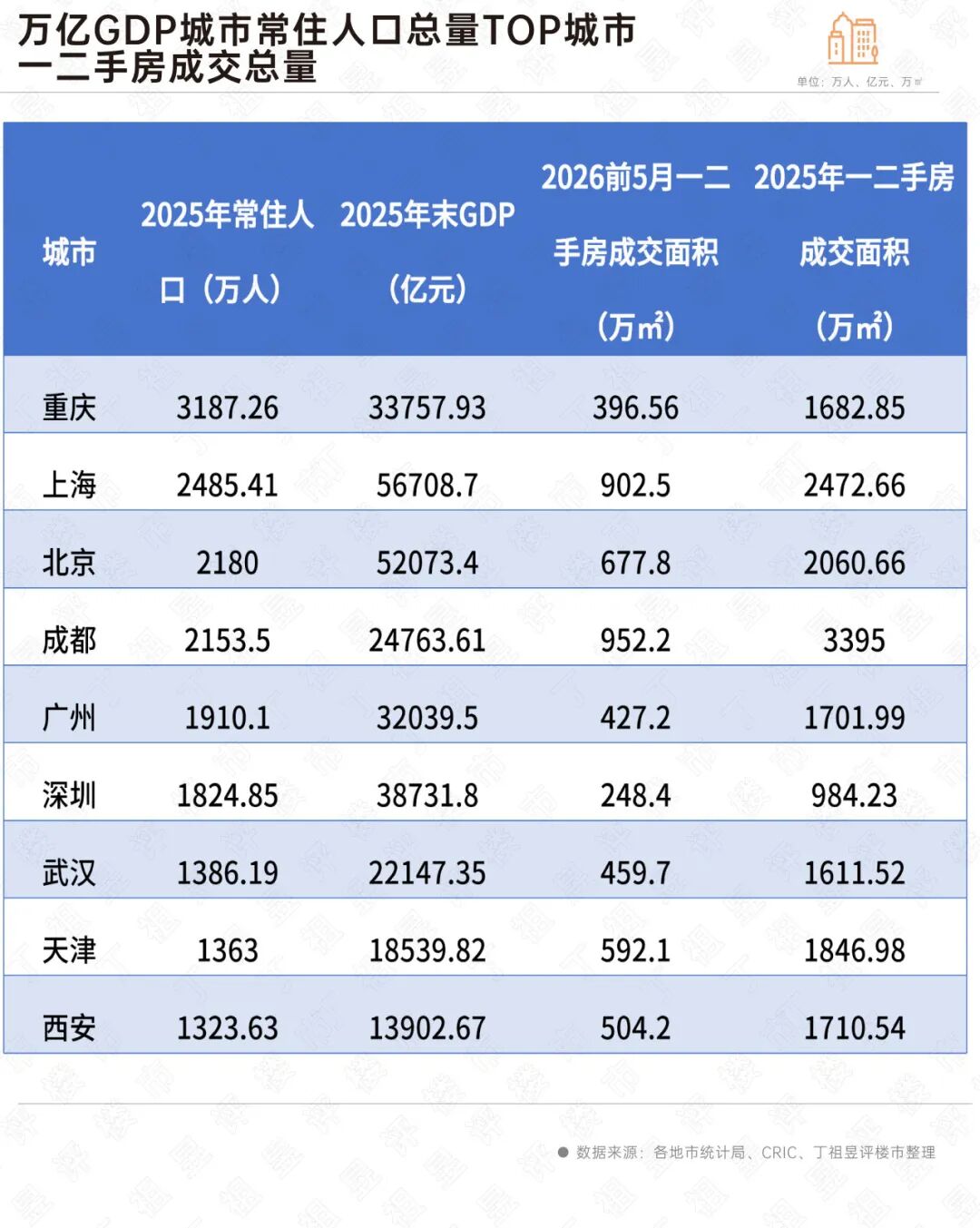
The population flow has changed, and so has the logic of the real - estate market. The total population is the basic foundation of the real - estate market, and the continuous inflow of population constantly activates the market vitality. The city's level, industrial strength, and residents' purchasing power will become important factors that widen the gap between cities.
It is not difficult to see from the population flow and real - estate transaction data in the past two years that the population is accelerating its concentration in the core cities of the Pearl River Delta and the Yangtze River Delta, as well as the strong provincial capitals in the central and western regions.
Looking further at the real - estate market, the Pearl River Delta has formed a demand foundation with a high - intensity population inflow, but the problem of supply - demand mismatch within the region is prominent; the cities in the Yangtze River Delta have a balanced development gradient, and the market trend is more stable; a number of provincial capitals in the central and western regions rely on the siphoning effect within the province to retain the population, but they also face the dilemma of insufficient conversion of new demand.
This article is from the WeChat official account "Ding Zuyu's Review of the Real - Estate Market", and is published by 36Kr with authorization.