I became a member of the last cohort of the Tourism Management program
01
Some time ago, Xiao Wang, a student majoring in tourism management at a university in East China, sent me a notice from the school about the cancellation of certain majors, with a rather bitter tone.
Xiao Wang said that he enrolled last September. Loving traveling since childhood, he thought he had chosen a major that could turn his hobby into a career and was full of expectations for the next four years. However, soon after, his senior classmates poured cold water on him, saying that the prospects for this major were average, and postgraduate studies or civil service exams were the real way to get a stable job.
While he was still hesitating about whether to change his major as soon as possible, a public notice of the cancellation of the major from the school arrived first.
Scrolling down the long list of majors to be suspended or cancelled, Xiao Wang finally found his major, tourism management, which would stop enrolling students from the next academic year.
Xiao Wang sighed to me that he had only been studying for less than a semester, and he already knew that there would be no new students in the same major this September. He felt like he was the last batch of students in this major, which was really a black - humor situation.
Then, he self - mocked, saying that it was no different from joining the Kuomintang army in 1949. Just as he got on the boat, the boat was about to sink.
Xiao Wang's experience is by no means an isolated case in today's higher education institutions.
In the past two years, the major of tourism management has been disappearing from the undergraduate enrollment brochures of more and more universities. Along with it, hotel management and air stewardship majors often also withdraw.
A statistics covering vocational colleges across the country shows that the number of tourism management major sites dropped from 1040 in 2025 to 987 in 2026, a decrease of 53 in one year. The number of hotel management and digital operation major sites decreased from 834 to 779, a reduction of 55. Even the number of air stewardship major sites decreased by 48.
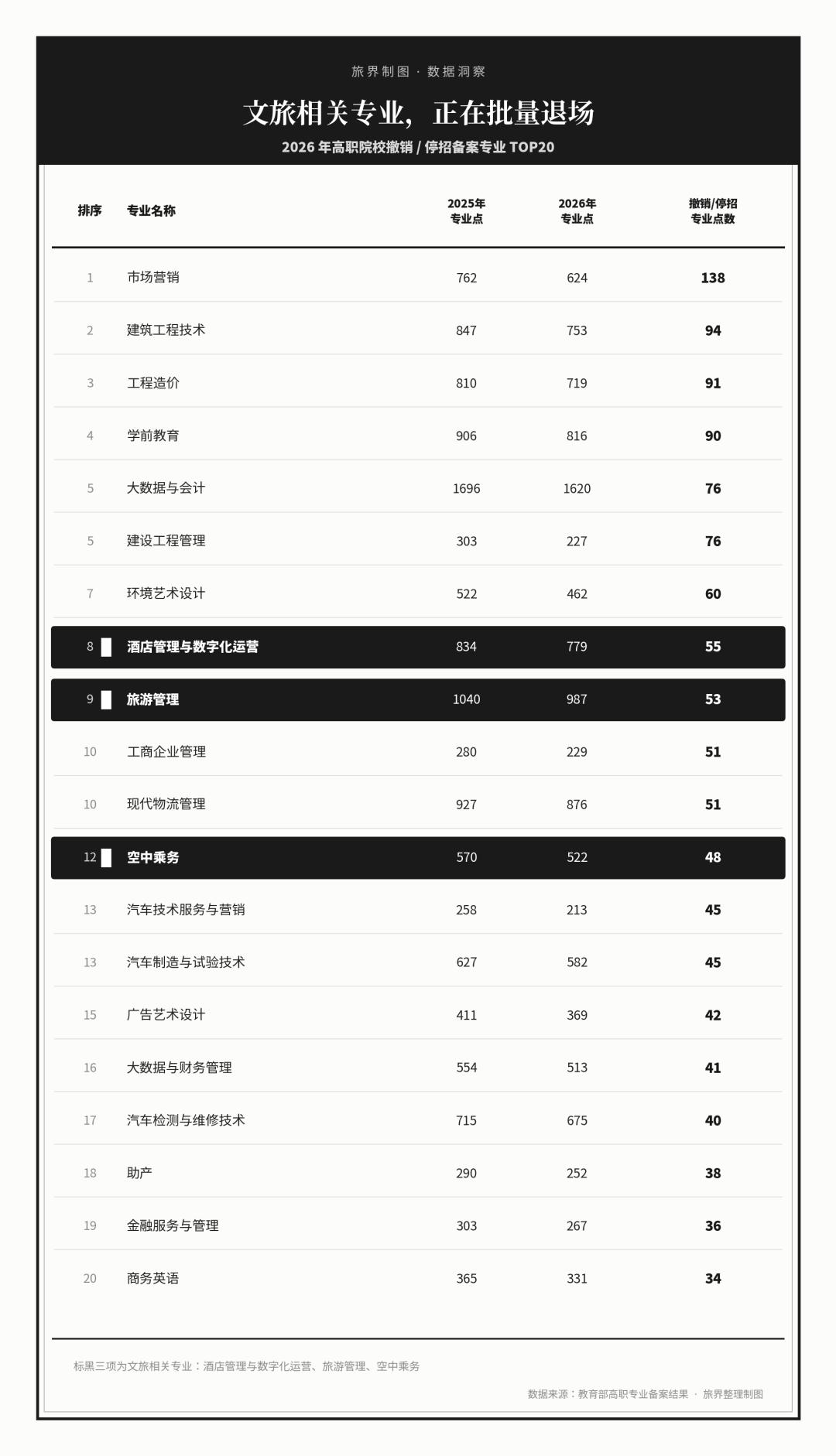
It is obvious that several majors related to culture and tourism are all on the decline.
On the other hand, for graduates of tourism management and hotel management majors in recent years, finding a job in their major has always been a difficult problem. According to incomplete statistics, nearly one - third of the students in these two majors apply to change their majors after one year of study or switch to other industries after graduation.
A student majoring in tourism management at a university in Beijing recalled that there were more than 30 students in his class, and after five years of graduation, the number of students still working in the culture and tourism industry could be counted on one hand. The low starting salary and slow promotion in the industry are the realities that make it hard to retain people.
Parents filling out college application forms have also begun to tacitly cross out tourism management from the list. In their simple judgment, a major that the school itself deems unnecessary, what future can their children have after studying it?
As the number of students in the classroom decreases, teachers are also getting anxious. A teacher of the tourism management major said bluntly in a tourism community that after teaching the current batch of students, he might have to switch to teaching other courses or face a job transfer.
The withdrawal of a major affects far more than just the future of students. Every link in the chain, from enrollment to training and then to employment, is now loosening.
When the speeding cultural and tourism train urgently needs a large amount of high - quality fuel to maintain full - speed operation, the factories that used to produce the fuel are quietly closing down.
02
On campus, there is a cold atmosphere. Students majoring in tourism management and hotel management are worried about being unemployed upon graduation.
In reality, however, the domestic inbound tourism market has been expanding rapidly in the past two years. Foreign tourists have flocked to every corner of major cities, and employers often complain that the undergraduate applicants are overly ambitious but lack practical abilities.
Why does the industry urgently need professional talents, but the cradles for cultivating talents are disappearing in batches?
To understand this, we first need to figure out one question: what exactly are the universities canceling?
Tourism and accommodation essentially belong to modern service industries that highly rely on interpersonal interaction. The competitive barriers of such industries are completely based on on - site practical experience and the ability to handle emergencies.
Just like when we go to a restaurant, what customers really care about is the taste of the dishes and the attitude of the waiters. No one will check whether the headwaiter has mastered profound business strategic planning theories.
A student majoring in hotel management studies management principles and a stack of theories in four years at school. But when he graduates and enters a hotel, after rotating through the front desk, guest rooms, and catering departments, the work he does is no different from that of someone who has not studied this major, and the salary is also the same.
This is embarrassing. The biggest crisis of a major is that it makes no difference whether you study it or not.
In fact, the apprenticeship system and real - scene simulation training in the European and American vocational education systems are more in line with the real employment needs of grass - roots positions in the domestic hotel and tourism industry. Shifting tourism majors to vocational colleges conforms to the most basic law of business efficiency.
But this is only half of the story.
If the cultural and tourism industry were shrinking, then canceling the majors would be a logical ending. But the problem is that the industry is not only not shrinking but also booming.
In 2025, the number of foreigners inspected at the border for entry and exit in the country reached 82.035 million person - times, a year - on - year increase of 26.4%. Among them, 30.08 million entered with visa - free policies, accounting for more than 70%, and the year - on - year increase was nearly 50%. In the same year, inbound tourists spent the equivalent of 131.1 billion US dollars, nearly 40% more than the previous year.
This is an expanding market with a surge in demand, and the people it needs are completely different from the past. As of now, China has unilaterally waived visas for 48 countries, has full visa - free agreements with 29 countries, and transit visa - free policies cover 55 countries.
China is transforming from a major outbound tourism country to a major inbound tourism country. The foreign tourists pouring in have diverse needs, and the market needs people who can handle the international tourists.

There is already a way to train such people in foreign countries.
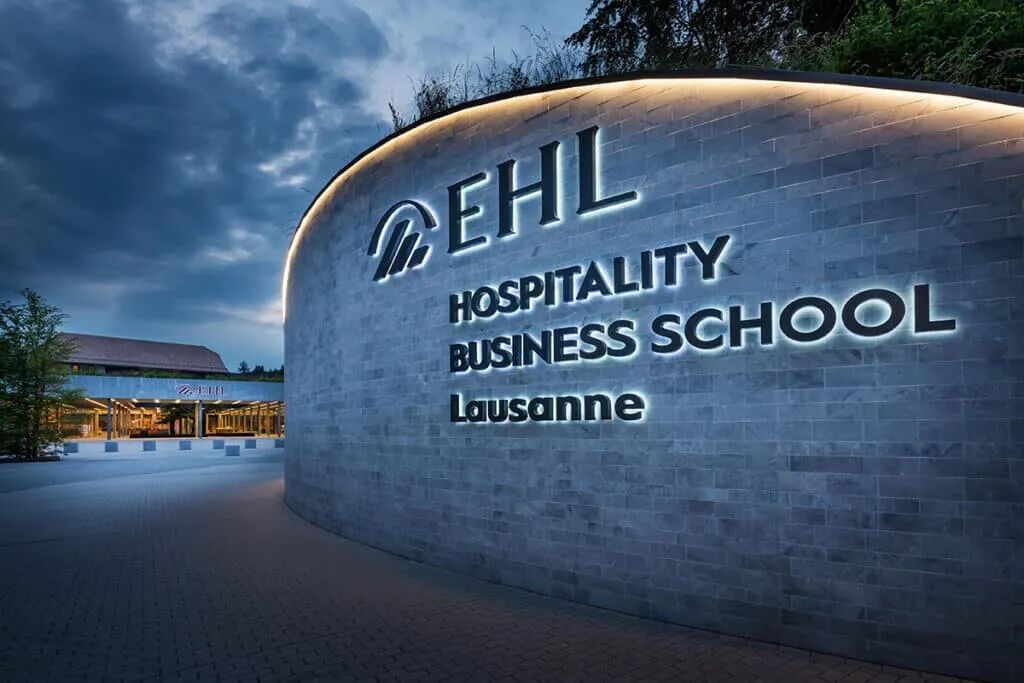
École hôtelière de Lausanne in Switzerland, which has always ranked first in the QS hotel management education ranking globally, arranges its students to do internships in management positions in their junior year. They are sent to world - famous resort hotels and brand groups to learn how to lead teams, control costs, and handle customer complaints in real - life operations. By their senior year, they can form teams to provide strategic consulting for multinational companies.
At the University of Angers in France, the internship for master's students in tourism management lasts for 14 months, almost half of the academic period. These internships are not for filling in grass - roots positions but for high - quality positions such as destination management and international hotel operation. When students graduate, their resumes are filled with impressive management experiences.
These schools understand very well that they want to send future general managers and directors into the market, not just an extra pair of hands.
In contrast, the internships of many tourism and hotel management majors in China have a completely different picture.
Students are sent to hotels in an organized way by the school. Nominally, it is an internship, but in fact, they do the most basic physical work such as making beds, serving food, and standing at the front desk for half a year or more.
Hotels are happy to use these obedient and cheap laborers to fill the labor gap, and the school meets the requirements of practical training hours. Only the students are in a difficult situation. They neither learn the tricks of management nor see the hope of promotion.
Some insiders in the hotel industry have said bluntly that the proportion of graduates from domestic hotel management majors who enter management positions is extremely low. After four years of studying management, they start as laborers after graduation. It is not surprising that students vote with their feet for such majors.
This is the embarrassment of tourism management and hotel management majors in recent years. What the school teaches does not match what the enterprises need.
When a diploma cannot be exchanged for a premium in the job market, its value will decline. Parents and students are not stupid. They will vote with their scores.
So, the logic of canceling majors sounds cold, but in fact, it is the most natural reaction of the market. The supply side has produced a batch of capacities that do not match the demand, and the clearance is just a matter of time.
03
Contrary to the large - scale cancellation of domestic management majors, I noticed an interesting contrast.
In the same year when tourism management and other majors withdrew in batches, a number of new majors were emerging in the enrollment brochures of universities.
In 2025, more than 80% of the newly added majors in Sichuan precisely targeted key industrial chains such as artificial intelligence, low - altitude economy, and new energy. Looking across the country, nearly 90 universities added artificial intelligence majors in one year, ranking first in the list of newly added majors.
While the old majors are being phased out, new ones are being established. The machine of higher education has never stopped running.
Many people only see the phasing - out but not the establishment, so they mistakenly think that the cultural and tourism industry has been abandoned.
On the contrary, while a large number of tourism management majors are being cancelled, the Ministry of Education has included culture and tourism in the list of key - supported industrial fields and added new majors such as international cruise management.
It should be said that the cultural and tourism business has never been disliked. It's just that education is re - equipping it with the right keys.
Understanding this logic, when we look back at the situation of people like Xiao Wang, our state of mind will be completely different.
He has caught up with an awkward transitional period. The old ship is sinking, and the keel of the new ship has just been laid.
But as the saying goes, rarity is precious. With the cancellation of the major, there will be fewer and fewer students with a professional background in the future. The diplomas of the last batch of students like Xiao Wang may even increase in value.
Although they may not reach the training level of École hôtelière de Lausanne, for employers, it is better to recruit someone who knows the business than to train a novice from scratch.
Moreover, when a new round of majors is established, the training methods will be more in line with the needs of enterprises. Today's embarrassment is the inevitable gap between the exit of the old standards and the emergence of the new ones.
The international cruise industry is short of people, and the high - end reception of inbound tourism has long been unable to recruit suitable candidates. The refined operation of destinations is also eager for talents. These positions are waiting for young people who can understand the world and be understood by the world.
I told Xiao Wang that instead of feeling sad about the cancelled major, he should figure out as soon as possible which new "ship" he wants to board.
In the long run, the talent war in the cultural and tourism industry has just begun. Machines will take over more and more standard operations, and jobs such as front - desk service, cashiering, and room reservation will be gradually taken over by algorithms.
What will remain and become more valuable are the skills that machines cannot replicate, such as quick - wittedness when guests change their minds, appropriate hospitality, and the ability to turn a sightseeing itinerary into an unforgettable story.
So, whether the major of tourism management remains in the professional catalog is not that important. What matters is that this vast land always welcomes guests from afar, and someone is needed to guide them to appreciate its vastness.
The young man who self - mocked that he caught up with a sinking ship may be the first one to see the lighthouse in the new journey.
This article is from the WeChat official account "Travel Industry", author: Theodore Xishao. Republished by 36Kr with permission.