ChatGPT is about to usher in its biggest overhaul in history, "The era when AI was only used for chatting is over"
On June 7th, local time in the UK, according to the Financial Times citing an informed source, OpenAI is preparing for the largest overhaul of ChatGPT since its launch in 2022. The new version will be gradually rolled out in the coming weeks.
The core of this overhaul is to integrate Codex, OpenAI's fastest - growing programming tool, into ChatGPT and connect to applications from external partners. This will reshape the chat dialog box with nearly one billion users into a "super - app" capable of writing code, managing schedules, and controlling software.
"The era of using AI just for chatting is over," a senior OpenAI employee summarized this transformation with this statement.
Within OpenAI, executives have reached a consensus that the future of AI lies not in simple conversations and answering questions, but more in becoming an intelligent agent that can run errands and do work for users.
ChatGPT's role is being redefined: it is gradually changing from a chat tool to a huge traffic entrance. What truly carries the valuation and the imagination of paid services are the programming tools and enterprise - level services behind it.
Thibaut Sottiaux, the executive in charge of the "All Core Products and Platforms" department at OpenAI, described the final form of the product: "You can connect to it via your phone, desktop, or web. When you're in the car, you can talk to it." OpenAI's intention is clear: to make this intelligent agent ubiquitous and truly complete tasks for users in life and work, thereby stimulating the willingness to pay.
However, it's still unknown who will dominate the next - stage AI application landscape. Players such as Anthropic, Google, and xAI, which has been incorporated into the SpaceX system, are also continuously increasing their efforts in model capabilities, application entrances, computing power resources, and ecological binding.
01
Codex Reshapes ChatGPT: Programming Tools Take Over the Super Entrance
Regarding OpenAI's strategy of integrating the entire Codex into ChatGPT, Alex Embiricos, the head of enterprise products, explained that the company has now entered the second stage. "With an intelligent agent that can help you do anything on your computer, the next goal is to bring this set of capabilities to everyone."
To make Codex break out of the narrow circle of programmers, OpenAI has launched six plugins targeting specific positions, covering areas such as creative production, sales, and public stock investment.
For ordinary users, the most intuitive change will occur in the interface in the coming weeks.
In the early stage of the overhaul, a large number of prompts and function entrances will be added to the ChatGPT website and mobile app to guide users to click on programming tools, image generation, or use applications built by external partners such as Canva and Booking.com.
In the short term, users will see an option to manually choose whether to let Codex or ChatGPT respond to their requests.
Embiricos described several daily automation scenarios that non - technical users can quickly start using:
After connecting to email or Slack, users only need to dictate, and Codex can automatically draft content, match recipients, and send it with one click after user confirmation;
After connecting to the calendar via a plugin, users can orally inquire about upcoming activities or retrieve meeting backgrounds at any time;
Users can even set up a process that runs automatically at 8 a.m. every day to regularly push the day's meeting summaries and the most urgent to - do items in the inbox.
But Sottiaux's vision goes further. He believes this transition period won't last long. In the long run, the model will automatically determine whether a task should be run locally on the user's device or in the cloud, and users won't have to worry about which tool is doing the work at all.
As time passes, those guiding prompts and function entrances will also be gradually removed. OpenAI is betting that the model can automatically understand the user's intention when they use the application or website.
Regarding this design direction, some netizens commented that it sounds like the beginning of the transition to AGI, and the direction is correct. Abandoning prompt - word guidance may mean that users will have a better voice - interaction interface and can directly speak to mobilize the intelligent agent behind.
02
The Underlying Driving Force Comes from Model Upgrade
The root of this change in experience lies in places invisible to ordinary users. To make the public adapt to the "assigning tasks" mode, the underlying production tool of ChatGPT, which is Codex, needs to undergo a complete iteration first.
The most fundamental driving force comes from the model upgrade. GPT - 5.5, released in April this year, is significantly better than its predecessors in handling long - term, multi - step tasks and no longer requires frequent manual guidance. This gives Codex real confidence in "independently executing after receiving clear instructions." In the words of Mitch Trojanowski, co - founder of Basis, "By GPT - 5.5, Codex's advantages have become too significant to ignore."
As the model's capabilities improve, developers' trust also grows. A tacit understanding has gradually formed in the circle: when they have a clear plan, they are more willing to hand the work to Codex to complete from start to finish.
Varun Rao, an engineer at Notion, mentioned a detail. When he and his colleagues were developing a tool, Codex silently fixed a bug in the code every time. It was only when they used other intelligent agents that they found the problem had existed for several weeks.
With trust established, it also needs to be accessible to users. The launch of the Codex desktop application in February this year happened to hit this point.
Previously, using Claude Code could only be done through a pure - text command - line terminal, which was a high threshold for non - technical users. The desktop application brings up a graphical interface, allowing ordinary users to use it, and it also feels convenient for geeks who run multiple intelligent agents at the same time.
Max Schoening, the product manager at Notion, especially likes the experience of starting a task on the computer and then checking the progress on the mobile phone via the Codex mobile app.
Data can best confirm this enthusiasm.
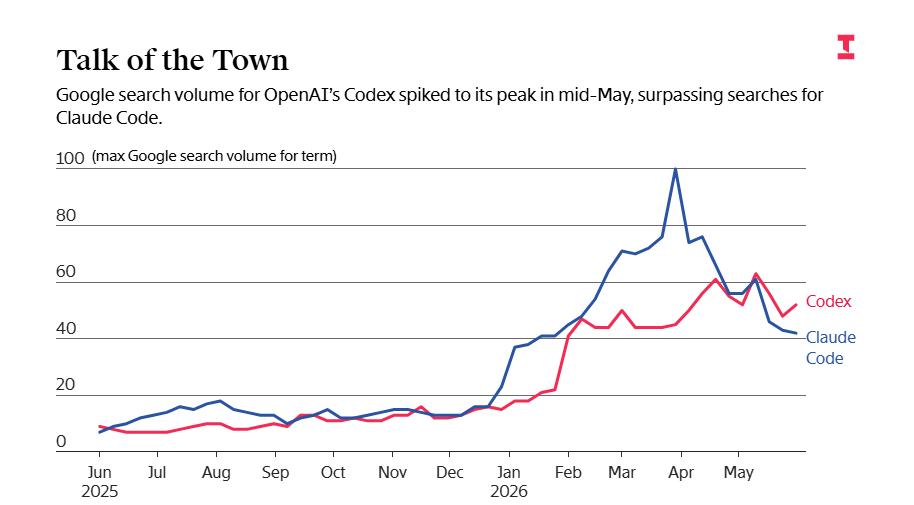
In mid - May, the Google search volume of Codex under OpenAI reached a historical peak, exceeding that of Claude Code.
Since the launch of the desktop application, the user base of Codex has increased six - fold in less than two months, and its weekly active user count exceeded the 5 - million mark at the end of May.
Sam Altman, CEO of OpenAI, revealed in a recent all - hands meeting that the overall usage of Codex is increasing at a rate of 5% every day.
Meanwhile, Greg Brockman, co - founder and president, also told employees last month that the revenue from enterprise customers of Codex increased by 50% week - on - week.
03
The "Hasty Merger" Forced by Anthropic
OpenAI's major strategic shift is largely "forced" by its competitor, Anthropic.
The feud between the two was sparked in the autumn of 2024. At that time, internal measurement standards showed that the programming capabilities of Anthropic's models were ahead of OpenAI's.
In February 2025, when Anthropic officially released the preview version of its programming tool, Claude Code, OpenAI suddenly realized that it had been overtaken by this much smaller competitor in this key area.
For OpenAI, falling behind in programming capabilities is a disaster that shakes the foundation. Because the company's long - standing core belief is that AI for programming will accelerate the core research process of developing super - intelligence. Falling behind in programming means being outpaced on the track to AGI.
Jenny Shaw, a former OpenAI researcher and now a partner at Leonis Capital, pointed out that "about a year ago, OpenAI's strategy was to go all out, while Anthropic focused on making money first. Now, the two paths are converging because both companies are aiming for an IPO, and investors are more concerned about making money than realizing dreams."
To regain lost ground, OpenAI quickly assembled a dedicated Codex R & D team led by executive Thibaut Sottiaux. This team has a very high degree of autonomy within the company and even, for the first time, open - sourced the code behind Codex to directly obtain improvement feedback from users.
The success of the Codex team even prompted OpenAI to adjust its organizational structure. In January this year, OpenAI urgently reorganized to make the product team closely cooperate with the underlying model researchers.
In May, the organizational adjustment reached a climax. OpenAI directly merged the ChatGPT, Codex, and API teams to form a unified core product and platform department, managed by Sottiaux.
In this major resource - reallocation reorganization, some consumer - oriented projects became victims. For example, the ChatGPT shopping checkout function under development was put on hold, and the video - generation product Sora, which had been launched for less than a year, was directly shut down. OpenAI's strategic shift is very clear: put aside consumer businesses that are difficult to monetize and concentrate resources on enterprise customers willing to pay.
04
IPO Imminent: Calculate the Accounts with "Productivity"
All the technological integrations, organizational reorganizations, and product trade - offs ultimately boil down to one thing: before the IPO, the revenue data must be made more solid.
Currently, about 2 million enterprises using OpenAI's products contribute about 40% of its revenue. The company expects this proportion to rise to 50% by the end of this year. In this process, Codex will show terrifying monetization efficiency because most Codex users are paid - subscription users.
However, the fierce competition still makes OpenAI feel urgent. Relying on Claude Code and Claude Cowork to attract a large amount of money from developers and enterprises, Anthropic's annualized revenue soared to $47 billion in May. In contrast, although some media reported that OpenAI's annualized revenue has exceeded $30 billion since it announced $25 billion in March, the gap is still obvious.
This is why OpenAI has to urgently introduce Codex to the more than 900 million consumer - level users of ChatGPT. On this huge user base, even a slight increase in the per - capita willingness to pay will turn into a huge cash flow before the IPO.
The choice of the technical route is also closely related to the revenue logic.
In January 2025, OpenAI launched an intelligent agent called Operator, trying to make AI complete daily tasks such as booking tickets and shopping in the browser like a human. But the management quickly realized that having AI simulate human clicks on the web was extremely inefficient. Sottiaux admitted that directly writing code is a more effective way for AI to complete tasks such as building complex spreadsheets on the computer.
This key judgment directly promoted Codex from an auxiliary programming tool to a position for building a general intelligent agent, and also explains why this super - app integration is regarded as a key step in developing a general intelligent agent, with an evolution path similar to Anthropic's transition from Claude Code to the general Claude Cowork.
The blueprint of the super - app has been laid out, and the ambition at the operating - system level is obvious. But the most realistic question still remains for Altman: Will hundreds of millions of consumers who are used to free "chit - chat" and chatting eventually be willing to pay for a digital intelligent agent that can do work for them and help them earn a salary?
This high - stakes gamble that will determine the industry standards and the ownership of the dominant position in the second half of the AGI era has just begun.
Special translator Jin Lu also contributed to this article.
This article is from the WeChat official account "Tencent Technology". Author: Li Hailun, Editor: Xu Qingyang. Republished by 36Kr with permission.