Huachao Super Control Secures 100 Million Yuan in Angel Series Financing, Accelerating the Development of a New-Generation AI Ultrasound Brain-Computer Interface Platform | 36Kr Exclusive
Text by | Hu Xiangyun
Editor | Hai Ruojing
36Kr learned that recently, the new-generation AI ultrasonic brain-computer company BCI-Sonics has completed a series of angel-round financing worth hundreds of millions of RMB. The angel-round financing was led by Matrix Partners China, and the angel-plus round was co-led by Delian Capital and Daoyuan Capital. Xunlight Capital continued to serve as the exclusive financial advisor. The raised funds will be used to promote the company's technology verification and industrialization.
BCI-Sonics was founded in 2025. Its founder, Li Xin, is a doctor of biomedical engineering jointly trained by the Chinese Academy of Sciences and the Fraunhofer IGD Institute in Germany. He once served as the head of the China region of the global R & D center of GE Healthcare and has continuously founded innovative technology and medical companies. He has profound experience in medical imaging, AI, brain-computer interfaces, and industrial transformation.
The company's core team consists of talents from domestic and overseas universities such as Tsinghua University, Shanghai Jiao Tong University, and Imperial College London, covering multiple fields including neuroscience, acoustics, medical imaging, and artificial intelligence. They have both R & D and industrial experience and are familiar with the complete process of medical devices from the principle prototype, engineering prototype, clinical verification to registration and transformation.
It is understood that the BCI-Sonics team had reached a consensus on the industrial certainty of the ultrasonic brain-computer interface technology before starting the business, which belongs to the model of "first having a team, goals, technological accumulation, and clinical judgment, and then moving towards entrepreneurship and financing".
The ultrasonic brain-computer interface technology, which is collectively favored by these senior experts, is a popular niche direction in the current brain-computer interface track. It has attracted technology pioneers from Silicon Valley such as Sam Altman, the founder of OpenAI, and Fred Ehrsam, the co-founder of Coinbase, to start their own businesses. In China, relevant enterprises and research teams are also intensively deploying. Some believe that the domestic ultrasonic brain-computer technology is almost on the same starting line as overseas, with a technology gap of "less than 1.5 years".
The reason for the "popularity" of the ultrasonic brain-computer interface lies in the brain-computer interface technology itself: the brain is known as the "last frontier" of human cognition and is also one of the most difficult fortresses to conquer in the future technology field. Traditional brain-computer interface solutions are mainly invasive/semi-invasive or non-invasive. The former requires craniotomy, while the latter, such as transcranial magnetic and electrical stimulation, is safer but has limited spatial resolution and is difficult to act on deep brain regions.
So, can humans repair the brain non-invasively and accurately without opening the skull?
This is exactly the goal that BCI-Sonics wants to achieve: to turn the deep brain regions that could only be reached through surgical operations into a non-invasive, reversible, and precise regulation that can be completed in the outpatient department.
Therefore, different from traditional solutions, BCI-Sonics has chosen the technical path of low-intensity focused ultrasound (tFUS/LIFU) because ultrasound is currently one of the few physical pathways with the potential of being non-invasive, reaching deep regions, and having high spatio-temporal resolution. Transcranial magnetic stimulation can only act on the superficial cortex of about 2 cm, while low-intensity focused ultrasound can penetrate the skull non-invasively and reach several centimeters deep into the brain, accurately hitting the key deep nuclei that determine movement, emotion, pain, and addiction.
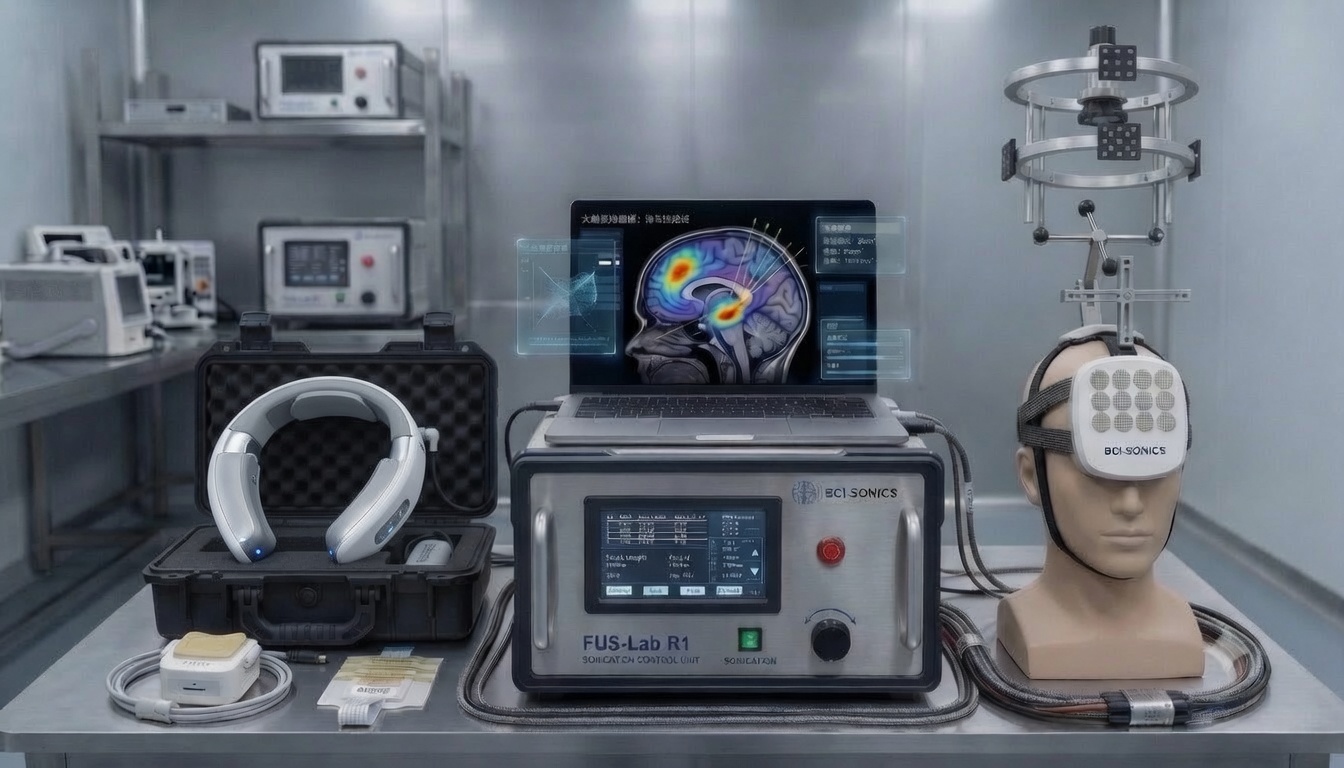
Image source: BCI-Sonics
In this process, the most important thing is accuracy. There are significant individual differences in the thickness, density, and curvature of the human skull. When ultrasound passes through the skull, phase distortion, energy attenuation, and focal shift will occur. Therefore, if there is no effective phase correction, there may be a deviation between the theoretical target and the actual sound field focus, which will affect the stimulation efficiency and clinical reproducibility.
BCI-Sonics uses its self-developed transcranial phase correction algorithm to quickly compensate for the sound field distortion caused by the skull, converging the transcranial focusing accuracy to a minimum of 1.5 mm, which is equivalent to achieving millimeter-level precise regulation at a depth of several centimeters.
"This transcranial phase correction ability is one of the core thresholds for tFUS technology to move from laboratory research to equipment with verifiable efficacy, replicable operation, and quasi-commercialization." Li Xin believes. It is reported that currently, BCI-Sonics' self-developed transcranial phase correction algorithm can complete individual calibration in a very short time. It is also one of the few domestic ultrasonic brain-computer devices with this ability and is about to move towards commercialization.
In addition, another major technical barrier of BCI-Sonics lies in its AI closed-loop neural regulation platform. The company is not just making a single stimulation device but creating a closed-loop system of "reading - understanding - regulation - feedback - re-optimization". On the one hand, it collects multi-modal neural signals and uses a high-precision acoustic feedback AI algorithm for real-time dose feedback; on the other hand, it uses an AI algorithm to identify the brain state, generate an individualized stimulation plan, and dynamically adjust the regulation strategy. This is equivalent to integrating the "decoding" and "regulation" abilities: using AI to read and analyze neural activities in real-time, precisely intervening with low-intensity focused ultrasound, and then forming a complete closed-loop with dual-modal monitoring to dynamically calibrate the target and dose on a millisecond scale.
For patients, what are the direct benefits of this seemingly profound and complex technology? For example, in the past, if a Parkinson's disease (PD) patient wanted to relieve symptoms, patients in certain situations often had to undergo invasive deep brain stimulation (DBS). Now, relying on the non-invasive ultrasonic brain-computer interface regulation technology to stimulate specific nuclear regions may also achieve similar effects and enable patients to regain a decent life.
At present, BCI-Sonics has established in-depth cooperation with multiple universities, top-tier hospitals, and clinical expert teams to promote the practice in aspects such as underlying acoustic technology, neural regulation mechanism, multi-modal data collection, clinical protocol design, and real-world verification. It jointly designs research paths and verifies clinical value in areas such as pain, addiction, and neural remodeling, and promotes the ultrasonic brain-computer interface technology from the development of research prototypes to quasi-clinical applications.
Li Xin believes that "for the brain-computer interface to truly achieve industrialization, three conditions need to be met simultaneously, that is, the underlying technology has a verifiable physical and physiological mechanism; the equipment has the ability of engineering, standardization, and replicability, and a clear enough product path to be continuously verified in real application scenarios."
Investors' views:
Matrix Partners China said that compared with traditional implantable solutions, low-intensity focused ultrasound (LIFU) technology has advantages in both stimulation depth and spatial resolution and realizes non-invasive stimulation, greatly expanding the boundaries from clinical treatment to consumer health. The company's core team has strong technical barriers in underlying algorithms and transducer technology. Its products not only have a first-mover advantage in the academic field but also show strong engineering implementation ability in the fields of general medical AI and neural rehabilitation. We look forward to working with the company to jointly define the "next decade" in the field of brain science.
Delian Capital said that transcranial focused ultrasound, as a newly emerging non-invasive neural regulation method in recent years, has the characteristics of large depth, high precision, and reliable targets. It makes up for the deficiencies of existing traditional transcranial electricity and transcranial magnetism to the greatest extent, has strong scalability, and has great application potential. BCI-Sonics is a rare platform-based enterprise in China that can achieve self-research across the entire industrial chain. It has various core capabilities such as acoustic-related hardware, algorithm research and development, high-integration medical device development, and registration, as well as full-cycle practical experience. We are optimistic about and believe in the company. In the future, with the AI + ultrasound integrated solution, it will achieve full-process product implementation from research to clinical practice, from in-hospital to consumer use, promote the development of the industry, and benefit patients and the general public.
Daoyuan Capital said that the brain is the most important organ of the human body, and human exploration of the brain is still in its early stage. Brain science is one of the core fields that Daoyuan Capital is optimistic about and continuously deploying. Ultrasonic brain-computer interfaces and neural regulation are research hotspots both at home and abroad. They have the advantages of being able to reach deep regions, being safe and precise, etc. They have started to enter the clinical stage from the laboratory and are continuously exploring different indications and application scenarios. The BCI-Sonics team has been deeply involved in the field of ultrasonic brain-computer interfaces and neural regulation for many years, has rich experience, and strong execution ability. We are full of confidence in the company's future development and look forward to bringing better ultrasonic solutions to more patients and the general public.
Xunlight Capital said that the ultrasonic brain-computer interface is one of the most clinically accessible and platform-potential technical paths in the current non-invasive neural regulation field, and there are only a few teams in the world that can truly make this path work. The core advantage of BCI-Sonics lies not only in the team's accurate judgment and technical accumulation in the promising direction of "ultrasound + closed-loop + AI" in neuroscience but also in its extremely rare industrial cohesion - first reaching a consensus and then starting the business. Xunlight Capital will continue to work side by side with BCI-Sonics and looks forward to the company's real explosion in the vast blue ocean of neuroscience.